



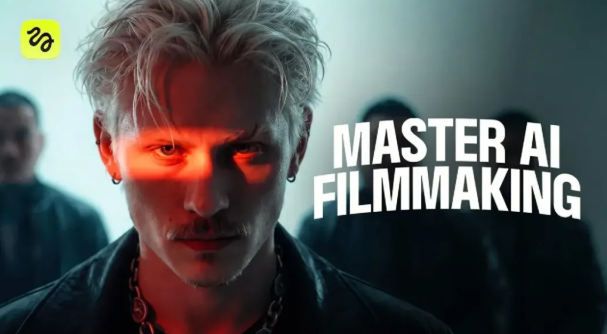
一张角色图怎样变成能跨镜头表演的演员?一场打斗怎样获得多个机位?Higgsfield创作者 adilinthewildtempo 的这份制作记录,把资产、提示词、生成素材与剪辑选择放到了同一条流程里。
拍AI短片,最容易卡住的地方,是单个镜头看着不错,接起来却像几部不同的电影:人物换了脸,办公室换了布局,上一镜的动作到了下一镜接不上。
这份教程值得拆解的,是它给每个环节都准备了明确的参照。先确定角色、场景和道具,再让Claude协助组织镜头与表演,最后从多次生成里挑出能够连接的片段。
下面按实际制作顺序,梳理这套方法。配图与视频均来自原作者公开教程,本文为中文整理与分析。
1.开拍之前,先建立资产库
原作者把素材存成Higgsfield的 Elements。角色、地点、道具各有固定名称,Claude里写的名字与Higgsfield里绑定的名字保持一致。
主角Adam、老板Ron与反派Victor,使用的是三分角色视频元素。Victor的特殊状态、伤口,以及场景、武器等,则根据用途单独准备图片。
这种分工让每份参考承担清楚的任务:人物视频提供身份和表演,场景图片提供空间,道具图片提供外形。不要让一张图同时负责脸、服装、动作和机位。
四份Skill,分别负责什么?
原文提供了四份可下载附件,素材包里保留了原文件。
higgsfield-prompt-engine.skill:组织场景与镜头提示词。
higgsfield-fight-scene.skill:组织打斗动作与动作关系。
higgsfield-acting-skill.skill:组织情绪变化、表演与对白。
Anamorphic skill.md:补充变形宽银幕镜头的视觉语言。
实际使用时,先讲清这一场发生什么、谁想做什么,再让相应Skill帮助展开。它们提供写作方法;具体资产仍需要自己建立,并在生成界面正确绑定。
命名,是跨工具协作的基础
角色使用 @char_adam_video_v1、@char_ron_video_v1、@char_victor_video_v1。地点使用 @loc_alley_v1、@loc_room_ron_v1、@loc_club_dancefloor_v1 等名称。
这些名称的价值在于对应关系。提示词写到哪个人物、哪个房间,就能找到那份已确认的素材。换角色或重做场景时,也能明确更新哪一项。
2.先定人物,再处理真实质感
Adam从作者本人的照片开始。白发、苍白肤色、黑色长皮衣与银色配饰构成了辨识度。作者先比较卷发与直发两个方向,同时保持服装和设定图结构一致。
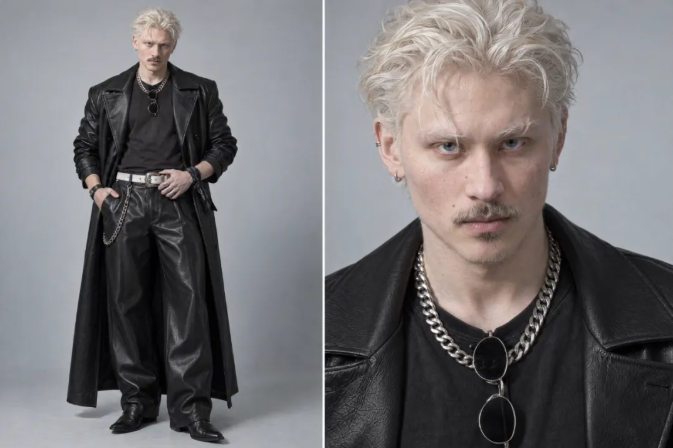
图片提示词:On the RIGHT panel, make a highly detailed half-body portrait photo of this character — show the skin and hair in fine detail. Take the hair texture from <<
>> and adapt it onto this character in <<
>>. Take the skin texture details from <<
>> and adapt them to this character, but make the skin tone paler / whiter than <<
>>. Use <<
>> as the texture for the black t-shirt. Use <<
>> as the BACKGROUND texture. On the LEFT panel, add a full-length photo of the character – keep it the same.
这个阶段解决的是角色选择。先选定面孔、发型和造型,后面的镜头才有一个稳定的起点。
角色确定后,作者又分别提供头发、皮肤、背景和黑色T恤面料的参考,交给Seedream 5.0 Pro细化。把“更真实”拆成几项可以看见的材质目标,修改才有依据。
这张毛发参考图有什么用?
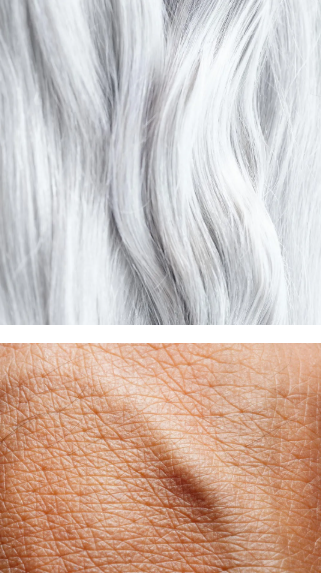
这张图给模型提供的是头发的质感参考。角色设定图先确定Adam的脸、发型和服装,毛发图再补充发丝粗细、蓬松程度、纹理与反光等视觉信息,帮助细化白发,减少塑料感。
使用时,把已确认的Adam角色图与这张毛发图一起上传到Seedream 5.0 Pro,并明确各自职责:角色图用于保持人物身份和造型,毛发图用于参考头发质感。再配合皮肤、背景和T恤面料参考,逐项细化画面。
参考图的作用是提供可观察的材质目标;实际生成后,还要检查人物面孔和原定发型是否保持一致。
提示词:
Add Real Texture
What it does: Provides separate references for the hair, skin, background, and T-shirt texture.
Once the design works, improve the surfaces. I use separate references for the hair, skin, background, and T-shirt. Each reference has one job, so the model gets a concrete visual target.
Attach in order: approved Adam sheet; hair texture; skin texture; background; black T-shirt fabric.
@image_1
@image_2
@image_3
@image_4
@image_5
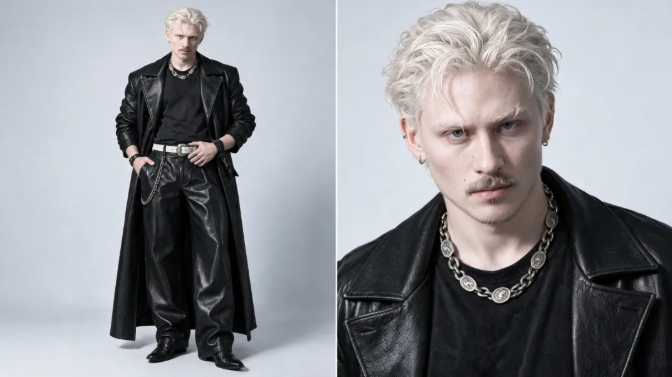
这里有个需要实际操作时核对的细节:原文说明中的上传顺序,与内嵌提示词里的图片编号并不完全一致。说明列的是Adam、头发、皮肤、背景、T恤五项,而提示词使用了Image1、Image3至Image6。
复现时请按当前上传槽位重新对应编号。 人物身份对应角色图,头发对应头发参考,皮肤对应皮肤参考。先检查这张对应表,再提交生成。
Victor的做法不同:先通过AI Cast探索面孔,再选出符合角色的中年男性形象。Ron则通过Soul Cinema制作角色设计。几个人物可以从不同入口建立,但最终都要进入同一套资产管理流程。
3.把角色图变成表演参考
确定人物图片之后,作者为Adam、Victor和Ron分别生成角色视频,并加入声音参考。Adam的声音由作者录制,另外两个人物的声音由朋友提供。
这一步需要让人物开口、转头、眨眼,并展示适量的表情变化。后面调用的,是一个有运动和声音信息的角色参照。
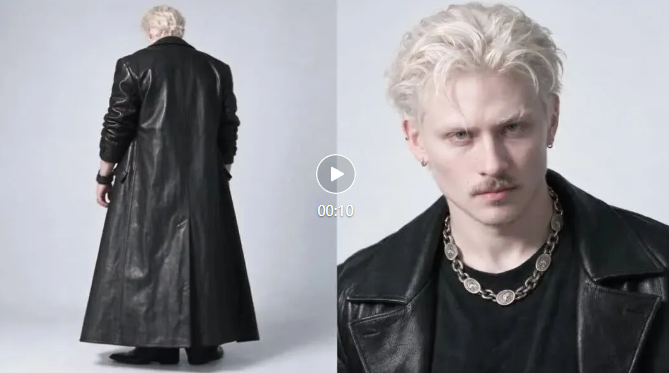
视频提示词:Animate the attached approved Adam character image into a short video reference. Preserve his exact face, white hair, eyes, build, black leather outfit and silver accessories. Show a clear three-quarter face view, a small natural head turn, a blink, a quiet breath and restrained jaw movement. Use the attached authorized voice recording for his vocal performance; keep the face clearly readable. Neutral studio background, stable light, no camera orbit, no outfit changes, no music or on-screen text. Save the approved result as @char_adam_video_v1.
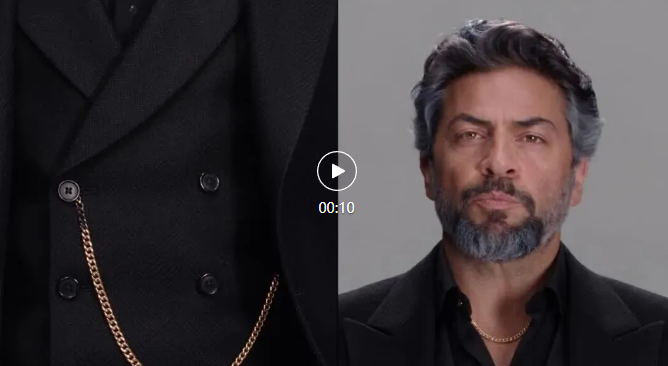
视频提示词:Animate the attached approved human Victor character image into a short video reference. Preserve his exact face, gray hair, beard, build and formal wardrobe. Show a clear three-quarter face view, a small turn, a restrained knowing smile and a brief shift to irritation. Use the attached authorized voice recording for his vocal performance. Human appearance throughout; no claws, fangs, wound or transformation. Stable neutral light and background, no music or on-screen text. Save the approved result as @char_victor_video_v1.
角色参考视频的任务是让身份看得清楚。复杂运镜、强烈光影变化和剧情动作,可以留到正式场景。Victor的人类形态也与后续变化后的形象分开保存。
我的理解是:人物设计决定“这个人长什么样”,角色视频进一步提供“这个人动起来、说起话来是什么感觉”。两者在制作中承担不同任务。
4.场景先做空镜,正反打先对空间
作者先建立没有演员的场景图:夜间巷道与电话亭、Ron的办公室、夜店、走廊,以及Victor的办公室。
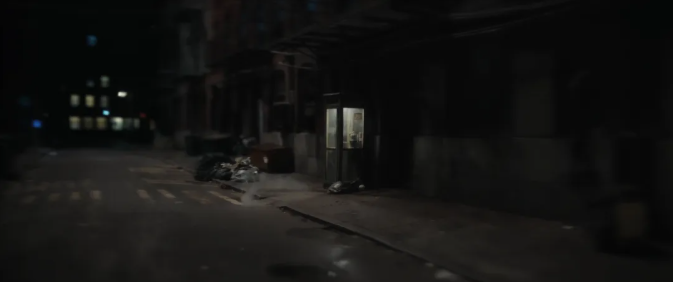
提示词:
Wide establishing plate of a dark back street at night, deep neo-noir — a wide alley broad enough for cars to drive through, a two-lane stretch of wet asphalt running between the buildings. An old weathered telephone booth stands against the wall midway down the street, its glass panels scuffed and grimy, only the faintest dim glow barely visible inside. Brick and concrete walls line both sides, rusted fire escapes zig-zagging up the buildings, a dumpster and stacked trash bags against the wall, tangled cables overhead, a few faded painted lane marks on the road. Light wisps of steam drift lazily up from manhole covers and a street grate. The whole scene stays dark and moody, but a soft, low ambient light fills every part of the frame — a gentle diffuse city-glow spill from the sky and distant windows, faint bounce off the wet asphalt — so that even the shadowed corners, far end and walls retain readable detail and texture, with no fully black crushed areas anywhere. Wet asphalt and puddles reflect a single flickering security lamp and the dim ambient glow. Gritty, moody, dangerous, cinematic noir atmosphere.
CAMERA: wide 24mm anamorphic lens, three-quarter angle looking diagonally down the wide street toward the telephone booth, shallow depth with soft background blur and pronounced anamorphic oval bokeh on the distant lamp, strong anamorphic 24mm edge falloff with pronounced soft blur and horizontal streaking toward the left and right frame edges from field curvature, the center sharp while the corners smear into painterly anamorphic bloom, subtle horizontal blue streak lens flares, micro-handheld with natural operator-breathing sway.
STYLE: shot on real 35mm film, Kodak Vision3 500T grain; 24mm anamorphic lens with subtle horizontal flare, gentle highlight bloom and characteristic edge distortion and corner blur; rule-of-thirds composition; natural true-to-life color; realistic environment physics — light steam rising from the manholes, drifting haze, dripping water, blowing litter, flickering light; gritty documentary film realism, indistinguishable from a real photograph, absolutely no CGI or render look. Dark low-key noir night lighting with lifted shadows — a soft even ambient fill keeping detail visible throughout, blacks lifted and never crushed, a barely-there glow in the phone booth and a faint flickering practical. No cloned or duplicated elements. Clean environment plate, no characters, no cars. No text, no watermark, no logo. Aspect ratio 2.39:1.
空场景负责布局、家具、材质和光线;镜头提示词再负责人物站在哪里、怎样移动、摄影机怎样拍。
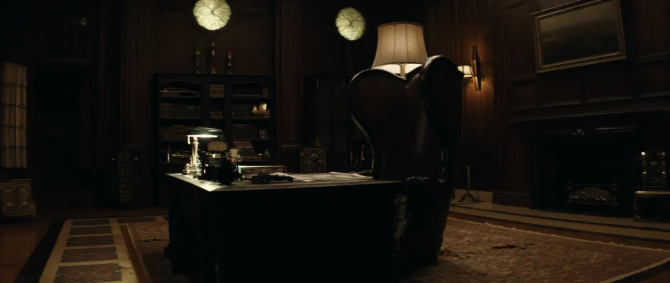
开头电话与结尾都回到Ron的办公室,因此复用同一份确认过的场景。这样,重复出现的地点也成为叙事的连接点。
Cinematic film still, three-quarter angle medium-wide shot of a private study at night, camera set at about seated eye level to one side of the room, looking diagonally across the desk toward the far corner. A classic wood-panelled study: a large heavy desk of dark polished walnut with a leather writing inlay, brass drawer pulls and a slightly worn edge, angled so its front corner is nearest the camera; behind it a tall high-backed leather armchair in deep oxblood, the leather creased and softly shining, turned a little toward the desk; along the back wall a tall glass-fronted wooden bookcase cabinet of the same dark wood, its shelves lined with old cloth- and leather-bound books, a few small framed pictures and objects; on the desk a green-shaded brass banker’s lamp switched ON, a stack of papers, a fountain pen, a heavy glass tumbler, a closed leather folder. Behind the armchair in the far corner a tall brass floor lamp with a warm cream fabric shade, switched ON, its light spilling down the wall and across the back of the chair. Dark wooden floorboards with a worn Persian rug in deep reds, wood-panelled walls, a curtained window with heavy drapes drawn shut, a small side table with a decanter. Warm evening light only from the two lamps — the low golden pool of the banker’s lamp on the desk and papers, the softer amber wash of the floor lamp behind the chair haloing its silhouette, gradual falloff into deep warm-brown shadow in the corners and along the ceiling, practical lamps blooming gently. Polished walnut, creased leather, brass, old paper, wool rug. Empty and still.
CAMERA: 35mm anamorphic lens, three-quarter angle at seated eye level, moderate depth of field with the desk corner, lamp and armchair sharp and the bookcase and far wall softening gently into anamorphic oval bokeh around the lamp glows, mild anamorphic edge character and a subtle horizontal warm flare from the floor lamp, micro-handheld sway.
STYLE: shot on real 35mm film with fine natural grain and filmic highlight roll-off; anamorphic lens character; warm low-key palette — deep brown-black shadows that retain texture, rich separated midtones of walnut, oxblood leather, brass and cream, the amber lamp light kept close to its sources without a uniform yellow filter, an articulate midtone range so wood, leather, paper, brass and rug each keep their own value; realistic environment physics — still air, faint dust in the lamp glow; gritty documentary film realism, indistinguishable from a real photograph, absolutely no CGI or render look. Night, warm, quiet, private.
Clean environment plate, no people, no silhouettes, no faces, no figures in the chair or reflected in the glass. No readable text on papers or book spines, no watermark, no logo. Aspect ratio 2.39:1.
Victor办公室还做了更细的准备:先调整主视角的照明,再制作朝向门口的反向视角。沙发一侧和门口一侧必须属于同一个房间,光线和布局才能在对白切换时接起来。
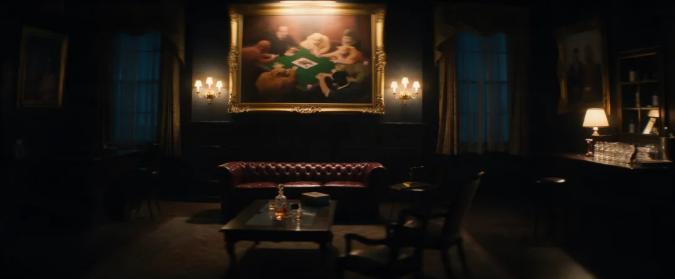
这里最值得借鉴的顺序是:先把房间搭对,再让演员进去。 如果每次生成对白时都重新描述一次办公室,家具位置与光源很容易一起漂移。
5.从电话到夜店,镜头要有叙事任务
正式生成从电话开始。原作者用同一个提示词得到四段有用素材,分别保留Adam开场、Ron的情绪表演、挂断电话和离开等部分,再放进剪辑。
这说明“一段生成”与“最终一个镜头”不必完全对应。只要其中有可用的表情、动作或转场,就可以成为成片的一部分。
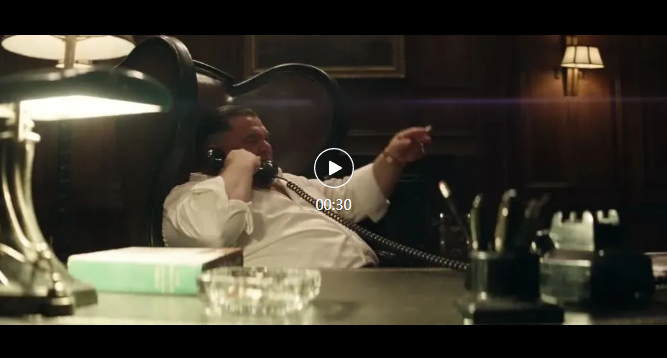
视频 04 · Scene 1.1 — The Phone Call
随后是夜桥骑行。摄影机跟随摩托车,转到Adam后方,再抬升展示大桥和城市。这个镜头既连接两处地点,也给片名留下空间。
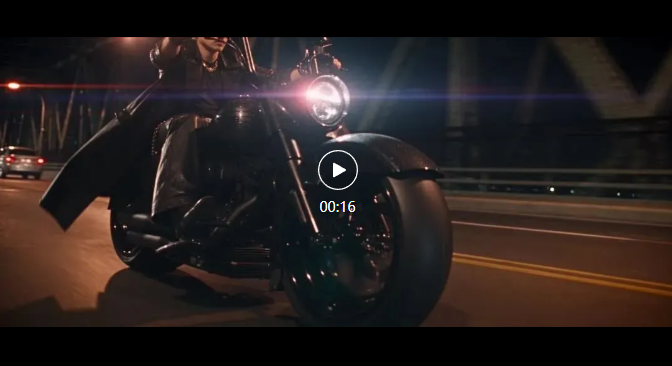
视频 08 · Scene 1.2 — The Bridge at Night
到夜店后,作者没有马上进入打斗,而是依次安排入场、派对空隙镜头、在人群中寻找、回头、被守卫发现。
这些镜头各自只推进一点信息:Adam在找人,环境仍在狂欢,危险逐渐靠近。等到冲突发生,观众已经知道人物和空间的关系。
多人打斗,先把顺序写清楚
夜店一对三的设计,按身后、右侧、左侧的威胁顺序展开。动作的先后关系,比堆砌“激烈”“震撼”等形容词更能帮助读懂这一场。
到了走廊,作者先建立狭窄空间与五名有区别的守卫,再生成对话和打斗。最终走廊打斗从两段生成中挑选,借助快速摇镜的模糊与身体运动隐藏连接。
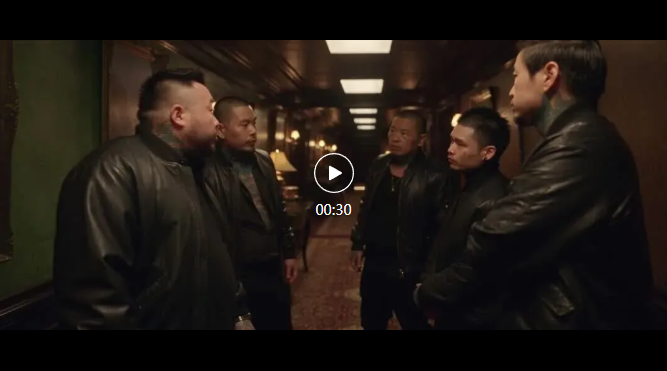
视频 17 · Scene 3.2 — The Corridor Fight
这种剪法给制作留下了余地:不必要求一次生成把整场戏全部完成。把能够连起来的段落保留下来,再处理动作方向和剪切点。
6.对白与动作,都需要连续性
Victor办公室对白由六次生成的选段组合而成。画面可以切换,台词需要保持完整;Adam背后的门和Victor背后的沙发,也为观众提供了稳定的方位。
这时,表演的重点是变化过程:一个人保持镇定,另一个人的态度逐渐改变。提示词应当交代变化发生的时机,而不是只写一个情绪标签。
后续特殊状态同样拆开处理:人物身份继续使用视频元素,局部状态与道具分别调用图片。作者还借前景人物的背部遮挡完成形态变化,让变化发生在画面遮挡之后,再展示最终造型。
这是一种可以迁移的拍摄思路:难以稳定生成的过程,可以通过遮挡、反应镜头和剪辑重新组织。
7.先生成基础动作,再补机位
办公室最终打斗之前,作者先探索空房间的全景、中景和俯视角,确认同一空间的不同观看方向。
随后,在高角度场景图上标出Adam与Victor的起始位置。这张图控制的是 人物站位,不是要求最终视频始终使用俯拍机位。
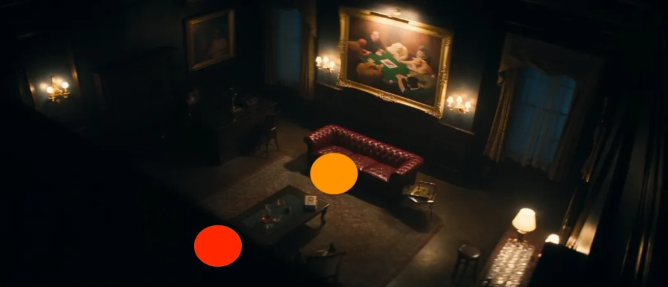
基础打斗围绕红色沙发附近展开。每次动作都要有接近、接触和反应,让人物之间的距离与力量关系看得明白。
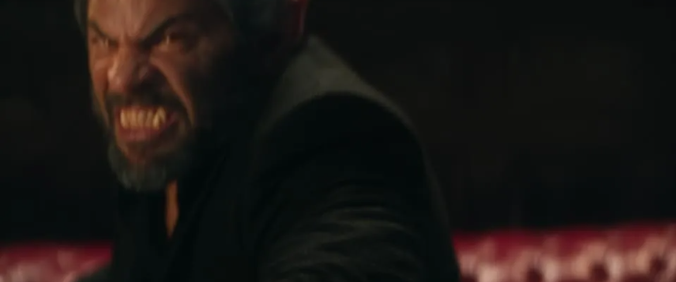
视频 29 · Scene 4C.1 — The Base Fight
选定基础打斗后,再把它作为 @video_1 输入,生成更宽的景别、低角度和带前景遮挡的新机位。
先让一条动作成立,再围绕这条动作补覆盖镜头,是这套流程中很实用的一步。它让补机位有了可参考的运动,而不必每个角度都重新设计整场动作。
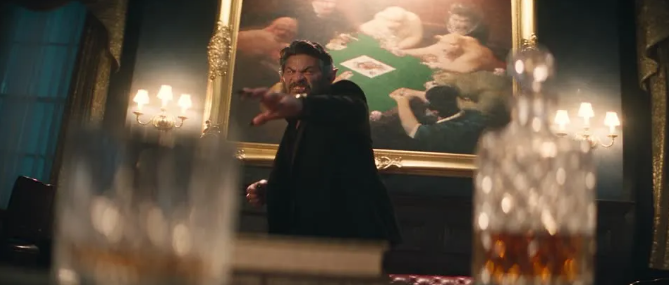
视频 30 · Scene 4D — New Camera Angles
最后使用Forward Extend继续选定片段,从末帧向后延展。人物位置、抓握关系、光线和服装都需要接着上一段,才能把动作收尾与人物喘息连接起来。
结尾再回到Ron的办公室,通过一句话引发Adam的表情转变,为故事留下下一步。动作戏之后的停顿,也成为整部短片节奏的一部分。
8.把这套方法带回自己的项目
如果按这份教程练习,可以先选两个角色、一个地点、一段对白或一个短动作,走完一遍完整流程。
资产确认:角色造型、角色视频、空场景、必要道具都能一一对应。
场景拆解:每个镜头说明叙事任务、人物位置、动作变化和摄影机行为。
生成挑选:保留有效选段,记录可用时间,而不是只按整段成败判断。
连续性检查:核对脸、服装、道具、光线、动作方向与对白衔接。
剪辑补拍:需要时补反应、空镜和机位,再处理连接与收尾。
这份记录最有用的地方,是把角色设计、场景准备、镜头生成和剪辑选择串成了可检查的制作过程。每一步都给下一步留下一份明确的参照,复杂短片才有机会逐段完成。
原文与素材来源:Higgsfield / adilinthewildtempo,《How to Make a Cinematic AI Short Film》。