



April 23rd.OpenAI Launched on April 22nd, local time ChatGPT ClinicianThe version, a version designed to support clinical tasks, such as documentation and medical research, allows clinicians to focus on providing quality patient care. OpenAI has been used free of charge in the United States by all certified doctors, nurses, medical assistants or pharmacists。
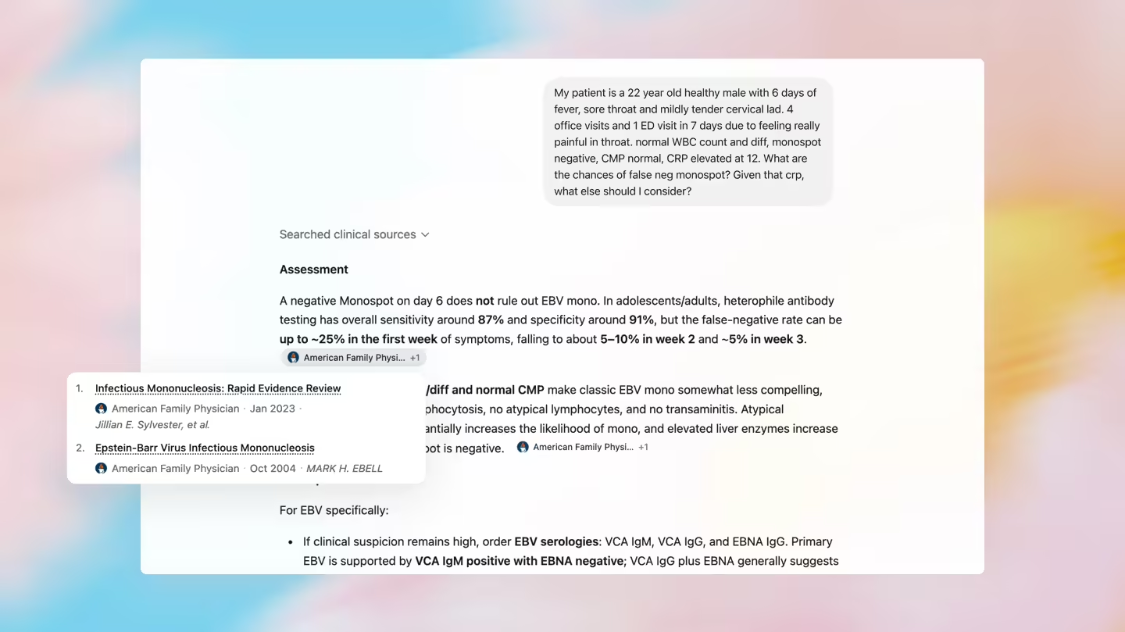
According to official accounts, the United States medical system is under great pressure today. Clinicians are required to take care of more patients while managing growing administrative needs and rapidly expanding medical research systems. Many people have started to rely on such an AI tool as ChatGPT. According to data from the American Medical Association in 2026, doctors now use artificial intelligence at an all-time highTHE DOCTORS AT 72% SAID THEY NOW USE ARTIFICIAL INTELLIGENCE IN CLINICAL PRACTICEIt's up from last year's 48%. Today, millions of clinicians around the world use ChatGPT every week to support their clinical care, for such purposes as nursing counselling, writing and documentation, and medical research. The proportion of clinicians using ChatGPT has more than doubled over the past year。
OpenAI ' s team, in collaboration with hundreds of medical consultants, mentored and upgraded the capacity of ChatGPT clinicians to ensure that they support critical clinical applications。
ChatGPT, for the clinician
- ADVANCED AI MODEL FOR COMPLEX CLINICAL PROBLEMS: FREE ACCESS TO OUR CURRENT FORWARD MEDICAL MODEL TO HELP ADDRESS PROBLEMS, RESEARCH AND DOCUMENTATION MORE RELIABLY。
- Achieving skills for repeatable clinical work processes: Translating common work processes into reusable skills, enabling ChatGPT to follow the same steps at each time, handling referrals, prior authorization and patient instructions。
- Credible clinical access: Cases are reasoned in a faster and more confident manner through real-time evidence based on millions of authorities and peer-reviewed medical sources。
- Cross-medical periodicals conduct in-depth research: the synthesis of medical literature is sent to ChatGPT, which selects the source of your trust and, if necessary, directs the research to produce comprehensive and good reports within minutes。
- CME from a real clinical issue: When you study clinical issues in ChatGPT, a qualified evidence review can automatically count on a continuing medical education credit - without separate courses or additional documents。
- OPTIONAL SUPPORT FOR HIPAA COMPLIANCE: PHI IS NOT REQUIRED FOR MANY CLINICAL TASKS, BUT ELIGIBLE ACCOUNTS CAN BE SUPPORTED THROUGH THE BUSINESS PARTNERSHIP AGREEMENT (BAA) IF REQUIRED。
- Account security and privacy: Dialogue is not used in training models, and protection measures such as multi-factor certification help to protect sensitive work safety。
According to the official announcement, OpenAI has been improving the safety and accuracy of ChatGPT's response in the health scene. OpenAI ' s medical consultant continuously reviews model responses and provides feedback on quality, reasoning, credibility and security. So farThey've reviewed over 700,000 model responsesIt reflects how the clinicians and patients use ChatGPT in the real world; every few minutes, doctors review a new model response. The OpenAI model was rated in third-party assessments as the best-performing system in actual medical applications。
This rigour also affects the development of ChatGPT clinicians. Prior to the release, doctors ' consultants tested 6,924 conversations in their daily work, covering clinical care, documentation and research. In generalDOCTORS RATE 99.61 TP3T'S ANSWER AS SAFE AND ACCURATEI don't know. In 355 examples, three independent doctors in each case have designated true references, and the clinical practitioner ChatGPT has cited these sources more frequently than human doctors. Even so, ChatGPT clinicians aim to provide information support to the clinicians, not to replace their judgement or expertise。
Today, OpenAI also presents the HealthBench Professional Edition, an open benchmark for real clinicians to talk to, covering three examples:Care counselling, writing and documentation and medical researchI don't know. Based on a broader assessment of the health dialogue based on HealthBench, it measures the performance and safety of regular clinicians in their conversations using the dialogue and scoring criteria written by doctors, multi-stage doctor decisions and detailed data filters。
The HealthBench Profiling Example is selected for quality, representativeness and difficulty in order to measure progress on a continuous basis. About a third of the cases involve doctors who are interested in “red teams”, that is, trying to find problems in our models, where OpenAI chooses to concentrate data, the most difficult conversation is 3.5 times the model。
OpenAI reports the results of the clinicians and cross-models through ChatGPT. As a strong basis, OpenAI requires that human doctors have unlimited time and network access within their specializations to generate their own answers. OpenAI found that ChatGPT for Clinicians GPT-5.4 performed better than basic GPT-5.4, all other OpenAI and external models, and human doctors。