



Now video models can understand more and more natural language, especially in Seedance 2.5, and can produce a fairly real picture of a real person, even if they do not prepare the whole scene in advance, provide a character, then describe space, light and lens by text。
This time, I want to take advantage of that capacity。
The project as a whole will not produce a large number of reference maps in advance. When actually entering Seedance 2.5, each set of videos is regenerated by word, using a current personal asset to stabilize the role of the person, with buildings, spaces, the natural environment, light, video and the overall atmosphere outside the person。
But that doesn't mean we just have to write a "high easterly film sense" to start smoking cards. On the contrary, when the scene is no longer fixed by reference maps, the preceding period becomes more important for aesthetic and spatial design. Models can help us create the world, but first let it know what color the world should be, how space should be organized, why people should be here, and how the camera should be filmed。
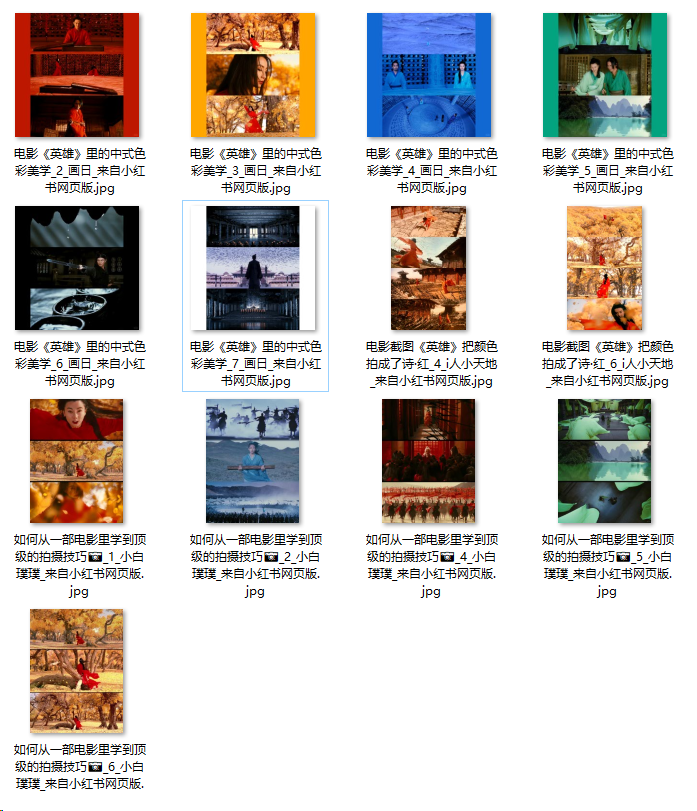
This time, I chose Zhang's hero for visual analysis. I like it not because of a specific image, but because the film enables a very rich combination of red, blue and green to dominate the world, while maintaining a unified sense of photographic quality。
So I have five different colors for the same female role: deep red, gray powder, green, dark blue and goose yellow。
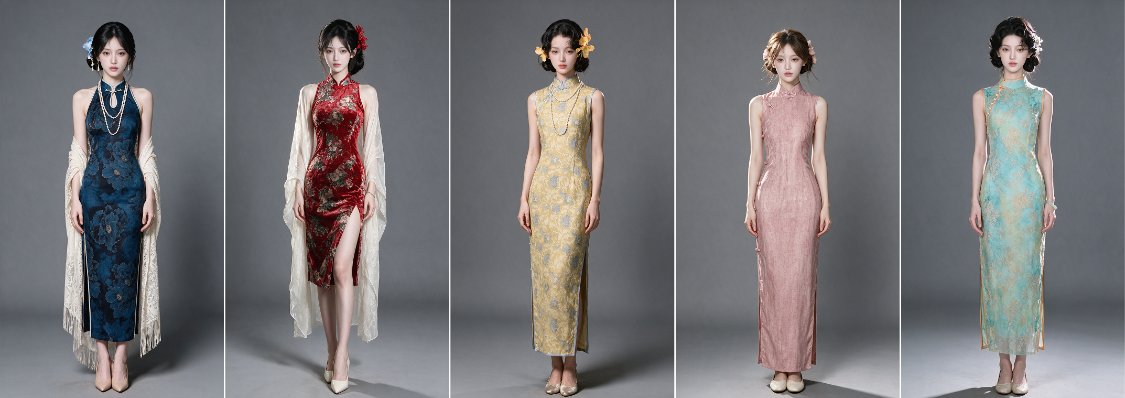
In particular, the five colours do not together form a 30-second video. Each set of characters completes a 30-second short film alone. Finally, there are five 30-second visual works of different colours that share the same photography language, but each has its own integrated colour and scene world。
The entire production process can be integrated into five steps: analysis of the aesthetics of the film, production of characters and counter-scenes, creation of a photo master, and extrapolation of 30-second spectrophs。
Step 1: Remove the "Choose Bottoms" and "Consolidated Colours" from Heroes
IF IT WAS JUST TO GIVE THE HEROES' SCREENSHOT TO AI, AND THEN ASK “WHAT'S THIS STYLE”, THE ANSWER IS USUALLY THE KIND OF ADJECTIVE OF EASTERN AESTHETICS, CINEMATIC SENSE, POETRY, RESTRAINT, ADVANCED. THESE WORDS ARE CORRECT, BUT WHEN THEY ARE ACTUALLY USED TO GENERATE VIDEOS, IT IS DIFFICULT TO SOLVE ANY SPECIFIC PROBLEMS。
SO THE FIRST STEP IS NOT TO LET AI LABEL THE IMAGES, BUT RATHER TO ANALYZE THEM: WHY DO THESE IMAGES HAVE SO STRONG A COMBINATION OF COLOURS WITHOUT TURNING THEM INTO A CHEAP, PURE COLOUR FILTER。
This is especially about analysing the size of the main color in the picture。
Many of the impressive images in Heroes are not “persons wearing a red dress with a grey background to her”, but people, trees, twilight, buildings, ground, environmental reflections, even air and light enter the red world together. What really keeps the level is different internal red light, materials, cool heat and shallow space。
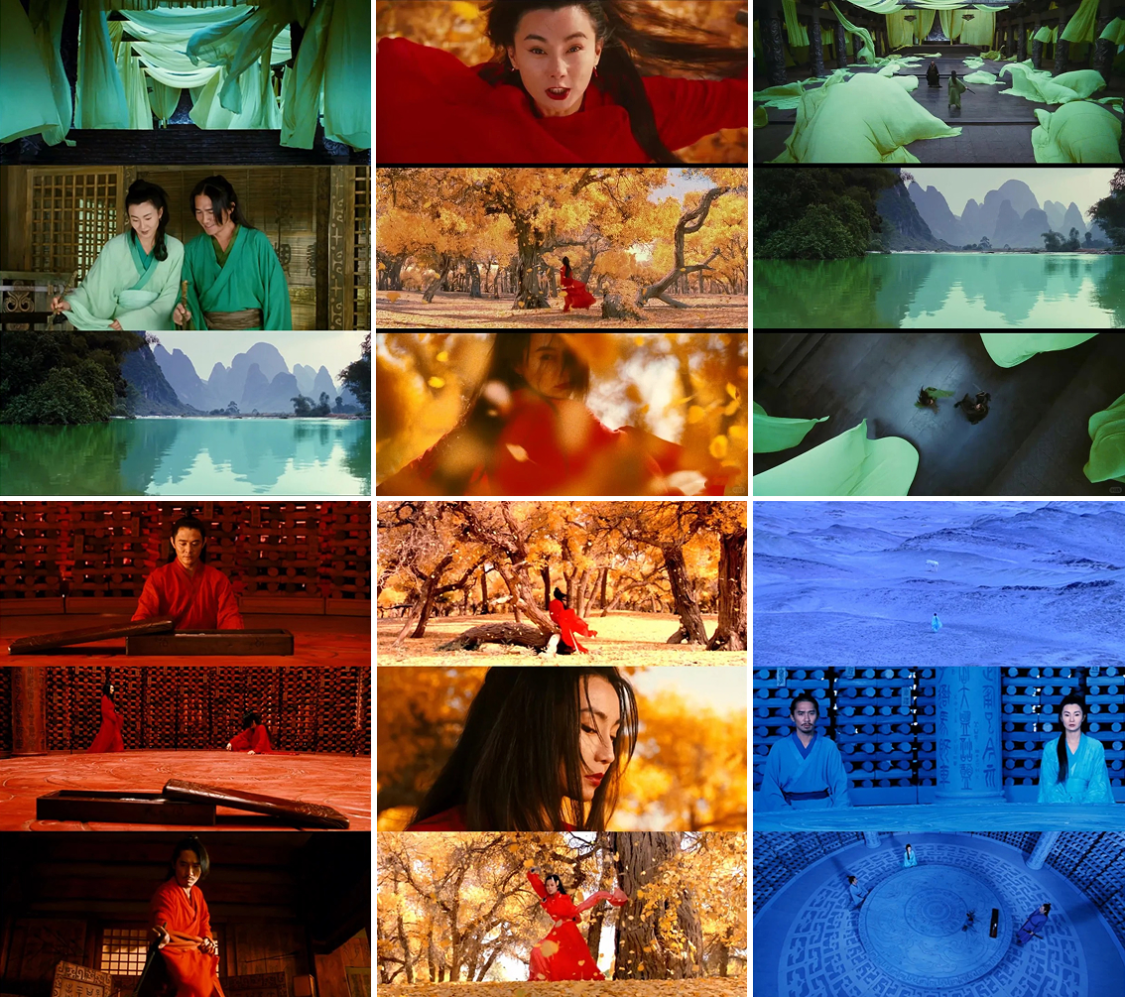
From The Heroes
So the analytical hint can be more clearly written:
Please analyse my images of The Heroes from three angles: cinematography, fine arts design and tuning, so as not to repeat the specifics, nor to summarize the abstract words “Oriental aesthetics, film senses, high senses”。
Focus on visual coverage and coverage in different colour paragraphs. Observe whether human clothing, buildings, natural environment, fabrics, trophies, ground, air and environmental light are integrated into the same integrated colour system, and how the same colour is formed by visibility, integrated colour temperature, material and space distance。
At the same time, it analyses the scale relationship between the person and the wider environment, the common view, the image, the circle structure, the frame, the whiteness, the vision cover, the camera quality, the lens focus, the depth, the main light direction, the colour of the person, the dark side and the high light。
Finally, the results are organized in two parts: the first is a consistent pattern of photography between different colour images; the second is a high-colour-density picture, where the main colour enters the person, scene, light and air and maintains the method of film level。
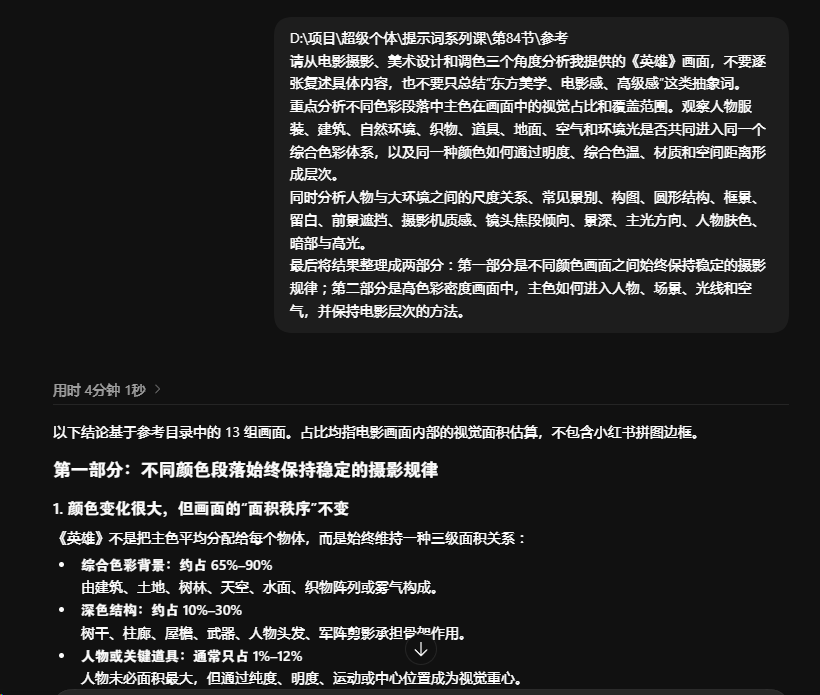
dialogue in codex
A concept that requires special attention here: high colour density。
We are not simply saturation, nor are we putting the whole picture on a red or blue filter, but we are actually getting a composite color into space. Red, for example, can be seen as a reflection of the environment in dark red paint, dark red silk, tanstone, warm red; blue can also be found in the sky, water, building darkness and mist at varying degrees of light。
So this time the picture cannot be understood by default as "high equals gray, light, low saturated." What is really needed is a coloury, large enough area, with clear internal layers。
And that's the basis for all the behind scenes。
Step 2: Production of five sets of personal assets, with the "situation world" countered by clothing
Having analyzed Heroes, I found that what I really liked was not a fixed color, but that the picture was still able to maintain a unified film quality after changing different colors。
So this time I decided on a fixed female role
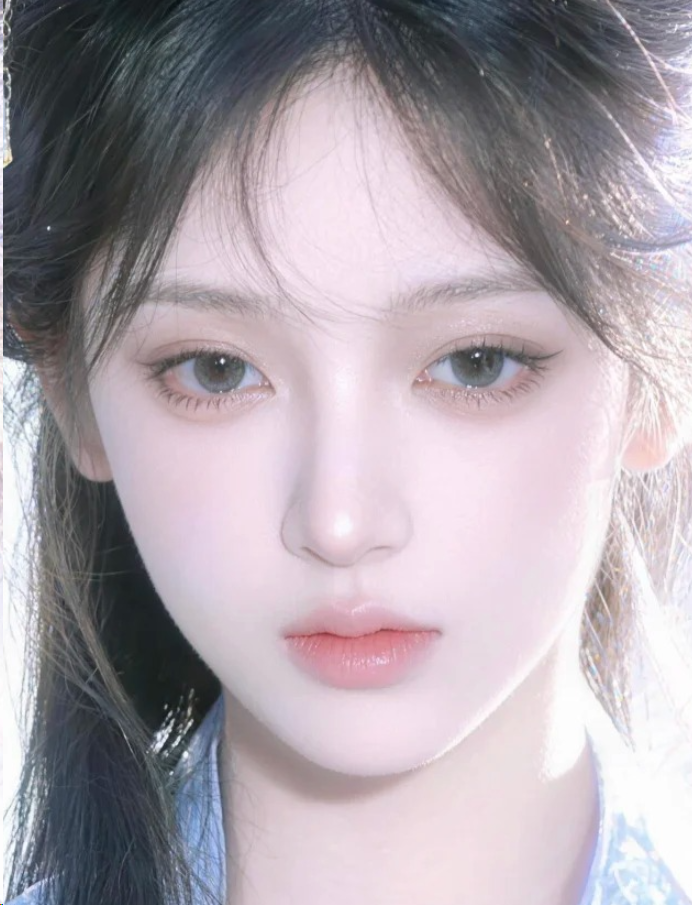
Personal Face Reference
Five more pairs of tiaras are made around the same person, using deep red, low saturated ash, green, dark blue and goose yellow。
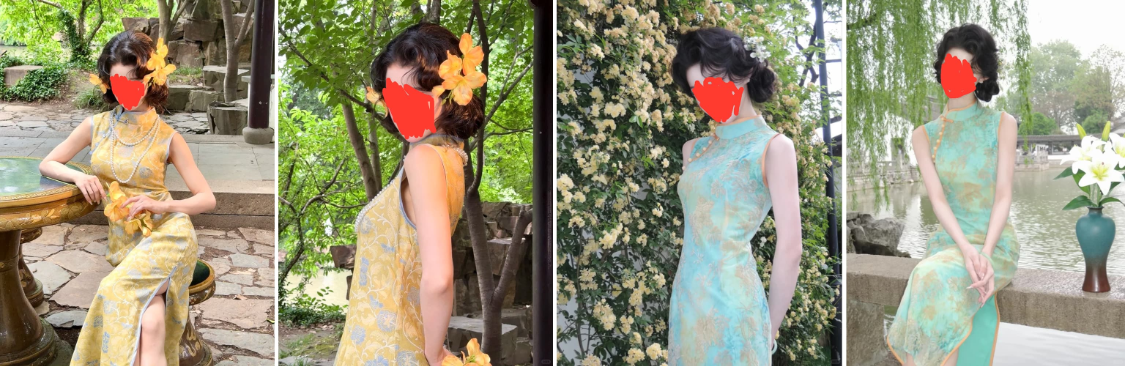
I found five different colors on the Internet
The five maps are not five persons, but five sets of assets of the same person。
It is therefore the role identity that really needs to be given priority in the asset phase. The five officials, the face, the age, the colour, the body ratio and the basic quality of the person must be as stable as possible. What really changes is the colour of the flag, the material, the embroidery, the hairdressing and the small amount of the dress。
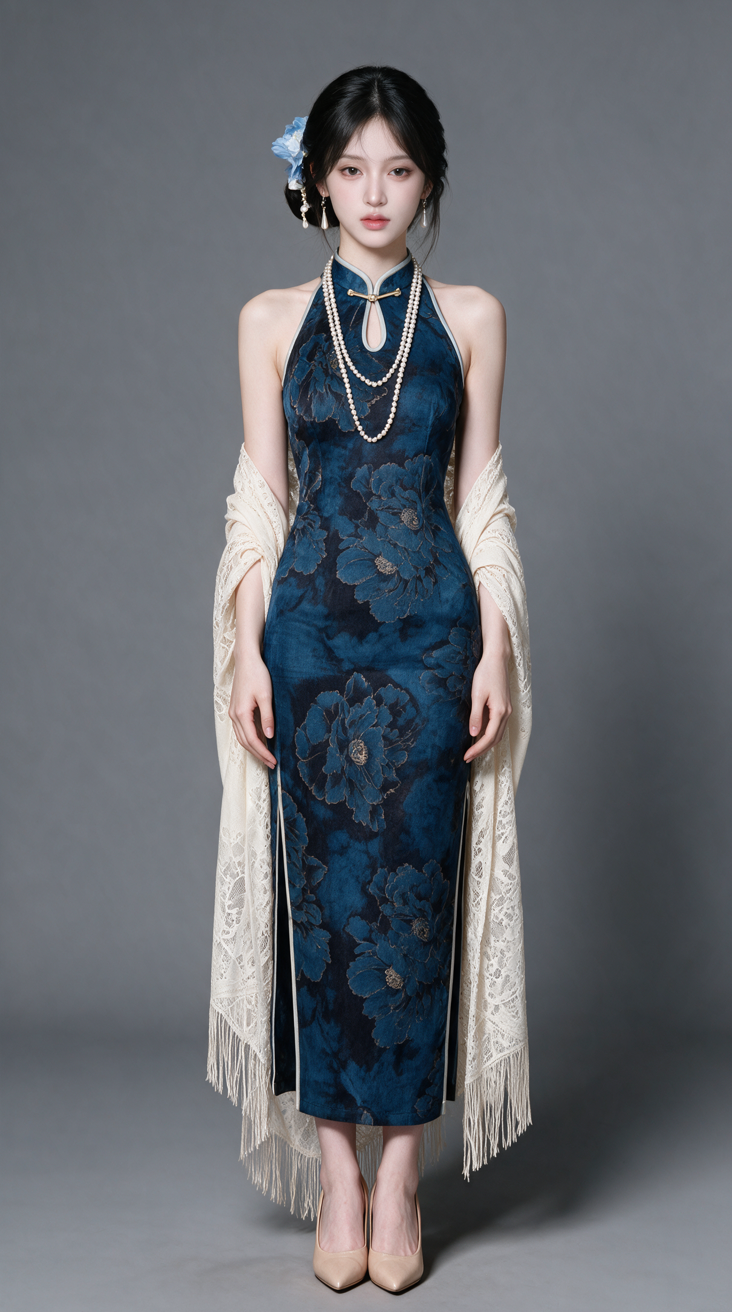
in the following video, a video of the person's body was produced using a copyream 5.0 pro:
Figure 1, figure 2, refers only to clothing, hairstyle, hairdressing and accessories, with reference to the dark blue tiara, tiara gratuity, white laces, pearl necklaces, eardressing, and hairdressing and hairdressing in figure 1, figure 2, and figure 3, with reference only to the person ' s face, five official scales, eyebrows, nose, mouthbrow, makeup and overall amelioration, without reference to the original dress in figure 3, nor to the original hairdressing in figure 3。
A photo of young Chinese women in front of their bodies. The person ' s face is strictly referenced in figure 3, figure 1 and figure 2, in a dark blue tiara with a delicate and low-tweaked gravitation, a white lace cape with a pearl necklace and earring. Hair and hairdressing are made from figure I, figure II: elegantly retroverted hair or low-discretion structure, full-cut hair, blue flowers with the same style as figure I and figure II hairdressing and fine decorative details, and the whole form is soft, fine and retro. The person stands on his or her face, his or her body is natural, his or her head is full to his or her shoes, the person is in the middle, and the whole form is clearly presented。
The background is a pure grey studio background, with a standard three-point light, with clear main light, auxiliary light, contours and clean light, highlighting the person ' s face, hair, clothing and bodylines. It is presented as a whole as a high-quality photo shoot, official person-made make-up, dress-forming display, clean and high-quality images, natural figures, dress-up, whole hairstyle and clear accessories。
**Constraint requirements:** Do not retain the original red cougar of figure 3; do not retain the original hairstyle of figure 3; do not mix with the human face features of figure 1 and figure 2; preserve only the face of figure 3 and use only the costumes, hairstyles, hairdressers and accessories of figure 1, figure 2; do not have complex scenes, do not have a courtyard background, only the effects of a pure grey-floor studio. Watch out for head-to-head ratio, supermodel body size ratio
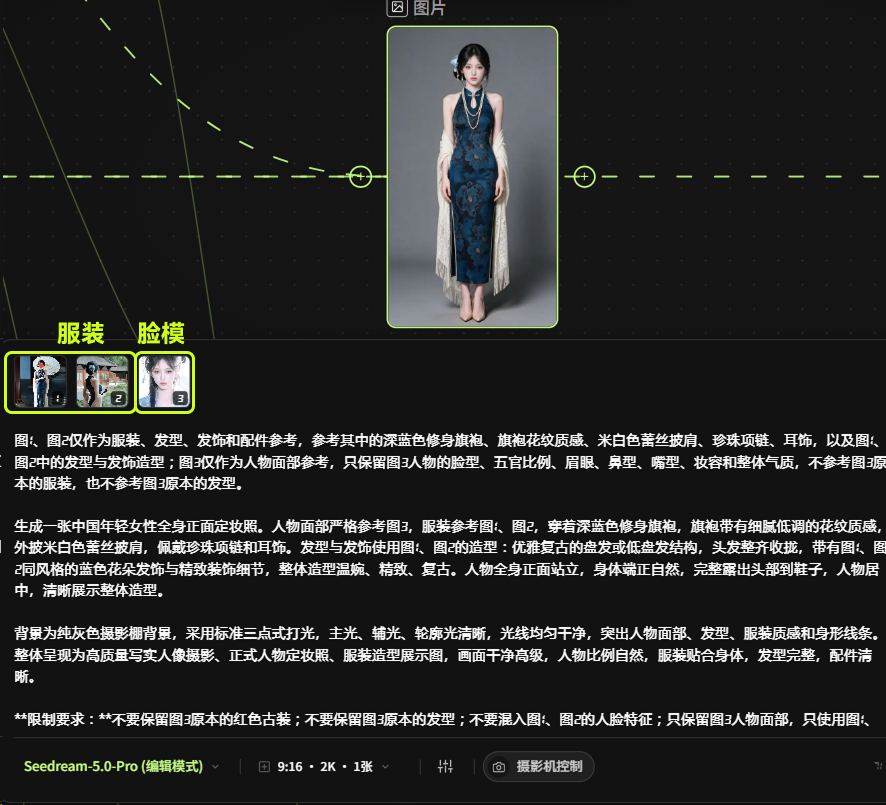
generate using feedseedream 5.0 pro
and to create a personal asset map (generated using nanobanan pro):
The image of the person in the image is set in four views, the grey studio background, the overall make-up board for the professional human role, the layout, the clean, not the poster, not the big magazine, not the drama, not the complex scene。
The overall layout is strictly divided into two parts, top and bottom: the first half accounts for one third of the height of the picture and the second half for two thirds. The area above displays two fine face features, on the left, on the front, and on the right, on the side. Both features are focused on the head and the neck, and are well organized, with a clear display of the characters ' five officials, bone structure, make-up, hair, hairdressing and decorum. Personal facial features, hairstyles, make-up and head dressing must be strictly consistent with the reference image. The skin sense is real and natural, with porosity, stripes, fuzzy hair, eyebrows, nuanced hair and light on the skin, not grinding skin, not too sharp, not looking like a beauty, and a high-resolved make-up feel。
The area below shows two reference maps of body and clothing, arranged around。
The left-hand picture must be a larger, front-looking costume display with a standard A-pose position for the person. The focus of this picture is not on the whole body, but rather on “a significantly larger number of people”, so that the role is more proportional to the picture. The picture on the left side must be taken in a more proximate light, with the person starting to draw from the lower side of the shoulder neck, until the end of the shoe, and the head being completely cut off from the picture because the image was amplified. Please note that this is not an ordinary long-range body picture, but rather a positive one that is magnified at close range: the body is significantly larger in the picture, with the upper and lower parts being magnified and the overall visual effect being the main part of the dresser in the time frame. The person ' s shoulder, arms, hands, torso, waist, legs and shoes must be preserved in their entirety, and the edge of the image allows for only the head to be cut off and the hand, foot or body to be cut off. This figure on the left must look closer, more “full” and more “expanded” than on the back of the right to make the details of the dress and the body more visible. It is prohibited to make the left part of the body as a general small scale, to make the person too small in the left side, to keep the head in the picture and to cut off only half the head or leave a chin, mouth, nose, edge of the hair。
The right side of the picture is the entire body of the back, standard A-pose, which presents the whole body from the head to the back of the shoe. The person's back-to-back lens, with complete back, hair, back structure of the clothing, shoes and overall contour, is used to display the role-back shape. The right side of the picture is shown on the general whole back, with a normal figure ratio, which does not need to be magnified as the left。
The two charts below must be the same person, the same dress, the same set of accessories, the same body ratio. The entire body is maintained at a permutation rate, but do not exaggerate. Clothing design, fabric level, shoes, dress style, clothing structure and costume styles must strictly follow the original map. All clothing and fittings are characterized by a sense of true physical material quality, with natural wrinkles, crumblings and thin changes, with real reflections of metals, and with real natural expression of materials such as leather, silk and veils. If the original dress is a long skirt with a fork, the person on the left side can walk half-step by leg in order to show the fork structure and the effect on the leg, but the whole body will still need to remain in a stable position with a make-up and not a show。
The light is only polished using a three-point clean and integrated studio: the main light on the right, the auxiliary light on the right and the contours on the right. Don't mess with the light, don't color the light, don't get the vibe. The background is pure gray and seamless。
STRICTLY REQUIRED: 2 FACES ABOVE ACCOUNT FOR ONE THIRD OF THE PICTURE. THE TWO BODIES BELOW ACCOUNT FOR TWO THIRDS OF THE PICTURE. THE LEFT BOTTOM FIGURE MUST BE A “MAGNIFIED FRONTAL COSTUME DISPLAY”, WITH A SIGNIFICANTLY LARGER FIGURE IN THE PICTURE AND A FULL HEAD CUT OUT FOR CLOSE PROXIMITY. THE RIGHT BOTTOM FIGURE MUST BE A FULL BACK FULL BODY. IT IS FORBIDDEN TO USE THE LOWER LEFT-HAND MAP AS A SMALL GENERAL SCALE. DO NOT ALLOW ANY HEAD INFORMATION TO APPEAR IN THE LOWER LEFT CHART. THE RIGHT AND LEFT CLOTHING IS PROHIBITED FROM INCONSISTENT. THE NUMBER OF CHARACTERS IS PROHIBITED. IT IS FORBIDDEN FOR AI TO BE GREASY, PLASTIC SKIN, EXCESSIVE BEAUTY, CHEAP CG。
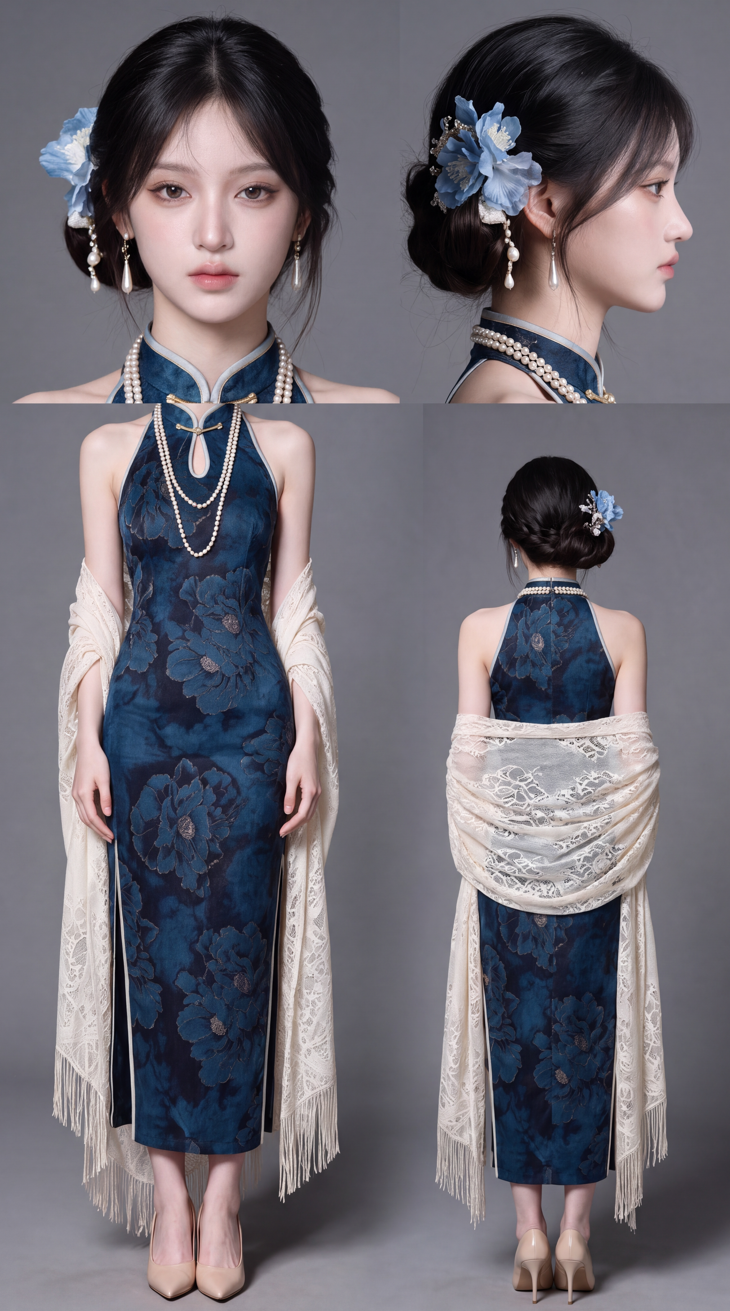
Personal Assets Chart
Do not start writing the spectroscopy immediately after the person ' s assets have been completed。
Because it's Vincent's video, it's really important to first figure out what kind of world people should be in。
THIS IS WHERE EACH INDIVIDUAL'S ASSETS CAN BE HANDED BACK TO AI, SO THAT AI CAN REVERSE THE SCENE FROM THE COSTUME ITSELF. THE MAIN COLOR, THE SUPPORTING COLOUR, THE FABRIC, THE FLORIST, THE HAIRDRESSING AND THE SENSE OF WEIGHT CAN ALL FORM THE BASIS OF SPACE DESIGN。
BUT SINCE EACH COLOUR ULTIMATELY NEEDS TO BE SUPPORTED FOR 30 SECONDS ON ITS OWN, LET'S NOT LET AI DESIGN "ONE BACKGROUND". WHAT NEEDS TO BE REVERSED IS A COMPLETE SCENE SYSTEM THAT CAN SHOOT 7-8 SHOTS。
You can ask:
Please design an Eastern film scene system for the current character that will support the 30-second Seiedance 2.5 Vincent video, in conjunction with the personal asset chart I've provided and the visual reference chart of The Heroes film** provided earlier。
The first is to analyse the colour of the person ' s flag, supporting colour, fabric, tattoos, hairdressing, embellishment, weight sense and overall character of the person ' s assets, using the main colour of the person ' s clothing as the starting point for the combined colour of the 30-second video。
It also focuses on the image and colour presentation in the Hero visual reference. Instead of replicating the specific characters, buildings and scenes in the reference map, you learn about its color organization logic, integrated colour density, photo-level, the ratio of the person to the larger environment, and the overall film-photographic sense。
Ultimately, the scene will need to inherit the following visual features of the reference map:
The main colour has very clear visual domination, not only the colour of the person's clothing, but also of the person's clothing; The main colour is allowed to enter the building, natural environment, fabric, plant, ground, water, air, environmental reflection and light at the same time; The presentation of the thick, thick, high colour density in the reference map is maintained, and the image is not automatically processed into low saturated, grey, light, low-intensity new medium styles; The same main colour is embedded in a deep, bright, luminous, material, cold, and space distance, rather than simply using a pure colour to cover the picture; The medium is well coloured, the high light cannot be white by exposure, and the dark side must retain a clear colour and environmental material, even in the depth of the reference map; The scale relationship between the person and the vast space, the large complex, the frame, the white, the prospective shade and the geometric structure of the eastern architecture is maintained; The whole is a real film and not a true picture, a picture, television drama or modern commercial advertising。
On this basis, the scene is re-engineered in the light of the current flag robe. The reference diagrams are for graphics, colour presentation and film aesthetics, and the person ' s assets are for the current combination of colour, clothing and character formation. The two should not be replaced。
Instead of designing a single context, the scene will be designed around a single, integrated world, with multiple space areas that can be filmed continuously, such as the main courtyard, the porch, the door hole, the window edge, the stone steps, the water surface, the mooring area, the forest or the interior and out-of-door transition space. All regions must belong to the same architecture and art system and be able to support 7-8 different shots in a 30-second video。
The current main color of clothing must continuously control the entire 30-second video. Even if the camera were to be switched from the courtyard to the gallery, window, water or person view, the main colour could not suddenly disappear and could not be re-engineered into ordinary grey, wooden or neutral ancient buildings. Integrated colour needs to persist in the outlook, mesoscape, context, environmental light and air。
** Do not mechanically make everything in the same pure colour as the dress. ** Reference should be made to the colour treatment of Heroes to create layers within the same integrated colour system, using different dark colours, different materials, as well as minimal complementary colours and cooler heat comparisons. Auxiliary colours can only help create space and do not weaken the current visual domination of the dominant colour。
Last output:
(a) A comprehensive colour analysis of current clothing。
The ultimate goal is not simply to produce an “Oriental scene in the colour of the flag”, but to allow the current person to enter a whole new world that belongs to the same American system of first instance as the image, combined colour concentration and film photography。
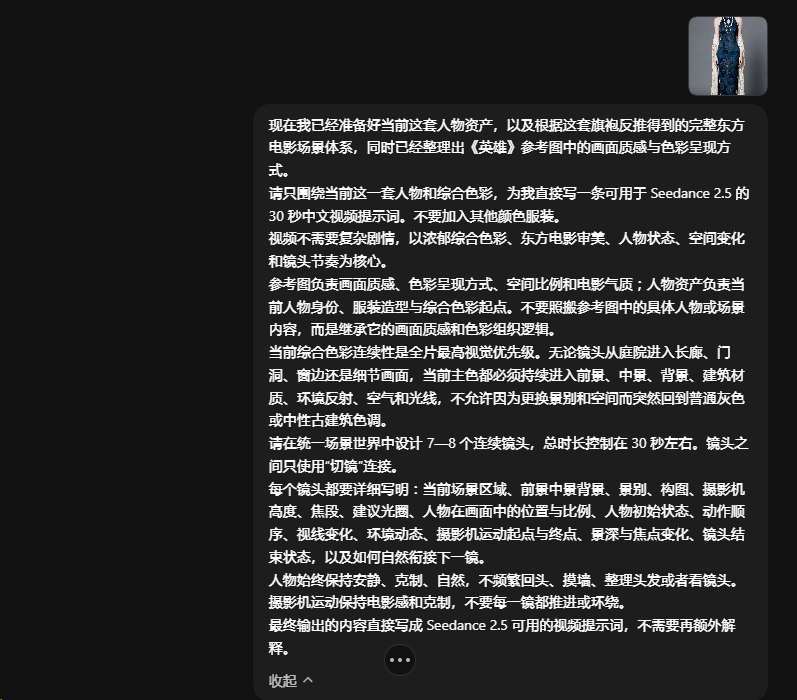
We'll continue with the conversation
Here I'm leading a continuous scene line:
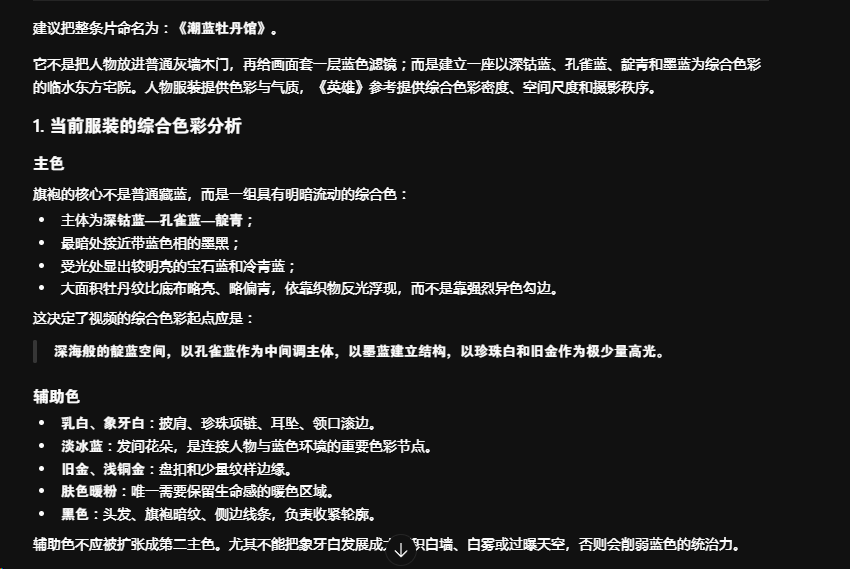
Step 3: The five worlds share the same photo master
Five sets of clothes and scenes can be completely different, but the background cannot be changed with them。
So five videos share a set of photography languages。
This time, we can put the photo master in the form of:
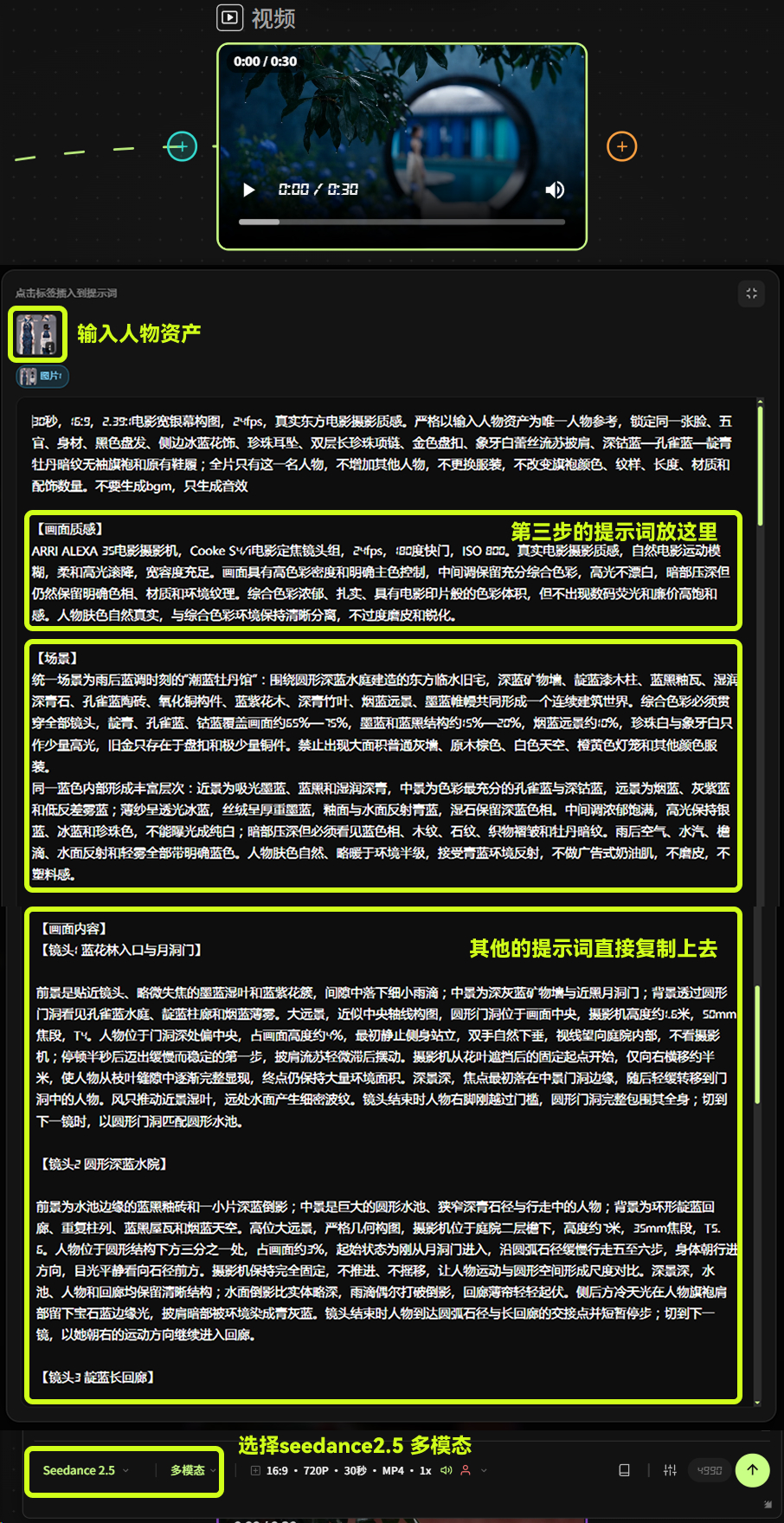
ARRI ALEXA 35 Film Camera, Cooke S4/i Film Focused Camera Group, 24fps, 180 degrees, ISO 800. Real film photography, natural film movement is vague, soft and high and tolerant. The image is of high colour density and clear main colour control, with a middle tone that preserves a full and integrated colour, a high light that is not bleached, and a dark substrate that still retains a clear colour, material and environmental texture. Combined colours are thick, solid and film-printed in colours, but there is no digital fluorescent or cheap high saturation. The skin colour of the person is natural and clearly separate from the colour complex, and does not overwhelm and sharpen。
Cameras and camera sets can be unified, but different spectroscopes need to re-select the focus and radium from the image。
The most important sentence of this photo master should be:
Colours can be strong, but the light cannot be bleached, and the dark must remain colored。
This is how a combination of colours really has size。
Step 4: Directly generate 30-second mirror video alerts
Once the current personal asset and scene system has been identified, there is no need to convert the spectroscopy into a video alert. Because as long as the spectroscope is complete, it's already a video alert that Seedance 2.5 can use directly。
I'll hand over to AI the current person's assets, the system of scenes to be done in the opposite direction, and the image that the Hero draws out with the color, and then ask it to design a 30-second Seedance 2.5 video tip around the current colour of the flag。
Instead of emphasizing complex scenarios, the hint is centred on a hymn complex colour, oriental film aesthetics, character status, spatial change and lens rhythm. The whole video proposes to be split into 7-8 continuous lenses, with a total length of time in about 30 seconds. Only the "scene lens" connection is used between the lenses, each of which provides a detailed description of the scene area, the mid-scene background, the spectrograph, the slot, the focal area, the optical circle, the position of the person, the order of the action, the change of the vision, the dynamics of the environment, the start of the mirror, the depth of the scene and the end state。
This generates content that is both a complete spectroscopy and, ultimately, a video alert that can be used directly for Seedance 2.5。
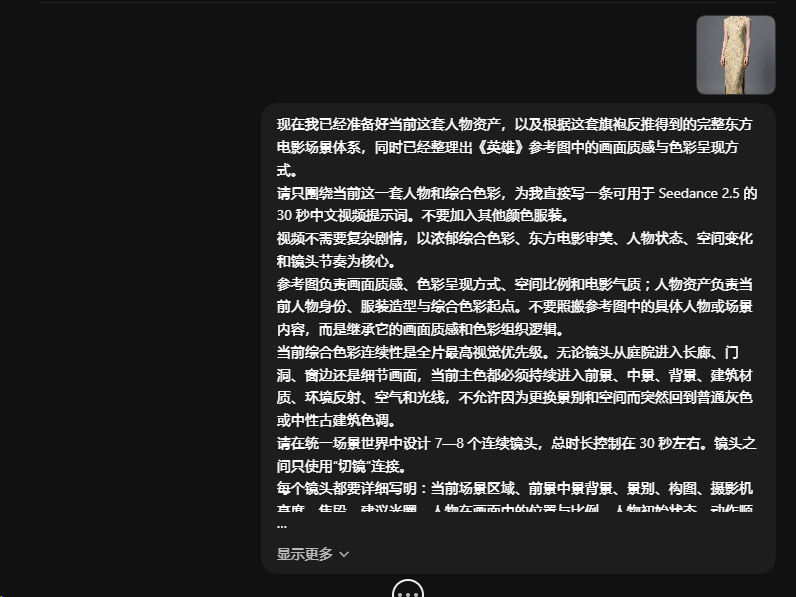
ASK AI DIRECTLY AND FOLLOW UP ON THE CHAT
AI HINT TEMPLATE:
Now I have prepared the current set of people's assets, as well as a complete system of Eastern film scenes based on the backsliding of the flag robe, and I have mapped out the image and colour presentation in the Hero。
Please write a 30-second video alert for me in Chinese that can be used only around the current set of characters and composite colours. Do not add other colored costumes。
Videos do not require complex dramas and are centred on condensed ensemble colours, oriental film aesthetics, character status, spatial changes and lens rhythms。
The reference diagrams cover the image quality, colour presentation, space ratio and film quality; the person ' s assets are responsible for the current person ' s identity, costume and integrated colour starting point. Instead of replicating the specific person or scene in the reference map, it inherited its image and colour organization logic。
The current integrated colour continuity is the highest visual priority of the entire picture. Whether the camera enters the porch, door hole, window edge or detailed image from the courtyard, the current main colour must continue to enter the horizon, medium view, background, building materials, environmental reflection, air and light, and it is not permitted to suddenly return to the normal grey or neutral ancient tone of the building by changing the view and space。
Please design 7-8 continuous lenses in a unified scene world, with a total duration of about 30 seconds. Only "scene" connections are used between the lenses。
Each camera is detailed: the current scene area, the medium view background, the scene, the image, the camera height, the focal area, the recommended optical circle, the position and proportion of the person in the image, the initial status of the person, the sequence of the action, the change of the view, the dynamics of the environment, the point and end of the camera's movement, the depth and focus change, the end of the camera, and how the natural connection is to the next lens。
The characters are always quiet, restrained, natural and do not look back, touch walls, sort their hair or look at the lens. Cameras exercise with a sense of film and restraint and do not push or surround every mirror。
The content of the final output is written directly into the video alert that is available for Seedance 2.5, without additional explanation。
The text of the output is as follows:
30 seconds, 16:9,2.39: 1 film wide screen, 24 fps, real east film photography. strictly single-faced with the input of a person's assets, the same face, five officials, body size, black hair, side-side ice-blue bouquets, pearl ear falls, two-story long pearl necklaces, gold-coloured caps, ivory lacelles, deep-cobalt blues and blue-coloured police robes, as well as their original shoes, are locked in the same face, five officials, body sizes, black hair, side-side blue bouquets, pearl ear falls, double-stacked pearl necklaces, gold-coloured shawks, ivory white laces, deep-cobalt blues and blue-collar police robes; this single person, without adding others, without changing clothes, and without changing the colour, striping, length, material and size of the flag robes。
THE UNIFIED SCENE IS THE “TWILIGHT BLUE HOUSE” OF THE BLUE HOUR AFTER THE RAIN: AN OLD HOUSE BUILT AROUND A ROUND DEEP BLUE COURT, A DEEP BLUE MINERAL WALL, A BLUE-PAINTED WOOD COLUMN, A BLUE BLACK BALM, WET AND DEEP STONES, PEACOCK BLUE TILES, COPPER OXIDE COMPONENTS, BLUE PURPLE LUMBER, DEEP BAMBOO LEAVES, SMOKE BLUE VISIONS, AND INK BLUES TO FORM A WORLD OF CONTINUOUS CONSTRUCTION. COMBINED COLOURS MUST RUN THROUGH THE WHOLE LENS, WITH ABOUT 65%-75%, APPROXIMATELY 15%-20% IN MELANCHOLY AND BLUE BLACK, ABOUT 10% IN SMOKE BLUE, ONLY A SMALL AMOUNT OF LIGHT IN PEARL WHITE AND IVORY WHITE, AND ONLY A SMALL AMOUNT OF OLD GOLD IN BUTTONS AND VERY LITTLE COPPER. LARGE AREAS OF COMMON GREY WALLS, LOG BROWN, WHITE SKY, ORANGE LANTERNS AND OTHER COLOURS ARE PROHIBITED。
The same blue interior has a rich layer: the periphery is luminous, blue and wet, with the most coloured peacock blue and deep cobalt blue, with a vision of smoke blue, gray purple blue and low inverted mist blue; the veil is luminous and velvet blue, velvet is thick ink blue, the raisins and water reflect blue blue, and the moist rock is kept dark blue. The middle is thick and full, and the high light is silver blue, ice blue and pearl, which cannot be exposed to white; the dark is deep but must see the blue, wooden, graphy, fabric wrinkles and the owl. Air, water vapour, twilight, water reflection and light fog are all clearly blue after the rain. The person's skin colour is natural, slightly warmer than the environmental half, receiving a reflection of the blue environment, not advertising cream muscles, not grinding skin, and not plastic。
The person is quiet, restrained, natural, has a small movement, has a real breath and pace, does not look back often, does not touch the wall, does not prepare his hair, does not look at the camera repeatedly. The shawl weighs soft and falling weight, leaving the guillotine and the edges softly in the wind, and the body of the tiara is thick and not exaggerating. Cameras exercise restraint, which is based on stable observation, short-range movement and slow follow, do not move in or around. All lenses are scrutinised and do not use folding, deformation, flashing, transient special effects or scenes to dissolve。
[Spoken 1:00 to 00:04 at the entrance to the Blue Flower Forest and the Moon Hole]
The outlook is a small drop of rain in the gap, close to the lens, slightly obscurous moist leaves and blue vermin, with a middle view of a deep grey blue mineral wall and a near black moon hole door; and a background view of the peacock blue water court, the coronary and smoke blue fog through a round door hole. Large vision, near-central axis, round door holes in the centre of the picture, camera height approximately 1.6 m, 50 mm focal, T4. The person is located in the middle of the door hole, at an altitude of approximately 41 TP3T, where he first stands still on his side, with his hands naturally leaning down, looking at the inside of the courtyard without looking at the camera, and takes the first step of a slow and stable half-second pause, with a slight lag in the shawl stream. Starting with a fixed starting point after the foliage, the camera moved only about half a metre to the right, allowing the person to gradually become fully visible from the suture of the leaf and maintaining a large environmental area at the end. Deep, the focus initially fell on the edge of the Midview Gate and then slowly shifted to the characters in the Gate. Winds drive only wet leaves of the peri-situdinal and produce thin seams from the far surface. At the end of the lens, the person's right foot had just crossed the threshold and the round door hole had completely surrounded it; when cut into the next mirror, the round water pool was matched by a round door hole。
2:04-0:08 Twilight Blue House
The outlook is blue black bricks on the edge of the pool and a small, deep blue reflection; the medium view is a large round pool, a narrow, dark, blue and walking figure; and the background is a rounded blue corridor, a repeat column, a blue black house and a blue sky. High-level vision, strict geometry, camera under the second floor of the courtyard, approximately 7 metres altitude, 35 mm focus, T5.6. The person is located at one third below the circle structure, which accounts for approximately 3%, starting with a state of entry from the Moon Hole, walking five to six steps slowly along the arc and moving towards the body, with a calm look ahead of the stone. The cameras are fully fixed and do not advance and do not shake, allowing for the movement of people against the circle space. Deep, well-defined structures are maintained for water pools, characters and accessors; the water reflection is slightly deeper than the physical, and the raindrops occasionally break the reflection and the back porch curtains rise and fall. The dark side of the shawl is dyed to the ground by the dark side of the sapphire. At the end of the lens, the person reached the intersection of the round arc and the long porch and briefly paused; cut to the next lens and continue in the right-hand direction。
[Scene 3:08-0:12 Blue Long Hall]
Foregrounds are blue and black columns, which are constantly passing through the picture, and the non-coated peacock blue curtains with an agglomerations; the medium view is the character and the wet, deep-blank ground, which produces an intermittent blue reflection of the ground; and the background is the shrunk columns, blue and black windows and long-term smoke blue mouths. Medium Vision, single-point visual image, with one third of the person on the right side of the picture, at an altitude of approximately 281 TP3T; camera height of 1.35 m, slightly below the person ' s chest, 65 mm focal, T2.8. The person is in the middle of a walk, with three steps of flat pace, and then naturally slows down because of the sound of the lids falling into the water, but without turning back, with the line of view slightly falling to the surface. The camera began at approximately 3 metres to the left side of the person, where it was held at the same speed, in parallel with a side-scattered camera, under a brief natural cover of the three columns, and ended up in front of the corner of the corridor, not exceeding 2.5 metres. Deep in light, the focus is always following the eyes and upper body of the person, the outlook column is rapidly defunct, and the distant column is gradually softening but still retaining the blue geometry. In the environment, there are only twitching, continuous drops of lids and a slight twitching of the ground. At the end of the lens, a deep blue chorus was blown from the left side of the picture and briefly occupied most of the outlook; it cut directly to the indoor poaching in the same direction as the next mirror。
[Scene 4:012:0:16 Windshall]
The outlook is a visceral, semi-transparent smoke blue veil, with a soft focus on the edges; a medium view is a luminous luminous luminous light of peacock blues, aluminum and aluminum with different depths and thickness; and a background of blue and black wood, low-lighted windows and water reflections. Medium view, non-fully symmetrically symmetrically stacked frame, with the person on the center left, at an altitude of approximately 45%; camera height of 1.5 m, 50 mm focal segment, T2. The person first entered from the blow-out, then stopped after two slow steps, with two thirds of his body remaining on his side, with his shoulder relaxed and his hands naturally falling down; first, looking at the light between the front side, then moving slightly to the water outside the right side of the window, without making a visible turn on the head. The camera began with a static position on the outer side of the rim, moving about 80 centimetres very slowly to the left, using multi-layer fabrics to create a vision, with the end end point in a position where the top half of the person and the tiara were fully visible. The focus is first on the texture of the outlook, where the person enters and slowly focuses on her eyes, the outlook retreats into a soft and blue shade, and the background maintains a low contrast. The veil grazes out of the ice and blue, the velvet is in the ink, and the shawl flows only a small swing. At the end of the lens, the person's vision was stabilized outside the right window, and the foreground veil stopped moving; it cut to the direction of the next mirror's glazing window。
Five minutes: 0:16:20:20 at the watery window
Foreground is a wooden-blue window border on the right side and a frayed pearl-chain arc on the lower left corner; medium view is a figure ' s chest image, a deep-cobalt blue tusk, a ivory cape and an old gold plate; background can be seen through a window to the peacock blue water surface, a smoke blue wall and a vague blue purple tree. In the peri-view, a narrow frame is formed using a window, and the person is one third on the left side of the picture, which accounts for approximately 551 TP3T, while the right side retains a large area of blue water. Camera height equals the person's eyes, 85 mm focal, T2. The person began with a two-thirds face, looking beyond the window; she did not turn around and only performed a natural breath, with a slow look from the distant water to a closer reflection, a slight perusal of the eye, and a very small swing of the pearl ear with the breath. The camera is completely fixed. Extremely shallow, but not excessive depths, with a steady focus on the immediate side of the eye, with the water light remaining blue rather than white; a very slight shift of focus occurs in the middle, moving from the eye to the old gold button and the punt in the chest and returning to the eye. Cold skyscrapers in the back of the side outline the surface, blue water reflected into the lower cheeks and necks, and very weak heat in the room preserved only the skin colour of life. At the end of the lens, a drop of lice fell from the window into the surface; it cut to the details of the next mirror drop that hit the reflection。
[Specific camera 6:20-0.23]
The outlook is deep blue water and a spiral of ice blues; the medium view is a reflection of the flag robes in water, a reflection of the shawl and the edges of the moist rock; the background is only a reflection of the vague blue and black architecture. Details, low altitude close to the water surface, approximately 15 cm altitude, 100 mm microspecies, T3.2. The person's body is outside the painting and is confirmed only by the reflection of the water and by the shawl that enters the image; the first drop of the water has just fallen, the round bellows spread, and the mirror of the cape is slightly dispersed. The person then took a step towards the stone, and the head of the shoe stopped by the water without stepping into the deep water, and the shawl slowly ran over the picture. The camera was fixed and focused on the centre of the guillotine, then slightly along the water, and then moved to the penetrator in the reflection, before falling to the edge of the stone. In the dark, the gill-blue waterlines are maintained, the high light is silver-blue, and there is no pure white reflection. At the end of the lens, the head of the person's shoe forms a stable slope at the edge of the stone; it cuts to the whole structure of the stone step in the same direction as the next mirror。
[Scene 7:0:23:26:5 humid stone steps and watering platforms]
The outlook is a black wall on both sides and a vandalized blue flower, which forms a low-level trap; a medium view with a downgraded deep-blown layer, a person's body and shallow water reflection; and a background of deep-blue water, a circular platform, a smoke blue far shore and a blue and black ridge in the fog. Panorama, slightly lower position, with the person on the center right, at an altitude of approximately 351 TP3T; camera height of about 70 cm, 40 mm focal, T4. The person starts at the top of the stone steps, goes first in a calm direction down to the third level, the tiara is kept vertically heavy and the shawl flows with its natural swing; at the end of the first stage, the line of view stops, with the step below the foot moving up the tectonic table without looking at the camera. The camera starts from behind the stone bar and moves back about 1 metre at a very slow step when the person goes down, with the end end point allowing the round platform and the large area of the water to proceed in its entirety. Medium depth, clear man and stone levels, and lower contrasts on the far shore due to aqueous air; focus is steady with the person and does no bragging. There was a light wind blowing over the water, and the blue reflection moved in the same direction, and the far mist slowly crossed the ridge. At the end of the lens, the body of the person is headed towards the dome, leaving a narrow bridge to the surface of the water in the centre of the picture; it cuts to the last mirror and continues in space in the direction of the person。
It's the end of the water
The outlook is a small part of blue and black water surfaces and lumberless, deep leaves; the medium view is a round water platform, a narrow bridge and static character; the background is a rim of cylindrical blue structures, blue and purple flowers, blue and black roofs, and the sky is still coloured with gray blue. Large vision, duly centralized, slightly lower than the centre of the picture, with a person on the left side of the centre of the dome, at an altitude of about 3%, camera height of about 2.5 m, medium focus of 75 mm, T5.6, with light space compression to increase the combined colour density of the blue building, water and fog layer. At the end of the narrow bridge, the person moved slowly to the dome, then stopped after three steps, with his body on its side to the water, with his hands naturally falling down and his eyes silently looking to the far side; he did not look back or look at the camera. Cameras are fixed, unpropulsed and unencircled. Deep but far-reaching visions are softened by real water, with a focus on the person and the dome, with a bright future and a geometry of the structure. The water surface continues to move slightly, with long-distance gills and leaves being pushed light and light by the same wind, and ice blue hair, pearls, shawl and deep cobalt blue-coloured robes remain clear in large, integrated spaces. The last-second figure is completely static, with only breath, ear crashes, fluids, water waves and fog remaining in motion, ending with a stable image of the figure surrounded by the vast blue world and not faded out。
THE WHOLE FILM MAINTAINS A REAL CAMERA OPTICAL, NATURAL MOTION BLURRY, FINE FILM PARTICLES, SHARPNESS RESTRAINT, RICH BLUE MIDDLE AND IDENTIFIABLE MATERIAL REFLECTION. IT IS PROHIBITED TO WRITE IN ANCIENT STYLES, FILM-MAKING, FAIRY TALES, TELEVISION DRAMAS, MODERN LUXURY ADVERTISING, MV DISPLAY MIRRORS, TOO SOFT, LOW SATURATED ASH, BLUE ORANGES, FLUORESCENT BLUE LIGHT, PURE BLUE-SKINNED SENSE, PLASTIC SKIN, FLOATING PEOPLE, DEFORMATION OF CLOTHING, CHANGES IN PEARL NUMBERS, LOSS OF SHAWL, CHANGE OF FLOWERS, CHANGE OF OFFICIALS, SUDDEN APPEARANCE OF OTHER PERSONS OR OTHER COLOURED CLOTHING。
all you have to do is add a third-step video-mass word to the tip, and then upload the person's assets directly into the feedance 2.5
Summarize
The last step in this workflow is not to “translate” the lens into a video message, but to write it directly into a video message。
Because, for Seedance 2.5, as long as the lens description is complete, the spectroscopy itself is of operational value. The real decision to produce effects is not to do a later formal transliteration, but rather whether the person, scene, composite colour, image sense and lens sequence are clearly designed。
This complete production sequence can therefore be summarized as follows:
An analysis of The Heroes' extraction of photography and integrated color patterns produces five sets of personal assets that combine the person's assets with a reference map to reverse the current color scene world and directly output 30-second Seedance 2.5 video alerts。