



MING RECENTLY BECAME OBSESSED WITH WRITING WITH AI. ONE DAY, HE ASKED AI TO WRITE AN ARTICLE ON "HOW TO FOSTER EARLY-UP HABITS". AS A RESULT, AI GIVES A LOT OF OLD TALK ABOUT "GOOD PHYSICAL AND MENTAL HEALTH IN THE EARLY MORNING" AND "PROGRESSIVE." MING IS DISAPPOINTED. ISN'T THAT WHAT YOU CAN FIND ON THE INTERNET
ACTUALLY, IT'S NOT THAT AI WASN'T SMART ENOUGH, BUT MING DIDN'T GIVE CLEAR INSTRUCTIONS. IT'S LIKE GOING TO THE RESTAURANT TO ORDER, AND IF YOU JUST SAY, "I WANT ONE FACE," YOU MIGHT GET ANY KIND OF FACE. BUT IF YOU SAY, "I WANT A BOWL OF JAPANESE RAMEN WITH A FORK AND AN EGG, THE SOUP NEEDS TO BE LIGHTENED," THE CHANCES OF A SATISFACTORY OUTCOME ARE MUCH GREATER。
So how can you give clear instructions to AI?
The answer is: structured expression.
STRUCTURED EXPRESSION REFERS TO THE ORGANIZATION OF YOUR NEEDS AT A CERTAIN LOGICAL LEVEL AND FORMAT, PRESENTING THEM TO AI IN A MORE CLEAR, CONCISE AND STRUCTURED MANNER. STRUCTURED INSTRUCTIONS ARE LIKE CREATING A LIST OF TASKS FOR AI THAT ALLOWS IT TO UNDERSTAND AND IMPLEMENT YOUR REQUIREMENTS MORE EFFICIENTLY。
Today we share a structured that works particularly well in everyday usePrompt wordMethodology: 3W1H framework.
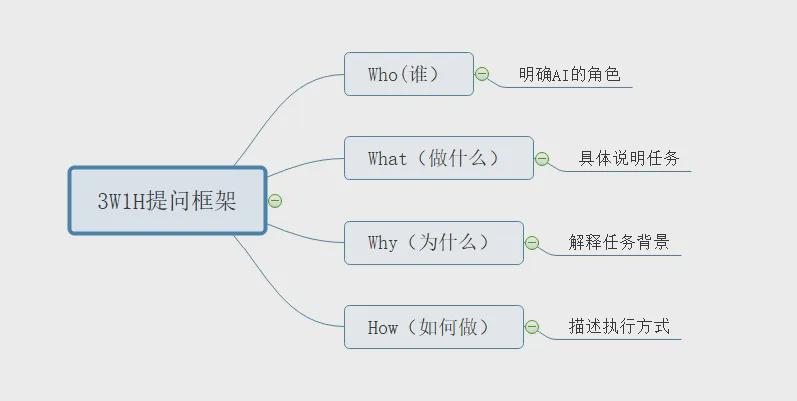
Let's learn how to apply this framework through detailed explanations and real-world examples.
Recognizing the 3W1H framework
WHEN WE TALK TO AI, WE OFTEN SEND VAGUE INSTRUCTIONS LIKE "HELP ME WRITE AN ARTICLE" AND "HELP ME ANALYZE DATA". AI, WHILE ABLE TO GIVE ANSWERS, IS OFTEN NOT THE RESULT WE WANT. AND THAT'S WHEN THE 3W1H FRAMEWORK HELPS YOU TO CLEARLY DESCRIBE YOUR MISSION FROM FOUR DIMENSIONS。
Who (Who) – AI character positioning
Specify in what capacity the AI should accomplish the task. Giving the AI a clear characterization can make its output more professional and focused.
Good example: "Assuming you're a financial consultant with 10 years of experience, familiar with all types of investment, funds, stocks, etc."
Pipes: "You're a financial advisor." (The role is too general and not professional)
Applicable scenarios:
- When writing in the field of specialization (e.g. financial, medical, legal)
– It takes a particular style to write
– Resolution of professional issues (e.g. software development)
What (what to do) – Mission statement
Specify the content and requirements of the task to be accomplished by the AI. The more specific the task description, the more the AI's output will meet expectations.
Good example: "Book me a 2000-word primer, focusing on the fund's investment strategy."
• Pit: “Write a financial article” (no word and specific subject)
Applicable Scenarios:
- Content creation (articles, programmes, reports)
– Data analysis
– Code writing
Why - Targets and audiences
Explain the context and purpose of the task, as well as the audience for which the content is intended. This helps the AI adjust the depth and presentation of the content.
Good example: "This is for young people who are just working, who have a steady income and have no financial experience and want to learn how to start investing in finance."
Pit: "To those who want to learn about finance." (Audience description too broad)
Applicable Scenarios:
– The background of the audience in content creation
– Describe the context of the problem when resolving the problem
– Description of the purpose of the analysis in the data analysis
How (how) – execution
Describe the organization of the content, style tone, structure and other specific requirements.
Good example: “Please insert in plain and easy to understand the actual case, in 3 parts: 1) Why to start financial management early 2: 3) How to avoid financial error”
Pit: “Detailed” (no specific structure and requirements)
real-life example
Let's take a look at how the 3W1H framework can improve the quality of AI output through a few real-world examples:
Case 1: Writing a Public Article
Common Cue Words:
"Do me an article on time management."
After using 3W1H:
“Assuming you're a career efficiency management expert (who), write a 2000 word time management skills article (what). This article targets new entrants to the workplace who often work late, but work inefficiently (Why). Please use easy language, taking into account specific cases, and in accordance with the three parts of the `Know Your Time Black Hole - Efficient Time Management Code - New People's Action List, each part of which has a practical proposal (How)”
Case 2: Data analysis requirements
Common Cue Words:
"Help me analyze the sales data."
After using 3W1H:
“Please analyse sales data for the last 12 months, in your capacity as data analyst (Who), with a focus on trends in sales volume, unit prices and conversion rates (What). The analysis will be used for monthly sales strategy meetings to identify the reasons for the decline (Why). Please generate an analysis with data visualization and provide at the end of the report three to five specific recommendations for improvement (How)”
Tips & Tricks
1. Not all scenarios require the use of all four dimensions. For simple tasks, only the core dimensions can be used.
2. The clearer the positioning of Who and Why, the more specialized and targeted the AI output will be.
3. The How section suggests providing a clear structure or framework so that the output of the AI is more organized.
4. In writing-type assignments, it is important to clearly specify the word count and writing style.
Practice Recommendations
Now you can try to rewrite your prompt words using the 3W1H framework.
It is advisable to start practicing with simple writing tasks, such as writing a product description or a work plan.
As you practice more, you'll find that conversations with the AI become smoother and the output more in line with your expectations.
Listen, a good cue is like a clear mission statement, allowing the AI to understand exactly what you need. By mastering this technique, you can realize the full potential of your AI assistant and make it your best working partner.