


March 10th.GoogleThe company published a blog post on March 7 announcing the launch of the Gemini EmbeddingThe Gemini API is an AI-based text processing model that is now integrated into the Gemini API.
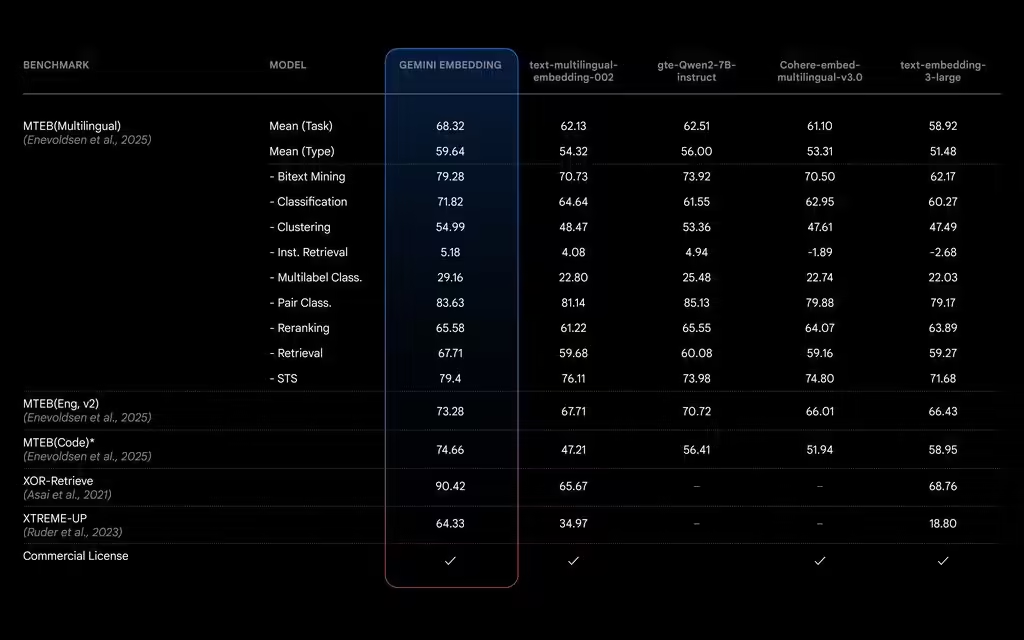
The model came out on top in the Massive Text Embedding Benchmark (MTEB), outperforming the MistralCohere and Qwen and other competitors, becoming the most powerful text embedding model at present.
Gemini Embedding converts text into numerical representations (vectors) to support functions such as semantic search, recommender systems and document retrieval. It performs well in the MTEB benchmarks with an average task score of 68.32, significantly higher than models such as Linq-Embed-Mistral and gte-Qwen2-7B-instruct, and reaches State-of-the-art.
State-of-the-art (SOTA) AI models are the current models or methods that perform optimally in a given task or domain. These models typically prove their superiority by achieving the highest scores in various benchmark tests and often outperform previous models in terms of accuracy, efficiency, or capability, and even achieve human-level performance in certain tasks.
The model scores 85.13 on pairwise classification; 67.71 on retrieval, and 65.58 on reordering, indicating that Gemini Embedding has significant advantages in real-world applications such as AI search engines, document analysis, and chatbot optimization.
Created by Hugging Face, the MTEB evaluates the ability of AI models to rank, categorize, and retrieve text data across more than 50 datasets. As the industry standard, the MTEB rankings provide an important reference for organizations when selecting AI models.Gemini Embedding's strong performance not only reinforces Google's leadership in AI, but also lays the groundwork for its rollout in commercial applications.
The high performance of Gemini Embedding makes it promising for a wide range of applications in the following areas:
- Search engine: Improve the relevance of search results and support the pure AI-driven search model that Google is testing.
- Multilingual applications: Enhanced cross-language translation, customer service automation and content ranking capabilities.
- Enterprise Services: Optimize Google Cloud-based AI analytics, semantic search, and automated data retrieval.