



April 18 news, according to foreign media TechCrunch reported today, today more and more users began toUse ChatGPT to decipher the exact location where a photo was takenThe new phenomenon has become a rapidly spreading and worrying new phenomenon on the Internet.
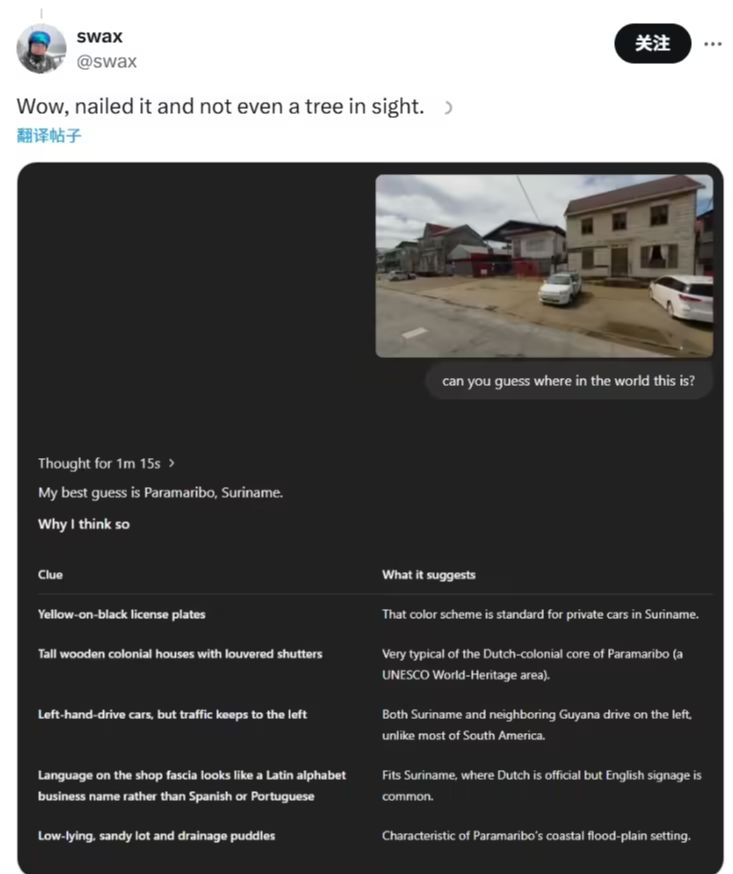
This week,OpenAI Introduced two new models -- o3 and o4-mini -- both with image inference capabilities that can beAnalyze the details of the screen through the uploaded photosThe program can even be used on blurred or distorted images toCrop, Rotate and Zoom, completing a more in-depth identification.
With this analytical power, combined with the model's web search capabilities, ChatGPT has become a powerful "targeting tool." Users on X have quickly discovered that new models such as o3 are good atInferring cities, landmarks, and even specific restaurants and bars from various details.
It is worth noting that the model's judgments often do not rely on ChatGPT's past conversational history, or the EXIF metadata of photos that often reveal where they were taken.
Nowadays, many users on X have uploaded restaurant menus, neighborhood photos, building exteriors, and even selfies, asking o3 to pretend that they areChallenge an online land guessing game called GeoGuessr!(Note: Google Street View allows players to recognize locations via Google Street View).
This trend obviously raises concerns about privacy risks. If someone intercepts a screenshot of someone's limited-time Instagram feed, they canUse ChatGPT to try to locate the partyThere are no technical barriers to the process.
Nevertheless, the o3 is not perfect in terms of localization. There were several instances in the tests where the model got stuck in a loop, never gave a clear conclusion, or was simply mislocalized. x There was also feedback from users that theo3 Occasional significant deviations in positional extrapolation.
This phenomenon highlights the security risks posed by the increasing power of the new generation of "inference-based" AI models. Currently, ChatGPT lacks effective measures to prevent such "reverse location finding," and OpenAI's security reports for o3 and o4-mini do not mention such issues.