



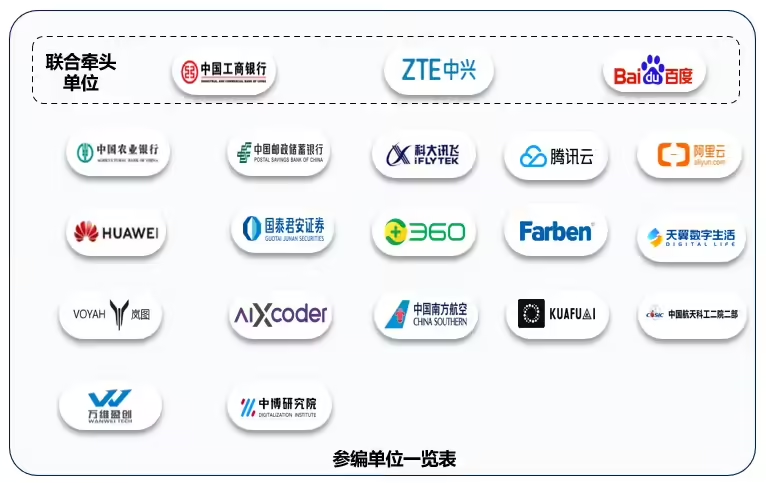
May 27 news, the China Academy of Information and Communication Research, in conjunction with the Industrial and Commercial Bank of China, Baidu, Tencent, Ali, Huawei and other more than 20 head enterprises, officially released theSoftware EngineeringAgentTechnical and Application Requirements Part 1: Developing Intelligent Bodies" (Standard No. AIIA / T 0219-2025).
This standard focuses on two dimensions: technical capability and service capability, and establishes for the first time a full-stack technical specification for software development of intelligent bodies, marking a key step in the standardization process of China in the field of AI intelligent bodies.
As the first technical specification document for the development of intelligent bodies in China, the standard empowers the industrial ecosystem through the dual path of "guidance for capacity building and reference for technology selection".
On the one hand, it helps vendors to quickly complete product function benchmarking and reduce repetitive R&D investment; on the other hand, it provides an objective evaluation basis for enterprises to choose partners and accelerates the efficiency of technology landing.
1AI cites a blog post that describes the technical capability requirements proposed by the standard as covering four core modules: perception, memory, planning, and execution:
- Perception requires that the intelligences be able to parse code structures and recognize signals of anomalies in the development process;
- Memory capabilities need to support long-term code base knowledge deposition with short-term task context storage;
- Planning capabilities emphasize the need for intelligences to have multi-task scheduling, resource allocation, and risk prediction capabilities;
- Execution capability, on the other hand, requires that the intelligences be able to directly invoke the development toolchain to accomplish code generation, debugging, and other operations.
The standard also proposes five core service scenarios in the full life cycle from code writing to quality assurance:
- Coding intelligences generate specification-compliant source code through natural language;
- Unit Test Intelligence automatically identifies potential logic gaps;
- The Inspection Repair Intelligence will locate and correct safety defects;
- Intelligent Q&A system provides real-time technical advice;
- And the development of the whole process of intelligent body more realize the demand analysis to the deployment of operation and maintenance of one-stop support.
This layered architecture design not only meets the enterprise's demand for specialized tools for specific segments, but also reserves interface space for the construction of a unified intelligent platform.