



Recently, Stanford University professorFei-Fei LiWith Erik Torenberg, Partner at a16z, and Martin Casado, an early investor in World Labs, we discussed the "Theworld model" and other hot topics.
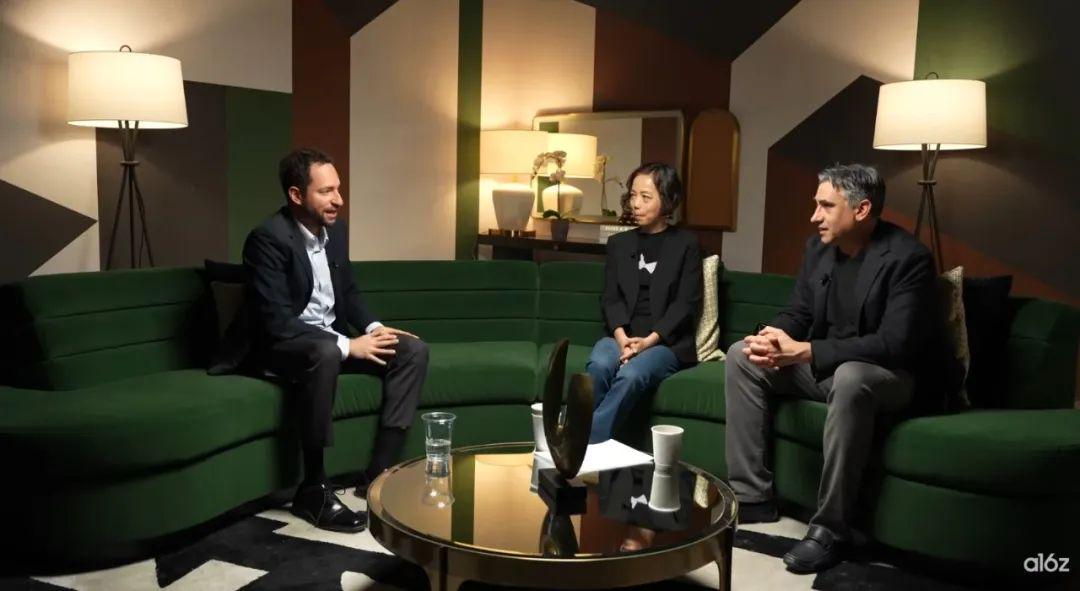
Asked why she started a basic modeling company rather than continuing with academics or participating in existing big models, Fei-Fei Li said that her goal has always been to solve the real 'Polaris problem' rather than to start a business per se.
Li Feifei argues that language is a way of capturing the world with a loss of information, and that while powerful, the entire evolutionary history of humans living in a three-dimensional physical world, including animals, has been based on a great deal of perception and ultimately embodied intelligence, rather than on the generation of pure language.
"Physical phenomena occur in three-dimensional space, and interactions also occur in three-dimensional space. Navigating behind a desk needs to be done in three-dimensional space. Whether you're building things in the physical world or the digital world, you need to do it in three dimensions. So fundamentally, it's a three-dimensional problem."
In terms of applications, Feifei Li cites examples of how spatial intelligence can reshape the entire creative process, from architectural design to industrial manufacturing to film creation. martin adds that this AI Not only can we generate language, but we can also build complete three-dimensional worlds from two-dimensional images, and even create spatial structures that didn't exist, for use in virtual reality, gaming, art, and other scenarios.
In Feifei Li's opinion, it is the rapid advancement of language modeling over the years that makes her more sure of the importance of world modeling.
From her personal experience, she recounted how she lost her stereo vision due to an eye injury and was unable to drive properly, further demonstrating the high reliance of humans on three-dimensional spatial understanding. Martin also pointed out that the part of the human brain responsible for spatial perception has a long history, much earlier than the evolution of the language area, and can even be traced back to the reptile or even earlier times, indicating that spatial intelligence is the root of intelligence.