



in the previous chapterWho is the best domesticAI Video ToolsAn in-depth comparison of 4 AI video generatorsIn it, we witnessed four major "Vincennes Video" challenges.Keling,DreamConchs,ViduThe different imaginative, physical and narrative properties of the four tools.
Today, we have a more demanding challenge ahead of us - theFigure videoThis ability is no longer "out of thin air", but a secondary creation based on static images! This ability is no longer "out of thin air", but based on static pictures for secondary creation, extremely test AI's deep understanding of the details of the picture, spatial relationships, artistic style and internal logic.
This test we still follow the "cost-effective" main model of the previous article. Without further ado, here are the four main models, and the challenge is to upgrade them!
Toussaint Video Pentathlon Challenge
Challenge 1: "Micro-expression" test for static portraits (★ Character Core)
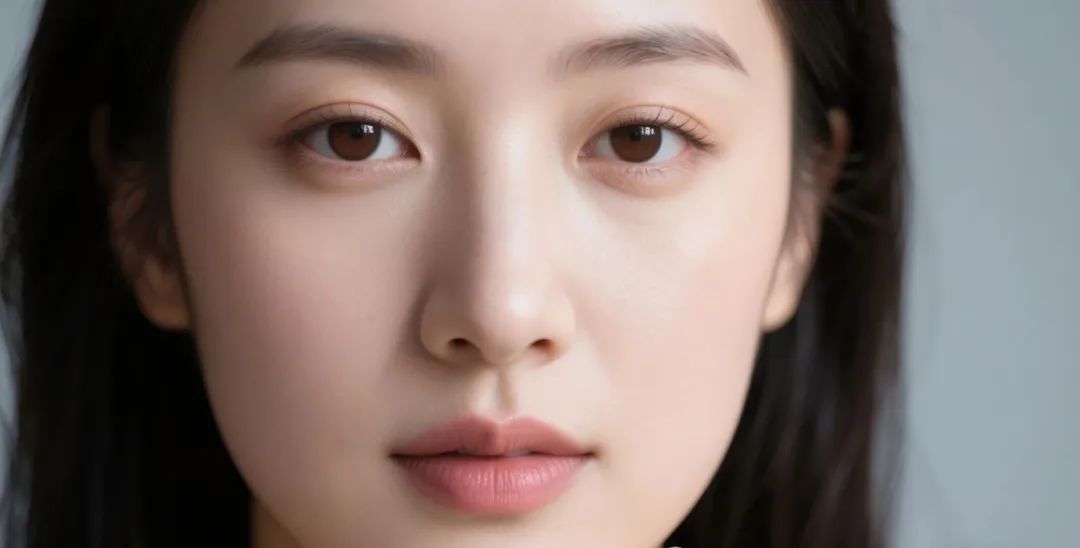
Selected image: A high-resolution, realistic close-up photo of a woman's face with a calm expression.
Dynamic commands.
"Have her take one slow, natural breath, blink her eyes very slowly once, and turn the corners of her mouth up a touch into a more pronounced smile."
What to look for: Are the dynamics natural? Is there any stiffness in the facial muscles? Can you avoid the "Valley of Terror" effect?

Kling.
Pros: Successfully executes commands such as open eyes and smile, and the image maintains good clarity and stability.
Weaknesses: The smile formation process is a bit "one-size-fits-all", the muscle movement is not subtle enough, and it feels like the face is being "pulled apart" by the program, which is not enough to show the real emotion.
Dreamina.
Pros: The most stable and high fidelity image, the character's blinking action is very natural and realistic, just like high-definition photography material.
Weaknesses: For the "Smile More Visibly" command, the smile is more open and the muscle linkage is not natural.
Conch AI (Hailuo AI).
Pros:The performance of this round is perfect. Its dynamics are the smoothest, most natural and full of emotion. The process of opening the eyes, breathing and smiling is all in one, and the muscle linkage is very much in line with the logic of the real character's expression, which really gives the photo a "sense of life" and "sense of beauty".
Weaknesses: Performance in this case was near perfect.
Vidu.
Pros: The movement is large, complete with eye opening and "toothy grin", and a head tilt is added to try to add dynamism.
Weaknesses: Dynamic fluidity is lacking, head tilts and smiles are slightly stiff and "abrupt".
Challenge 2: "Mirroring" Tests for Static Landscapes (★ Technical Core)
Selected image: A photo of a landscape with a clear hierarchy of foreground (trees), middle (lake), and back (distant mountains).

Dynamic commands.
"A very slow forward (Dolly In) effect on the image creates 3D depth."
What to look for: Is the effect of parallax scrolling obvious and natural? Is there any unreasonable stretching or distortion of the image?

Kling.
Pros: Successfully creates the standard 3D mirror (parallax) effect, and adds a natural breeze to the leaves in the foreground, which enhances the vibrancy of the image.
Weaknesses: The attached leaf dynamics are a plus, but may be an unnecessary "play" in a scene that requires pristine lens movement.
Dreamina.
Pros:Best technical performance this round. The 3D effect and layer separation of the mirror is the most accurate and smooth, as if it were a product of professional post-production software, showing top technical stability.
Weaknesses: Purely technical implementation, lacks some "human touch" dynamics.
Hailuo AI.
Benefits: The realism and immediacy of the image is greatly enhanced by the addition of an almost imperceptible "handheld" shake while the camera is in motion.
Weaknesses: The leaves in the foreground are blurred and noticeable, and the overall effect is moderate.
Vidu.
Pros: Basic understanding of the "forward" command.
Weaknesses: The 3D depth of field is not successfully created. The effect is more like a simple "image enlargement", and there is a content error in the right side of the image where a red tree branch that does not exist in the original image is "illusory".
Challenge 3: Stylized Dynamics of the World's Greatest Paintings Test (★ Art Core)
Selected image: Van Gogh's Night of the Stars and Moon.

Dynamic commands.
"Let the nebulae and the moon in the picture swirl and flow slowly in a way that is consistent with the rough strokes of the original."
What to look for: Do the dynamics maintain the "brushstrokes" of the original? Do the flowing nebulae look like "oil paint moving" or simply "image distortion"?

Kling.
Pros: None.
Weaknesses: Failed to recognize the "flow" command at all, only very slight and meaningless shaking of the screen, test basically failed.
Dreamina.
Pros: It has the most advanced dynamics, allowing the sky to move and attempting to retain the original style, showing its stability in the face of other models failing or "messing up".
Weaknesses: The understanding of dynamics is rather elementary, and the resulting "panning" cloud flow fails to reflect the sense of rotation and energy in Van Gogh's brushstrokes.
Hailuo AI.
Benefits: Generates the most "energetic" dynamics of any model, with a very fast flowing sky and a strong visual impact.
Weaknesses: The dynamics create a strong disconnect from the stillness of the rest of the image, which is very jarring and more of a technical glitch than an artistic creation.
Vidu.
Pros: Best in round. While other models used "image distortion" or "misinterpretation", Vidu was the only model that attempted to align the animation path with the direction of Van Gogh's original brushstrokes, and succeeded in driving the inner "energy flow" of the image. Vidu is the only model that tries to keep the animation path in the same direction as Van Gogh's original brushstrokes, successfully driving the inner "energy flow" of the picture, which is the most artistically comprehensible.
Weaknesses: The stability and clarity of the image is its shortcoming, there is a sense of blurring, and its dynamic expressiveness still has room for enhancement compared to the grandeur of the original work.
Challenge 4: The "Separation of Character and Setting" Test (★ Scene Narrative Core)
Selected image: A photo of a detective in a cyberpunk rainy alley.

Dynamic commands.
"The subject of the figure remains still, but the surroundings begin to move: rain falls, the ground ripples, and a neon sign begins to flicker in the distance."
What to look for: Can you accurately recognize and immobilize people? Are the dynamics of the environment rich and logical?

Kling.
Benefits: Adds the effect of the camera moving forward while keeping the character static, creating a dynamic visual.
Weaknesses: The "self-initiated" addition of mirrors does not follow the instructions exactly. The environmental dynamics of the background are rather homogenous.
Dreamina.
Pros: Stabilization of the subject is the best of the four, and it's as "ironclad" as it gets, demonstrating its strong image stabilization and segmentation capabilities.
Weaknesses: Dynamics are "stingy" at best. The neon lights in the background are not flashing, sacrificing the dynamic range and life of the image for stability.
Hailuo AI.
Pros: The best performance of the round. It not only perfectly separates the primary and secondary, and makes the background move, but also does a great job on the details of the "movement". The trajectory of the raindrops, the spreading of the ripples on the ground, and the flickering of the neon lights all stand out, creating the strongest overall atmosphere and sense of storytelling.
Negatives: The neon flashing lights in the background are not obvious enough.
Vidu.
Pros: The whole picture is moving, the neon light is flashing obviously, and also "took the initiative" to add a forward movement, a strong sense of dynamics.
Weaknesses:Drastically changed the color tone of the original image, added a heavy purple light effect, and a content error.
Challenge 5: From Static Pose to "Dynamic Extension" Test (★ Character Movement Core)
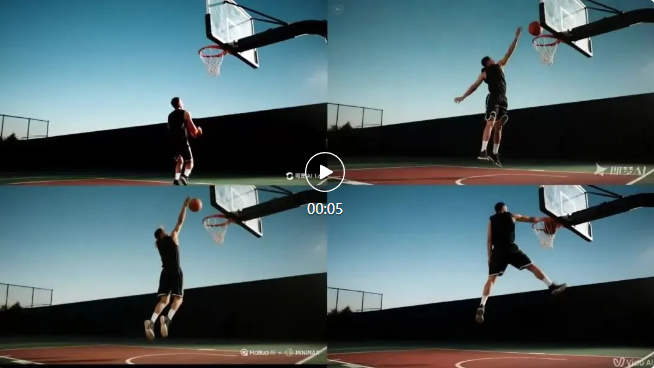
Selected Image: A tension filled still action photo of a basketball player standing on the ground about to jump up and dunk. Dynamic Instructions.

"Let him complete this jump and land smoothly, his coat and hair swinging violently with it before slowly calming down."
What to look for: Does the follow-through conform to physical inertia? Is the fluttering of clothing and hair realistic? How is the coherence of the action?
Kling.
Pros: The most complete narrative chain. It manages to pull off the whole "dunk-ball-in-the-net-on-the-floor-turn-around-and-walk-away" maneuver, and it's the only model that tells the whole story, with a high degree of technical finish.
Weaknesses: The power and height of the dunk is a bit mediocre, the landing action is a bit stiff, the image is distorted and unnatural, and the basketball frame is seriously deformed.
I.e. Dream (Dreamina):
Pros: The graphics are as stable as ever, the character models don't show any distortion during movement and the action is very smooth.
Weaknesses: Dynamic expression is the weakest. The entire dunk is soft and lacks explosiveness, more like a "put-back". Once again, it sacrifices the "power" and "dynamic range" of the command for stability.
Hailuo AI.
Pros: The moment of jump and dunk is very dynamic and graceful.
Weaknesses: Catastrophic model crashes, where characters "liquefy" into unidentified objects after hitting the ground, exposing a huge stability risk when dealing with intense dynamics.
Vidu:
Pros: Best performance of the round with the most realistic physical dynamics. The dunking motion generated by Vidu, its body force, stretching, weight transfer and cushioning after landing, are all in line with the real human body's movement mechanics. It perfectly demonstrates the realism of the "trajectory".
Negatives: Near-perfect performance this round.
The Endgame: Comprehensive Assessment and Final Recommendations
Combining the extreme challenges of the previous and next articles for a total of nine rounds, we have a final verdict on the combined strength of the four tools!
Kling: versatile, but with shaky quality control - "Best Producer"
Advantages: the widest coverage of functions, the ability to cope with most types of creative tasks, a reliable "multi-tasker".
Cons: Unstable performance, often distorting the image, and likes to "take matters into their own hands" to add additional effects, not enough precision.
Dreamina: a stylistic replica of the machine, but lacks vigor - "Best Art Direction"
Advantages: Best in reproducing a given artistic style and performing precise technical maneuvers (e.g., mirroring), with unmatched picture stability.
Weaknesses: Extremely "conservative", dynamic expression is its biggest shortcoming, lack of power and full of emotion.
Hailuo AI: Highest Limit, But Biggest Risk - "Best Movie Director"
Advantages: The highest ceiling in terms of narrative logic, emotional expression and cinematic atmosphere, the most capable of injecting "soul" into the work.
Weaknesses: The least stable, prone to spectacular and surreal "model crashes" in difficult dynamic tasks.
Vidu: The "eccentric genius" who is the king of a specific field - "the best action director".
Pros: World class in the difficult areas of "Real Physics Mechanics" and "Artistic Stylized Dynamics".
Cons: Generalization ability is its weakness, performing poorly or even failing in many basic tests, not suitable for novices.
Thus, the dust has settled on this side-by-side review of domestic AI video.
In the age of AI, the essence of creation has not changed. But the way of creation has evolved - from finding a "master key" to understanding and utilizing a "master toolbox" of art.
The value of a true creator is no longer to wield a single brush, but to be like a seasoned conductor who understands the temperament of each instrument and, at the most appropriate time, allows them to play together an unprecedented and colorful piece of music of our own.
The throne of tools may change hands, but the true king will always be the one who knows how to navigate them, you.
Well, the above is the content of today's sharing, is not super dry goods? Hurry up and put these four tools to good use~!