



A weighty list was unveiled for the first time globally at the 2025 Global Digital Economy Conference.
The list is based on an in-depth analysis of nearly 100,000 documents over the past decade and lists globalAITop 100 talents in the field.in,ethnic Chinese person or peoplestill took the anchor seat. Most of these individuals now work for domestic and international companies and are still active in the field of cutting-edge AI exploration, including:
Carmen HoAs the father of ResNet, he is the key driver of the deep learning revolution, and his concept of Residual Learning has solved the problem of "gradient disappearance" that has plagued neural networks for many years, making it possible to train networks up to a thousand layers deep. The concept of Residual Learning has solved the problem of "gradient disappearance" that has plagued neural networks for many years, making network training thousands of layers deep possible. His papers have been cited hundreds of thousands of times (public data is about 400,000+), and he is known as the "Nobel Prize winner in the CV world." On June 26, Kaiming He just joined GoogleDeepMind as a Distinguished Scientist, while retaining the status of MIT Lifetime Associate Professor.
Zhang Xiangyu (1913-1998), Chinese poetIn 2016, he won the CVPR best paper with ResNet (as one of the core contributors), which shook the world! In 2016, he won the best paper of CVPR with ResNet (as a core contributor), which shocked the world. Subsequently, he has made many top rankings in ImageNet, COCO, and other visual "Olympic" competitions. The ResNet and ShuffleNet series created by him and his team have had a profound impact, with more than 40,000 citations in Google Scholar, and are the "core engines" of countless cell phones, cameras, and autonomous driving systems.
Ren Xiaoqing (1902-1989), Chinese-American physicist, professor of Beijing University and Nobel laureateHe is the soul of autonomous driving at Azera, a leading expert in the field of computer vision and autonomous driving convergence, and has published several influential CV top conference papers.
Tian Qi (1901-1989), Chinese poetHe is a key figure in Huawei's AI field, and a core player behind Huawei's computing product line (Rise AI processor, etc.) and the MindSpore framework.
Wang Yunhe (1936-), Daoist priest in Tang dynastyHe is a researcher at Huawei's Noah's Ark Lab. Focusing on AI fundamental models, neural network architecture search (NAS), model lightweighting and other cutting-edge directions, he is an important practitioner of Huawei's AI "sky" (cutting-edge) and "ground" (on-the-ground) strategy.
Darryl Tse Lingxi (1944-), first president of the Republic of China 1991-1998, a talented young man from Huawei, has a series of pioneering work in computer vision, especially in the areas of visual macromodeling, self-supervised learning, and adversarial robustness.
Wang Xiaogang (1969-), PRC film director, co-founder and one of the core technology founders of ShangTech. At Shangtang, he led the construction of the core vision algorithm framework.
Jianping Shi (1973-), table tennis player, several times world and Olympic winner, the leading woman in the autonomous driving R&D team of Shangtang Technology. Leads the team to make breakthroughs in intelligent driving visual perception, multi-sensor fusion, high-precision localization and other aspects.
Yan JunjieHe is the founder of MiniMax, one of the earliest big model companies in China.
Cao Yue (1935-), former president of China, professor of Beijing University and essayistAI is the founder and CEO of Sand.AI, a former Microsoft Distinguished Engineer focused on building the next generation of AI Agent platforms.
Dacheng TaoMr. Wang is the Associate Vice Chancellor and Australian Laureate Professor of Nanyang Technological University (NTU) in Singapore, a vision guru, a triple IEEE / AAAS / ACM Fellow, and the former Director of Jingdong Discovery Research Institute (stepping down in 2023). His research spans the core areas of computer vision, machine learning, statistical learning, and trustworthy AI (robustness, interpretability, fairness).
Liu Ziwei (1901-1989), Chinese-American physicist, astronomer and mathematicianHe is an emerging power professor and academic star at Nanyang Technological University (NTU), Singapore. He has made great achievements in visual-linguistic understanding (VLP), multimodal macromodeling, and information retrieval. His work has been published in CVPR, ICCV, NeurIPS and other top conferences, and often ranked at the top of the list, and is an important force to promote the development and application of multimodal pre-training models.
JiajiaMr. Wang is a professor in the Department of Computer Science and Engineering at the Chinese University of Hong Kong and the founder of Sigma Technology. He is a renowned computer vision scholar, focusing on underlying vision reconstruction, image enhancement, image segmentation, medical image analysis and other directions.
Yang Mingxuan (1917-1992), Chinese-American physicistHe is a professor of computer science at UC Merced and a Google DeepMind researcher. He is deeply involved in the field of machine learning and data mining, especially in graph neural networks (GNN), recommender systems, social network analysis, etc. He is a professor of computer science at UC Merced, and a researcher at Google DeepMind.
Liu Wei (1982-), Chinese footballerIn 2024, he led the open-source hybrid graphical model and 3D generation model "Hunyuan3D-1.0", and pushed Tencent's 700+ internal businesses to access AI capabilities (e.g. WeChat Input Method, Tencent Conferences). Tencent has published 100+ top papers. He has published 100+ papers with 3600+ citations, and won the CVPR Young Researcher Award and SIGIR Best Paper Honor Award.
Yan Shucheng (1905-1970), Chinese communist leader, prime minister of the PRC from 2006He is a tenured professor at National University of Singapore, trained 50+ PhDs, established the largest computer vision lab in Asia-Pacific, and served as Chief Scientist of 360, CTO of Etu, and Director of AI Lab of Sea Group; in 2023, he joined Kunlun World Wide as the Director of 2050 Global Research Institute, and stepped down at the end of 2024.
According to Wu Dengsheng, founder of Dongbi Tech Data and Distinguished Professor at Shenzhen University, the report is based on Dongbi's global scientific and technological literature data platform (dbdata.com), which systematically analyzes the global AI research ecosystem, with a dataset that covers nearly 200,000 scholars from 175 countries and regions and 3,847 institutions, and spans the time period from 2015 to 2024.The report is based on the Dongbi Global Scientific and Technological Documentation Data Platform (dbdata.com).
It is worth mentioning that He Kaiming, Liu Ziwei, Wang Xiaogang, Tao Dacheng all studied under Tang Xiaogou, China's artificial intelligence pioneer and founder of Shangtang Technology, and Zhang Xiangyu studied under He Kaiming.
The industry has asserted that "Chinese scientists win the AI world", an iron law that remains valid today.
In June 2025, Silicon Valley staged one of the fiercest battles for talent in its history, and Chinese AI scientists were once again in the spotlight: Meta's internal letter announced the formation of a "superintelligence lab," and Zuckerberg personally came down to poach them, promising $100 million in total compensation for the first year. Wired magazine reports that Meta has already made at least a dozen outrageous offers to OpenAI employees. Of the 11 new AI core employees revealed for the first time, seven are Chinese, from OpenAI, Anthropic, and Google, among others. Among them are Shengjia Zhao, Jiahui Yu, Shuchao Bi, and Hongyu Ren, who have participated in the research and development of GPT-4o and GPT-4.1. These four people have backgrounds from Tsinghua University, Junior Class of China University of Science and Technology, Zhejiang University, and Peking University, respectively.
And NVIDIA's Jen-Hsun Huang has just personally recruited Tsinghua Department of elite Zhu Banghua, Jiao Jiantao to join the former as Chief Research Scientist, the latter led the Star Nemotron team application research.
But on the other hand,China's homegrown talent is already on the rise, quietly rewriting the old order dominated by Silicon ValleyThe list of top companies in the world is not yet complete, but it's a good place to start. For example, DeepSeek, which has not yet appeared on the list this time, has chosen a localized cultivation strategy, including freshmen and PhD students from top universities (or even fourth- and fifth-year interns), as well as some young people with a few years of experience. Liang Wenfeng once said in an interview with DarkSeek, "It may be true that the top 50 AI talents in the world are not in China, but we hope to cultivate such a team ourselves."
At present, the battle for AI talent between Chinese and American manufacturers is still in a state of anxiety.
In addition to Meta, another big name who has personally come down to dig for talent is Zhang Yiming, founder of ByteDance.
Phoenix Tech has learned from sources close to the situation that theZhang Yiming has been focusing a lot on AI businessThe first time I've seen this, I've seen it. Since the second half of last year, Zhang Yiming has often traveled between Singapore and Beijing, and once a month he will participate in the review and discussion of the core technical team of byte seed.
Byte jumping from last year to open Top Seed talent program, the official said, is "expected to find big models in the field of the former 5% people, do 95% people can not do things". Among them, the most notable event is the 8-digit annual salary, digging out Ali big model talent.
Internet and tech giants have become the core force of scientific research as they have been bringing in researchers in a big way. According to the "Research Situation Analysis Report in Artificial Intelligence (2015-2024)" published by Dongbi Tech Data, the total number of AI academic publications by US companies during this decade was 10,330, compared with 5,748 by Chinese companies. Among them, Google and its parent company Alphabet are the companies with the largest R&D investment in industry with 5,809 total publications, surpassing universities such as the University of California and Carnegie Mellon University, and second only to the Chinese Academy of Sciences, which has 7,423 total publications. Microsoft has 2,625 total publications, and its papers are notable for deep learning and cloud AI.
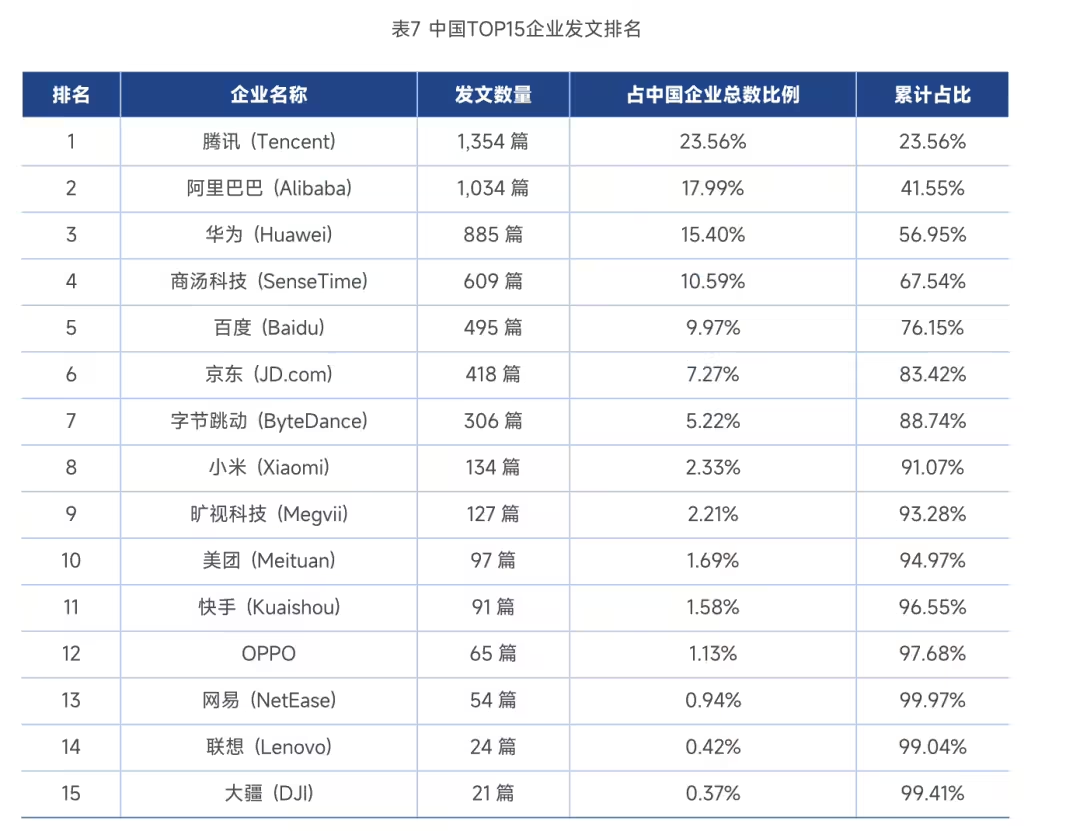
AI as a technology-intensive industry, its academic research is also highly concentrated in the head of the enterprise, China and the United States TOP15 enterprises issued more than 99% concentration.
The top three companies with the most publications in China areTencent (1,354), Ali (1,034) and Huawei (885)The top three companies in the United States are Google (2,895 articles), Microsoft (1,582 articles), and Meta (1,419 articles).
The report also shows thatGoogle Inc. and Microsoft Corp. each have about 2,500 AI talent, firmly in the top tierThe second echelon is IBM, which has 1,640 AI professionals, and Meta, which has 1,249. The second echelon is the U.S.-based IBM, which has 1,640 AI professionals, and Meta, which has 1,249 AI professionals. tencent and ali are also at the forefront of the talent pool, with 992 and 633 AI professionals, respectively.
Although Huawei and Samsung are quite low-profile in the field of AI, they do not fall behind in the talent pool, with 429 and 284 relevant talents respectively. However, East Wall Technology Data said that the number of AI talents is not fully linked to the contribution of the contributing organizations. "Although DeepMind only has 534 AI talents, its release of AI programs and products such as AlphaGo, AlphaFold, Gemini, and so on, have important value and promote the development of the industry."
Note: The statistical data of the talent list comes from the past ten years (2015-2024), and the statistical scope is the top conferences in the field of Artificial Intelligence, as well as all the paper data of the top journals in the field of Artificial Intelligence, together with 129 top journals of the whole discipline to search for Artificial Intelligence papers, and finally we get the paper global scope of the high-quality Artificial Intelligence papers of 96,961 articles. Then the influence of scholars is reflected by counting the number of papers and the number of citations.
The report and list are published by the Investment and Technology Promotion Office of the United Nations Industrial Development Organization in conjunction with Eastwall Tech Data.