



August 17, 2011 - On August 16, the fifth "Xiaobao Gong Cup" college student competition was held in Beijing, according to China News Service.lawThe award ceremony of the Empirical Analysis Essay Contest was held in Guangzhou. During the same period of the event, China's first legal fieldVertical Large Model --The official release of "Little Bao Gong's Legal Content Model" and a seminar on the construction of AI + Law Lab marked the key stage of China's legal AI from academic exploration to large-scale application.
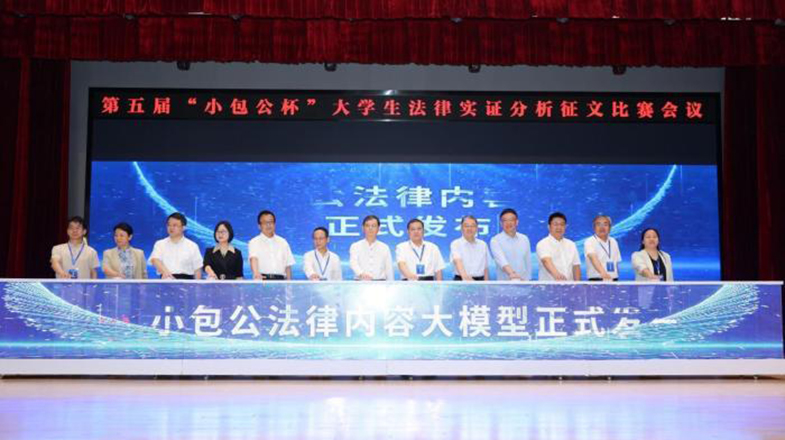
According to 1AI's understanding, the "Little Bao Gong legal content model" is developed by Prof. Wang Yanling's team at South China Normal University School of Law. The model has passed the National Internet Information Office's deep synthesis service algorithm filing, and adopts the advanced dual-engine structure of "general large model + specialized vertical large model". It deeply integrates more than 200 million judgment documents and more than 4.2 million laws and regulations, and combines legal knowledge mapping and retrieval-enhanced generation (RAG) technology to exclude the interference of "layman's concepts" in various legal scenarios, accurately match the legal basis, and provide traceable and verifiable answers for the whole legal scenario.
Compared with the generalized big model, the Xiaobao Gong legal content big model has a dynamic learning mechanism, which can be continuously iterated based on practical feedback, and dynamically intervene in the accuracy of answers based on the law as a criterion.
Legal experts have pointed out that the popularization of legal AI will effectively alleviate the problem of uneven distribution of legal service resources in China. At present, 700,000 practicing lawyers in the country are mainly concentrated in developed areas in the east, while some counties in the west do not even have law firms. The intelligent system is expected to become an important supplement to inclusive legal services.
Professor Wang Yanling believes that the scale and standardized application of the legal big model will be the first to achieve demonstration effects in key areas such as administrative review, procuratorial supervision, and contract compliance.