



Aug. 23 (Bloomberg) -- According to theHangzhouThe Daily News On August 22, the HCM City Education Bureau held aAIEducation press conference, the scene officially released "Hangzhou primary and secondary schools artificial intelligence education local curriculum outline" "Hangzhou primary and secondary school teachers artificial intelligence literacy framework" two documents, but also announced that in September the new semester, Hangzhou will be in primary and secondary school segmentsComprehensive education for general education courses on artificial intelligenceThe program is designed to provide a minimum of 10 hours of instruction per school year.
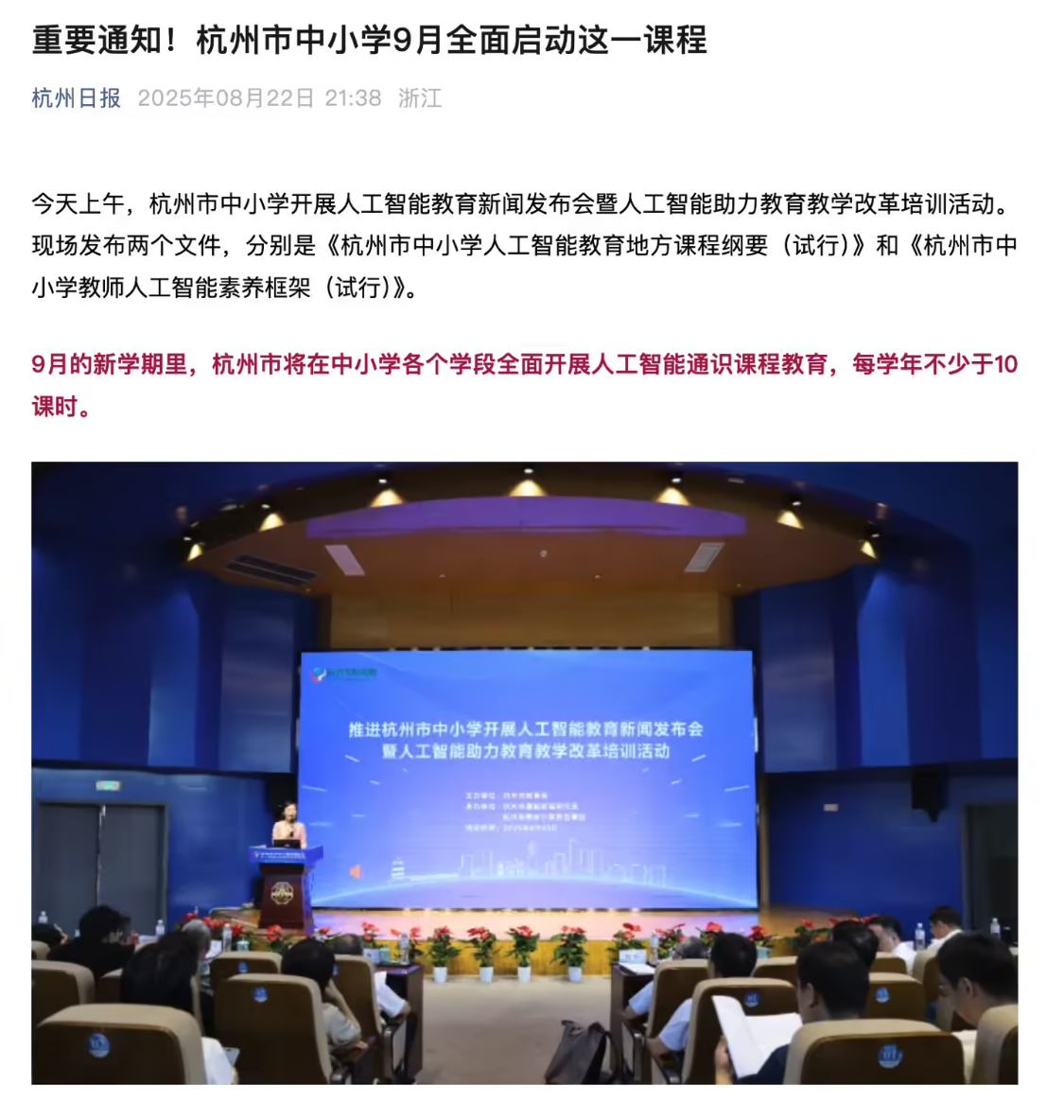
Jiang Feng, deputy director of the Hangzhou Education Bureau, said that from the beginning of this semester, Hangzhou will comprehensively carry out general education on artificial intelligence courses in all sections of primary and secondary schools, implement the Initiatives to foster "future students" in the AI era and "future teachers" in the AI eraIn addition, Hangzhou will actively promote the construction of "future classroom" and "future school" schools to strengthen the construction of AI education support environment and further carry out practical exploration of education wisdom empowerment. In addition, Hangzhou will actively promote the construction of "future classroom" and "future school", strengthen the construction of AI education support environment, and further carry out the practical exploration of education wisdom empowerment.
1AI was informed in the report that a variety of forms of curriculum implementation, combining centralized and decentralized, can be adopted for specific implementation, including centralized instruction through thematic project weeks and the use of interdisciplinary thematic learning, and the integration of IT, science and other disciplines in designing and implementing the curriculum.
- First stage of elementary school (grades 1 to 2): It is required to recognize common AI applications on campus under the guidance of teachers, to be able to interact with AI devices in a simple way, to know that AI exists in social life, and that one needs to pay attention to the norms and ethics of use and protection of one's own personal privacy during the application of smart devices.
- Stage 2 (grades 3 to 4): To be able to design and create simple works, etc., based on learning and life task situations and under the guidance of the teacher, using appropriate AI technology to access resources such as text, images and sound.
- Stage 3 (grades 5-6): Be able to understand the basic structure of models such as decision trees and neural networks, know the basic principles of algorithms such as inference and violent search, etc. through the analysis of AI application scenarios.
- Learning at the middle school level can be done through hands-on, experience the whole process from data preparation, model training to model inference, experience the process of solving real problems with AI, be able to use generative AI critically, and be able to stimulate innovative thinking in interdisciplinary project practice.
- High school level through project-driven practiceStudents will learn to design AI systems, develop intelligences to enhance the ability to apply AI to the social life on the ground.