



According to ITmedia on December 6JapanKawasaki's heavy workOpened on 3 DecemberHumanoid RobotRecent Model 'Kal 'eido 9。
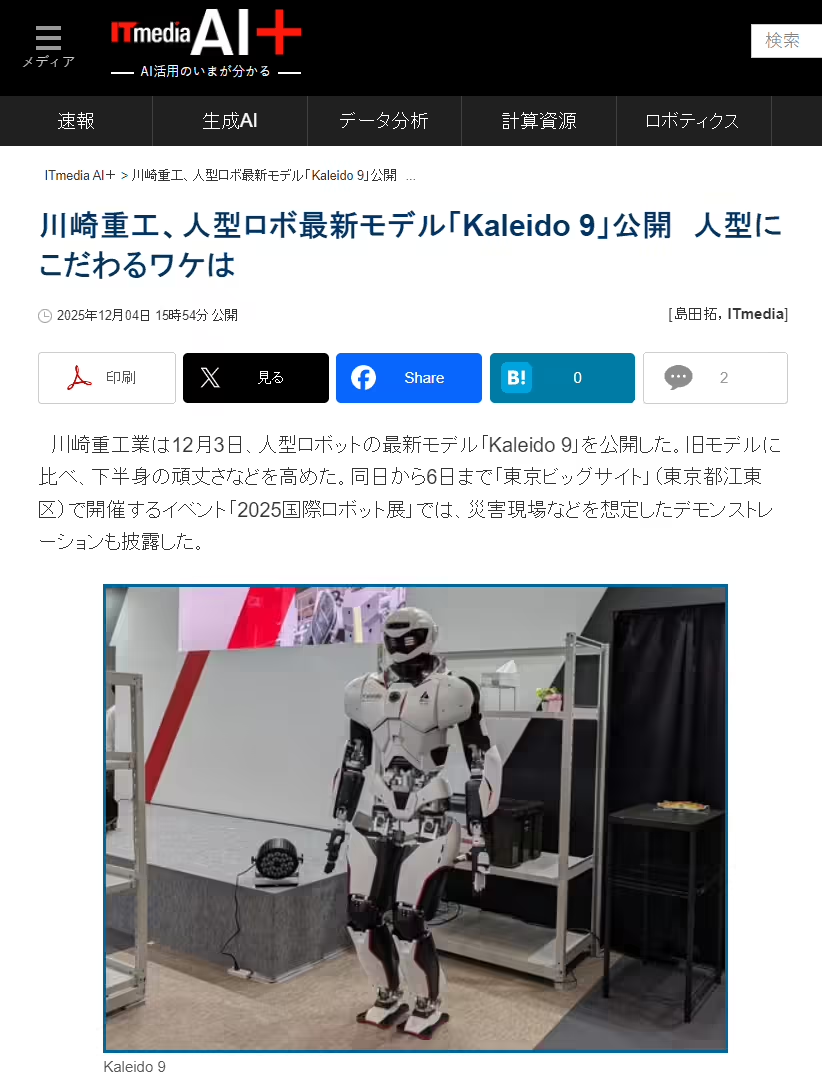
Compared to the old model, Kaleido 9 has increased the stability of the lower part of the body, with a presentation at the “2025 International Robotic Fair” at the Tokyo International Exhibition Centre, as well as a demonstration of scenes such as the disaster scene。
Kaleido 9 is the ninth generation product of the human robot RHP Kaleido, developed by Kawasaki Heavy Worker since 2015. Their waists and legs are stronger and their sensors are increased compared to their predecessorsAuto-walking through perception of surroundings, the developers can also operate remotely through VR head-on devices. Kaleido 9 was developed using the Virtual Space Robotic Development Service “Isaac Sim”, which is provided by Weidar。
Kawasaki heavy labour currently envisages, inter alia, the application of robots to disaster sites and a focus on human robots. The company said, “All the tools for fire-proofing lamps can be used directly, and we insist on building human-size robots.”
On the road map, Kawasaki's heavy-duty target is Around 2030Application of human robots to communication in medical and nursing sites and simple work in factories. By 2040, man-shaped robots will focus on mechanical assembly and high-altitude operations; in 2050, man-shaped robots will be able to cope with various environments, such as disaster sites。
It was also reported by Reuters that the new generation Kaleido 9 was equipped with a modular end-of-pipe implementer system that could quickly replace the kit according to industrial application needs。MAXIMUM LOAD CAPACITY INCREASED FROM PREVIOUS GENERATION 351 TP3T TO 18 KGThis has further expanded the potential for application in operational scenarios such as handling, assembly, etc。
1AI noted that at the exhibition site Kaleido 9 completed the tasks of garbage cleaning, moving, etc., and was consistent and environmentally adaptable。