



January 16, according to Quantum Bits, Qinghua's famous alumni of Yao, UC Berkeley EECS Assistant ProfessorChen LijieConfirmed Accession OpenAII'm in charge of mathematical reasoning. The news came from the "Top Chinese" channel and was confirmed within OpenAI。
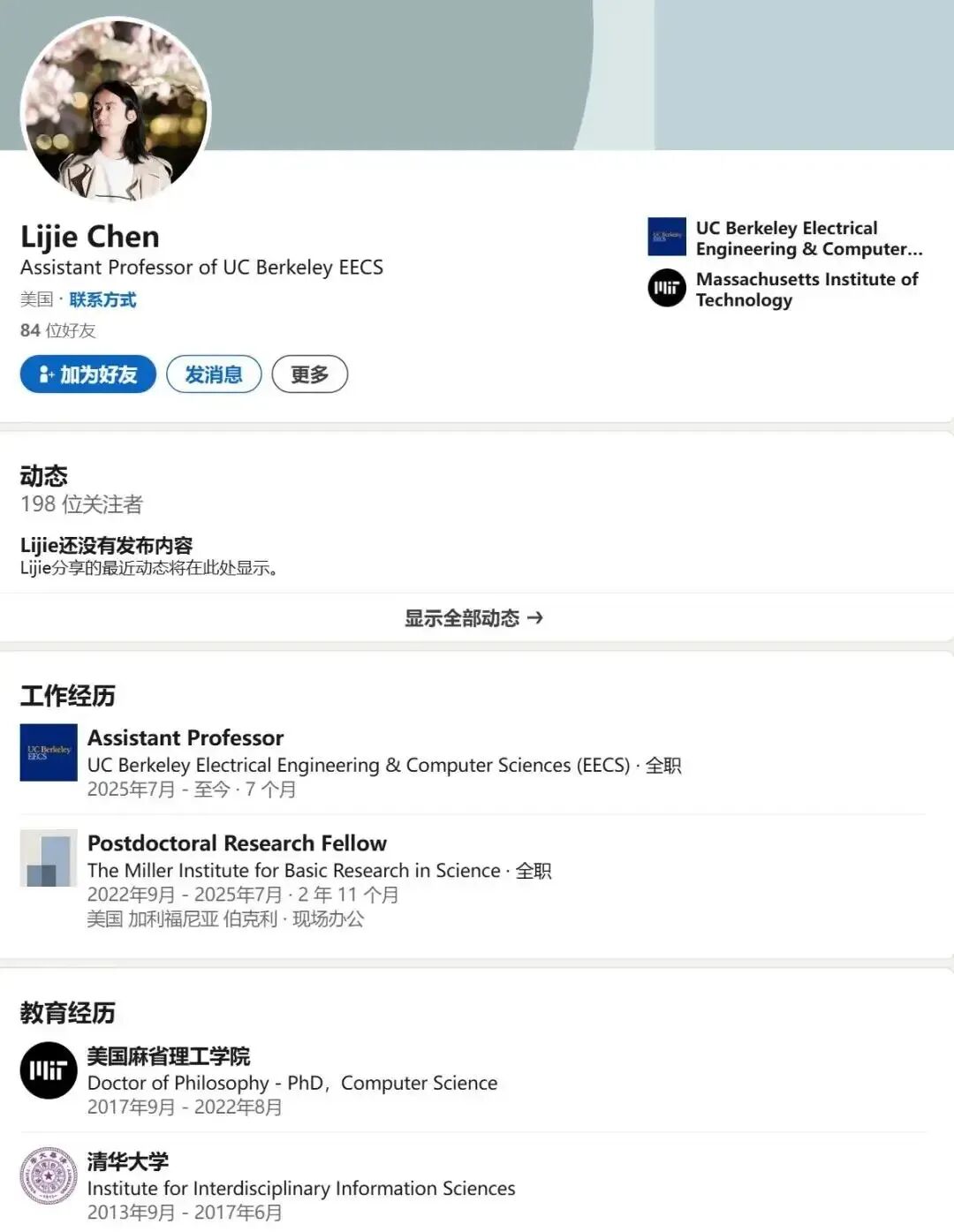
According to sources, Chen Lijie joined OpenAI as a full-time researcher this time. At the same time, he is currently in the state of Berkeley, On Leave (removed without pay), i.e. he retains his post at the university and does not leave。
Chen Lijie was born in 1995, 16 years of age, who received the National Informatics Osaikin medal and was sent to Qinghua University, and was one of the most representative young scholars in Yao Ben。
DURING HIS TENURE, HE PUBLISHED SEVERAL PAPERS AT MAJOR CONFERENCES SUCH AS AAAI, AAMAS, COLT, CCC AND BECAME THE FIRST UNDERGRADUATE STUDENT IN CHINA TO PUBLISH PAPERS AT FOCS IN 2017。
HE THEN WENT TO MIT TO STUDY FOR A DOCTORATE, FOCUSING ON THE THEORY OF COMPUTATIONAL COMPLEXITY AND THE THEORY OF FINE PARTICLE COMPLEXITY, AND RECEIVED NUMEROUS AWARDS FOR THE BEST STUDENT THESIS FROM STOC, FOCS。
After his graduation in 2022, he joined the UC Berkeley Miller Institute as a postdoctoral researcher, with a collaborative mentor who included Umesh V. Vazirani, a quantum calculator。
Last year, he became an Assistant Professor of UC Berkeley EECS and gave a post-graduate course, Computation Complex Theory。
In the direction of research, Chen Lijie has long focused on the core issues of theoretical computer science, such as P and NP, wiring complexity, de-randomization, and algorithmic submersibles, and made systematic contributions in the direction of Hardness Complexification. He also introduced the theory of complexity into the frontier areas of quantum physics and AI security。
It is noteworthy that OpenAI's paper, " Why language models are hallucinating " , published last September, quoted another study in which Chen Li Jie was involved, " Why and how large language models are hallucinating: a mechanism to analyze on the basis of subsequence linkages " 。
Recently, he has also been involved in research related to the Diffusion Language Models, keeping up with the latest evolution of the generation model。
Currently, Chen Lijie 's home page has not been updated to include OpenAI. He remained low on several platforms, showing only the latest papers。