



May 19th news: Today, more and more people around the world use it dailyAISystems, although many users are willing to trust the answers given by artificial intelligence, they are not always accurate and reliable。
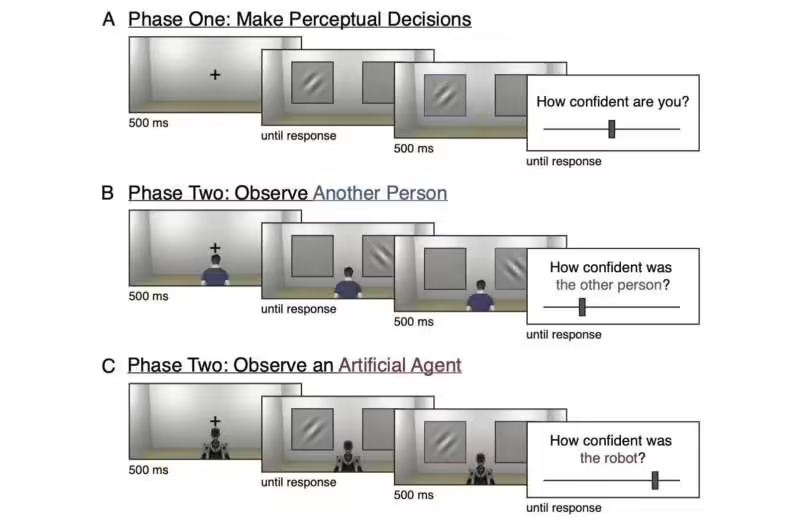
1AIIt was noted that researchers at Waterloo University and the University College in London had recently carried out a study aimed at in-depth exploration of how to judge the self-confidence of humans and artificial intelligence in making predictions and drawing conclusions. The results of the study, published in the journal Newsletter Psychology, showed that:Even though artificial intelligence is fully consistent with human responses, there is still a general consensus that artificial intelligence is more confident when responding。
In an interview with Phys.org, the first author of the paper, Clara Columbato, said: “As the artificial intelligence system matures more and more and more, people increasingly rely on it for advice, such as the selection of goods, the selection of browsing content, etc.”
“This is very similar to our daily behaviour with people, and we often seek guidance and advice from others. But there is a significant difference between listening to humans' advice and listening to artificial intelligence advice: when humans give advice, they tend to show the degree of certainty in their own words, and this confidence will have a direct impact on the level of trust in and acceptance of the proposal.”
Unlike human beings, the vast majority of artificial intelligence systems currently produce answers only to specific problems and do not proactively demonstrate their own degree of confidence in the answers. This lack of confidence information has had an impact on the user ' s trusting artificial intelligence response, which has not been clearly determined。
Colombato explains: “We want to know whether people are conscious of human and artificial intelligence determination, even if the other side does not show a direct degree of confidence, and what factors influence this subjective judgement. In order to study the way people judge the confidence of others, we have designed an experiment that allows the subject to observe human or artificial intelligence for decision-making, and then to determine the level of self-confidence that both hold in each of the choices.”
Columbito and his team then analysed the experimental data collected and looked at how various external clues influenced the determination of human, artificial intelligence confidence. The study found an interesting phenomenon:The faster the answer, the easier the decision-making looks, the more people feel confident。
“It is particularly critical that, even without a realistic basis, a subject with a higher level of accuracy and a higher level of competence is subjectively presumed to be more confident.” Kolumbato said, “This is particularly important in the area of artificial intelligence. People often agree that artificial intelligence is better than humans in some matters, and then subjectively judge that artificial intelligence is more powerful than it is, but that is not the case, giving rise to artificial intelligence's "confidence illusions."
In general, the study confirms thatPeople don't have to show their confidence in the results, so they can speculate about their confidenceI don't know. Most of the participants in the experiment are conscious of the self-confidence of the other by relying on a variety of external clues, such as the speed of response, the level of ability shown, etc。
Kolumbato stressed: “These judgement lines are highly misleading. Once a given artificial intelligence is found to be remarkable, it is accepted that the answer is very certain, but in practice the system is not necessarily symmetrical in the context. In short, people judge the degree of self-confidence of artificial intelligence, often on the basis of their inherent bias rather than the actual performance of artificial intelligence.”
This study by the Cologne team fully illustrates the need to clearly communicate to users the self-confidence of the system itself, both through direct presentation and through multiple external forms, when developing artificial intelligence products. The findings of the study can provide research and development ideas for adding new functions to artificial intelligence models, such as large language models, and optimizing existing performances。
Colombato says, “In interpersonal relationships, emotional self-confidence is an important social signal that helps us to judge when we take advice from others and when we think carefully. This study shows that if artificial intelligence does not proactively indicate its level of self-assurance, the user is subject to subjective speculation, which leads to a number of risks: even if the artificial intelligence itself is sceptical and prone to error, the user may still over-appreciate on the recommendations it gives.”
Currently, the research team is preparing a new round of research that will help people to judge more accurately the level of confidence in artificial intelligence and to focus on the search for efficient and feasible ways in which artificial intelligence can clearly convey to users their understanding of the results。
She added: “When people talk to each other, we can convey confidence in a variety of ways, including speech, look, physical gestures. However, the vast majority of artificial intelligence has no voice or physical form in the human class and no such means of expression exist. Therefore, the search for efficient, intuitive and trustworthy means of communicating confidence in human interaction will be an important direction for future research.”