



A lot of people do AI Video, will be caught in an error:
I'm just thinking about the image and the character, and I'm missing something more important
Camera language。
Same scene, different scenesmirrorsThe rhythm, the effect of coming out is very different:
|
|
|
|---|---|
|
|
|
|
|
|
Speculation, yes It's the heart of the movie.
TODAY, I'M TEARING DOWN THE IA VIDEO CAMERA LANGUAGE 3 parts Speech:
|
|
|
|
|---|---|---|
|
|
|
|
|
|
|
|
|
|
|
|
Each part has:FOUNDATION + AI HINTING + PIT AVOIDANCE GUIDE + FIELD TECHNIQUES.
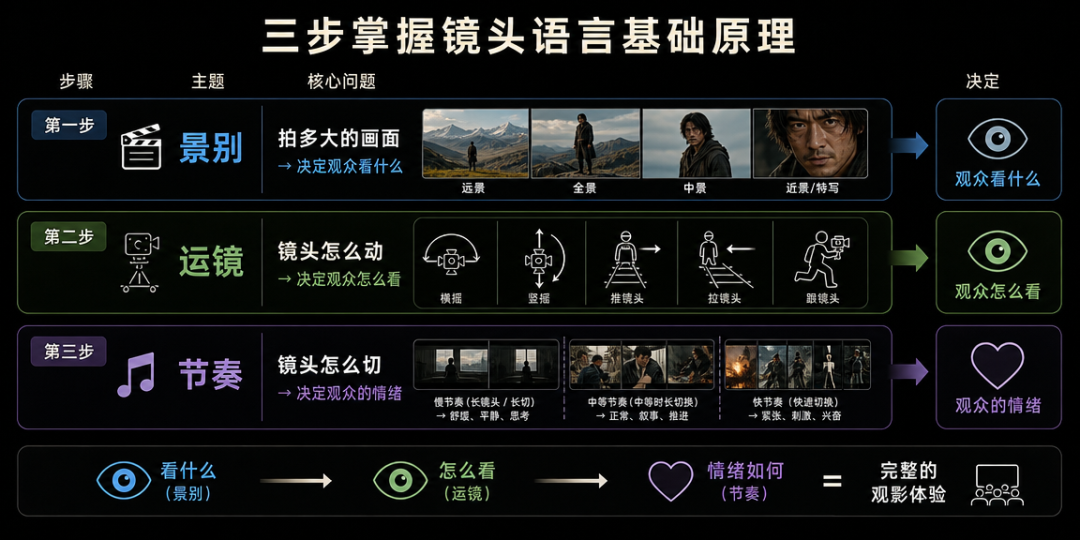
And one moreFull spectroscopy caseYou can use it directly。
First step: the vision -- determining what the audience is looking at
"How much is in the picture"**。
But it's not just a "middleview/nearview/specialty" category -- it's a director's "Focus bar.":
- You want to show the audience the environmentlong-range view
- You want the audience to see the moodClose shot
- You want to show the audience the detailsclose-up (filmmaking, photography etc)
How do you remember。
6 Core View and Usage
|
|
|
|
|
|---|---|---|---|
| Grand Vision |
|
|
The big vision, a tiny figure in the vast desert |
| long-range view |
|
|
Vision, stand alone at the top of the mountain |
| panoramic |
|
|
Panorama, people stand up |
| medium term view |
|
|
Midview, two people at the table |
| Close shot |
|
|
Near view, sad look on the face |
| close-up (filmmaking, photography etc) |
|
|
Close-up, shivering fingers |
Side by side: progressive narrative power of the side by side
It's nothing in a single view..It's all about power.
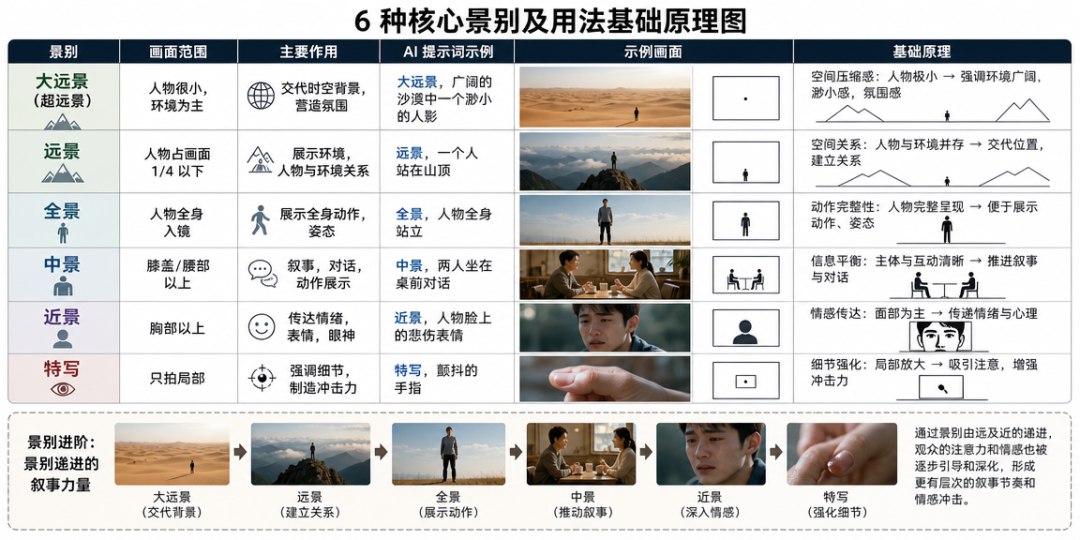
It's the most classic scenery chain:Vision, panorama, medieval, proximate, close-up
It's like walking into people's hearts:
|
|
|
|
|---|---|---|
|
|
|
|
|
|
|
|
|
|
|
|
|
|
|
|
|
|
|
|
- 💡 AI VIDEO TECHNIQUES: Do not attempt to complete all the conversions in one shot. Make every viewSingle cameraAnd later cut together -- better than a single long shot 10 times.
Paranormal: Don't jump, it'll blow
It's not always gradual。
Jump to the edgeIt can create a strong impact:
|
|
|
|
|---|---|---|
|
|
|
|
|
|
Queue (jump cut) |
|
One hand pops the file on the table
There is no medium-term transition — the impact is simply full。
THIS "JUMPING" IS PARTICULARLY USEFUL IN AI VIDEO -- BECAUSE AI, GENERATING A SINGLE SHOT IS MUCH MORE STABLE THAN CREATING A COMPLEX MIRROR.
AI GENERATES SEPARATE 3 PITS
PIT ONE: WRITE A FAREWELL BUT AI DOESN'T LISTEN
A lot of people said, "I wrote a close-up, and the result was still a medium."。
REASON: THE DESCRIPTION IS TOO GENERAL, AI DOESN'T KNOW YOU WANT MORE "SPECIAL."。
|
|
|
|
|---|---|---|
|
|
close-up (filmmaking) |
|
|
|
THE CLOSE-UP CAMERA, ONLY THE PERSON'S FACE |
|
Pipe II: The scenery doesn't match the movement
FOR EXAMPLE, WHEN YOU WRITE "THE PERSON IS RUNNING," HOW DO YOU FILM A RUN? AI DOESN'T KNOW HOW TO PRODUCE IT。
- ✅ Vision / Panorama Magnificent (run, walk, fight)
- ♪ In the middle, in the middle ♪
- ♪ Close view / close-up ♪
Pipe Three: Extreme scenery is prone to collapse
THE BIG VISION AND BIG FEATURES ARE THE WORST-HIT AREAS OF AI:
|
|
|
|
|---|---|---|
|
|
|
|
|
|
|
|
Step two: the mirror -- deciding what the audience thinks
The mirror "How does the camera move?".
The good mirrors allow the audience to follow the camera, and the insinuation is just full; the bad mirrors are just hanging around, looking dizzy。
How do you remember: the mirror = the movement trajectory of the eyes of the audience。
AI VIDEO'S MOST POPULAR 8-VIEW MIRRORS
|
|
|
|
|
|
|---|---|---|---|---|
| push the camera forward |
|
The camera is moving forward slowly
Slow down to the characters |
|
|
| pull camera |
|
Pull back slowly
It's getting away |
|
|
| Shake the camera |
|
Scatter to the left
Keep the camera up |
|
|
| Move camera |
|
Camera Parallel Move
Side and side |
|
|
| Follow the camera |
|
The camera follows the person
Follow it from behind |
|
|
| Surrounding Lens |
|
The camera rotates slowly around the person
Round and around |
|
|
| Up and down |
|
The camera is rising slowly
The camera is falling |
|
|
| Handshake |
|
Slight handshake
Handheld shoot |
|
|
- 💡 Selection principlesFirst-hand push/pull/smash (low-problem, good-impact); second-hand push/pull is the best-priced mirror — impact blows, low rate of car flips。
Gold law: Slow is steady
THIS IS AI video transport lensFirst rule:
- The slower the mirrors, the more steady the picture; the faster the mirrors, the easier they fall。
WHY? BECAUSE AI IS A FRAME-- IT'S A BIG MOTION, IT DOESN'T MATCH THE FRAME, IT'S SCINTILLATING, DEFORMING, DRESSING。
|
|
|
|---|---|
|
|
Very slowly
Slowly |
|
|
Softly
Slowly |
|
|
Quick Round
|
⚠️ The blood and tears: NEVER WRITE "FAST ZOOM" OR "QUICK ROLLER." 90%'S PROBABILITY WILL BE TOO HIGH FOR MOM TO RECOGNIZE。
2026 New play: First frame control precision mirrors
THE OLD AI MIRROR WAS "BLIND BOX" -- YOU WRITE A "SLOW ADVANCE," AND AI PUSHES AS MUCH AS YOU LIKE。
Now I doFirst End Frame Control, you can precisely control the start and end of the mirror:
- Zenium Example: Move from Panorama to Nearview
- First Frame: Panorama. People in the middle of the room
- End FrameThe view, the upper half, the same angle and position
- Prompt word: From the panorama to the periphery, the camera moves smoothly
- AI AUTO-GENERATED INTERMEDIATE PROPULSION
It's a better mirror than a plain word 10 timesAnd it's stable。
Mirror protection: 4 of the most prone to collapse
|
|
|
|
|
|---|---|---|---|
|
|
|
Quick Zoom
Quick Shrink |
|
|
|
|
360 degrees rotate around |
Forty-five degrees slowOr later |
|
|
|
|
|
|
|
|
Strong handshake |
A little hand-held
|
Step three: rhythm -- determines the mood of the audience
The rhythm is..It's easy to be ignored, but it's hard to seeTHE PART。
What's the rhythm? In short:
- How long is every shot
- How do you cut between the cameras
- Faster or slower
- The rhythm determines emotions:
- Quick rhythm = stress, excitement, excitement
- Slow pace = silence, depression, deep love
- ♪ Slow and slow ♪
How do you remember: rhythm = rate of heartbeat of the audience。
3 classic rhythms
|
|
|
|
|
|---|---|---|---|
| Lens Length |
|
|
|
| Change of scenery |
|
|
|
| mirrors |
|
|
|
| Application |
|
|
|
AI VIDEO RHYTHM DESIGN HEART METHOD
Heart method one: set the whole rhythm, then take one shot
Think about it before you make a video:
- Is this whole video fast or slow
- What's the mood tone
- Where to accelerate, where to slow down
Don't come up here and do it all in one shot and end up in a mess。
Heart Method II: Respiration changes
A better rhythm would be boring. It's like breathing
|
|
|
|---|---|
|
|
|
|
|
|
One by one, the audience won't get tired。
Heart method three: The card points aren't all the rhythm
- The real rhythm is for content, not for card points。
It's time to slow down, it's time to hurry. Card music is a means, not an end。
AI VIDEO FOR RHYTHM 2 TECHNIQUES
Skill 1: Generate by lens, later cut
DON'T TRY TO CREATE A LONG VIDEO WITH A CLIP -- AN ACCELERATOR OUT OF A MESS。
Correct practice:
|
|
|
|---|---|
|
|
|
|
|
|
|
|
|
|
|
|
YOU CONTROL THE CUT, AI HANDLES THE SINGLE-PHOTO--Clear division of labour. Best results.
Skills II: Making rhythm with speed change
Same shot, different speeds, different moods:
|
|
|
|---|---|
|
|
|
|
|
|
|
|
|
AI PRODUCES THE ORIGINAL AT NORMAL SPEED, YOU CAN RE-PACE LATER:
- Critical emotional lens Slow down
- Transitional camera Speed up
- Action lenses
Full field case: 30 seconds emotional short shot
So many theories, a full-scale battlePart + Mirror + rhythmAnd make a 30-second rain-day emotional short。
|
|
|
|---|---|
| Theme |
|
| Total rhythm |
|
| tool |
|
Mirror watch (6 lenses in total)
|
|
|
|
|
|
|
|
|---|---|---|---|---|---|---|
|
|
|
|
|
|
Grand Vision, Rain City Skyline, High Towers, Drizzling Rains, Scramble Down, Cold Blue, Film-class |
|
|
|
|
|
|
|
Panorama, a man walking on an empty street with a transparent umbrella, in the rain, with the camera slowly moving forward, soft and environmental light, a lonely atmosphere |
|
|
|
|
|
|
|
Midview, side view, character walks through a puddle of water, splashes up, shots follow, rain streets, reflections on the ground |
|
|
|
|
|
|
|
Look, people look up in the rain, and there's raindrops, soft and light on their faces, and there's a shallow view |
|
|
|
|
|
|
|
Closely written, raindrops fall from transparent umbrellas, micro-species, slow advance, background vandalization, fine details |
|
|
|
|
|
|
|
The vision, the characters go deep into the rain, the shadows get smaller and smaller, the cloudy atmosphere, the wide lenses, the end of poetry |
|
Speed Design
Total curve:Slow, quick, slow
|
|
|
|
|---|---|---|
|
|
|
|
|
|
|
|
|
|
|
|
|
|
|
|
Post-production steps
|
|
|
|
|---|---|---|
|
|
|
|
|
|
|
|
|
|
|
|
|
|
|
|
|
|
|
|
|
|
|
|
- 💡 Core approach: THE LENS LANGUAGE IS NOT A SHOWDOWN, BUT A SERVICE TO STORIES AND EMOTIONS. THE SCENERY LEADS TO ATTENTION, THE MIRROR CREATES A SENSE OF ENTRY, THE RHYTHM MOBILIZES EMOTIONS. THREE PEOPLE WORK TOGETHER TO MAKE AN AI VIDEO THAT REALLY HAS A MOVIE SENSE。
• Comprehensive summary
|
|
|
|
|---|---|---|
|
|
|
|
|
|
|
|
|
|
|
|
|
|
|
|
|
|
|
|
|
|
|
|
|
|
|
|
|
|
|
|
|
|
|
|
|
|
|
- Zenium Remember that: Good shot language. The audience doesn't feel the camera. It's just being carried away。
Today's three steps, you learn
Leave a little homework: PICK A FILM CLIP YOU LIKE, TAKE IT OUT OF THE SCENERY, THE MIRROR, THE RHYTHM, AND TRY TO RESET IT WITH AI。
It's too much. It's natural。