




Seedance 2.0 was born out of nowhere, and many people did very good work, and I myself became an amateur creative player as a non-film worldist。
Although many good works have been made, there is a desire to study video production in depth and systematically. Then I'll publish some of the things I've learned, sorted out, and urge myself to grow and progress, the so-called Feynman Learning Act. The Great God is welcome to discuss communication。
TODAY'S WONDERS ARE GOING TO MAKE THESE THINGS INTO A SERIES, WHICH WILL GRADUALLY TEAR DOWN THE BASIS OF EACH VIDEO/AI PRODUCTION AND HELP YOU TO DO YOUR BASIC WORK. IT'S BASICALLY ABOUT THIS
i. Lens language:mirrorsIntroduction/return art/spectrum and structure/light and emotion
II. DIRECTOR REDUCTION / SENSION Scripts/temperature
III. GUIDELINES FOR THOSE SURVEYS: FIELD CASES/ Common Errors
Let's start with the first page of "The Voice"
Foreword: Why is "the mirror" so important
A LOT OF PEOPLE JUST STARTED DOING AI VIDEO, AND THE FIRST REACTION WAS, "IT'S GOOD TO SEE, WHY IS IT SO IMPORTANT TO MOVE THE CAMERA?"
The answer is — very important。
The static images convey messages, the motion lens transmit emotions。
The same person stood by the window
- The camera is coming closer -- the sense of oppression, the tension, something's going to happen
- The camera slowly pulls out -- lonely, away, the world forgets him
- The camera revolves around him -- power, epic, he's the lead
The mirror is a silent conversation between the director and the audience。
IN THIS ISSUE TODAY, WE SYSTEMATICALLY DISMANTLE SEVEN BASIC LENSES, EACH OF WHICH TELLS YOU WHAT IT IS, WHAT EMOTIONS IT CONVEYS, WHAT SCENES IT USES, AND HOW IT'S WRITTEN IN THE AI HINT。
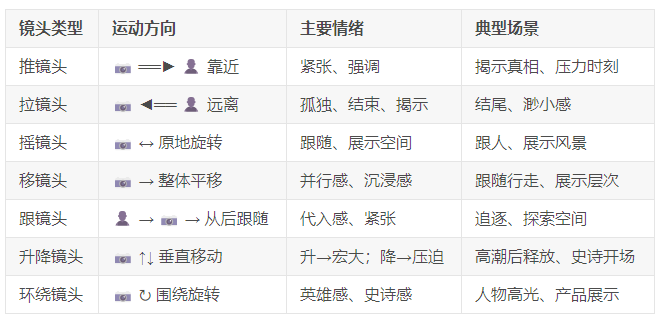
7 basic lens movements
Push In / Dolly In
Motion signs:

Passing emotions
- Focus, emphasize, reveal
- Stress, stress
- "This is important."
Classic use of scene:
- The moment the character realized the truth
- The key leads are shown in the suspense
- Lectures/declarations, reinforcement of the man-like field
I'm sorry, I'm sorry. It gives the audience a sense of anxiety without knowing why and confusion。
AI PHRASING REFERENCES:
- The camera is slowly moving to the main character's face, light view, film sense
2. Pull Back / Dolly Out
Motion signs:

What is it: the camera is far away from the subject, the subject is getting smaller in the picture and the surrounding environment is getting into the picture。
Passing emotions:
- Loneliness, smallness, release, end
- Revealing the environment/background ( "his original place is this")
- Narratives are used to end paragraphs
Classic use of scene:
- At the end of the movie, the main character stood alone, and the camera slowly pulled out -- the classic "good-bye"
- Discover the size of the scene (a person in a huge city/natural)
- It's like this
One concrete example: the spaceships are getting smaller and smaller in Interplanetary and eventually disappear into the stars -- that's where the pull lens conveys "small and large."。
AI PHRASING REFERENCES:
- The camera slowly pulls out and gradually reveals the vast view around the lonely
3. Rock-and-roll (Pan)
Motion signs:

What is it: the lens is fixed, it's horizontally rotated, like you're standing there looking。
Passing emotions:
- Follow moving subjects
- Show the width/wideness of the space
- CREATE A VISUAL RELATIONSHIP BETWEEN THE TWO SUBJECTS (FROM A TO B, IMPLYING A CONNECTION)
Classic use of scene:
- Following a walking character
- Show a big view
- From one character to another, to create a reaction
Note: Rock-and-roll speed is very sophisticated. Slow shake = face-to-face, elegant; quick swing Pan = energy sense, time twitch, often in action or comedy rhythm conversion。
AI PHRASING REFERENCES:
- The camera swayed from left to right at the golden hour, showing the mountains
- SWINGING FAST FROM A TO B, FULL OF ENERGY
Move camera (Truck / Tracking Shot)
Motion signs:

And what is it: the whole glitch of the camera (right and left, not spin), parallel to the subject, like sitting outside a window in a car。
Passing emotions:
- Following, resting, immersion
- "We're side by side with the lead" visual metaphor
- Horizontal movement shows a sense of spatial hierarchy (relative shift of outlook/median view/background)
Classic use of scene:
- Walk with the lead, keep side by side -- it makes the audience feel like, "Come with him."
- Show a sequence of objects/buildings
- It's a combination of moving foregrounds, creating a difference of vision, making the picture so solid
The difference between "scrambling" and "scrambling." Move the lens to a better sense of space。
AI PHRASING REFERENCES:
- Follow the camera to the side, follow the character through the wet streets
5. Flow Shot
Motion signs:
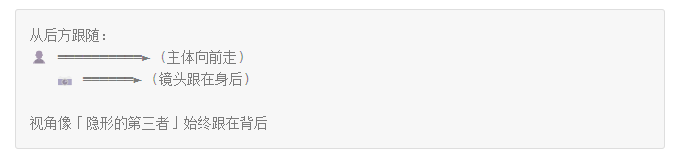
What is it: The camera follows the movement behind the subject (or in front), usually the handheld or stabilizer style。
Passing emotions:
- Tension, pursuit, conflict
- The third perspective is "seeing."
- Handheld and filming, real, documentary
Classic use of scene:
- The main character walks fast in the corridor/street, and the camera follows behind -- classic tension
- Action scene chase
- The character enters a new scene, the camera follows, helps the audience explore. This space
One concrete example: The entire film of 1917 is using a follow-up camera, which makes you feel like the soldier, who's always on his way -- that's the incipient incipient from the lens。
AI PHRASING REFERENCES:
- The back of the shoulder and the eye, hand-held style, followed the soldiers through the trenches
6. Crane / Pedestal
Motion signs:
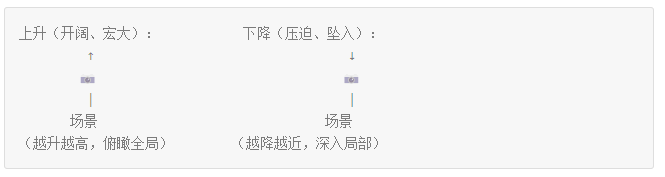
What: lenses moving up and down. Up, up, down, down。
Passing emotions:
- Up: Open, grand, hope, relief, role or plot "uplift"
- Decline: oppression, crash, crisis, environment to swallow
- Large-scale rise: epic, full-sighted
Classic use of scene:
- The scene rose slowly after the orgasm, overlooking the whole scene -- the feeling of "sweeting" to the audience
- The lens rises slowly from the details, and eventually looks over the whole -- creating the macro
- Falling lenses match down/down and reinforce "defeating" or "deep" narratives
AI PHRASING REFERENCES:
- The rise and fall are slowly rising, crossing the roof to reveal the whole city at sunset
7. Orbit / Arc Shot
Motion signs:
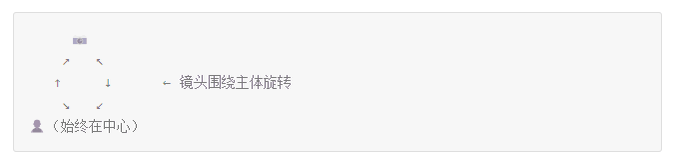
What: The lens rotates around the subject, 360° or part radians, and the subject remains at the centre of the picture。
Passing emotions:
- Power, heroism, epic
- "To focus on this man/matter, it deserves to be appreciated."
- It also conveys a sense of loss and dizziness
Classic use of scene:
- The main character is "converted/awaken" and the camera is round and round, and the air is open
- Every angle of the item in the product ad
- Two characters facing each other, and the camera going around slowly, to reinforce the tension
One concrete example: the heroes gathered in the Avengers' Alliance, and the camera was rounded to show everyone. This is the classic "high-light moments" that surrounds the lens。
AI PHRASING REFERENCES:
- # Round and around the camera #
Quick check
A common mirror error by a rookie
1. No "motive" in mirrors
The camera moved, but for no reason. Camera sports should serve emotions or narratives, not because of "silentness."。
2. Disparities in speed
Half of the speed of the push suddenly goes up to half the stop — this instability makes the audience play. Speed and flow are basic requirements。
All scenarios are surrounded
It's cool to go around the camera, but it turns into "every shot has to show off" and loses its sense of power。
4. AI HINTS ARE TOO VAGUE
To clearly state direction, speed and relation:
- ♪ The film-sensitization movement ♪
- The camera slowly thrusts to the main character's face
When you watch a movie or draw a little video, think about it. Is this camera moving? Which direction? What does it want to convey? You can also use a Seedance or any AI video tool, the same scene, to try to push and pull the lens, and feel the emotional difference。
That's where Oprah's introduction came in, hoping to help someone. And that's just the first step, cutting, folding, matching the clips... and what scenes turn around, and one scene goes wrong. Next period, we'll break it down. Let's move on。