



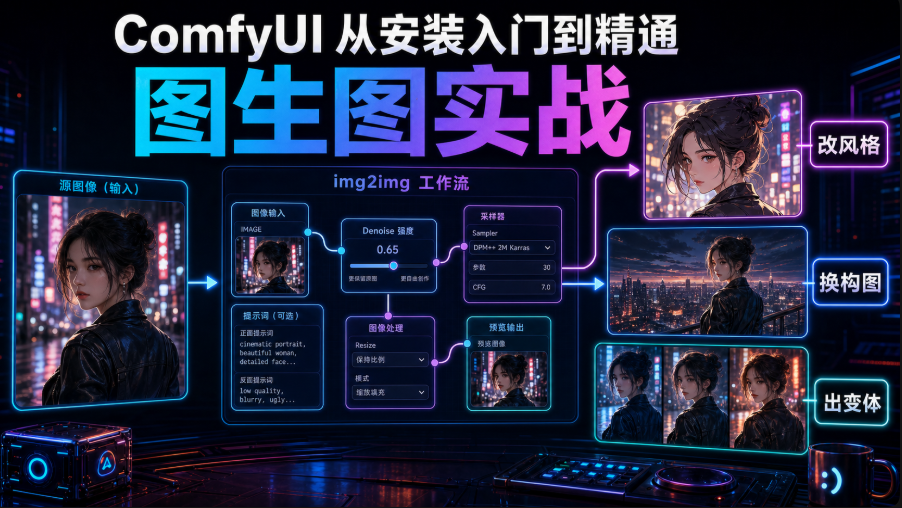
In the first seven, you've been able to report mistakes from zero, graphics, quality, self-help. But there's a problem: every time you get a hard "squeeze" from a text phrase, you want a picture, you want a position, you can't describe it simply by words。
This is the timefigure (img2img)OKAY. I DISCOVERED THAT THIS FUNCTION OPENED UP A NEW WORLD -- TO TAKE AN OFF-THE-SHELF PICTURE AS THE BOTTOM, TO MAKE AI CHANGE IT, 10 TIMES MORE EFFICIENT THAN A HINT FROM ZERO. THIS HAND-AND-HAND PIECE TEACHES YOU: WHAT'S GOING ON WITH THE DRAWINGS, HOW TO ADJUST THE NOISE INTENSITY, AND HOW TO COPY THREE REAL-WORLD SCENES。
I. HOW THE THOSE graphS ARE
One sentence:Fig = Vincent + a reference graphI don't know. The Vensheng map is "Playing from noise" and the drawing is "Encoded into subspace and recreated on this basis". Key node chain:
Load Image
VAE Encode (encoded subspace)
KSampler
VAE Decode
Save Image
Most critical pits:KSampler's last_image VAE Encode outputIt's not that part of Vincent's. I've seen the new guy connect the original to KSampler, and the result is noise -- the pixels are not coded by VAE, AI when the pure noise is processed. The original map must pass VAE Encode to feed KSampler。
ii. Noise intensity reduction
denoise decided “to retain the original figure”。0 = the original image remains intact, 1 = the total noise replacement (equivalent to the texture).
|
|
|
|
|
|
|
|
|
|
|
|
|
|
|
|
|
|
|
|
|
|
|
|
think of "same style" and "denoise" 0.4 The most comfy -- the image is still there, the style is changing. First-time starter with 0.5, with 0.1 for each turn. There is a difference between SDXL and Flux: Flux submersible space is more compressed than it is available at 0.8 to 0.95; SDXL is more appropriate at 0.2 to 0.4。
Trail experience:For the first time, I made a map of denoise = 0.1, which is almost exactly the same as the original one, and thought the work flow was broken. Later on -- the lower the denoise, the lower the AI changes, the lower the 0.1 is basically the same。
iii. Put your hand on a map
And the 05 base graphics, only two more points。
1. Add Road Image: Bottomchart (or drag to nodes)。
2. Add VAE Encode: Load Image IMAGE company pixels, Checkpoint VAE company vae。
3. Add KSampler: VAE Encode's LATENT Company League_image Not Emtty Latet。
4. Add VAE Decode + Save ImageAn identical map。
5. RunQueue Prompt。
10 minutes, change your picture to Sabpunk
That's the truth. After you've got one more picture of your photo turned into Saberpunk, you'll be able to confirm that Tusheng is real。
Preconditions: You've got the 05th Basic Chart Workstream. Lose it again。
TargetTake a photo of yourself and change it to Cyberpunk and keep the original image。
Step (sight, don't jump):
1. Chart: Find a picture of yourself (the best man) and put it on the table。
2. Add Road Image: Double-click blanks in the canvas search Load Image return car node "choose file" select photos (or drag a map into the node)。
3. Add VAE Encode: Load Image IMAGE company pixels, Checkpoint VAE company vae。
4. Reconnection (most critical): unplugged the original KSampler Emtty Latent and reconnected to the VAE Encode's Latent_image; set for denoise 0.6。
5. Write hints: negative emptiness, low quarity。
6. Output: Point Queue Prompt。
Checkpoint
One is also the position of the "you" and the position of the face, but the colored background is full of Sabpunk
2 acoustic noise, 80% KSampler still picks up Emtty Latet, not VAE Encode output (back to pit III)
3 same as original figure 80% denoise too low (<0.2), pull back 0.6。
job (chosen): the same photo, denoise sets a comparison of 0.3 and 0.8, respectively. it's "little change" and it's "most retrospects with only a contours" -- it's a denoise spin。
Four, three real battlefield scenarios
The principle and the tie-up, the three most common scenes below, the hints and parameters are written, and you change your own picture。
scene one: Photo to art
positive: cyberpunk style, new lights, light, city stage, masterpece, best quality
denoise 0.6dpmpp_2m+20step+karras+CFG7.5. Effects: Attitudinal maps are maintained and the twilight is completely changed to Sabourpunk。
scene two: line colour
positive: colored, vibrant colors, anime style+ specific colours。
denoise 0.7 ~ 0.8(conservation line, new colours); recommended binary base model. The more specific the hint, the better the "blue eyes, red skirts, blonde" is。
Scenario III: Old Photo Restoration / Clear
right in the middle of the day
negative: blurry, low quality, damaged, scratch, noise
denoise 0.2 ~ 0.3(Minimum, high-level, old-fashioned photo features); better to be magnified with title 06。
Can play:Plot(the sketch is the bottom, denoise 0.5 ~ 0.7)Variable(Same hint: 0.35 to 0.7 for the best)Partial repaint(Mask white = change of area, next section)。
V. QUIREMENTS OF PARLIAMENTS (Scene by scene)
|
|
|
|
|
|
|
|
|
|
|
|
|
|
|
|
|
|
|
|
|
|
|
|
|
|
|
|
|
|
|
|
|
|
|
|
VI. 4060 / 8G TECHNIQUE & PIT I STEPPED ON
Skills: Visible storage resolution 28G BASE MAP FROM 512X512, with a small hyphenation and magnification; donoise not too much time; and a sampler with Euler / LCM is lighter。
Pit 1: denoise = 1 free, equals the Ventura map The size doesn't match the model, pre-scaling originals; 3 Confusion between denoise and CFGThe former retains the original figure and the latter hears the hint。
Tusk will, you can take any chart as a springboard. NextTitle 09SpeakRORA USE ACTUALLY– How to select, lower, lower, and string weights so that the "Build-the-Build-Class-Class-Class-Class-Class-Class-Class-Class-Class-Class-Class-Class-Class-Class-Class-Class-Class-Class-Class-Class-Class-Class-Class-Class-Class-Class-Class-Class-Class-Class-Class-Class-Class-Class-Class-Class-Class-Class-Class-Class-Class-Class-Class-Class-Cass-Cass-Cas-Cas-Cas-Cass-Cor-Cas-Cas-Cas-Cas-Cas-Ced-Cas-Cs-Cas-C。