



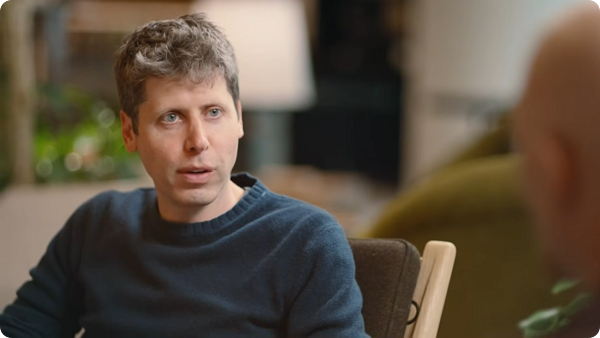
Message from August 25, OpenAI CEO Sam Altman In an interview with David Senra on 23 August, he expressed concern that the control of AI was eventually concentrated in the hands of a few companies or individuals. By contrast to the fact that a small number of institutions determine the direction of technology for society, he advocates for more people to actually participate and influence the future of AI and for society to evolve with models。
Altman did not name a specific company, but he criticized some AI practitioners for claiming that technology had the potential of 25%, causing a serious disaster, that half of the jobs might disappear, and that it would restrict the use of the strongest model and leave the decision to a few companies。Anthropic CEO Dario Amodei had previously publicly stated the AI disaster probability of "25%" and warned AI that it might replace half of the junior white collar in a few years, so it was interpreted by the outside world as implying Anthropic, but Altman himself did not confirm this。
The right path is to give people a deep grasp of the future. Society and models will evolve together。
Altman at the same time recognizes AI as a real risk to human control. He objected that the industry, on the basis of protecting the world, required the public to trade in large amounts of freedom for security and to concentrate technology control permanently in the hands of a few institutions. His sarcasm of such claims is tantamount to a commitment by technology companies to the public to cure disease, create wealth and entertainment in exchange for people's autonomy and ability to influence the future, and to call this power arrangement “very anti-human”。
His programme consists of two levels: on the one hand, social choices should continue into the evolution of models and products; on the other hand, the ability of individuals to use AI should be expanded. Altman, for example, AI will allow more people to start small businesses at a scale that could not have been achieved in the past, a way for individuals to participate in the future of technology。
This statement does not deny security governance, nor does it claim to allow for forward-looking model development. The border drawn by Altman is that the system of controlling mismatch models cannot permanently delegate decision-making to a very small number of institutions; safety, freedom and individual mobility need to be addressed within the same governance framework。