



Current AI VideoIn the area of generation, the clarity and physical authenticity of the picture have increased significantly as bottom models evolve. However, in practice, many creators still experience a core pain:
Even when very detailed hints are entered, the resulting images often lack overall coherence and there is a clear sense of fragmentation between the person ' s actions and the lens movement。
THE ROOT CAUSE OF THIS PHENOMENON IS NOT THE CALCULUS BOTTLENECK OF THE TOOL, BUT RATHER THE LOGIC OF THE HUMAN NATURAL LANGUAGE NARRATIVE, WHICH WE CUSTOMARILY FOLLOW WHEN WE CONSTRUCT THE HINT, OVERLOOKING THE MACHINE LOGIC OF THE AI MODEL FOR PROCESSING INFORMATION。
IN THIS SECTION OF THE COURSE, WE WILL EXPLORE A STEP-BY-STEP DEVELOPMENT TECHNIQUE BASED ON THE AI MECHANISM — A REVERSE HINT STRATEGY. BY DECONSTRUCTING THE RECENTLY DISCOVERED AI VIDEO GENERATION MECHANISM, WE WILL LEARN HOW TO SOLVE THE PROBLEM OF IMAGE FRAGMENTATION AT ITS ROOTS BY RECONFIGURING THE SEQUENCE AND PERSPECTIVE OF THE HINT, GIVING AI A HIGHER PROFESSIONAL SENSE OF QUALITY AND FILM-CLASS AESTHETICS。
CHAPTER 1: BREAKING THE MYTH - UNDERSTANDING THE AL'S "MECHANICAL BRAIN BACKWAY" COLLIDING WITH DIRECTOR THINKING
BEFORE LEARNING HOW TO WRITE BACKWARDS, WE HAVE TO FIGURE OUT AT THE BOTTOM OF THE LOGIC: WHAT EXACTLY IS AI “THINKING” WHEN IT PRODUCES THE VIDEO? WHAT'S THE DIFFERENCE BETWEEN IT AND THE REAL HUMAN DIRECTOR
DEADLY ERROR: AI DOES NOT "UNDERSTAND" YOUR IMAGE
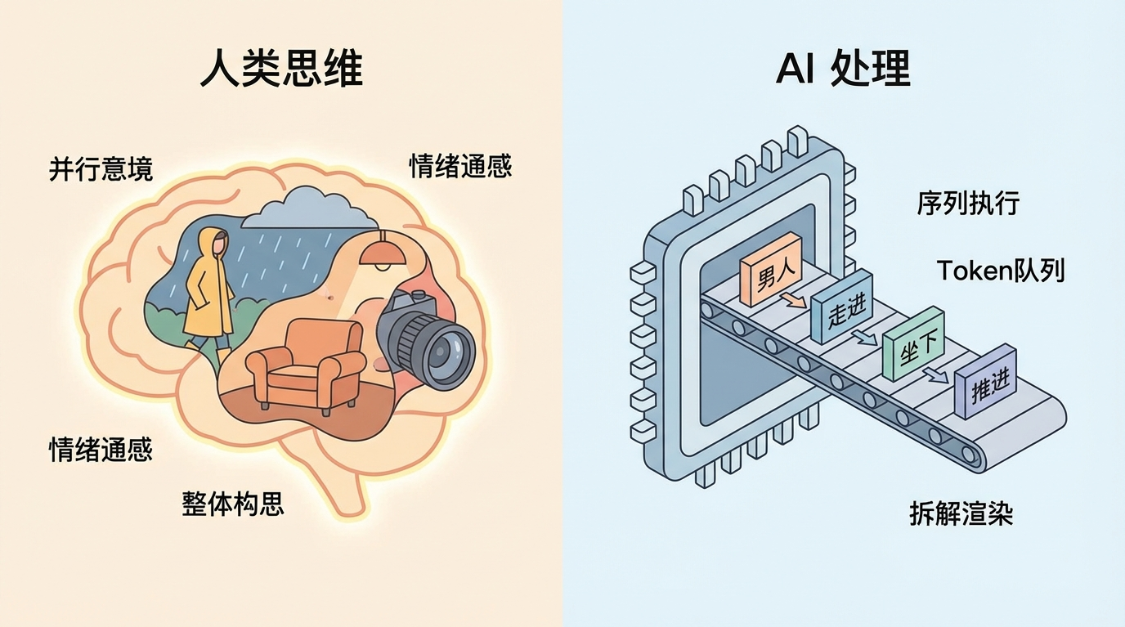
As human beings, when we close our eyes and imagine “a man walks into a room in the rain with grief and sits down, and the camera slowly draws near”, what emerges in our minds is a whole set of emotions, shadows and coherent actions. We're using a sense of common sense。
But AI (even the smartest multi-modular model of the time) is not human. The bottom logic of AI is based on the probability prediction and sequence of Token. It's an absolutely rational information processing machine。
Disasters brought about by “sequenced implementation”: senses of fragmentation and illusions
If you use the normal human narrative logic, you usually make the mistake:
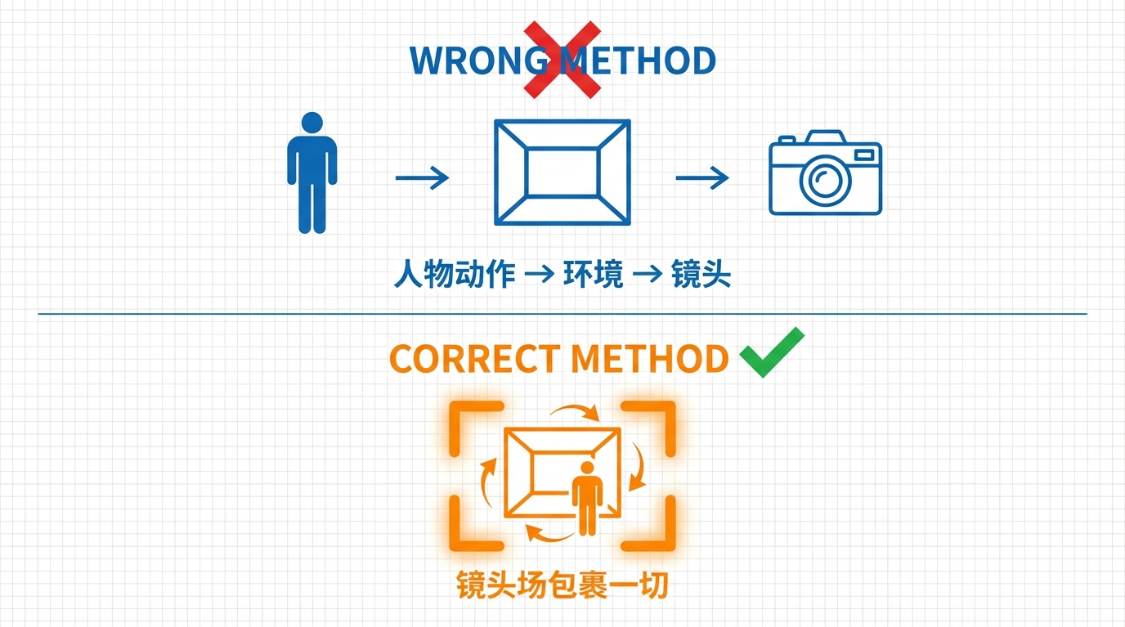
[conventional error]: Write action first, then details later, and last shot。
For example, a man enters the room and sits down and the camera slowly advances。
IT DOESN'T SEEM LOGICAL, DOES IT? BUT IN AI'S LINEAR EXECUTION SEQUENCE, THE PROCESS BECOMES "SLICE SAUSAGES":
First stage: Priority distribution algorithms to generate “men entering the room”。
Phase two: based on the original move, the "sit down" action is rigidly linked。
Phase three: Final recognition of the camera thrust
THIS LINE OF DIRECTION LED AI TO FAIL TO ESTABLISH THE RIGHT THREE-DIMENSIONAL SPACE-TO-VIEW RELATIONSHIP AT THE BEGINNING OF THE ACTION. AND THE RESULT IS THAT THE LENS AND THE WHOLE PICTURE HAVE A CLEAR SENSE OF "MIXING."
The human director's thinking is "Mise-en-scène" and the general user's thinking is "actions in the list". That's why your image is not high enough. What's the solution? It's simple. It's like a real photography guide to build a picture。
Invert space package
Cue word example:
“Slowly advancing low angle lenses through the dark room, a man is entering the scene and sitting on a chair.”
Correctness resolution:
IN THIS REVERSE EXAMPLE, AI RECEIVES THE FIRST COMMAND "LOW ANGLE LENS SLOW-MOVING." MODELS GIVE PRIORITY TO COMPUTING CHANGES IN SPACE THROUGH LENS MOVEMENTS. WHEN IT COMES TO "MAN WALKS INTO THE PICTURE AND SITS DOWN," AI WILL NATURALLY CALCULATE AND INTEGRATE THESE CHARACTERS INTO A THREE-DIMENSIONAL GRID THAT IS ALREADY MOVING. THUS, THE SIGHT OF THE IMAGES, THE FLOW OF LIGHT AND THE SENSE OF HUMAN OBJECTS ARE HIGHLY UNIFORM。
Chapter 2: Core policy one - camera front and "space package" law
IN ORDER TO ADDRESS THE FRAGMENTATION EFFECTS DESCRIBED ABOVE, WE NEED TO INTRODUCE THE “SITUATIONAL” THINKING IN FILM PRODUCTION. ON THE REAL SET, THE DIRECTOR'S PREMISE FOR DETERMINING THE ACTOR'S DEPARTURE WAS THAT THE LOCATION AND FOCUS OF THE CAMERA HAD BEEN SET. WE SHOULD ALSO FOLLOW THE PRIORITIES OF THIS SPACE IN THE CREATION OF AN AI MESSAGE。
2.1 Conceptual interpretation: What is the "photo package action"
One of the core elements of the “reverse warning strategy” is to pre-position the optical properties of the camera with the motion trajectory, then describe the space environment and then then fill in the specific actions of the person。
FORCE AI TO CREATE A “SPACE FIELD” WITH A SPECIFIC PERCEPTIVE RELATIONSHIP, DEPTH EFFECT AND STATE OF MOTION. WHEN THIS DYNAMIC FRAMEWORK IS IN PLACE, THE PERSON ACTION THAT IS THEN ENTERED IS NATURALLY “PACKAGED” IN THIS LENS。
2.2 Step-by-step exercise: set with professional camera parameters
In order to further enhance the image ' s industrial sense, we need to not only pre-screen, but also advance specific optical parameters and aesthetic style. This is an effective wake-up call for training data on high-quality film images in large models。
Common error: (actors move first, machines shake)
The usual example is: "A woman in a green dress walks in the halls of retrofitting, and the camera follows her, and then the camera turns around, and then she goes to the window, the dress moves, and the side is soft."
(Generating defects: The action is performed before the camera starts to intervene, or the person moves at a scale that is not consistent with the camera speed and lacks a sense of truth. I'm not sure
Example:
Tips:
Steadicam dynamic long take. The starting point was a very shallow view, with a focus on women ' s metal heels, followed by a smooth rise of the camera to the waist (Crane up) and a rollback (Dolly back) and a clockwise 180-degree orbital movement (Orbit pan). The scene is the English-style retro-luxurious garden gallery, with a soft, side-reverse light of classical oil. A woman wearing a long ink-green silk dress is walking back to the camera. As the lens revolves around and backslides, her ink-green silk skirt moves like a wave of water in the light。
"A Correct Understanding"
PRIORITY IS GIVEN TO SETTING UP A GLOBAL MOVEMENT VECTOR, AND WHEN YOU TOP THIS COMPLEX ARRAY OF MIRRORS UP TO THE WAIST -- BACK AND AROUND + 180 DEGREES, AI WILL GIVE PRIORITY TO BUILDING A DYNAMIC THREE-DIMENSIONAL GRID IN THE HIDDEN SPACE WHERE THIS SERIES OF COMPLEX MOVEMENTS IS UNDER WAY. THEN, WHEN THE GREEN DRESS GIRL ENTERS THE SCENE, HER “BACK TO CAMERA” MOVES, THE SILK SENSE OF THE DRESS, AND THE FLOW OF LIGHT UNDER THE WARM-COLOURED REVERSE LIGHT ARE PRECISELY CONFINED TO THIS ALREADY “MOVE UP” SPACE GRID. AI PERFECTED THE PHYSICAL AND PHOTOLOGIC LOGIC OF THE COMPLEX MIRRORS, AND THE IMAGES WERE EXTREMELY SILKY。
2.3 More aesthetic-style “tonic” applications
In addition to complex long lenses, this method of pre-empting optical parameters applies equally to setting the tone of advanced aesthetics for static or microdynamic images
i. the pursuit of an extreme sense of symmetry and order: rather than first describing the clothing of the person, it is the rules of the dead。
Structure prefix: Extremely wide symmetric fixed-angle shot, Wes Anderson director style, central map, bright Macalon tone. A doorman in a pink uniform walked out of the front door and stopped in front of the camera。
(DISCUSSION: THE SPACE CREATED BY AI IS ABSOLUTELY ORGANIZED, AND THE MOVEMENT OF PEOPLE AUTOMATICALLY FITS THIS RIDICULOUS SENSE OF ORDER. I'M NOT SURE
ii. creation of seclusion and confusion: the action itself is not important, and the optical defects of the lens can instead be a tool for emotional expression。
Structure prefixes: Hand-held hand-held camera (Shaky Handhold Camera), very shallow view, combined with step-printing, neon lights form a huge photoplasm outside the focal. A woman wears a flag robe and travels in a crowded night market. (Discussion: Put all the optical properties at the top, form a very strong emotional filter, and wrap all the subsequent moves in a paralyzing atmosphere. I'm not sure
Chapter three: Core strategy two -- building an absolute camera coordinate system, rooting "out of control."
WHEN WE USE AN AI VIDEO TOOL SUCH AS A CONCH, OR DREAM OR FILAMENT, WE OFTEN FACE ANOTHER FATAL PAIN:
AI IS OFTEN UNABLE TO UNDERSTAND THE EXACT DIRECTION OF THE PERSON'S MOVEMENT, LEADING TO AN OUT-OF-CONTROL MOVEMENT AND EVEN TO THE REVERSE GENERATION OF THE PERSON'S “RETROGRESSION”。
WHY ARE THE PEOPLE IN THE PICTURE GOING BACKWARDS WHEN THEY WRITE "RUN FORWARD"? THIS RELATES TO THE BASIC BLIND ZONE OF THE AI SPACE AWARENESS MECHANISM。
THREE-D SPATIAL AWARENESS BLINDNESS AND RANDOMNESS
In the common sense of humankind, people-centred “front, back, left, right” is extremely clear. However, there is no absolute sense of direction based on the "person's face in the direction" of the initial commotion noise in the Late Space for a large video generation model。
IN PARTICULAR, IN THE MEDIUM, NEAR OR CLOSE-UP IMAGES, BECAUSE OF THE LACK OF A VISIBLE BACKGROUND BUILDING OR HORIZON AS A GEOMETRIC REFERENCE, WHEN THE MODEL RECEIVES INSTRUCTIONS TO “GO FORWARD”, IT CANNOT DETERMINE WHICH SIDE IS THE “FRONT” OF THE PHYSICAL SPACE. IN THE ABSENCE OF THIS INFORMATION, AI CAN ONLY MAKE RANDOM PROBABILISTIC CALCULATIONS, WHICH LEADS TO AN EXTREMELY UNCONTROLLABLE DIRECTION OF GENERATION。
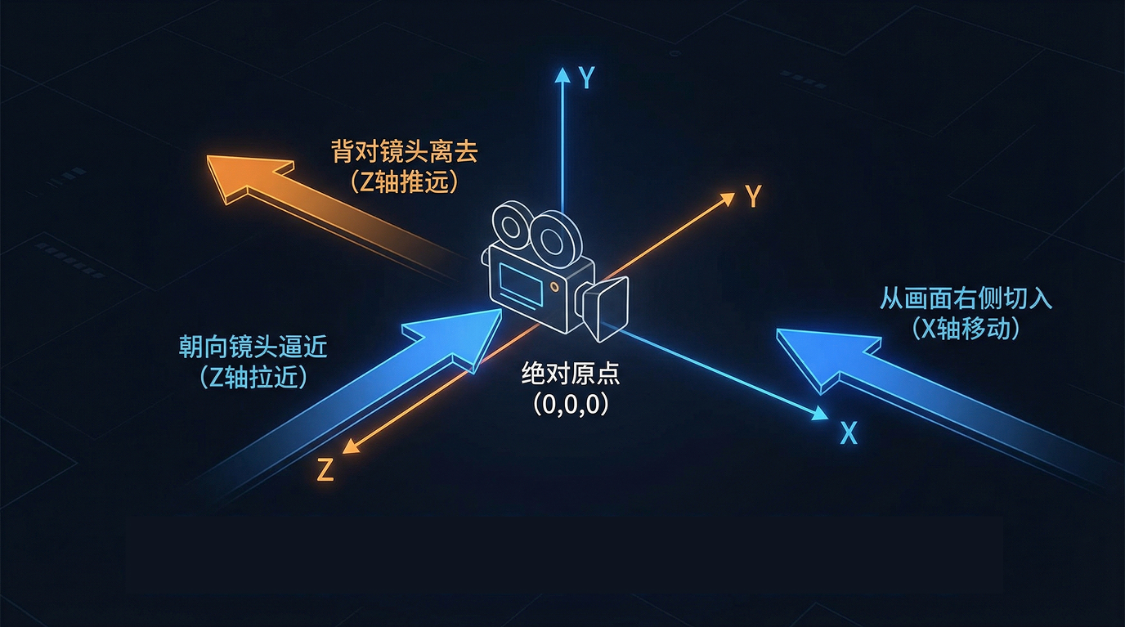
[kernel solution] Consider the camera as an absolute point of origin (0,0)
TO ACHIEVE PRECISION CONTROL OF VIDEO DYNAMICS, WE MUST COMPLETELY ABANDON THE CHARACTER-CENTRED NARRATIVE AND CREATE A SPATIAL REFERENCE SYSTEM WITH THE CAMERA AS THE ABSOLUTE POINT OF ORIGIN。
THIS MEANS THAT, IN PREPARING THE HINT, WE NO LONGER DESCRIBE THE ABSOLUTE MOVEMENT OF THE PERSON IN THE VIRTUAL WORLD (E.G., GOING EAST, RUNNING FORWARD), BUT RATHER A STRICT DESCRIPTION OF THE PERSON'S SPACE POSITION VIS-À-VIS THE CAMERA LENS. AS LONG AS THIS NON-MOVEABLE ABSOLUTE REFERENCE TO THE CAMERA IS ESTABLISHED, NO MATTER HOW COMPLEX THE MOTION TRAJECTORY IN THE PICTURE, THE AI MODEL CAN FIND A CLEAR CALCULATOR ANCHOR。
Common error versus high-level writing
THROUGH A SPECIFIC CASE-BY-CASE ANALYSIS, WE SEE HOW TO CONVERT VAGUE RELATIVE CONCEPTS INTO AI SPACE COORDINATES THAT CAN BE ACCURATELY IMPLEMENTED:
Scenario one: Positive impact expression
A SAMURAI SPRINTED IN ANGER. (ERROR RESOLUTION: AI DOESN'T KNOW WHERE THE FRONT IS, THE SAMURAI MAY RUN OUT OF THE PICTURE OR STEP IN. I'M NOT SURE
A samurai is fast approaching the camera, with anger, and he's rapidly magnifying in the image。
(ANALYSIS: THE FUZZY "FACE" IS DEFINED AS THE VECTOR MOTION "IN THE DIRECTION OF THE CAMERA" ON THE Z AXIS. THE EMPHASIS ON “CLOSING LENS” WILL FORCE AI TO CALCULATE A STRONG VISUAL MAGNIFICATION, WITH A DRAMATIC INCREASE IN IMAGES OF OPPRESSION AND TENSION. I'M NOT SURE
Scene 2: Backshade and space depth expression
The heroine turned sad and went further and further。
THE HEROINE TURNED BACK TO THE CAMERA, SLOWLY MOVING TO THE DEPTH OF THE PICTURE (Z-AXIS IN A POSITIVE DIRECTION), AND HER BACK WAS SHRINKING IN THE FOG。
(RIGHT RESOLUTION: PROVIDE A CLEAR Z-AXIS BACK REFERENCE. THE BACK-TO-SCENE LOCKS PEOPLE IN THEIR DIRECTION, AND “DEEP IN THE PICTURE” GIVES THEM A MOVING VECTOR, AND THE MODEL IS EXTREMELY ACCURATE IN CALCULATING A PERI-SCOPING RELATIONSHIP THAT IS CONSISTENT WITH PHYSICAL LAW. I'M NOT SURE
Scene III: Artistic and graphic control
A sports car comes out of the right, it's going fast。
One of the runners went in very fast from the right side of the frame, crossed through the front of the lens, then headed out the left side of the frame。
(CORRECTED: GIVES A CLEAR STARTING POINT FOR THE X-AXIS (RIGHT-SIDE FRAME EDGE) AND ENDPOINT. THIS IS TANTAMOUNT TO A STRICT MOTOR TRACK FOR AI, AND DYNAMIC CAPTURE WILL BE VERY SILKY AND NEVER ROLL OVER. I'M NOT SURE
Scene IV: High and low in vertical space
A hawk flew out of the sky to catch a prey. (Analysis: Without space setting, the images produced are often extremely mediocre visions. I'm not sure
The camera uses a very low angle, and an eagle dives from a high-altitude straight into the lens, and the claw expands at the front。
(Analysis: Combining the action with the specific physical position (on the back) and transforming the vertical landing into a “divide to the lens”. This not only avoids misdirection, but also transforms an otherwise mediocre vision into a first person with a very visual impact. I'm not sure
Chapter IV: High-level indicative structural paradigm and systemic re-engineering
COMBINING THESE TWO CORE STRATEGIES, WE CAN SUMMARIZE A SYSTEMATIC AND STRUCTURED SET OF HIGH-LEVEL WARNING-WRITING PARADIGMS. THIS TEMPLATE AIMS TO MAXIMIZE THE ALIGNMENT OF THE SEQUENCE RESOLUTION LOGIC OF THE AI MODEL WHILE ENSURING A PROFESSIONAL AUDIO-VISUAL LEVEL OF THE IMAGE。
4.1 Five-step structure method
It is proposed that, when creating complex scenarios, the following structural sequences should be followed in the preparation of the hints:
1. [Operative and camera parameters]: Set basic audio-visual languages (e.g. 35 mm lens, very shallow view, ARRI Alexa camera)。
2. [Spatial position and mirror trajectory of the camera]: Set space field and dynamic tone (e.g., low-angle, slow-to-right horizontal lens Pan right)。
[Environmental light and physical atmosphere]: Set the stage context in which the action takes place (e.g. Sabpunk street after rain, high contrast to cold-temperature lighting, neon light reflection)。
4. [Accurate spatial movement of the subject relative to the lens]: Description of the core action (e.g., a man in a windsuit is moving slowly from the depth of the picture towards the lens)。
[Key local interaction and detail]: Microrealism to improve the picture (e.g., he is down and rain falls in front of the lens)。
4.2 Example of application of structural law
Full examples of paradigms:
(1 Optical) Anamorpic Lens, (2 Mirrors) Camera set up and slowly pulled back (Dolly out). (3 Environments) In a dilapidated industrial warehouse, a strong line of light leaking from the top penetrates the dust. A giant robot doll is approaching the lens at a heavy pace from the shadow of the image. As it approaches, the oil in the metal joint is clearly visible in light。
THROUGH THIS HIGHLY STRUCTURED TEXT REORGANIZATION, CREATORS ARE ABLE TO GIVE CLEAR DIRECTION TO THE CALCULUS ALLOCATION PRIORITIES OF THE AI MODEL, THUS PRODUCING HIGHLY LOGICAL, HIGH-QUALITY VIDEO MATERIAL。
Summary of this section
TODAY, IN THE CONTEXT OF THE GROWING PREVALENCE OF AI VIDEO-GENERATION TOOLS, MASTERY OF THEIR USE IS ONLY THE BASIS, UNDERSTANDING THE UNDERLYING LOGIC AND BUILDING THE CORRESPONDING MINDSETS, WHICH ARE THE CORE COMPETITIVENESS OF CREATORS。
In this section, we've analysed two key concepts of progress:
Discards a routing of actions and uses a “photo front” strategy to build a space field。
(b) Reject the vague object-centred orientation and establish an absolute system of coordinates based on the camera。
It is hoped that, in their daily creative practices, you will be able to integrate this “reverse writing thinking” based on the camera's perspective, which will effectively reduce the uncontrollability of the process。