


A lot of people have been making contact latelySkillHowever, when first produced, it was often not known where to start。
Some would ask:
What the hell is Skill
What's the difference between it and an ordinary hint
Do you have to learn to write first
Can you make Skill without a process
What kind of file does a Skill need
Actually, making Skill is not as complicated as it looks。
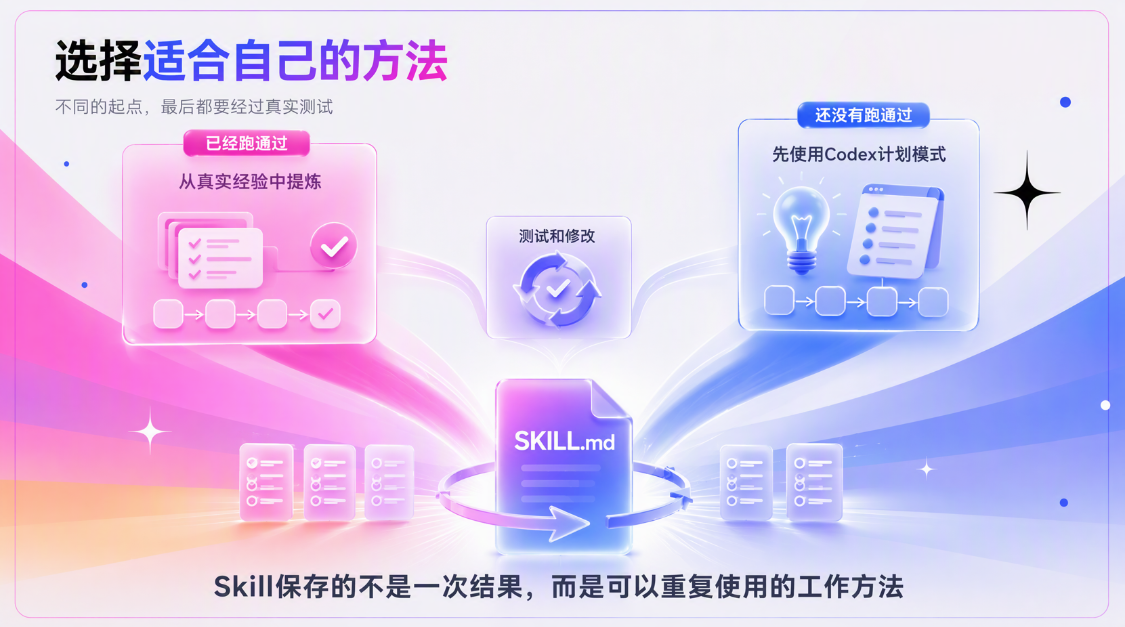
If you've already made a run for a mission, you can put the real work process into Skill; if you haven't made it, you can start with Codex's plan model and help you build the first version。
These two approaches will be presented separately。
The first of these will use the example of Skyll, a Chinese-species community of people, as a case in point, to demonstrate how a run-through video production process can be organized into working methods that can be used repeatedly by AI。
Chapter 1: What is Skill
1.1 IMAGINE AI AS A NEW NEW COLLEAGUE
AI IS SMART AND LEARNS FAST。
But when faced with a specific job, it does not know your personal experience and working habits。
It may not know:
Where should this work start
Do what first, then what
What do you need for every step
How do you judge when you're in different situations
Which requirements must be complied with
How far does it end
IF WE DO ONLY ONE MISSION, WE CAN WRITE A REMINDER TO AI ON A TEMPORARY BASIS。
But if this task recurs, it will be difficult to explain from the beginning each time and the end result will not necessarily be stable。
AT THIS POINT, WE CAN PREPARE A JOB DESCRIPTION FOR AI THAT CAN BE USED REPEATEDLY。
This job description is Skill。

1.2 What would a Skill tell AI
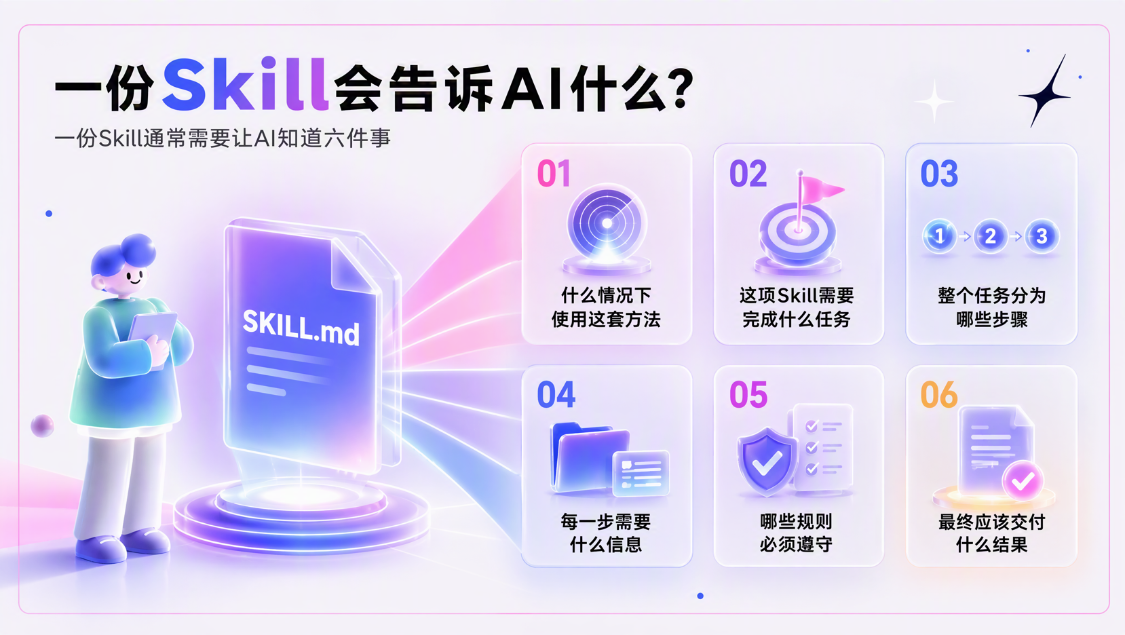
A Skill usually requires AI to know six things:
Under what circumstances
What's this Skill got to do
What are the steps in the overall task
What do you need for every step
Which rules must be observed
What should be delivered
For example, a Chinese field video, Skill, may tell AI (case link https://www.1ai.net/58465.html):
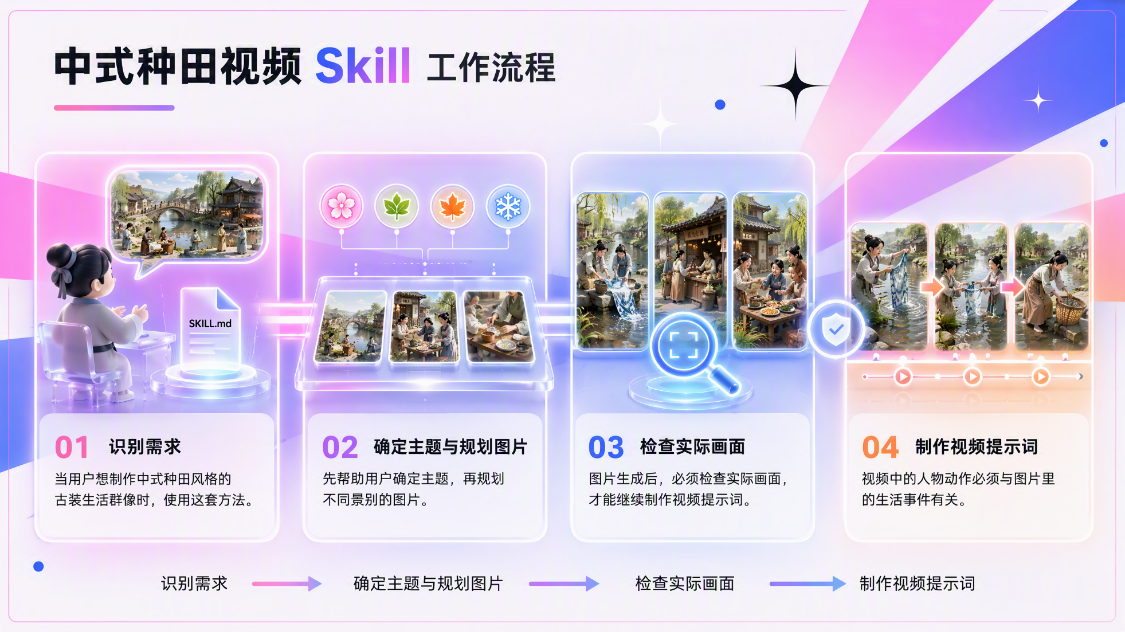
This method is used when users want to produce a Chinese-caste-style model of life。
Help the user to identify the theme and then plan the different scenery。
Once the picture is generated, the actual image must be checked before the video message can continue to be produced。
The character movements in the video have to be related to the life events in the pictures。
This is not just a generation requirement, but a complete task approach。
1.3 What's the difference between Skill and the common hint
The normal hint addresses the current task。
For example:
Help me generate five sets of Chinese field-style graphics。
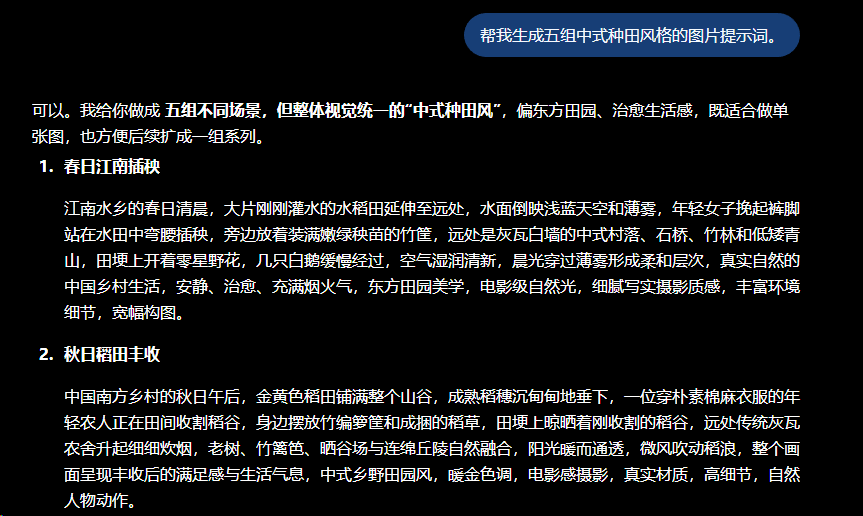
AI WILL DO ITS CURRENT TASK IN ACCORDANCE WITH THIS SENTENCE。
But with a new conversation, you might want to rephrase:
What's a Chinese field style
What are the plans
What should people do
What's the structure of the graphic tip
How to continue making videos after generating pictures
What are the problems
Skill addresses a sort of recurring task。
When created as Skill, AI will know in advance:
When should we use it
What stage is the user at
What should we do next
Steps not implemented earlier
Final delivery according to what format
It can be simply understood that the hint is the task given to AI this time, and that Skill is the method of work that may be used repeatedly by AI in dealing with such tasks later。
Chapter 2: What's the job for Skill
Not everything needs to be made of Skill。
If a mission is carried out only once, and two or three sentences make it clear, it would be simpler to use the phrase directly。
It is only when a mission occurs that Skill is more suitable。
2.1 This task will recur
For example:
It's the same style
Author of articles under a regular structure
Regular analysis of the same type of information
It often produces pictures of the same style
Regular compilation of data in the same format into reports
The production of Skill could be considered if AI was to be told a similar request once and every time a mission began。

2.2 The operational steps are similar each time
While the subject matter and material are different from input to input, the overall process is essentially the same。
For example, when making videos of Chinese field styles, themes and characters can change, but usually pass through:
Identification of themes
Planning pictures
• Write photo tips
Generate pictures
Check the actual image
• Write video alerts
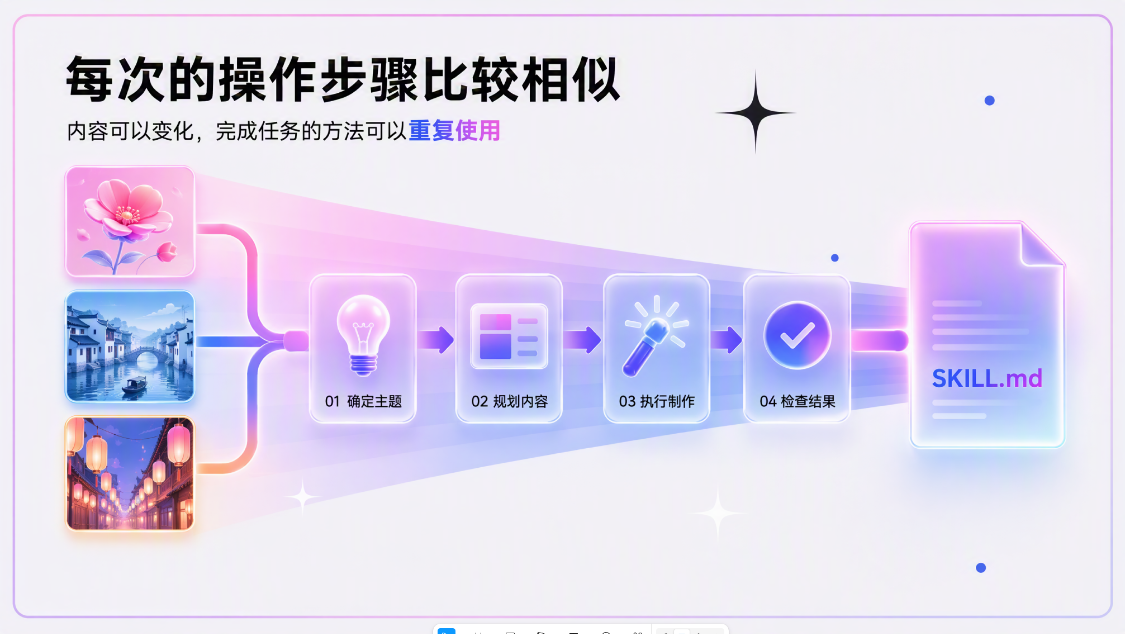
This relatively stable process is well suited for Skill。
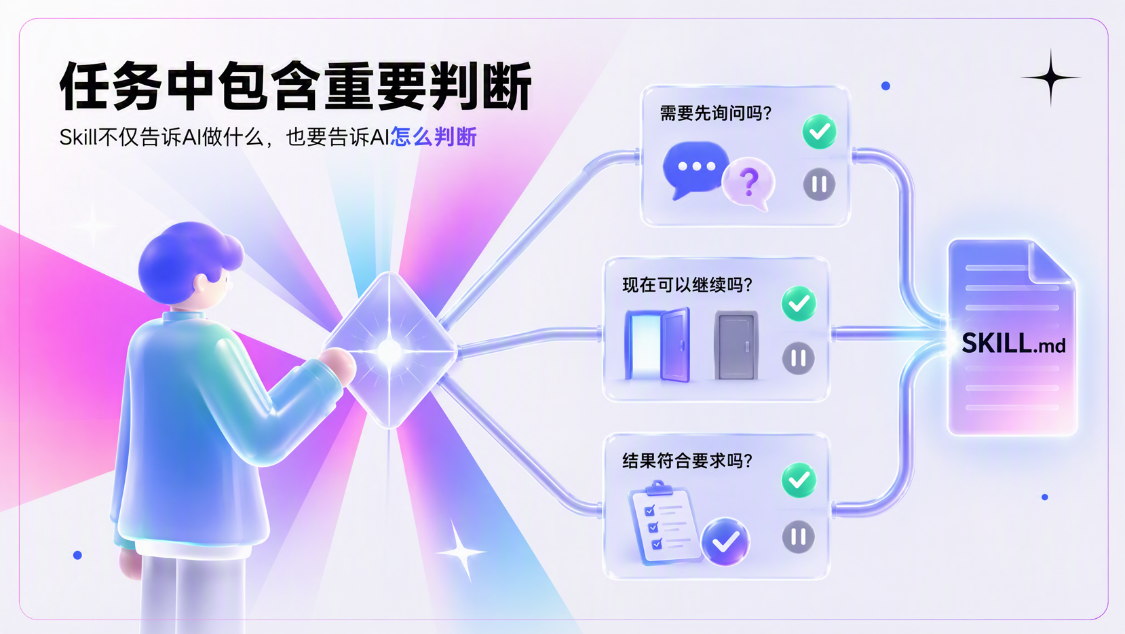
2.3 Mandate includes critical judgement
Some work is not carried out mechanically according to the steps, but also requires judgement。
For example:
Several directions should be provided when the user does not have a clear theme
Do not repeat queries when the user has identified the theme
You can't pretend to have checked without seeing the actual picture
You can't force a complex action when a picture is inappropriate for exercise
When users request capacity beyond Skill, they need to specify the boundary
If these judgements affect the final outcome each time, they should also be included in Skill。
2.4 Relatively clear completion criteria for mandates
For example:
Every picture must have a clear life event
People can't just stand, smile and show clothes
Video action must be sequenced and causal
I can only choose one main mirror
The end result must be delivered in a fixed structure
ONLY IF THE RESULTS ARE KNOWN WILL AI BE ABLE TO CHECK THAT ITS WORK HAS BEEN COMPLETED。

Chapter 3: There are two ways to make Skill
There is no single right starting point for making Skill。
Depending on the circumstances, two different approaches can be chosen。
Method I: Mission has passed
If you have done this in person, or if you have a more mature curriculum and operating process, you can extract Skill directly from real experience。
The basic processes are:
Looking back on the real mission
♪ Write the whole process, write the note ♪
Find a way to use it again
• Remove content that belongs only to a single item
Yeah, sort it out as Skill
Let's retest the mission

This approach has the advantage of being more stable。
Because many steps, problems and solutions have emerged in real missions, there is no need to rely entirely on imaginary design processes。
This was the method used to make the old Chinese-specified Chinese-species community like Skill。
Method two: Mission has not yet passed
If you only have one Skill idea, but you haven't actually done this, you can start with Codex。
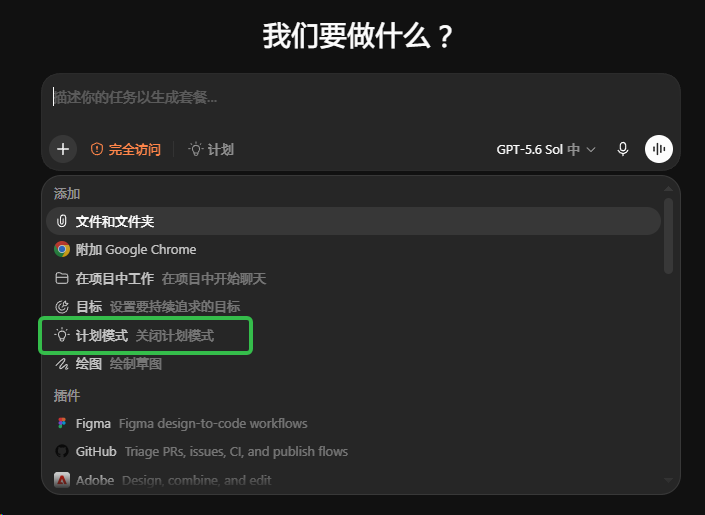
The basic processes are:
Show me what you want to do
Use plan mode to comb the steps
Check and adjust the plan
• Production of the first edition of Skill according to plan
Use real task test
Changed based on test results

This approach is appropriate for:
There's only one idea
I don't know the complete step
I don't know what kind of input I need
I don't know what judgment is in between
I want to start with the first version of the workflow
Needs attention:
The plan model helps us get the first version of the process, which does not mean that it has been validated。
The two methods are no higher。
There is real experience, and the first is used; the second is used without complete experience for the time being. Choose according to your circumstances。
Chapter 4: Methodology I - Extracting Skill from Real Processes
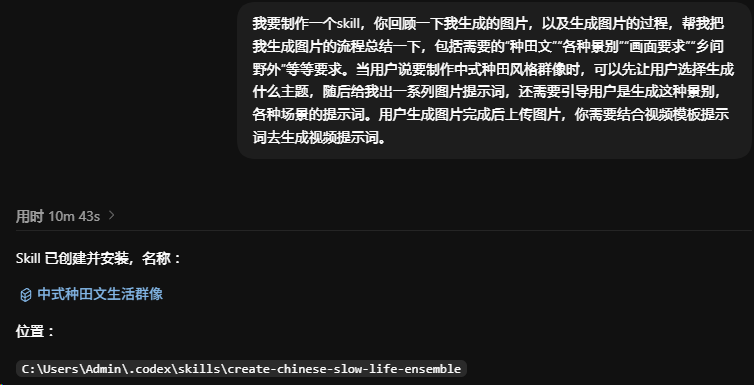
I've run through the Chinese field-style picture and video process before I make this Skill. (Case link: https://www.super-i.cn/info-3041.html)。
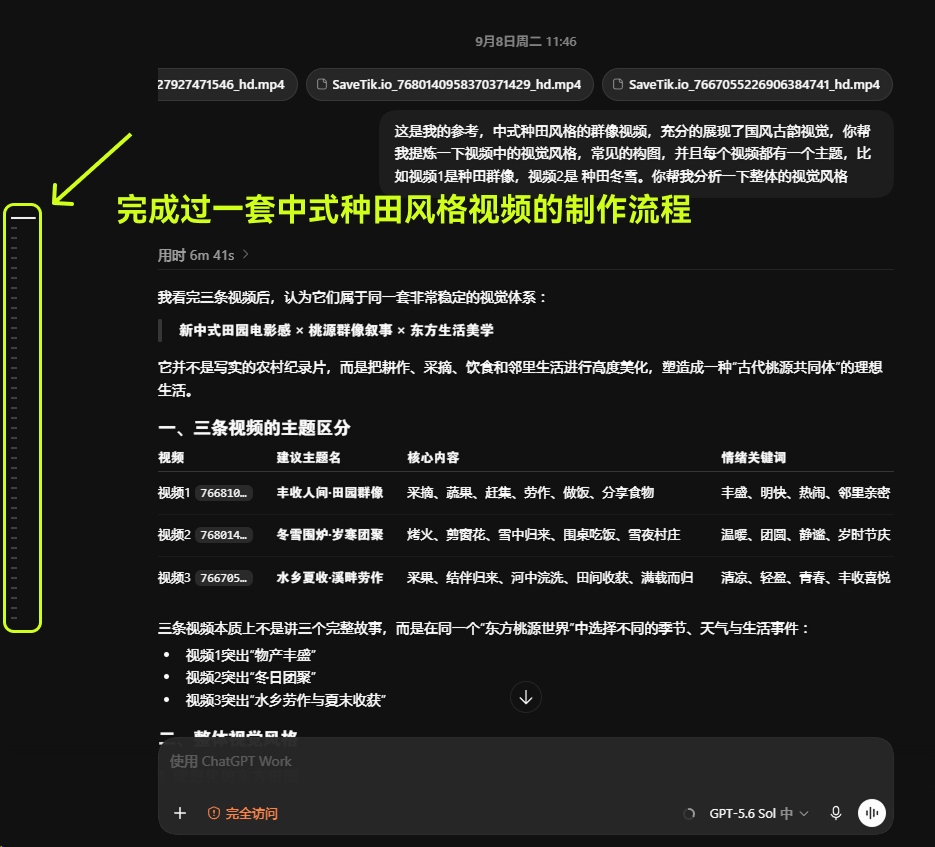
So I put my needs in the following line:
I'm gonna make a Skill. Please review the pictures I have generated and the production process, and help me summarize the production process, including the requirements of “sowning the fields” and “specturals” and “images” and so on. When the user wants to create a Chinese field style, first lets the user select the theme, then directs the user to choose the desired scene and scene, and produces a series of graphic hints. When the user completes the photo generation and uploads the actual picture, the video template is combined to generate the corresponding video message for each picture。
Although it is more spoken, it already contains the main information needed to produce Skill。
We can break it down with five questions。
4.1 What's this Skyll doing
The Skill needs to help the user complete a picture and video of Chinese field style。
It has two phases:
Photo phase: selection of themes, planning of images, generation of graphic tips
Video phase: checking images uploaded by users and generating corresponding video alerts
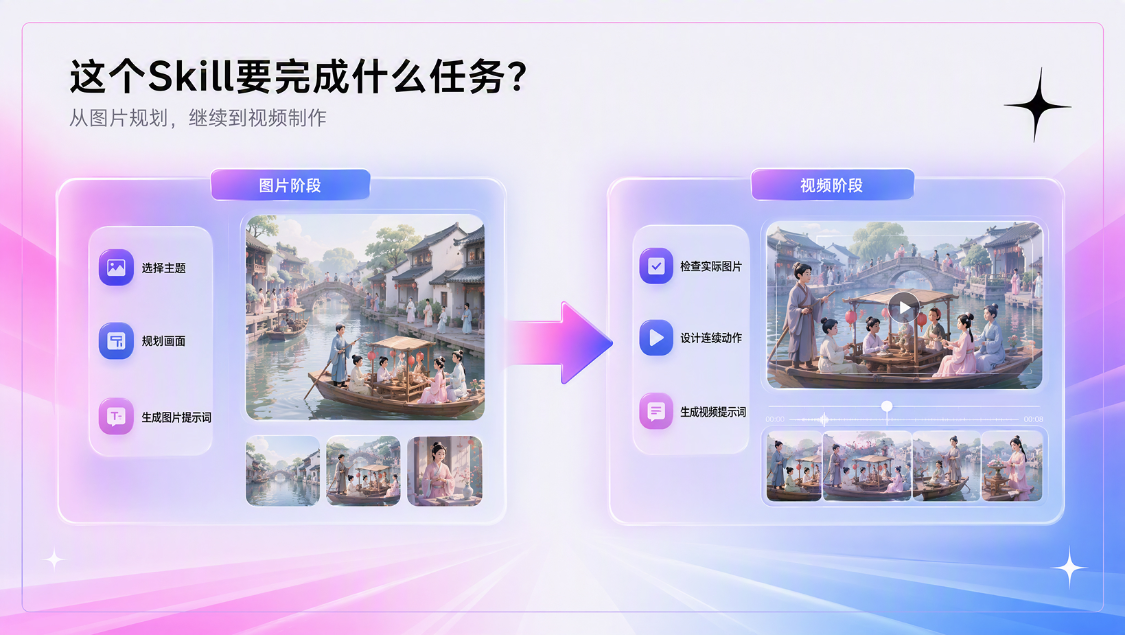
Therefore, it is not a Skyll, which is solely responsible for “writing photo tips”, but a complete approach from photo planning to video production。
4.2 Use under what conditions
As I explained in my message:
Use it when the user wants to make a Chinese field style。
For example, this Skill can be used when the user raises these needs:
Chinese field style
It's an old, slow life
Life in the East
Every day in the countryside
Old town life
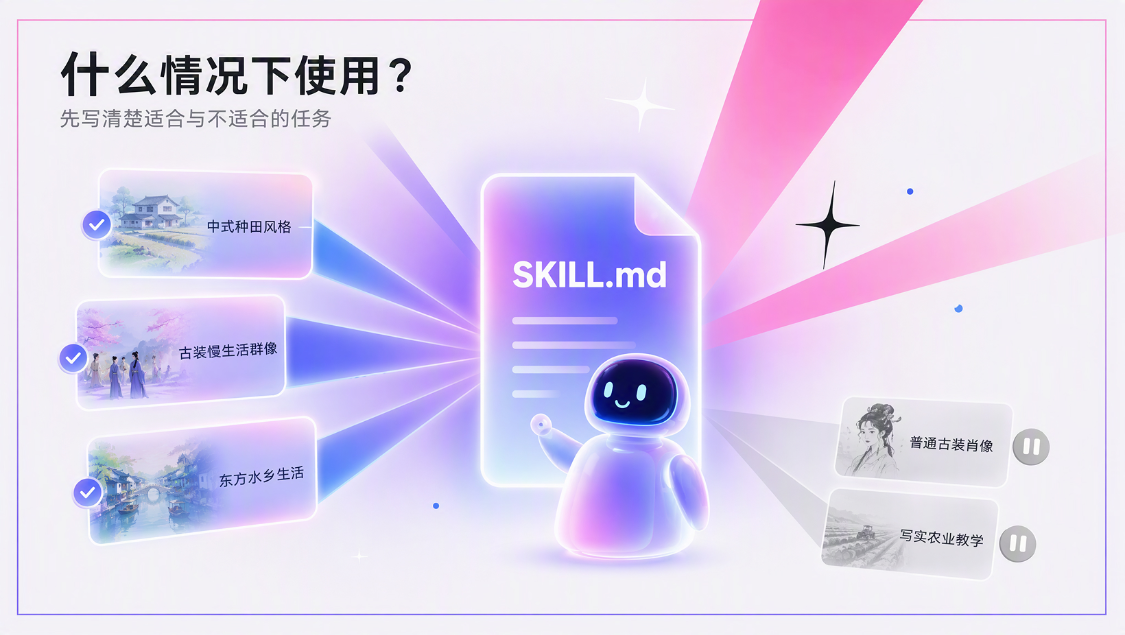
If the user simply wanted to produce an ordinary portrait of an antique or to produce a written agricultural teaching, it would not be appropriate to use this Skill。
4.3 Steps for the entire mandate
Based on the real creation process, the following process can be organized:
Users demand production
Select a theme
♪ Choose the places and scenes you need ♪
→ Generate a series of pictograms
• User generate and upload actual pictures
Check the characters, scenes and props in the pictures
○ Generate video alerts with video templates
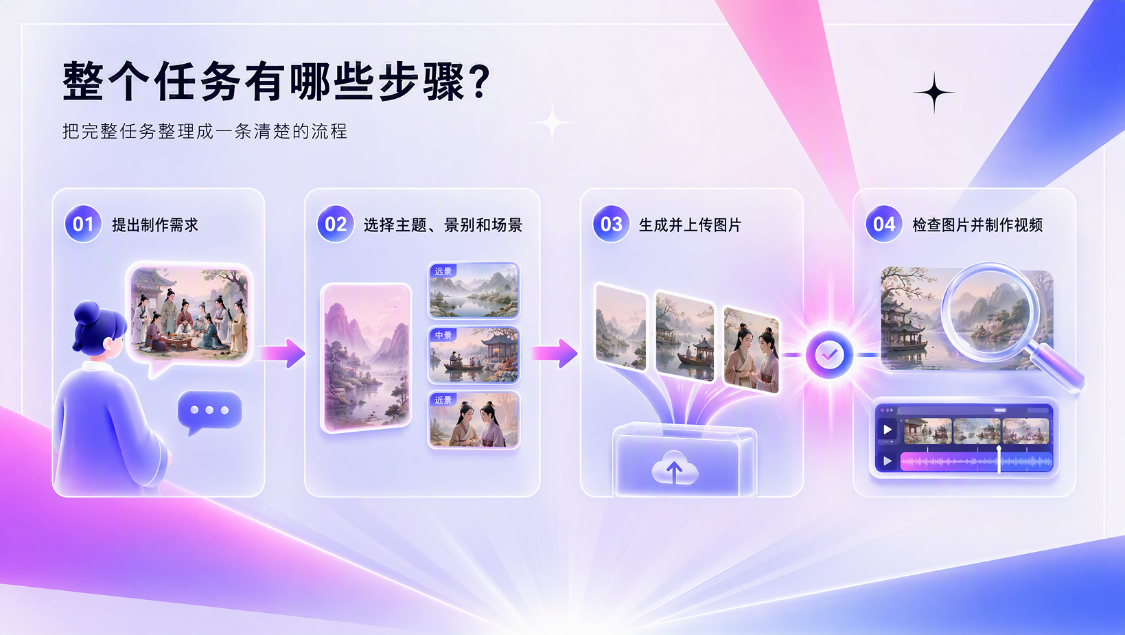
It's the whole Skyll business。
THE SUBSEQUENT RULES AND REFERENCE DOCUMENTS ARE INTENDED TO HELP AI TO COMPLETE THESE STEPS BETTER。
4.4 What are the important rules
In particular, my introductory remarks refer to:
Tana Man
All kinds of things
Image Request
The countryside
Video Template
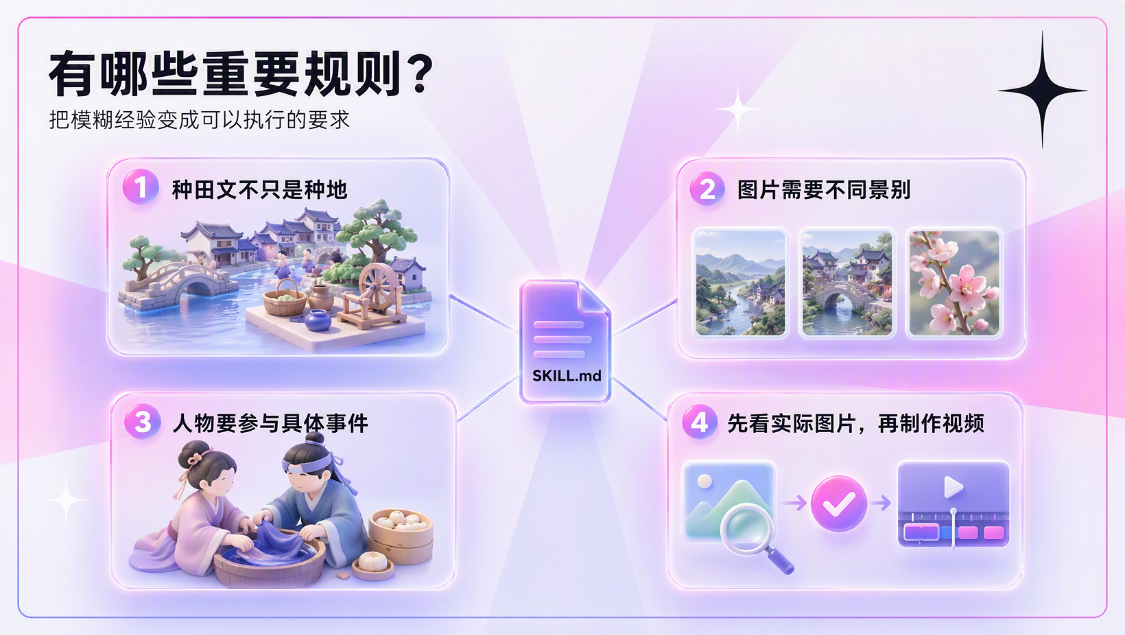
THESE ELEMENTS NEED TO BE CONSOLIDATED INTO AI-ENABLED RULES, TAKING INTO ACCOUNT THE REAL PROCESS OF PREVIOUS GENERATION。
For example:
It's not just land. It's water, town, handwork, food and neighborhood life
Pictures need to include vision, medium view, proximate view and lens interaction
People can't just stand and smile, they have to be involved in specific life events
There's more to the country than just a view
If the user does not determine the theme, provide a few directions first
After the user generates the picture, the actual image must be checked
When no actual picture is seen, no video message can be written directly
Video action needs to be related to the characters, scenes and life events in the picture
These rules determine the quality of the final outcome of Skill。
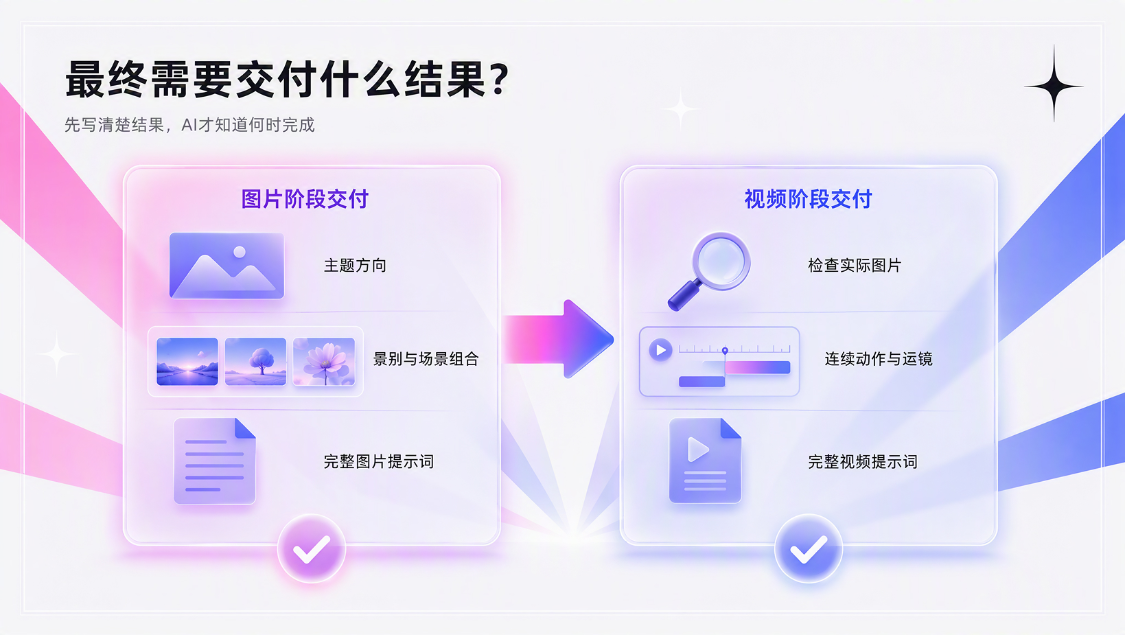
4.5 What ultimately needs to be delivered
This Skill needs to deliver two types of results。
Photo phase delivery:
Possible themes for users
The combination of different scenes and scenes
A series of complete photo tips
Video phase delivery:
Check results of actual user pictures
Video tip for each picture
Personal movements, mirrors and voice requirements
Through these five questions, it became clear that there was a need to compare oralism:
Do what
♪ Under what conditions ♪
What are the steps to be taken
What rules must be followed
What's the final delivery
4.6 Let Codex create the first version of Skill
When the answers to the five questions are clear, Codex can organize the process into Skill。
The resulting document structure is:
_other organiser
SKILL.md
agents/
it's openai.yaml
-references/
image-workflow.md
_other organiser
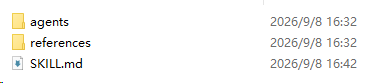
These documents can simply be understood as:
SKILL.md: Save Core Processes and Important Rules
image-workflow.md: detailed requirements for the photo phase
video-workflow.md: detailed requirements for the video storage phase
openai.yaml: Save the display name and default use of Skill
Making Skill from the real process is not a copy of all previous chats, but a search for what really needs to be repeated with five questions。
This can be summarized as follows:
Looking back on the real mission
• Dismantling demand with five questions
→ Remove content that belongs only to a single work
Let Codex be Skill
As a result, a run-through Chinese field video production process was organized into a Skill that could be used repeatedly。
Chapter V: Methodology II — Use of the planned model in the absence of a running mission
If you want to make a Skill, but you haven't run through the whole process, you can get Codex to help you with the reference and planning。
That's what I used when I made the Microsoft-style Skill. (Case links can be found at https://www.super-i.cn/info-3013.html)
At the time, I had collected several Microsoft-style promotional films and prepared a little script, but I didn't know:
How should the quality of this video be summarized
Why is the lens so slender
What should we do with the reference video
How does the analysis work for Feedance 2.5
What steps should the final production process be divided into
So I didn't just ask Codex to create Skill, but to start with the plan。
5.1 Statement of objectives and available material
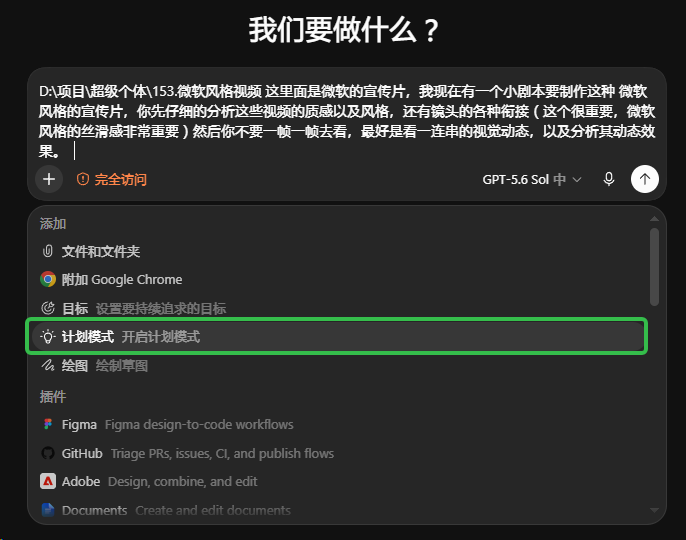
My request to Codex at the time was, in general:
This is a multi-soft-style promotional film. I now have a little script that I'd like to make in this Microsoft style. Please carefully analyse the image, visual style and lens interface of these videos. Camera connection is very important, and what I need is a continuous, silky visual dynamic in a Microsoft promotional film. Instead of describing the picture in a single frame, it looks at a sequence of visual changes, analysing how the object moves, how the image is converted, how the lens is connected, and why the whole body looks smooth. I'll end up making videos using Feedance 2.5. Please enter the plan model and plan how these reference videos should be analysed and not begin production immediately。
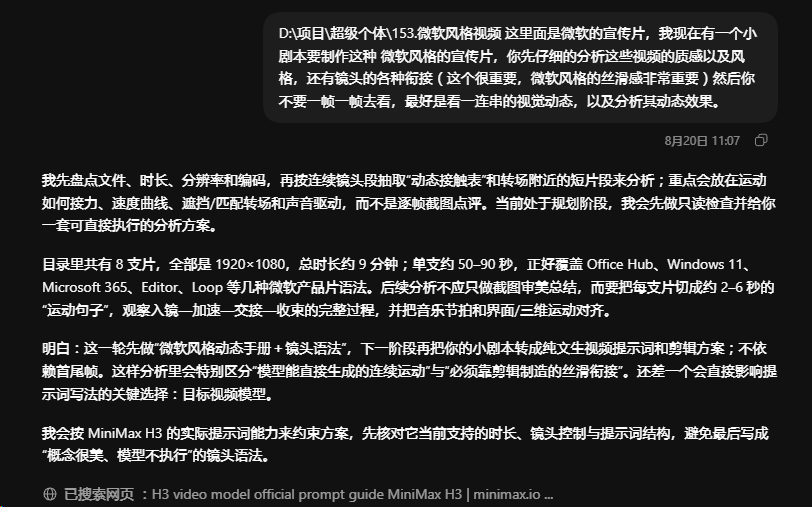
This hint tells Codex four things:
What's the reference
What do you want to make
What's the most important part of the analysis
What kind of video tools will be used at the end
5.2 Review the plan before implementation
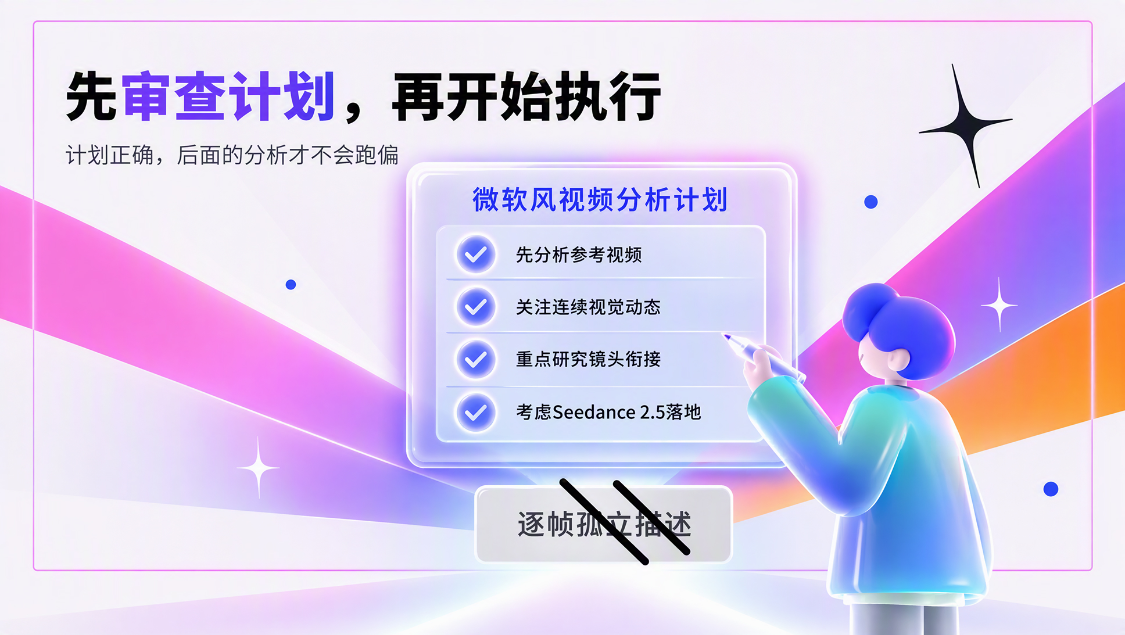
After Codex gives the plan, do not execute it immediately。
Let's check if the plan contains something really important:
Whether to analyze the reference video before processing your own script
Whether to focus on continuous visual dynamics
Whether to analyse changes in the direction and velocity of the object
Whether to analyse the match of the front-and-back lens
Whether or not to focus on the lens connection and the sense of silk
Whether to consider how to use the results of the analysis for Feedance 2.5
Once it has been confirmed that the plan is in line with the objective, Codex will begin implementation。
5.3 Implementation plan, dynamic manual
Codex may be able to organize a “development manual” following a reference video of the planned analysis after confirmation。
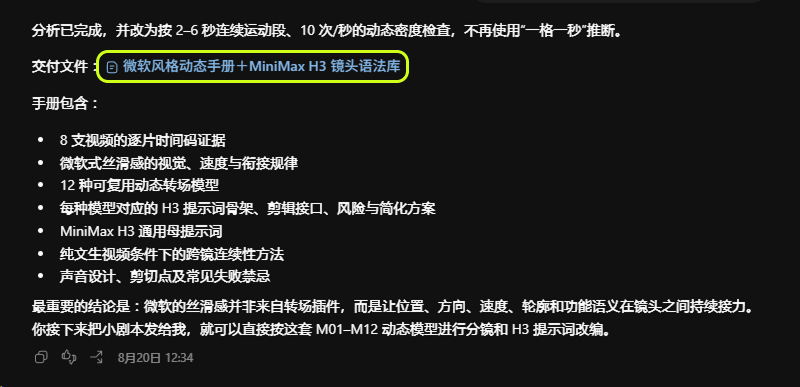
That's when it's not finally Skill。
It's more like a way to make it out of a reference video。
5.4 Combine your own production steps
Once a dynamic manual is in place, a complete production process will be organized, taking into account their actual needs。
For example:
Users provide promotional scripts
1. Refining product information and visual focus
2. Generate 16:9 Microsoft style boards
3. User-generated and uploading actual style boards
4 Split video paragraphs from script
5. Planning key images and lens connections
6 Preparation of Feedance 2.5 video alerts
7 Additional video text and voice requirements
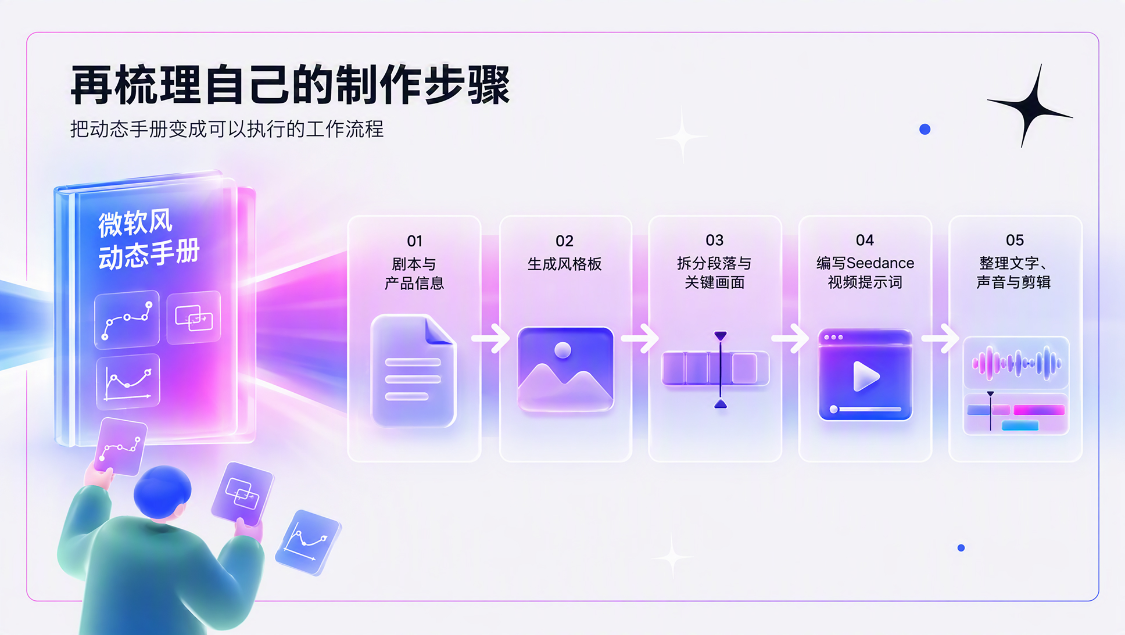
The process is then checked with five questions:
What's Skill's mission
Under what circumstances
What steps have been taken throughout the mandate
What are the important rules
What results are ultimately to be delivered
5.5 And finally, Skill
When the analytical methods of the reference video, the dynamic manual and the steps of its own production are organized, Codex will create Skill。
This approach is appropriate for:
Already has a reference
Well, I guess I know what I want
But I don't know how to make it
Need to study the pattern in the reference
Need Codex to help comb the process
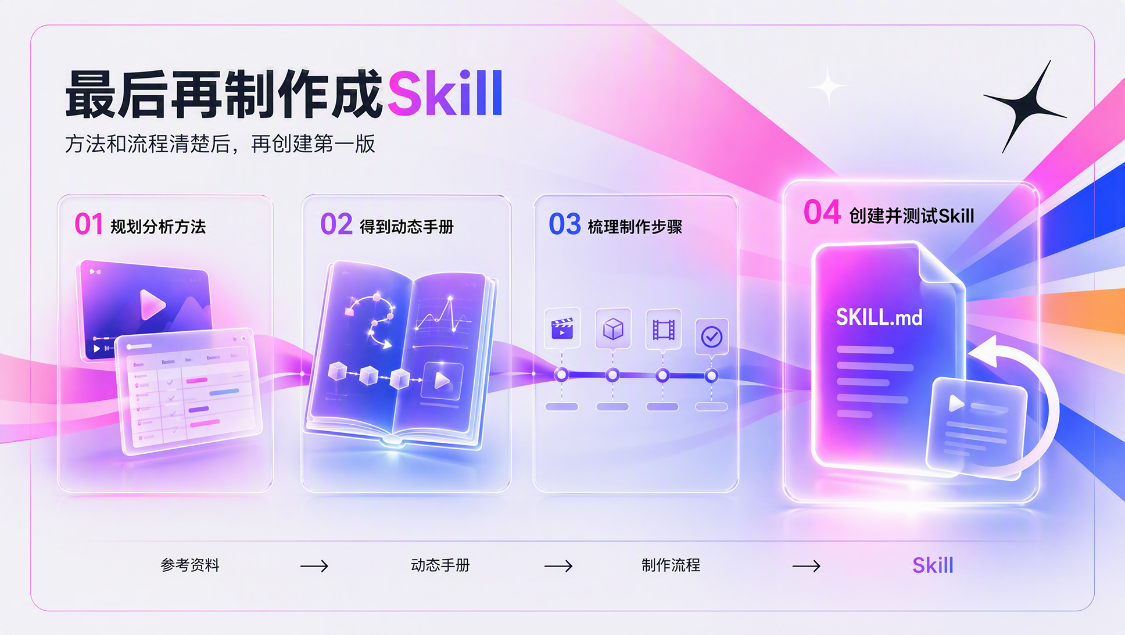
The role of the plan model here is not to write about Skill for you, but to help you figure it out:
How should the reference be analysed and what steps should be taken to complete the task in the future。
Concluding remarks: Choose a method that suits you
Make Skill not ask you to have a perfect set of processes from the start。
If such a task has been completed, then the real process is reviewed and the methods that can be repeated are extracted from five questions。
If it has not yet passed, the first version of the process will be built using the Codex model, which will be tested and modified on a continuous basis through real missions。
The starting points for both methods are different, but they have to be tested for real