



Japan's Yomiuri Shimbun published an article related to "Godfather of AI", an interview with Geoffrey Hinton, professor emeritus at the University of Toronto, Canada, discussing the AI development and potential threats.
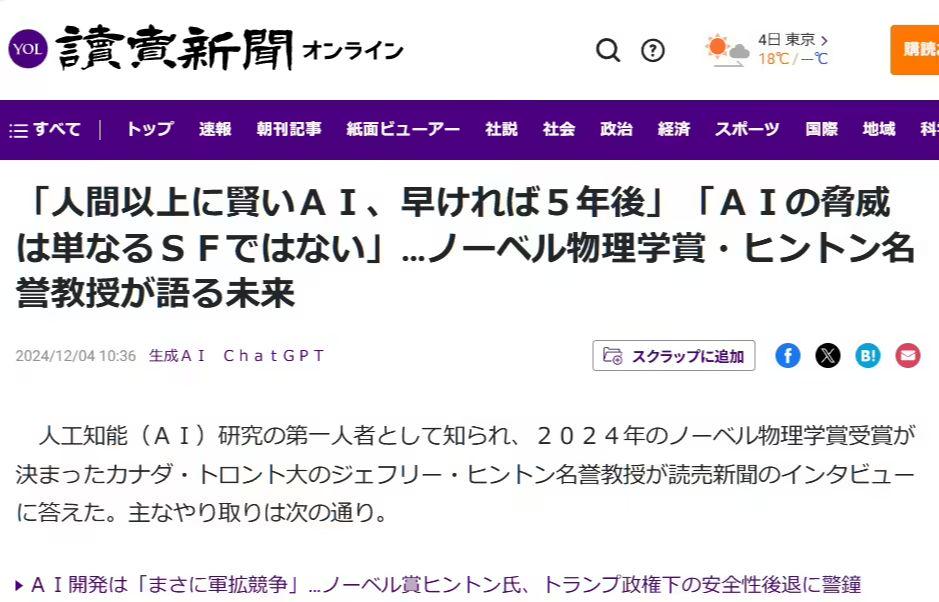
Asked how he sees the potential threat of AI, Hinton said, "Over the years, I've come to think of AI more and more as a kind ofAdvanced Intelligence Beyond HumanityThe question is: what does it mean for human society if AI has the ability to surpass human intelligence and even control us? Because of this, we need to seriously think about the question of what it means for human society if AI possesses intelligence beyond that of humans and even has the ability to control us. ThisIt's not science fiction., but rather tangible risks."
Hinton argues that human life is only about 2 billion to 2.5 billion secondsThat's all the time in the world.Not enough to absorb all the information on the InternetBut if there are 1,000 AIs, each capable of learning different content and sharing it with each other, then all the knowledge is there. But if there are 1,000 AIs, each capable of learning different content and sharing it with each other, it will have all the knowledge. chatGPT already has far more knowledge than any human, enough to make us revisit the potential of AI.
"AI has accelerated in the last few years, far beyond anyone's predictions. In the past, AI that we thought had superhuman capabilities At least 50 to 100 years from now.Only then will it appear. But now it seems that inWithin the next 20 yearsWe are likely to witness AI match or exceedHuman Intelligence. The earliest possible date may be in Within 5 years.”
As 1AI previously reported, the 2024 Nobel Prize in Physics was awarded to Jeffrey Hinton and John Hopfield for their innovative breakthroughs in machine learning. Hinton has said, "AI will have a huge impact, similar to the industrial revolution. It's not about surpassing human physical strength, it's about augmenting our intelligence. We haven't had the same experience before withSomething smarter than us.interactive experience. ai has the potential to deliver better healthcare and improve efficiency, although it can also pose the risk of losing control."