



January 7 news.China ICT CAICT's official public website published a blog post yesterday (January 6, 2025) announcing its efforts to solve the problem of MaaS the uneven quality of platform services and the difficulty of selecting a platform.Launched the MaaS (Model as a service) family of standards.
Project Background
As big models move deeper into industry applications, theHow to adapt the base model to proprietary domains through engineering development and produce intelligent user-oriented applications, becoming a key issue in the last mile of the big model landing.
Various types of MaaS platforms have gradually emerged in the industry, but at the same time, problems such as uneven quality of model services, difficult platform selection, and complex industry customization needs have emerged, thus creating an urgent need for a set of comprehensive standard systems to help the MaaS industry develop in a healthy and orderly manner.
Introduction to Standards
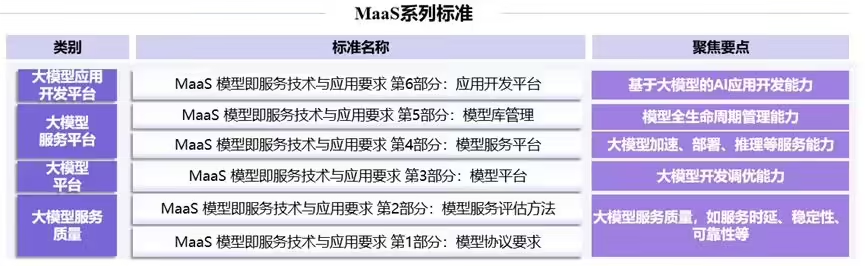
The China Academy of Information and Communications Technology (CIICT), following the latest development trend in the field of MaaS and relying on the China Artificial Intelligence Industry Development Alliance (AIIDA), set up the MaaS Working Group in 2023, and jointly initiated the preparation of the MaaS series of standards with experts from industry, academia and research institutes, and after more than one year's sustained efforts, has now formally released the following standards After more than a year of continuous efforts, the MaaS series of standards are now officially released.
This series of standards focuses on the problems encountered in MaaS landing, focuses on the dimensions of big model customization and tuning, big model service deployment and reasoning acceleration, model management, big model application development, and puts forward the capability requirements, provides the capability construction reference for the big model service providers and platform providers, and provides the technical selection basis for the application side.
This series of standards has the following six parts, IT home attached the relevant introduction is as follows:
- Model Service Agreement Requirements (AIIA / PG 0110-2024):Aspects such as model inference performance, service availability, measurement accuracy, and rights and responsibilities clauses are standardized to provide a reference for service agreements (SLAs) between supply and demand parties.
- Model Services Assessment Methodology (AIIA / PG 0173-2024): It clarifies the assessment methods for modeling quality of service, provides a basis for the compliance evaluation of SLAs, and helps the applicant in technology selection.
- Model platforms (AIIA/PG 0134-2024): Standardizes full-stack capabilities from data engineering to service operations, lowers the technical threshold for domain model customization, and improves efficiency and capabilities.
- Model Services Platform (AIIA/PG 0137-2024): It standardizes the full-process capabilities of large model servitization APIs, guides platform providers in capacity building, and improves deployment efficiency and service quality.
- Model Management Platform (AIIA/PG 0193-2024): It standardizes the management and operation of AI assets, and promotes the use of large models by users through model cards and other means, giving full play to the synergistic effect of large and small models.
- Model Application Development Platform (AIIA/T 0196-2024)The company has standardized the whole process of AI application development based on big models, from component construction to platform operation, to help enterprises quickly create private domain big model applications.
Officials said that since the second half of 2024, when the MaaS series of evaluations was launched, the first round of evaluations of some of the modules of seven enterprises, including KDDI, Wave Cloud, Huawei Cloud, Haojia, Profound Pavilion, ZiGuang, and Unicom, have been completed, and a new round of evaluations is underway.