



March 14, 2012 - In order to promoteAIhealthy development, regulate the artificial intelligence generated synthetic content logo, protect the legitimate rights and interests of citizens, legal persons and other organizations, and safeguard the public interest of society, the State Internet Information Office, the Ministry of Industry and Information Technology, the Ministry of Public Security, the State Administration of Radio and Television formulated theArtificial intelligence to generate synthetic contentMarking scheme(hereinafter referred to as the "Marking Measures"), which will come into effect on September 1, 2025.
In recent years, the rapid development of generative artificial intelligence, in-depth synthesis and other new technologies has provided a convenient tool for generating synthetic text, images, audio, video and other information, which, while promoting economic development, enriching online content and facilitating the public's life, has also resulted in the dissemination of false information and undermined the network ecology. Society has widely called for accelerating specialized legislation, strengthening technical supervision, and solidifying the responsibility of platforms. In order to actively respond to social concerns and public interest, the State Internet Information Office (SIIO), together with the Ministry of Industry and Information Technology (MIIT), the Ministry of Public Security (MPS), and the State Administration of Radio and Television (SARFT), has formulated the Measures for Marking. The Marking Measures take content marking as a hand, refine the marking-related requirements of the relevant departmental regulations in the early stage, further play the technical role of content marking to remind and supervise traceability, and strive to build an open, fair and effective governance mechanism, create a fair and orderly development environment, and promote the healthy and orderly development of the AI industry.
The Marking Scheme makes it clear thatArtificial intelligence generates synthetic content logos in two main forms: explicit and implicit logosExplicit logo refers to the logo added in the generated synthetic content or interactive scene interface, which is presented in the form of text, sound, graphics, etc. and can be clearly perceived by the user; implicit logo refers to the logo added in the generated synthetic content file data by taking technical measures, which is not easy to be clearly perceived by the user.
The Marking Scheme proposes that those who carry out AI-generated synthetic content marking activities in accordance with the relevant requirements of the Administrative Provisions on Algorithmic Recommendation of Internet Information Services, the Administrative Provisions on Depth Synthesis of Internet Information Services, and the Interim Measures for the Administration of Generative Artificial Intelligence Services, shall comply with the relevant requirements of the Marking Scheme.
The Measures on Labeling require that, if the generation synthesis service provided by a service provider belongs to the first paragraph of Article 17 of the Administrative Provisions on Depth Synthesis of Internet Information Services, it shall add explicit labeling to the generation synthesized content in accordance with the requirements; service providers shall add implicit labeling to the metadata of the files of the generation synthesized content in accordance with Article 16 of the Administrative Provisions on Depth Synthesis of Internet Information Services; and service providers that provide network information content dissemination services shall take technical measures to regulate the dissemination activities of the generation synthesized content. Service providers of network information content dissemination services shall take technical measures to standardize the dissemination activities of generated synthetic content.
The Marking Scheme emphasizes thatNo organization or individual shall maliciously delete, tamper with, falsify or conceal the generated synthetic content logo as provided for in these measures., shall not provide tools or services for others to commit the above malicious acts, and shall not harm the legitimate rights and interests of others by means of improper marking.
1AI attaches the full text of the Marking Scheme below:
Article 1 In order to promote the healthy development of artificial intelligence, regulate the identification of synthetic content generated by artificial intelligence, protect the legitimate rights and interests of citizens, legal persons and other organizations, and safeguard the public interests of the society, according to the Network Security Law of the People's Republic of China, the Provisions on the Administration of Algorithmic Recommendation of Internet Information Services, the Provisions on the Administration of Depth Synthesis of Internet Information Services, and Interim Measures for the Administration of Generative Artificial Intelligence Services, etc., these Measures are formulated. Laws, regulations and departmental rules, to formulate these measures.
article 2 These Measures shall apply to network information service providers (hereinafter referred to as "service providers") carrying out AI-generated synthetic content labeling activities in compliance with the provisions of the Administrative Provisions on Algorithmic Recommendation of Internet Information Services, the Administrative Provisions on In-depth Synthesis of Internet Information Services and the Interim Measures for the Administration of Generative Artificial Intelligence Services.
Article III Artificial Intelligence Generated Synthesized Content refers to information such as text, images, audio, video, virtual scenes, etc. that are generated and synthesized using Artificial Intelligence technology.
Artificial intelligence generates synthetic content logos including explicit and implicit logos.
Explicit logos are logos that are added to the interface of the generated synthetic content or interaction scenarios, which are presented in the form of text, sound, graphics, etc. and can be clearly perceived by the user.
Implicit marking refers to technical measures taken to add marking to the data of the generated synthetic content file that is not easily and obviously perceived by the user.
Article 4 Service providers to provide the generation of synthetic services belonging to the "Internet information services depth synthesis management provisions," the first paragraph of Article 17 of the situation, should be in accordance with the following requirements of the generation of synthetic content to add explicit identification:
- (a) Adding signs such as textual hints or universal symbols at the beginning, end or appropriate position in the middle of the text, or adding prominent hints in the interface of the interactive scene or around the text;
- (ii) Add voice prompts or audio rhythmic prompts and other signs at the beginning, end, or middle of the audio, or add prominent prompts in the interface of the interactive scene;
- (iii) Add a prominent reminder logo at an appropriate place in the picture;
- (d) Add a prominent reminder logo at the appropriate location around the video start screen and video playback, and may add a prominent reminder logo at the appropriate location at the end and in the middle of the video;
- (v) When presenting a virtual scene, add a prominent reminder sign at an appropriate location on the starting screen, which can be added at an appropriate location during the ongoing service of the virtual scene;
- (f) Other generation of synthetic service scenarios according to the characteristics of their own applications to add a significant reminder of the logo.
When service providers provide functions such as generating synthetic content for download, copying, and exporting, they should ensure that the files contain explicit identifiers that meet the requirements.
Article 5 The service provider shall, in accordance with the provisions of Article 16 of the Administrative Provisions on Depth Synthesis of Internet Information Services, add an implicit identification in the metadata of the file that generates the synthesized content, which contains information on the attributes of the generated synthesized content, the name or code of the service provider, the content number and other information on the production elements.
Service providers are encouraged to add implicit identifiers in the form of digital watermarks and other forms to generated synthetic content.
File metadata refers to descriptive information embedded in the header of a file according to a specific encoding format, which is used to record the information content of the file such as its source, attributes, and usage.
Article 6 Service providers offering network information content dissemination services shall take the following measures to regulate the generation of synthetic content dissemination activities:
- (a) Verify whether the metadata of the document contains implicit identification, and where the metadata of the document is clearly labeled as generated synthetic content, take appropriate means to add a prominent reminder logo around the published content to explicitly remind the public that the content belongs to the generation of synthetic content;
- (ii) If the implicit identification is not verified in the metadata of the document, but the user declares that it is generated synthetic content, an appropriate way is taken to add a prominent reminder logo around the published content to remind the public that the content may be generated synthetic content;
- (c) The metadata of the document is not verified to the implicit logo, and the user has not declared that it is generated synthetic content, but if the service provider providing network information content dissemination services detects the explicit logo or other traces of generation and synthesis, it will identify the content as suspected of being generated synthetic content, and will take appropriate means to add a prominent reminder logo around the published content to remind the public that it is suspected of being generated synthetic content;
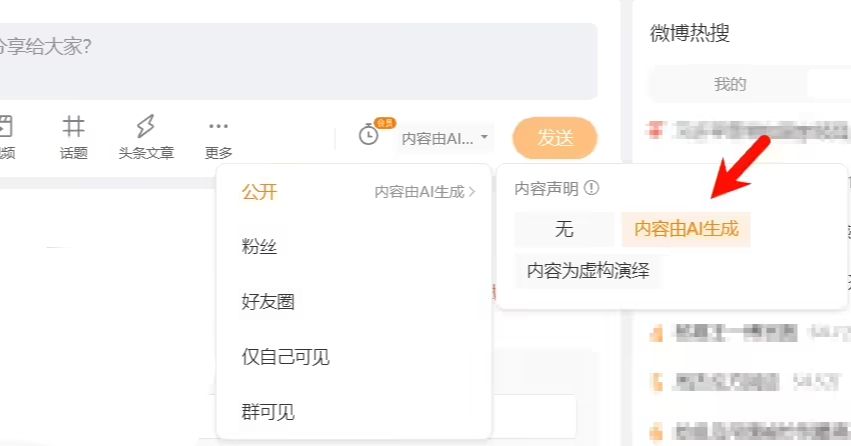
- (d) Provide the necessary identification functions and remind users to proactively declare whether the published content contains generated synthetic content.
In the case of the first to third subparagraphs of the preceding paragraph, information on the attributes of the generated synthetic content, the name or code of the dissemination platform, the content number and other dissemination elements shall be added to the metadata of the document.
Article 7 The Internet application distribution platform shall require the Internet application service provider to state whether it provides artificial intelligence generation and synthesis services when the application is put on the shelves or reviewed on the line. Internet application service providers to provide artificial intelligence generation synthesis services, Internet application distribution platforms should verify its generation of synthetic content identification materials.
Article 8 The service provider shall clearly state in the user service agreement the method of generating synthetic content logo, style and other normative content, and prompt the user to carefully read and understand the relevant logo management requirements.
Article 9 If the user applies for the service provider to provide the generated synthetic content without adding explicit identification, the service provider may, after clarifying the user's identification obligations and use responsibilities through the user agreement, provide the generated synthetic content without explicit identification and retain the relevant logs such as the information of the provided objects for not less than six months in accordance with the law.
Article 10 Users who use network information content dissemination services to publish generated synthetic content should take the initiative to declare and use the identification function provided by the service provider for identification.
No organization or individual shall maliciously delete, tamper with, forge or conceal the generated synthetic content logo as stipulated in these Measures, or provide tools or services for others to carry out the above malicious acts, or harm the legitimate rights and interests of others through improper logo means.
Article 11 Service providers carrying out labeling activities should also comply with relevant laws, administrative regulations, departmental rules and mandatory national standards.
Article 12 Service providers shall, when performing procedures such as algorithm filing and security assessment, provide materials related to generating synthetic content logos in accordance with these Measures, and strengthen the sharing of logo information to provide support and assistance in preventing and combating related illegal and criminal activities.
Article 13 Violations of the provisions of these Measures shall be dealt with by the relevant competent authorities of Internet information, telecommunications, public security and radio and television in accordance with their duties and in accordance with the provisions of the relevant laws, administrative regulations and departmental rules.
Article 14 This regulation shall come into force on September 1, 2025.