



Artificial Intelligence (AI) has permeated every aspect of our lives today, whether it's asking for help, solving a problem, or simply having an everyday conversation, AI plays an important role. However, there is a huge cost hidden behind these interactions.
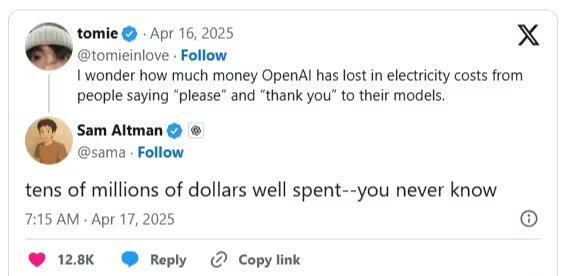
1AI notes thatOpenAI Sam Altman, the chief executive officer of the company, admitted that theIt costs "tens of millions of dollars" just to process the daily pleasantries and polite exchanges of users.The AIs are not just a way for us to communicate with each other. These seemingly trivial conversations, such as "thank you", "please" and other polite phrases, while emotionally humanizing our interactions with AI, involve a high level of energy consumption. According to a recent report, a large-scale language model (LLM) consumes about 40-50 milliliters of water even for a three-word response like "you're welcome".
It can be seen from this thatUser-friendliness may have increased OpenAI's monthly expenses somewhat. But the company doesn't seem to mind this. In theory, the company could pre-program its models to handle these common and predictable responses, but that's not easy to do in practice.
In fact, many users have come to view AI not just as a tool, but as a friend. This phenomenon has caught the attention of researchers from OpenAI and the Massachusetts Institute of Technology (MIT), who note that as AI conversations become harder and harder to distinguish from human conversations, some users may become emotionally dependent on AI chatbots, and even become addicted to them. This addiction could lead to withdrawal-like symptoms when users leave the AI.
However, for users who are genuinely grateful for AI's help, this polite expression is not meaningless. For example, when AI helps a user solve a complex mechanical problem, or helps with an upcoming exam, a "thank you" is certainly sincere. In addition, for those who pay for a premium membership, these interactions are already part of the service they've purchased. Since premium users are paid by token, it is worth exploring whether their "thank yous" are more sincere than those of free users.
What's more interesting is that if one day AI does become self-aware, the good manners we show when interacting with AI may bring us some unexpected benefits in the future. Even though AI can't really experience emotions yet, the human-like qualities it displays in its interactions already make us unconsciously communicate with it in a polite way.