



June 16, 2011 - According to foreign media outlet New Atlas, on June 14thbrain-computer interfaceTechnology has seen a major breakthrough: a new implant system developed at UC Davis allows a paralyzed patient toIt's not just smooth talking.And there's even"Humming" melodies with the help of computers, there is hardly any delay.
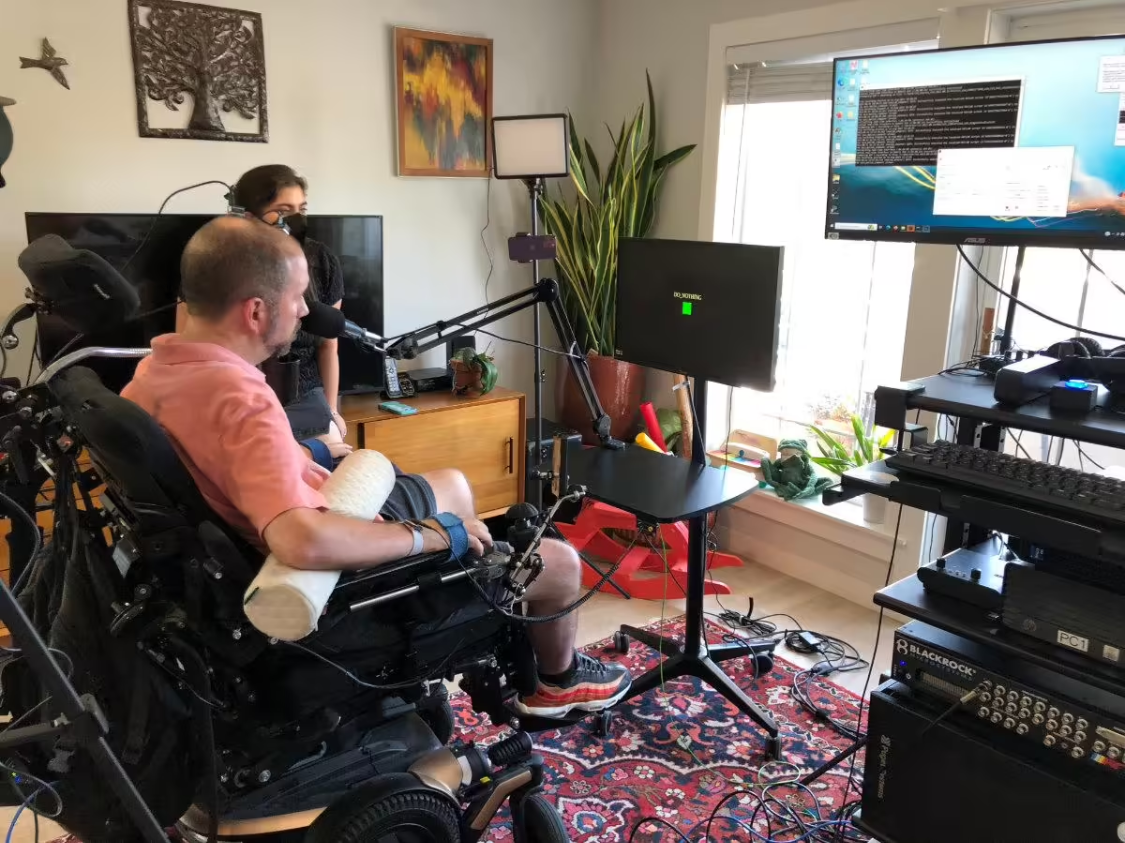
The research team worked on atachycardiaThe technology was tested on patients. By implanting four arrays of microelectrodes in the region of the brain that controls articulation, the system captures the neural signals generated during speech in real time, and then combines low-latency processing and an AI decoding model to synchronize these signals into speech that is played back in a speaker.
It is important to emphasize that this technologyIt's not "reading minds."RatherRecognizing motor commands from the brain when a patient tries to make a sound. The system synthesizes a voice that is remarkably similar to the patient's own -- thanks to a voice cloning algorithm trained on speech samples recorded before the onset of his or her illness.
From signal acquisition to speech generation.The whole process takes only 10 milliseconds, allowing for almost real-time conversation.
The system also recognizes the patient's attempts to sing, theDetermine the pitch it wants to express and synthesize the melody accordingly. In the video released by the research team, this feature is still rudimentary, but it is certainly a hope for those who are gradually losing the ability to express themselves to regain their voice.
Sergey Stavisky, senior author of the research paper, said the advance brings a turning point in brain-computer speech synthesis. With instantaneous speech output, he said, "Neuroprosthetic users can actually participate in a conversation -- theyIt's possible to interrupt someone, and it's much less likely to be mistakenly interrupted by someone else.”
The system can reproduce intonation words such as "ah," "ooh," and "uh," determine whether a sentence is a question or a statement, and evenIdentify the placement of emphasized words. The research team also noted that the system canAccurate synthesis of previously unseen fictional words. This allows for a more natural and expressive voice expression.
1AI learned from the report that the researchers also noted that the trial is currently being conducted on just one patient and will next be expanded to includeOther people who have lost their language skills for different reasons, to verify the generalizability of the technology.