



June 16 news.Massachusetts Institute of TechnologyA newly developed technology that allows AI An alternative approach to restoring famous paintings - by means of a removable mask (understood as an "AI-generated solid layer"), it is possible to make a reversible restoration directly on the body of the painting.
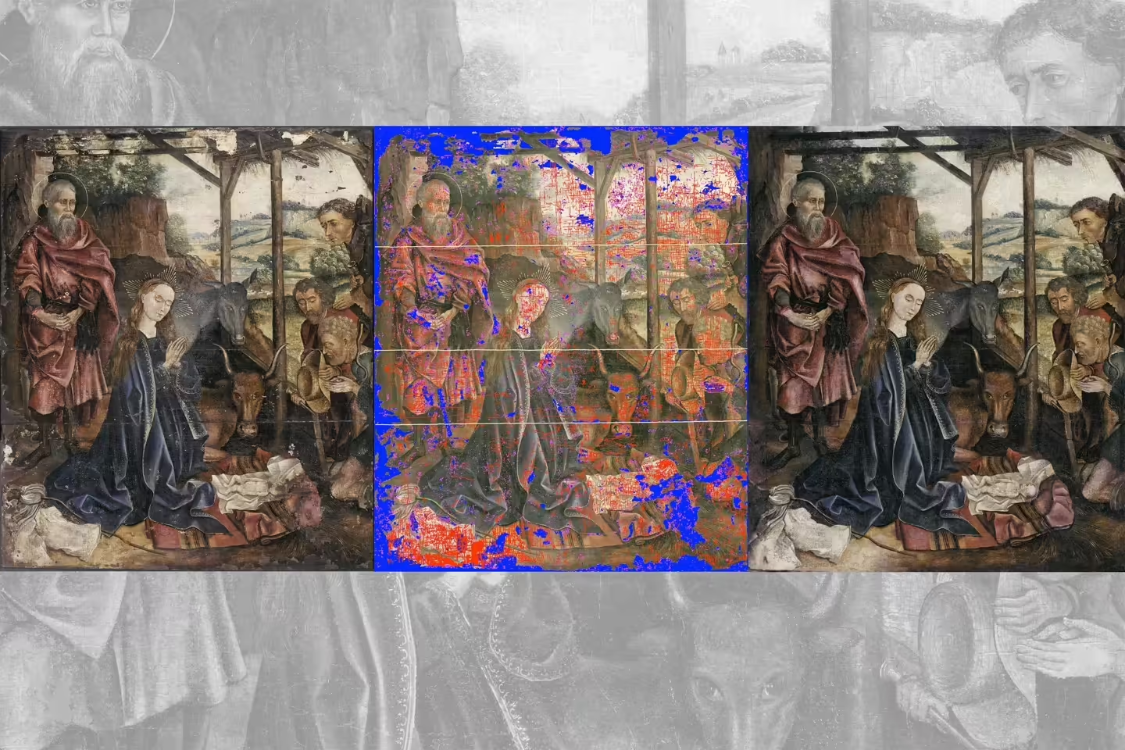
According to a June 11 report in MIT News, the technology was designed by mechanical engineering graduate student Alex Kachkine, who has a passion for restoring paintings in the traditional hand-painted manner. He noticed that many art museum collections were being damaged byCostly and time-consuming to repairAnd it's been sitting on the shelf for years. With this new approach, restorations that might have taken weeks, months or even years are nowIt only takes a few hours.It can be done.
During the development process, he first chose anSeverely damaged 15th centurypastelAs an experimental subject and in a traditional manner, excess pigment covered in historical restoration was removed, and the cleaned paintings were subsequently scanned at high resolution.
1AI learned from the report that he analyzed the image with the help of AI algorithms to generate a digital model of the painting as close to its original form as possible. He then utilizedSelf-developed software creates a "damage map."LabelingPeeling, cracking or fading of pigmentsposition and gives information about the color that needs to be filled.
Using a high-precision inkjet printer, the digital map is transformed into a double mask printed on an ultra-thin, transparent polymer film. One layer is responsible for precise coloring, while the other is a white substrate for enhanced color saturation. kachkine explains that for complete color reproduction, both white and colored inks must be printed at the same time.
Finally, this mask was precisely fitted against the picture and fixed to the canvas with a thin spray of varnish.
Both mask and varnish can be safely removed with existing restoration materials.No damage to the original painting. Also, this digital map will serve as a permanent record for future generations to refer to for restoration information.
In this experiment, Kachkine 57,314 colors were used, 5612 damages were repaired, and it took only three and a half hours!. He estimates that if it were entirely by hand, the time would be what it is now 66 times.
Kachkine says, "There are still too many broken artworks sitting in dusty warehouses, perhaps unloved forever. Hopefully this technology will bring them back to life, which would be a delight."