



Yesterday morning,Meta research scientist Rishabh Agarwal posted a message announcing that he was leaving Meta's superintelligence team:
Whether or not to continue with the new Superintelligence TBD lab was a tough decision for me, especially in that highly concentrated environment of talent and computing power. But he notes, "After 7.5 years at Google Brain, DeepMind, and Meta, I still feel a drive to take a different type of risk."
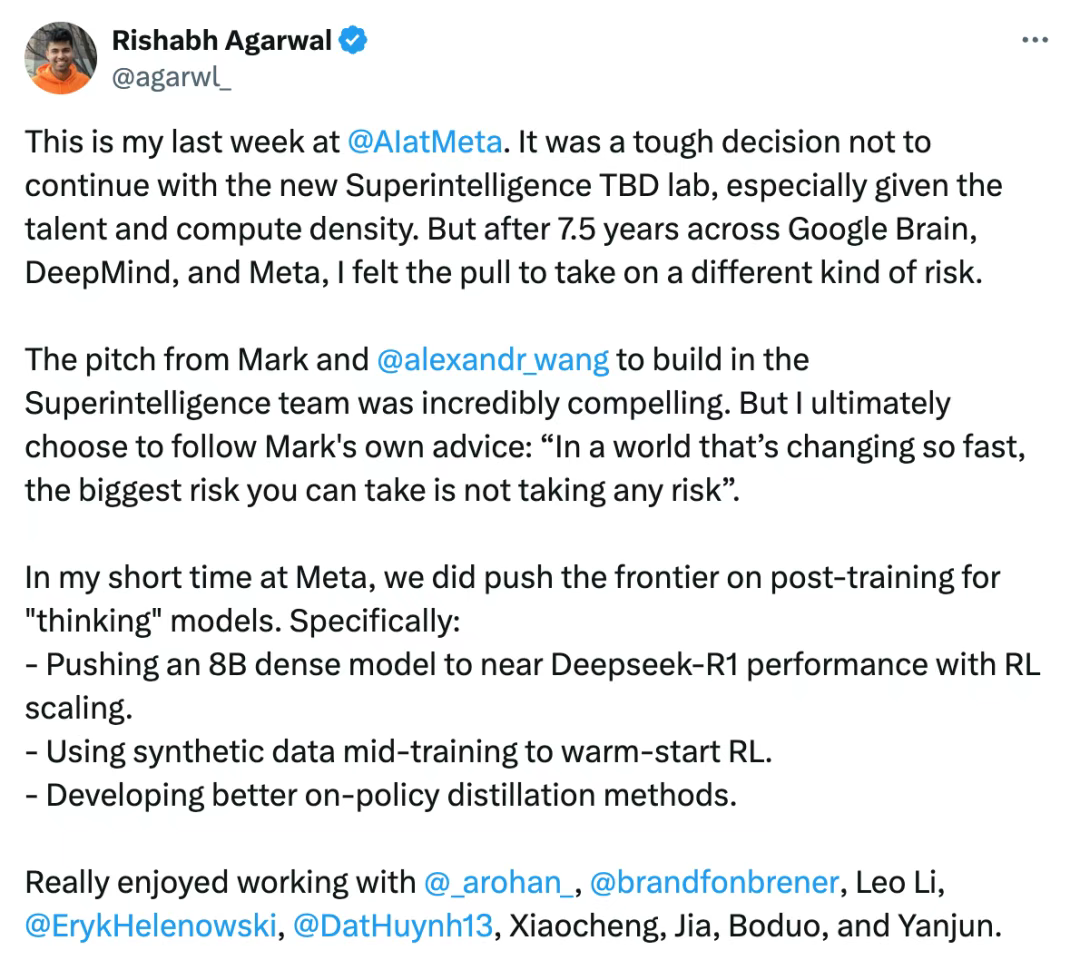
At the end of the article, however, Rishabh notes that "Mark (Zuckerberg) and Alexandr Wang's vision of joining the Superintelligence team was very appealing.But in the end I chose to follow Mark's own advice: 'In a world that is changing so fast, the biggest risk you can take is to take no risks at all.'"
Interestingly, Meta's Superintelligence Lab has just kicked off, with all the funding and computing power it needs, and CEO Zuckerberg is personally shouting slogans to make sure that "everyone has superintelligence". And in order to win the AI race, the recent pace of Meta's recruitment is also exceptionally aggressive.
Zuckerberg has reportedly offered up to nine-figure dollar salaries to a number of top researchers, and has even personally recruited talent from OpenAI, Google, and other companies via email and WhatsApp, with total salaries offered sometimes reaching $100 million.
As of mid-August, Meta had successfully poached more than 20 people from OpenAI, at least 13 from Google, three from Apple, three from xAI, and two from Anthropic, totaling more than 50 new hires. However, rumors have recently surfaced that Meta, after months of hiring more than 50 AI researchers and engineers, last week began freezing hiring in its AI department, downsizing it, and reorganizing its AI team.
Rishabh is known to have tossed around a number of results with his team in Meta, such as advancing progress in post-training "thinking" models, and pushing an 8 billion parameter dense model to near Deepseek-R1 performance with RL extensions.