



September 9 News, TodayTencentReleased a New AI CLI Tool CodeBuddy Code, and Announced the Public Beta of CodeBuddy IDE International Version, Open to All Users Without Invitation Codes.
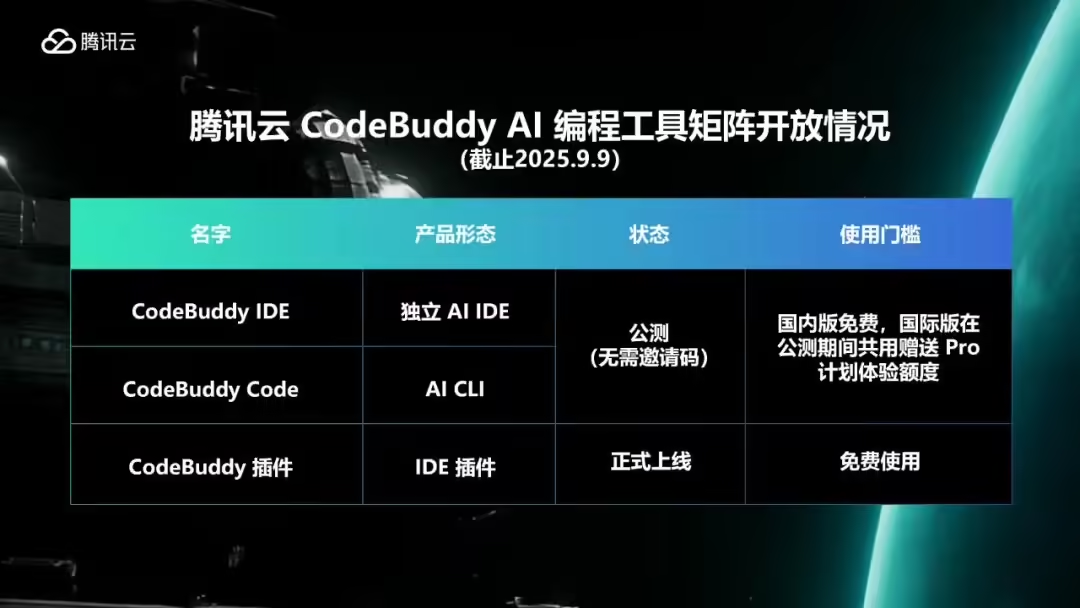
With This, Tencent Cloud Becomes the First Provider in the Industry to Support Three Forms of AI Tools—Plugin, IDE, and CLI— Programming ToolsCatering to the Full Spectrum of Needs, from Professional Developers to Zero-Base Users.
According to Reports, Users Can Freely Use the Full Suite of CodeBuddy Domestic Products, Seamlessly Accessing Large Models Like DeepSeek; The International Version Supports Mainstream Models Such as GPT and Gemini, with IDE and CLI Sharing Quotas (Some Trial Quotas Are Provided During the Testing Period).
1AI Noted That as Early as Last Year, Tencent Cloud Launched the IDE Plugin "Code Assistant CodeBuddy," Becoming China's First Code Assistant to Support the MCP Protocol. In July 2025, "CodeBuddy IDE" Entered Internal Testing as a Standalone Product, Promoting "Conversation as Programming," Allowing Users Without Coding Background to Complete the Entire Process from Concept to Deployment via Natural Language.
The Newly Released CodeBuddy Code Is an AI CLI Tool Aimed at Professional Engineers, Supporting Natural Language-Driven Development in the Command Line for Ultimate Automation.
Similar to Different "Driving Modes": the Plugin Is "Manual Transmission" for Precise Control; the IDE Is "Automatic Transmission" for Ease and Convenience; the CLI Is "Track Mode" for Pursuing Maximum Efficiency.
According to Reports, CodeBuddy Code Is Not an Ordinary Command-Line Tool but an Intelligent Terminal Assistant Deeply Integrated with AI Capabilities. It Can Be Installed with One Command via npm (npm install -g @tencent-ai/codebuddy-code), Allowing Developers to Use Natural Language Directly in Their Familiar Command Line. For Example, a Command Like "Help Me Refactor All Components in the src Directory into React Hooks" Can Automatically Generate Code, Run Tests, Handle Dependencies, and Even Complete Deployment.
Its Core Advantages Can Be Summarized As:
● Seamless Integration into Existing Workflows: Supports Integration with Tools Like Git and npm via Pipelines Without Changing Developer Habits;
● Out-of-the-Box Usability and High Extensibility: Built-In Tools for File Editing and Command Execution, Supporting Flexible Expansion via the MCP Protocol;
● Automation of Complex Tasks: Ideal for Batch Processing Scenarios Such as Refactoring, Debugging, and CI/CD, Enhancing Efficiency.