



The news of December 9thUSAPresident Donald Trump said he would sign an executive order this week to establish artificial intelligenceAITHE UNIFORM RULES (ONE RULE) IN THE FIELD ARE INTENDED TO LIMIT THE ABILITY OF THE CANTONS TO DEVELOP THEIR OWN REGULATORY POLICIES FOR THIS TECHNOLOGY。
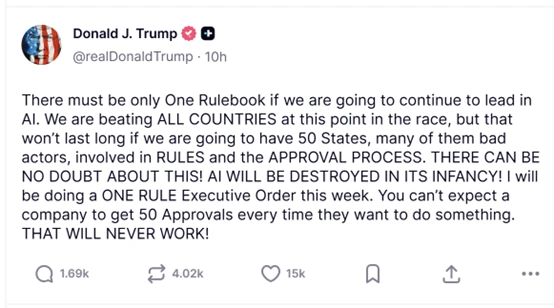
1AI NOTES THAT TRUMP WROTE IN SOCIAL MEDIA ON MONDAY THAT “I WILL ISSUE AN EXECUTIVE ORDER `UNIFORM RULES' THIS WEEK。You can't expect a company to get 50 states' approval every time it wants to do something. That won't work”
According to a draft of a potential executive order seen by the Bloomberg Government last month, the order would empower the Ministry of Justice to prosecute state-level artificial intelligence regulations that it considers unconstitutional and threaten to reduce federal funds in states that have laws that are considered overly cumbersome or restrictive。
This upcoming executive order is the latest attempt by Trump to leave a personal mark on artificial intelligence policy. Artificial intelligence technologies are developing rapidly and are increasingly being widely adopted by businesses, Governments and the general public. This will also be seen as a victory for the leaders of the artificial intelligence industry, who have been critical of the way states regulate themselves。
As the United States Congress has yet to agree on a regulatory framework for artificial intelligence at the federal level, the states have accelerated the enactment of legislation to protect their citizens from potential risks. Kevin Hassett, director of the White House National Economic Commission, said in an interview with CNBC on Monday that he had read the draft executive order。
Hasset said: “Some states want to impose maximum regulation on these companies. This executive order, which the President promised to issue, would make it clear that United States companies only had to comply with a uniform set of rules in the United States.”
Turang leaders of the science and technology industry warned that the fragmentation of state regulations would stifle innovation and complicate corporate compliance. However, Trump ' s attempt to take over state law by executive order has attracted criticism from some Republican governors, including Ron DeSantis, Governor of Florida, and Sarah Huckabee Sanders, Governor of Arkansas. Any such executive order may face legal challenges。
The Executive Order is also part of the Trump Government ' s broader artificial intelligence strategy, which aims to ensure that the United States remains dominant in this critical area。
Trump wrote on social media, "We are now leading all nations in this competition, but if we let 50 states-- Many of these are undesirable actors - all involved in the rule-making and approval processes, and this advantage will not last long. There's no doubt about that! Artificial intelligence will be destroyed in the shadows!"
Previously, Trump had signed a number of executive orders to simplify the process of building artificial intelligence infrastructure in the United States and to support the provision of electricity security for the AI data centre for high energy consumption. He was also committed to simplifying the procedures required for United States enterprises to export related products. Last month, Saudi Crown Prince Mohammed bin Salman successfully obtained United States approval to sell advanced artificial intelligence chips to Saudi Arabia during his visit to the United States。
In addition, last month Trump signed an executive order to launch the Genesis Mission, which aims to better coordinate the analytical work of federal agencies and to integrate the AI tools more effectively to facilitate scientific breakthroughs。