



With the multiplicity of large models, the emergence of more technological structures and the emergence of diversified products, and the contribution of the academic communityAgentic AI AND AI AgentThe whole new interpretation of these concepts may have gained a deeper understanding in the circles of technology, products and so on. However, the relevant practitioners in various fields remain vague on several concepts。
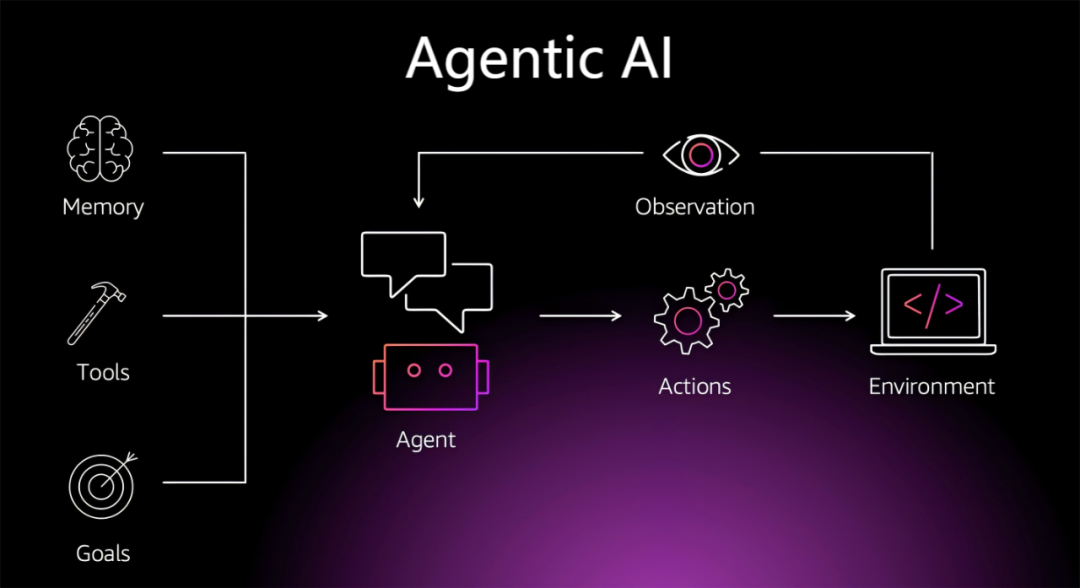
Now that AI Agent has become the mainstream of AI applications, the Agent-based AI system has really begun to evolve from a reactive response tool to an active Agentic AI system. In the process, the terms AI Agent, Agency Workflow and Agency AI are also being used extensively. However, in the different papers, frameworks and products, the addressees are often not consistent with the hierarchy。
Such conceptual confusion often leads to less than good results, most directly reflected in:
- System capabilities are miscalculated and single-body Agent is misconceived as system-level intelligence
- The architecture design is out of focus, replacing the system design with process complexity
- Governance and security issues are systematically neglected。
While, from an application perspective, current AI Agent, Actic Workflow and Actic AI speak of active AI applications based on LLM, there is a need to clarify the differences and linkages between these concepts. Understanding the interlinkages between the three is important for a clear understanding of the future direction of automation and intellectual collaboration。
So, what is the relationship between them, the concept of mutual independence, or the progressive system
From the point of view
Agentic AI, AI Agent and Agentic Workflow are three closely related but different concepts in the field of artificial intelligence. The three concepts, characteristics, scope and focus are as follows。
AI Agent
AI Agent is an independent software computing entity with the capacity to perform autonomous tasks (objectives, perception-decision-implementation) with the core characteristics of enabling the achievement of pre-defined objectives through a closed-ring process that perceives the state of the environment, plans for dynamic decision-making, initiatives to implement the operation, and is the self-functioning core implementation module of the Agenic AI system。
Typically in practice, for example, AI Agent in the AWS solution has the autonomy to process customer counselling, retrieve the internal knowledge base and export solutions without manual intervention throughout the process; and AI Agent in Salesforce has the ability to connect all-weather customers, understand natural language claims and provide data insight and decision support。
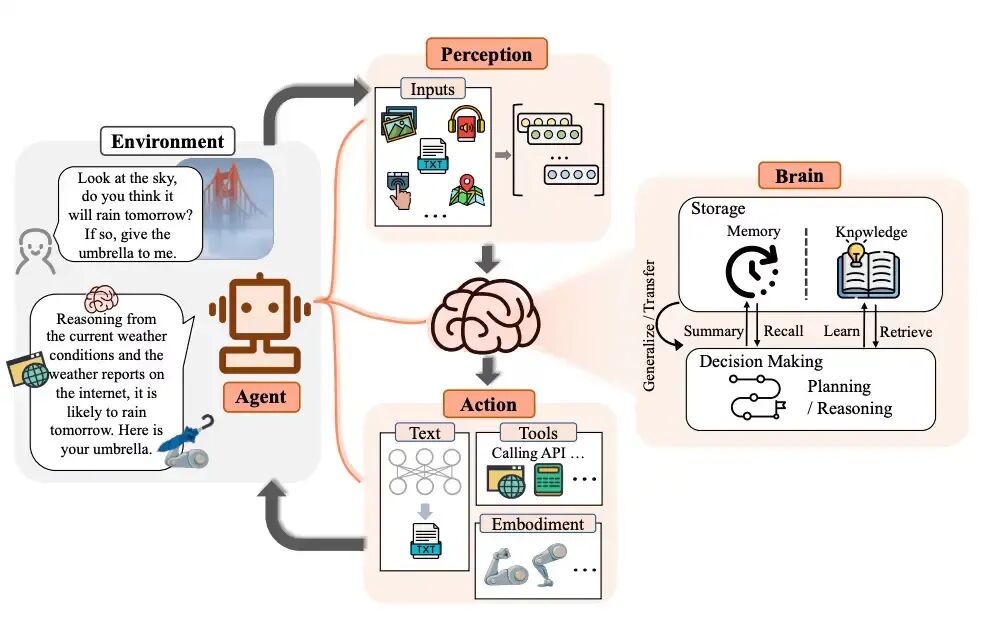
Source: The Rise and Policy of Large Language Model Based Agens
The main features of AI Agent are as follows:
- Core competencies: Develop a complete closed circle of “sensitization-decision-action”. Access to environmental information through sensors or data interfaces (sensitization), production of implementation programmes (decision-making) based on a rule-based engine, algorithmic model or large-linguistic model, and use of an implementer to act on the environment or system (action)。
- MODULES COMPRISE THE SENSORY MODULE, THE DECISION ENGINE (RULES/CALCULATIONS/LLM-DRIVEN), THE SHORT- AND LONG-TERM MEMORY MODULE, THE ACTION IMPLEMENTATION MODULE, AND THE MODULES WORK TOGETHER TO SUPPORT AUTONOMOUS OPERATIONS。
AIAgen focuses on the bottom design, technological realization and behavioural optimization of the individual or multiple Agents. The core answer is how to create an efficient and reliable self-implementing unit. It is the pictogram of Agentic AI and the core executive of Agentic Workflow. Its types and applications are as follows:
- Type: Covers the complex Agent (e.g., basic automatic response tool) from a simple reflect to a target-driven, enhanced learning type (e.g., auto-pilot drones, enterprise intelligence) to fit different complexity requirements。
- Scope of application: Specific landing patterns include intelligent chat robots, game AI roles, automated document management tools, industrial inspection drones, and multiple scenarios such as customer service Agent。
Instrument WorkFlow
Agentic Workflow is a structured mission implementation framework built by one or more AI Agents, with the core being the transformation of complex objectives into a step-by-step implementation path through task dismantling, role division, and process organization. It breaks down tasks into a series of steps and interactive modes (individually or in parallel) completed by Agent in sequence or in parallel, thus giving more attention to processes, interfaces and movements。
Agentic Workflow relies on AI Age ' s reasoning, tool mobilization and memory capabilities to achieve process adaptation and self-evolution, provide AI Agent with a clear definition of roles, target boundaries and implementation norms, and ensure that complex missions are efficiently closed. Practice examples such as Weaviate show that Agentic Workflow, through structured design, has enabled AI Agent to clarify the logic of division of labour and collaboration, significantly enhancing the efficiency of the task in a complex scenario。

The main features of Agenic Workflow are as follows:
- Process design: has the capability to stratification of tasks, to implement path planning, to support multiple process forms such as sequencing, parallel, branch, etc。
- Process design: A flexible interface between AI Agent and tools (API, plugins, multi-mode tools, etc.) can be achieved and data transfer and operational implementation completed。
- Process design: Internalizes mission impact assessment and process reflection mechanisms that adjust paths to implement results dynamically to achieve self-evolution。
- Process design: Support multiAgent division of labour collaboration, definition of role boundaries and communication rules, and adaptation to complex synergy scenarios。
The focus on how to maximize the implementation value of AI Agent through structured process design is centred on building an efficient, flexible and evolutive mission implementation blueprint, a key process vehicle for Agentic AI's landing and a parallel support to AI Agent's Implementation Module-Procedure Framework。
- Technical scope: Covers core technologies such as process layout engines, task schedule algorithms, resource (tool/data) allocation mechanisms, error and anomaly management systems。
- Scope of application: Focuses on multi-step, multi-role collaborative scenarios for business process automation (e.g., financial claims, customer life cycle management), complex problem resolution (e.g., scientific data analysis, project management synergies)。
Agentic AI
Agenic AI is a system/model that uses Agent as a basic building block to design the entire set of AI systems (governance, architecture, collaboration, standards and life-cycle management), emphasizing multiAgent collaboration, autonomy and governance. It integrates the top-level systems and strategic paradigms of AI Agent and Agency WorkFlow, with the core of which is to empower the AI system to take ownership of decision-making and to be proactive in its implementation, with the aim of building a smart system that can achieve a high degree of autonomy and a closed circle of complex tasks。
Agenic AI has breached its position as a “passive tool” and is no longer limited to a single smart indicator such as the accuracy of model predictions, placing greater emphasis on transforming intelligence into autonomous action in a dynamic environment and facilitating the evolution of AI to an autonomous implementer or partner. Its technology achieves multi-step complex tasks and adapts to real-time data dynamics, supported by a large-language model, integrating multiple types of AI technology。

▲ Agenic AI system for retail pet stores based on AWS Bedrock
Agenic AI features:
AT THE TECHNICAL LEVEL: INTEGRATION OF FRONT-LINE TECHNOLOGIES SUCH AS MACHINE LEARNING, ENHANCED LEARNING, NATURAL LANGUAGE PROCESSING (AT THE CORE OF LLM), MULTI-MODULAR AI, TO FORM A SYSTEM OF TECHNOLOGICAL SYNERGY。
Capacity level: A process-wide capacity for autonomous perception environments, dynamic decision-making planning, and complex mandate implementation。
Capacity level: Effectively aligned with humans and other systems in dynamically changing scenarios and adapted to multiple needs。
Agentic AI focuses on the underlying principles, technological pathways and engineering of the main body of the AI system, which is the theoretical and technical basis of AI Agent, as well as the basis for the design of Agentic Workflow, with a central focus on how to build a full-fledged smart system with the ability to act autonomously. Its theoretical, technical and applied scope is as follows:
- Theoretical scope: covers the core theories of intelligent body fundamentals (e.g. BDI beliefs, wish-intention models), mission planning algorithms, decision theory, multiAgent synergy mechanisms, etc。
- Technical scope: contains key technical modules such as LLM core engine, long- and long-term memory system, tool call framework (e.g. React model), multi-modular sensor integration technology。
- Scope of application: Covers a variety of scenarios such as business automation, intelligent passenger and transport, auto-driving, personal intelligence assistant, industrial intelligence dispatch。
If you still don't understand, remember the following sentence:
AI Agent is the building block workflowIt is a process for running these components to accomplish their tasks, and Agentic AI is a systematic paradigm for the integration of components and processes, governance, transport and ecology, and productization。
It's easier to remember。
The relationship between the three
The relationship between Agentic AI, Agentic Workflow and AI Agent has been an important research topic in recent years in the area of artificial intelligence, particularly in the areas of enterprise automation and complex task management. The following channel, Wang Gilway, analyses them in terms of context definition, hierarchy and relationship model。
From a definitional and functional perspective, the relationship is as follows:
AI Agent is the implementation module. AI Agent is a specific actor in the Agenic AI system responsible for understanding the environment, making decisions and carrying out tasks. For example, in the guest scene, AI Agent can answer questions, check account balances and recommend solutions。
Agentic WorkFlow is the guiding framework. Agentic Workflow provides AI Agent with structured processes that define how they work, how they plan their tasks and how they interact with tools and data. For example, task decomposition, the fragmentation of complex tasks into smaller sub-tasks, the selection of the best course of action through the decision-making process, and an iterative and multi-step approach can also improve the accuracy of mandate implementation。
Agency AI is the whole system. Agentic AI integrates the technical framework of AI Agent and Agentic Workflow to achieve the goal of a high degree of autonomy. Agentic AI achieves business-level examples that cannot be achieved by integrating Agent-related technologies into real-time data, autonomous operations, polydoAgent collaboration and multimodular interactions。
Agentic AI, Agentic Workflow, together with AI Agent, constitutes the synergy between the “top-level framework - implementation module - process carriers”: Agentic AI, as the top-level conceptual and technical framework, provides the core theoretical foundation and technical guidance for the construction of an autonomous smart system; AI Agent is the core implementation module for its specific landing to carry autonomous implementation capacity in the form of an independent calculation of the entity; and Agentic Workflow is a key process-down vector that guides individual or multiple AI Agents to perform complex tasks through structured design。
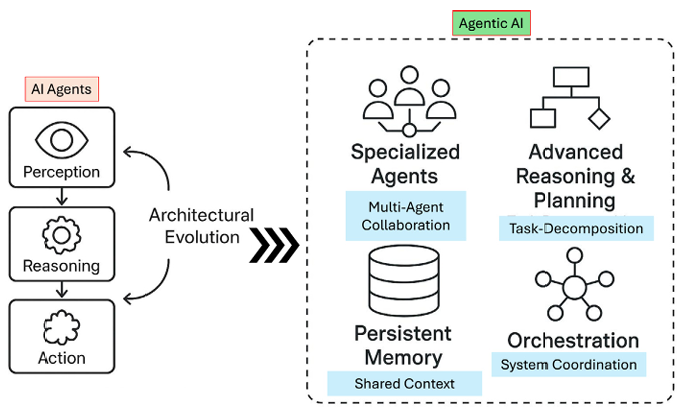
The relationship model of the three can be considered as a hierarchy: Agentic AI is the top-level concept, representing the AI system that can act on its own; AI Agent is the middle level, which is an individual entity with a specific mandate; and Agentic Workflow is the bottom-level framework that guides the action of AI Agent. This is a picture that shows the evolutionary and embedded relationship between the three。
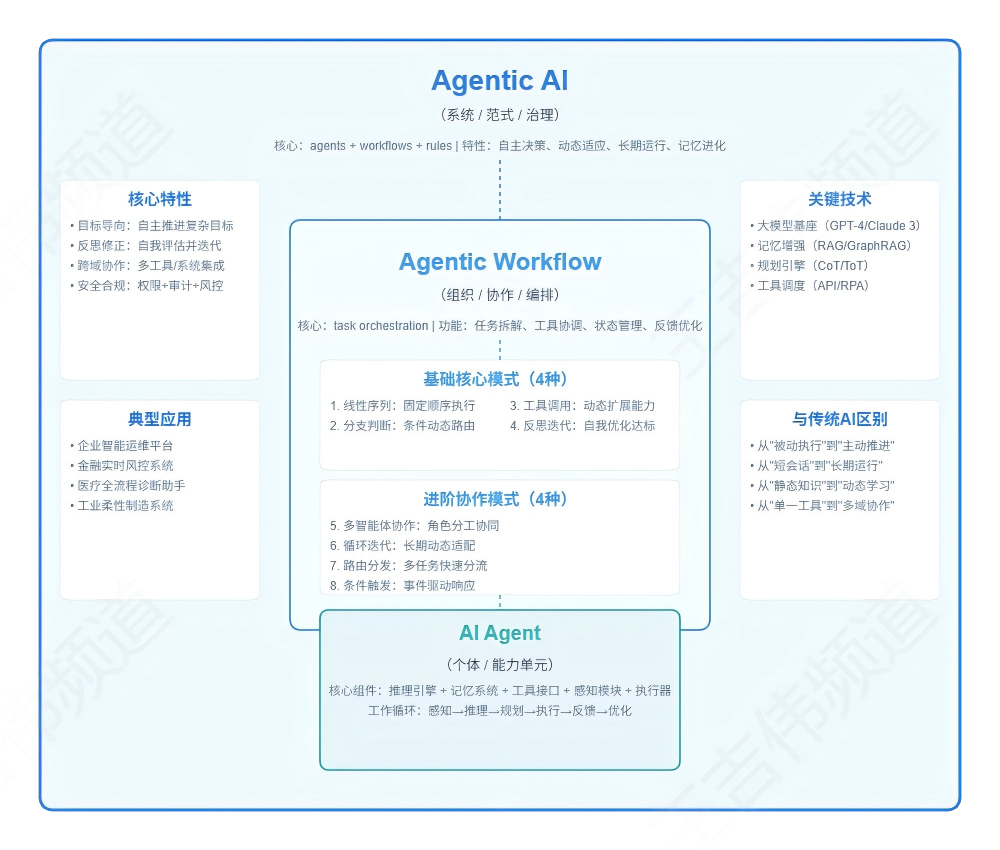
If Agentic AI is the science of robots capable of making autonomous action, AI Agent is the specific robot that was created, and it is the specific steps and methods that this robot (a group of robots) follows in cleaning rooms, cooking or performing other complex tasks。
For example, in auto-driving scenes: AI Agent is the vehicle ' s driving system that can sense roads, avoid barriers and chart routes; Agenic Workflow is the driver ' s system ' s decision-making process, including navigation, avoidance and route planning; Agenic AI is the technical framework for integrating sensors, machine learning models and control systems, enabling vehicles to drive independently。
A couple of papers
For those who want to learn more about the relationship with the triads, several papers are recommended to help you understand in greater detail the detailed differences between Agenic AI and AI Agent, and each concept。
1 IA Ages vs. Agentic AI: A Conceptual Taxonony, Applications and Challenges (2025)
By Ranjan Sapkota, Konstantinos I. Roumeliotis, Manoj Karkee
Systemic definition and separation of single AI angent from larger agentic AI systems. It proposes a concept classification (taxonony), comparative structure features, terms of reference, interactive models and autonomy. Analysis of typical applications and challenges, with future directions. One of the clearest and most academic papers available at this time, the conceptual differences between the two are structured and are well suited to the literature。
read: https://arxiv.org/abs/250510468
2-Agentic AI: A Comprehensive Survey of Architectures, Applications, and Future Directions (2025)
By Mohamad Abou Ali, Fadi Dornaika et al
Consider the structure of Agenic AI from a symbol and a neurobehaviour. Analyse the impact of different areas of application (e.g. medical, financial, robotic) on the agentic system. Discussion of ethics, governance and future integration directions. A comprehensive survey-type paper helps to position agentic AI as a broad research orientation linked to the development threshold of traditional AI angent。
read: https://arxiv.org/abs/2510.25445
3 EvoFlow: Evolving Diverse Agency Works On The Fly (2025)
By Guibin Zhang, Kaijie Chen, Guancheng Wan and others
A framework EvoFlow was proposed for auto-evoltic workflows. This method automatically search and generate isomeric workflow by evolutionary algorithms, rather than manual workstreams. This helps to enhance the diversity, performance and cost-effectiveness of workflow。
read: https://arxiv.org/abs/2502.07373
4-Advances and Challenges in Foundation Generations: From Brain-Integrity to Evolution, Collaborative, and Safe Systems (2025)
Author: 47 scholars from 20 institutions such as MetaGPT
The concept of Foundation Agent, the construction of brain modular structures (the seven main components of the cognitive core, multi-layer memory, world model, etc.), explores the alignment of evolution and security。
address: https://arxiv.org/abs/2504.09090
5 Agent AI: Surveying the Horizons of Multimedia Interaction (2024)
Author: 14 scholars, Lee Fei Fei and others
The definition of Agent AI is a multi-modular sensor-cognitive-action system that proposes a five-module closed-ring structure for environmental perception, cognition, action, learning, memory, and emphasizes the ability of large models to think and act. The authoritative framework for understanding multimodular intelligence is systematically analysed for cross-modular interactions such as visual-linguistic。
read: https://arxiv.org/abs/2401.03568
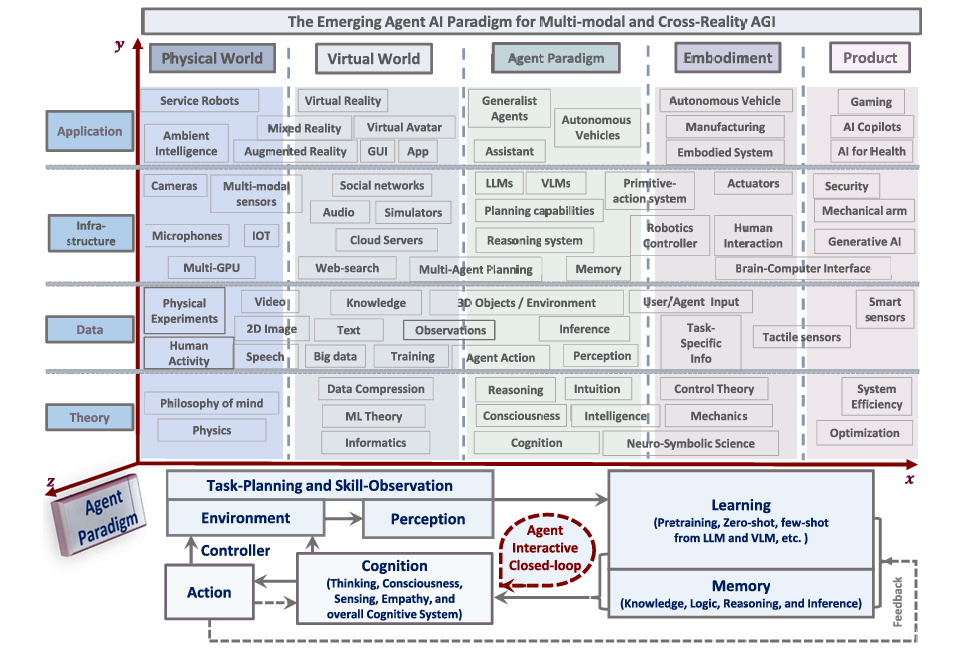
6. The Rise and Popular of Large Language Model Based Argentinas (2023)
AUTHOR: NLP TEAM, UNIVERSITY OF JORDAN, 86 PAGES, 600+ REFERENCES
The system combes the three broad paradigms of LLM-Agent (single, multi-agent, human) and constructs a "control-sensitization-action" generic framework. The Chinese team's foundation in this area has the most extensive literature, and the introduction to AI Agent is mandatory。
read: https://arxiv.org/abs/2309.07864
Several casesIncreased understanding
The following are a few examples in which we feel different concepts。
AI Agent case
1. Enterprise Web data capture and monitoring
Enterprise: TinyFish
Application scenario: Build automated WebAgent to replace manual, fragile script collection。
Function: People page views and interacts, automatically captures dynamic prices, inventories, supply information, and handles complex changes in page structure。
Value: To help enterprises monitor their competitors ' prices and stocks in real time and to improve market agility. The ability of AI Agent to operate automatically in a complex isomer Web environment was demonstrated
2. Intelligent employee queries
Enterprise: German Telecommunications
Application scenario: roll-out of internal AI Agent “askT” to support staff in searching for internal policies, processes and even tasks (e.g., leave requests)。
Function: Automatic submission of system tasks (e.g., completion of forms) in the context of the natural language query, which provides an internal knowledge base search results
Value: About 10,000 employees per day use askT to process queries and operations. The case of a digital employee of an enterprise's internal intelligence body extends from simple queries to assignments and automates the daily work of staff。
Actic Workflow
1. Client support automation and single route
Enterprise: ServiceNow
Application scene: ETC automated processing of support forms
(c) How this will be achieved: Agentic Workflow requests for access to the knowledge base to summarize the issues submitted for resolution either manually or automatically。
Features: Multi-step workflows combine knowledge retrieval, smart summary and approval nodes to achieve a secure, auditable response process。
2. Automation of electronic order processing and after-sale processes
Enterprise: Appen
Application scenario: Electronics platform automatically processing order queries, logistics status, return/refund requests
ACHIEVED: MESSAGE TRIGGER →RAG RETRIEVE ORDER DATA →AUTO-QUERY SYSTEM → EXECUTION REFUNDS OR RE-ISSUANCE OF API USER NOTIFICATION
Characteristics: multi-step state driven to complete the operation without manual intervention through Agenic Workflow。

Agetic AI Case
- Automobiles and supply chains: SAP-driven Sales+Supply Chain Agent
- ENTERPRISE: SAP
- Application scenario: marketing smart optimization and supply chain synergy
- Implementation programme: Marketing of Agent predicts the best price/portfolio timing, real-time inventory and delivery time for supply chain Agent, collaboration between data Agents, and provision of autonomous recommendations for operational decision-making。
- Value: Dynamic resource allocation and decision-making issues across business systems are addressed collaboratively through Agent rather than a single rule engine。
IBM Watson AIOps
- ENTERPRISE: IBM
- APPLICATION SCENARIO: ENTERPRISE-LEVEL IT INCIDENT LINKAGES, ALARM NOISE FILTERING AND SELF-REHABILITATION RECOMMENDATIONS
- Core function: Automatically identify critical events, associate multiple source logs and signals, automatically trigger repair actions or recommendations。
- Value: The typical Agentic AI and AIOps integration case, using a smart body as an automatic analysis and decision execution module. The rate of event resolution increased by about 60% and the number of false alarms decreased by about 80%, with a marked increase in system stability and reliability。
3. Agent platform (Citi Pilot) within large banks
- Enterprise: Citigroup
- Application scenario: in-house knowledge retrieval, data research, report generation
- Core function: A unified Agent platform automatically accesss internal/external system data and triggers multi-step tasks from a single hint: collects data, collates analyses and outputs。
- Value: Agentic AI moves in the direction of enterprise decision support systems, breaking the limits of the traditional interactive question and answer tool. By autumn 2025, about 5,000 users had been piloted as business analysis and decision assistants。

Agentic AI workflow
For specific applications, only relatively simple tasks, mostly for C-end applications, continue to be performed by single Agent. The B-end application is more of a multiAgent-Agentic Workflow integration, which allows for relatively complex tasks。
At the same time, in the complex business processes of the enterprise, the current large model and the capacity of Agent do not support a super Agent to complete long-process operations, and the organization of multiple Agent and AI applications through Agentic Workflow is a mandatory option for Agent enterprise-level applications. When multiple Agenent implements business processes through Agenic Workflow, with a hierarchy of governance, collaboration, standards and life-cycle management, it becomes an Agentic AI system。
In fact, the enterprise-level Agent application is currently transitioning to the Agenic AI system, and more Agentic AI systems have been introduced and strengthened in the governance and control of multiAgent and Agentic Workflow on the basis of the original end-to-end full-life system, as has been the case with the Agentic AI system for its own business processes. Of course, in the last year, with the strong demand for a business-level application market in Agent, a number of corporate-level Agentic AI application frameworks have also emerged. In the next article, Wang Jie's channel will talk to you about this。
Review and summary
Next, we will review and strengthen the differences and linkages between the three。
AI Agent is an intelligent implementer with a target-sensitization decision-making action feedback loop. Agentic Workflow is a process-based design of multiple Agent missions, collaboration sequences, feedback loops, and control logic. Agentic AI is an AI paradigm of how to build an AI system, with AI Agent at its core, to achieve long-term objectives, autonomously run and system-level intelligence through the organization of Agentic Workflow。
AI Agent is the basic behaviour module of the system, and the new AI-based Agentic Workflow, which focuses on task dismantling, collaboration sequence, feedback loop and control mechanisms between multiple Agents, is a process-based structure for organizing Agent behaviour; Agentic AI is an organization strategy that is built on AI Agent as its core unit and organizes its behaviour through Agentic WorkFlow, thus achieving system-level intelligence。
By comparison with human organizations, if AI Agent is a person who can act independently, Agenic Workflow is the way in which these people are organized, and Agenic AI is a new paradigm that uses Agent as the basic unit to construct the AI system。
Agentic AI is not a specific model or product, nor a single Agent with a certain ability or function, but a new institutional design: using AI Agent as the basic builder unit, using Agentic Workflow as the organizational mechanism, organizing its behaviour through a workflow and feedback mechanism to build a sustainable running smart system。
Thus, the key to Agentic AI is not to create a more intelligent body, but rather to harmonize the behaviour of multiple Agents into sustainable, functioning smart systems that achieve long-term goals and complex missions through institutionalized workstreams and feedback mechanisms。
Posterior: Three Ones Advance Agency AI
Agentic AI is an area/model study of how to construct an AI for autonomous action, which is one or more of the processes/operating methods followed by AI Agent in order to accomplish its mission, and AI Agent is the specific implementer/entity that follows the Agentic AI concept。
This relationship promotes the potential of Agenic AI to apply in a number of areas. If you care about AI's autonomy, focus on Agentic AI; if you need an independent and intelligent entity, it's AI Agent; if you want to design an automated process with multiple Agents, use Agentic Workflow。
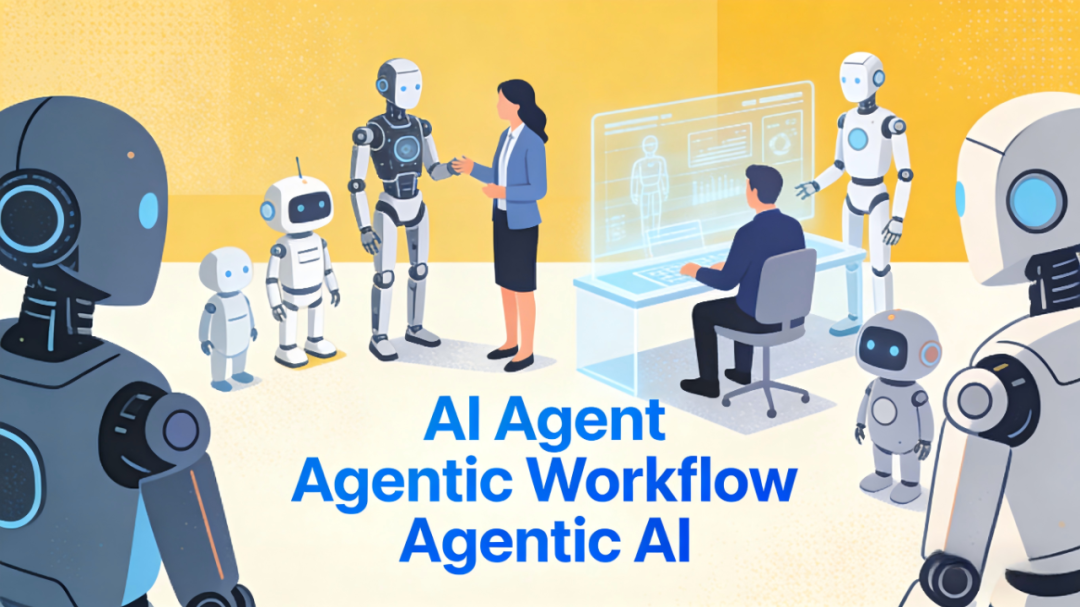
Current Agentci AI industry challenges include ethical considerations, system costs and credibility. The shift in focus in business implementation from AI Agent to Agency WorkFlow reflects the importance of work streams in practical applications. The growing interest of the enterprise in Agenic AI also shows that it is becoming an important strategy for the organization ' s operations。
Agenic AI represents the main form of AI at this stage, and its main landing methods are AI Agent and Agency WorkFlow。
Under this logic, whether you're doing Agent, or using Agenic WorkFlow, or designing Agenic AI, you're all involved in the design, development and application of relevant technologies and products, and are contributing to the progress and development of Agenic AI。