



On January 30th, Tech Crunch reported that since October last year, when it was high-profile and quickly ascended to the top of the US App Store, it has been a long time since the end of OctoberOpenAI Under AI VIDEO GENERATION APPLICATION Sora The growth has slowed down significantlyBoth downloads and user consumption have declined significantly and market heat is declining。
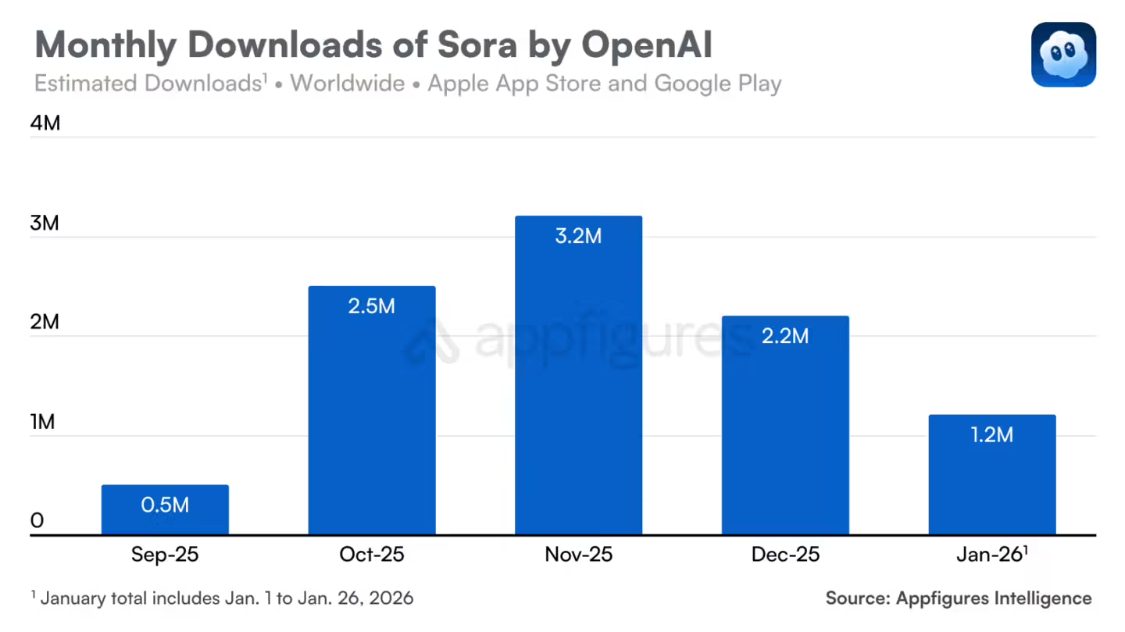
Note: Sora App based on OpenAI 's Sora 2 video generation model, with video generation speed and quality well above that of the same product. When its iOS version came online in October last year, the first day it was over 100,000 downloads and rapidly achieved a million downloads under the invitation system, growing faster than ChatGPT, once at the top of the US App Store free application list。
However, according to the latest data released this month by the Mobile Applications Analysis Platform Appfigures, the growth momentum of Sora is no longer sustainable. Last December, its download ratio dropped 321 TP3T; in January this year, the download ratio dropped significantly, 451 TP3T to about 1.2 million. Total in-service consumption by users decreased by the same period, by 321 TP3T, to $367 million, down from $5.4 million in December。
So far, Sora has had a total of about 9.6 million downloads on the iOS and Ando platforms, with total user consumption of about $1.4 million. The United States is its largest market, followed by Japan, Canada, Korea and Thailand。
The application market ranking also reflects Sora’s downward trend, which now ranks 101th out of 100 on the US App Store Free Applications Master List, and 181st in Google Play。
Tech Crunch analyses that Sora's growth is weak due to multiple factors. First, the increased competition in the market and the successive introduction of video-generation functions for similar products led to the diversion of users。
Secondly, the issue of its copyright has not been explicitly resolved. In the early days of Sora, in the absence of strict controls, users were able to generate videos on well-known IP roles such as SpongeBob, Pikachu, which, while contributing to some extent to early dissemination, provoked strong opposition from copyrighters. In the face of pressure, OpenAI changed the rules for the use of copyright from “the default option” to “the need for express authorization” and strengthened the limitations in its application。
Sora uses its own primary AI video creation and social sharing, and users can use their own image or that of a friend as the leading video player and the resulting video can be edited twice. However, reports indicate that many users are not very interested in using realistic images to produce AI videos. In the context of the lack of social attraction of acquaintances and limited use of commercial IPs, the user ' s sense of Sora ' s freshness is fading。
Current data are not enough to conclude that Sora has lost its market, but the continuing downward trend has given rise to market concerns. Sora was the cause of great excitement when it was released, when it was called a social media subversive and even compared to an AI version of TikTok. It remains to be seen whether it can revive growth with more copyright cooperation or new functions。
By the time this document was sent, OpenAI had not responded to the data。