



MARCH 11TH. YESTERDAY, THE CEO WAS RELEASED Jen-Hsun HuangPresented undersigned article AI "FIVE LAYER CAKE" ARCHITECTURE MODEL AND CLEARLY CHARACTERISE AI AS ASSOCIATEDelectrical powerThe same important modernityInfrastructure.
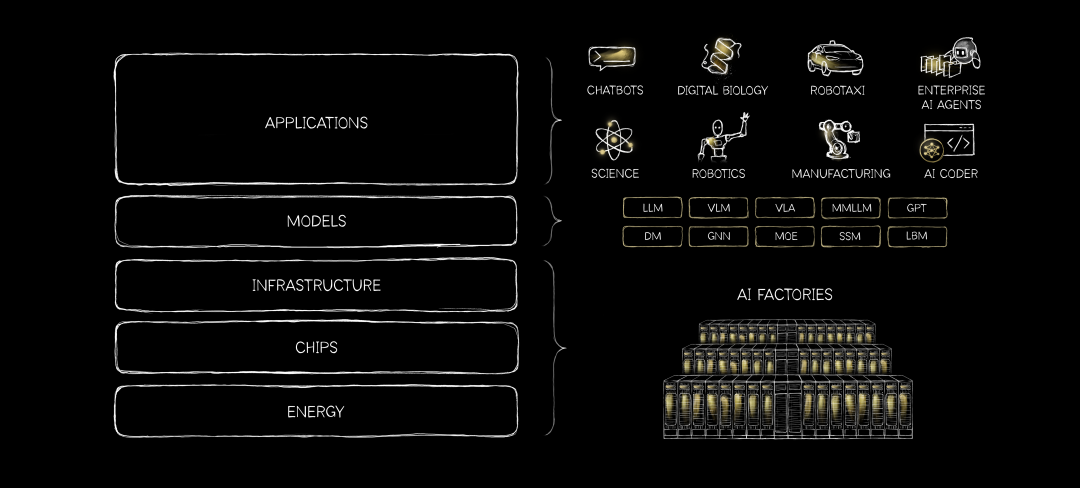
IN HIS ARTICLE, WONG IN-HOON NOTED THAT COMPUTING TECHNOLOGY WAS MOVING FROM TRADITIONAL PREFABRICATED SOFTWARE TO REAL-TIME-GENERATED INTELLIGENCE AND THAT THE EVOLUTION OF THIS BOTTOM LOGIC REQUIRED A COMPLETE RE-ENGINEERING OF THE ENTIRE COMPUTING ARCHITECTURE. HE DECOMPOSED THE AI ARCHITECTURE FROM THE BOTTOM UP TO FIVE LEVELS: ENERGY, CHIPS, INFRASTRUCTURE, MODELS AND APPLICATIONS。
THE PAPER EMPHASIZES THAT ENERGY IS THE PRIMARY BOTTLENECK THAT CONSTRAINS THE SCALE OF OUTPUT OF SMART SYSTEMS; THAT THE CHIPS LAYER DETERMINES THE SPEED AND EFFICIENCY OF AI EXPANSION; THAT THE INFRASTRUCTURE LAYER IS REPRESENTED BY THE AI PLANT DESIGNED TO "MANUFACTURING INTELLIGENCE"; THAT THE MODELLING LAYER IS EXPANDING FROM LANGUAGE TO FRONTIER AREAS SUCH AS BIOCHEMISTRY, PHYSICAL SIMULATION; AND THAT THE TOP LAYER OF APPLICATIONS (E.G. AUTOPILOT, HUMAN ROBOTS) IS RESPONSIBLE FOR CREATING ECONOMIC VALUE。
The five tiers are mutually reinforcing, and the success of any top-level application will generate a strong demand for bottom-up equipment and energy。
At the level of industry movement, the article affirms the critical role of open-source models in activating the overall computing demand. Hoang In-hoon cited DeepSeek-R1 as an example where the extensive openness of the high performance reasoning model had directly accelerated the spread of the application layer and led in reverse to the scaling up of bottom training, computing facilities and energy。