



A lot of new words have recently come out of the AI field, including prept, context, harness, loop, codex, hermes, claude code, etc., so there are a few questions
- What are they, substitutes for each other?
- why don't i just use loop engineering? is that true?
- the underlying allm model is getting stronger, so i'm just choosing the strongest model, so i don't have to worry about anything else
- HOW CAN I GAIN CORE COMPETITIVENESS WHEN AI IS GROWING RAPIDLY AND I AM ANXIOUS? FIRST WE LOOK AT THE WHOLE TIME LINE;
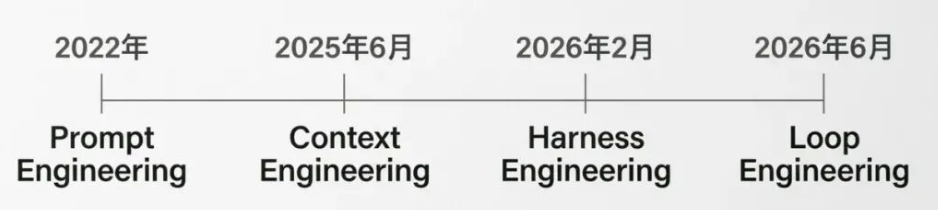
i've decided to give you two more articles; this is about the content of the prompt, context, harness. i hope i can help you
catalogs
- Prompt Engineering
- Advantages of hint engineering
- The disadvantage of the hint project
- Contact Engineering
- Core pain points: natural constraints on contextal resources
- Core design principles for context engineering
- Context engineering's Advantage
- Context undermining
- Harness Engineering
- what's harness?
- production classharness anent contains components
- elements of a harness design
- it's the relationship between harness and subject
- harness learning materials
- References
Prompt Engineering
Prompt engineering is also known as the Phrasing Project, which guides LLM to a precise understanding of needs, output stability, compliance and compliance with expected results by designing, debugging and optimizing the text instructions (known as the Phrasing / Prompt) entered into the Large Language Model (LLLLM); In the same information content, in different terms, the results of the large model are better。Typically, it refers to a single, static, stand-alone mission, the core of which is the optimization of command text writing, with a focus system only, which is a one-time static configuration。The introduction usually consists of the following:
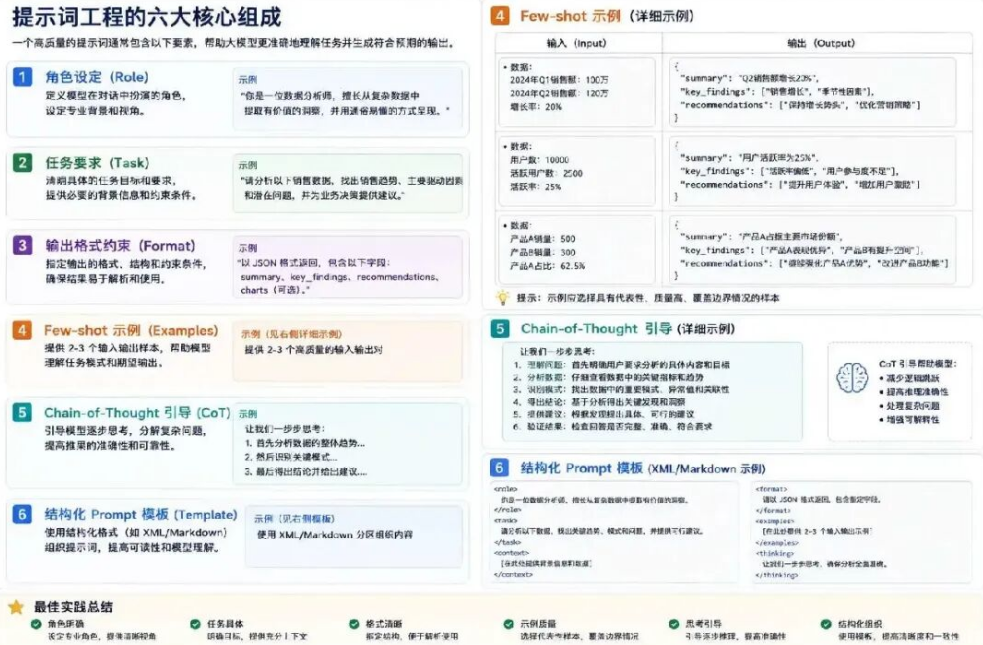
Advantages of hint engineering
- Output format is controlled。
- Improved quality of reasoning。
- Role boundaries are clear。
The disadvantage of the hint project
- (b) Unable to answer real-time and interactive questions, unable to solve the problem of "models don't know your business data" ; for example, how weather is today, recent hot-spot real-time news
- No memory: each round of dialogue corresponds to almost independent. It is not possible to sink the memories of the conversation, nor can they be restored
- Reliance on human triggers and judgment: Need for constant adjustment of authentication tips
Contact Engineering
over time, in june 25, when the base capacity of llm was greatly enhanced, a growing number of researchers have found that simple warning works are far from sufficient to allow llm to understand the context in which it needs to be provided with the corresponding business scene。
karpathy's on platform X on June 25th
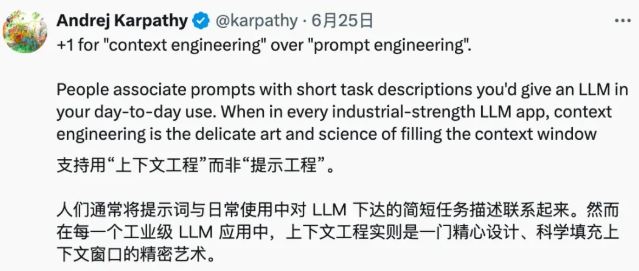
A short time ago, on September 29th, 25th, Anthropic published the project blog Effictive-content-engineering-for-ai-agents, which provides an official definition:
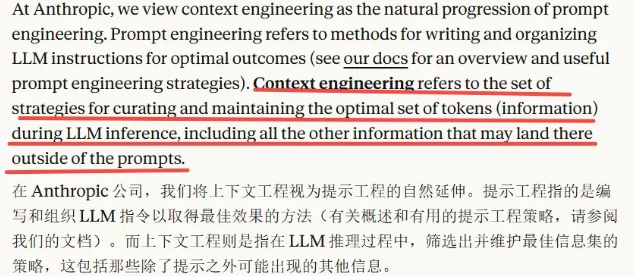
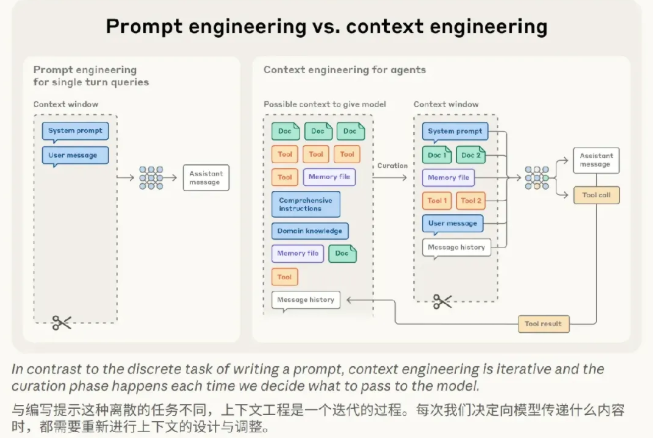
Context engagement is the best token set of strategies to filter and maintain, including all other information falling outside of prompt. From here
- context including
- Tip Project: For a single, static, stand-alone task, the core is to optimize command text writing, with a focus only on system hints, which is a one-time static configuration
- Context Project: Covers all of the Token sent to the model from the entire process of reasoning and contains system tips, definition of tools, external retrieval of data, history of dialogue, a small number of examples, active and dynamic loading of information, which is an iterative, dynamic and continuous management of the whole context status。
- at the same time, the whole agent design paradigm has changed: the development goal has changed from "writing a perfect hint" to "building the best context information mix within a limited focus budget to stabilize driving intelligent output expected behaviour."。
Core pain points: natural constraints on contextal resources
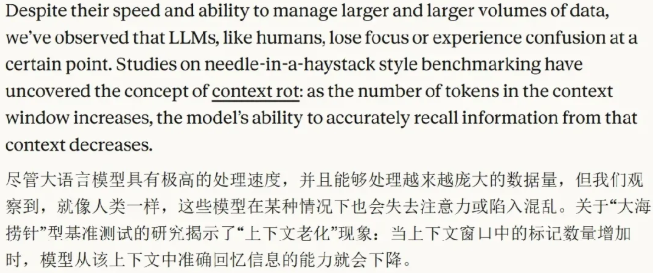
From a bottom-up perspective, there are natural attention constraints to the Transformer architecture: n Token creates a n2 focus correlation, the longer the context, the continued decline in the model ' s recall and long-range reasoning precision of remote information; model training data are dominated by short series and long text-dependent. The context is a scarce and limited resource, and redundant information can deplete the attention budget and cause AI to forget and break logic, and therefore must be refined to screen high-value Token. It contains a wide range of information on harness, from the most basic technical blogs, from Context, Memoory & Working State, Contractors, Guardrails & Safe Autonomoy, to all presentations made by agent;
- Context window limited: All LLM single deductions can read the Token ceiling (from 32k->128k->512k->1M) and the longer the task, the more the tools to call, the easier the information spills。
- context decline (drink attention)The larger the total number of Tokens in the context, the continued decline in the accuracy of long-range search of the model and of the early information associated with it, rather than total failure, is a gradual decline in the accuracy of the reasoning。
- Smart scene information explosion:Agent Multi-wheel interaction, tool calls, cross-sky long-term missions, multi-source data integration, continuous generation of large-volume redundancy information, unable to fit all in context windows。
Core design principles for context engineering
General Programme: Minimise High Signals Token Pool, retaining only information that is decisive for decision-making at the current stage, removing noise and maximizing Token ' s efficiency。
- Structured Layer Layout Context: Fixed sequence->System command->System Summary->Tool Definition->Toolport Output->Recent Dialogue History; Markdown/XML labeled partitions to reduce the cost of accessing model information。
- System hints light-quantified iterative: Precise baseline tips, additional constraints based on actual running error reporting, without pre-stamping redundant rules; a small number of high-quality examples are much better than long boundary rules。
- Information Layer Storage: Distinguishing the immediate context (in the window) from the external long-term memory (outside the window) without plunging the entire history into the context。
- Priority structured data: The task status, the return of the tool, etc., is stored in a compact format such as JSON, reducing meaningless natural language occupation of Token。
Context engineering's Advantage
- ACHIEVING A UNIVERSAL AI TRANSITION TO AN ENTERPRISE-SPECIFIC BUSINESS INTELLIGENCE THE PROGRAMME PROVIDES ACCESS TO THE ENTERPRISE KNOWLEDGE BASE, INTERNAL BUSINESS SYSTEMS DATA LINKS, SO THAT INTELLIGENT BODIES NO LONGER EXPORT GENERIC GENERIC ANSWERS, AND ALL RESPONSES AND RECOMMENDATIONS ARE BASED ON BUSINESS-OWNED DATA GENERATION, EVIDENCE-BASED, AND ARE THE CORE BASIS FOR BUSINESS AI SMARTNESS TO PRODUCE REAL BUSINESS VALUE。
- Token efficiency improvements and significantly lower AI call costs LLM service providers generally charge to the Token consumption, and context works follow the minimum high-value ton-noise set core principle to streamline ineffective redundancy information。
- Guarantee that single-chamber multi-cycle dialogues are logical and address long-term interactive forgotten issues Through the management mechanism described below in the history of the standardized dialogue, the intelligent body can retain the full-text message of the session in its entirety, keeping in mind the pre-communication content and key decision-making conclusions in the context of a dozen long rounds of dialogue, and avoiding the issue of information fragmentation and forgetting historical consensus。
Context undermining
- Control model input only, cannot limit model output behaviour The context works only screen and send the information required for the model, and only ensure that the model acquires complete and accurate business material; even if the input is free of bias, the model may result in erroneous judgement and the execution of deviations from expectations, which cannot be addressed optimally by the context。
- MISSING LLM CALL ERROR SELF-DETECTION, SELF-CORRECTION MECHANISM During the multi-wheel interaction, the system cannot automatically identify and modify a system that produces a logical, operational type error in the middle wheel; the same error is repeated and less tolerance for error is weak when the same business scene is followed。
- I can't complete the full-process shut-down without artificial independence Optimization of the context only increases the accuracy of the response for a single task, but mission initiation, definition of demand, output compliance and usability determination rely on manual operations and clearance. Intelligent bodies are by their nature high-calculation professional tools that require manual leadership and supervision throughout the process。
When your Agent makes the same mistake over and over again, and you can only "hope" by changing prompt or RAM that it doesn't happen again -- you needharness engineing;
Harness Engineering
before talking about what's natural engineing, let's show you some real cases;
what's harness?
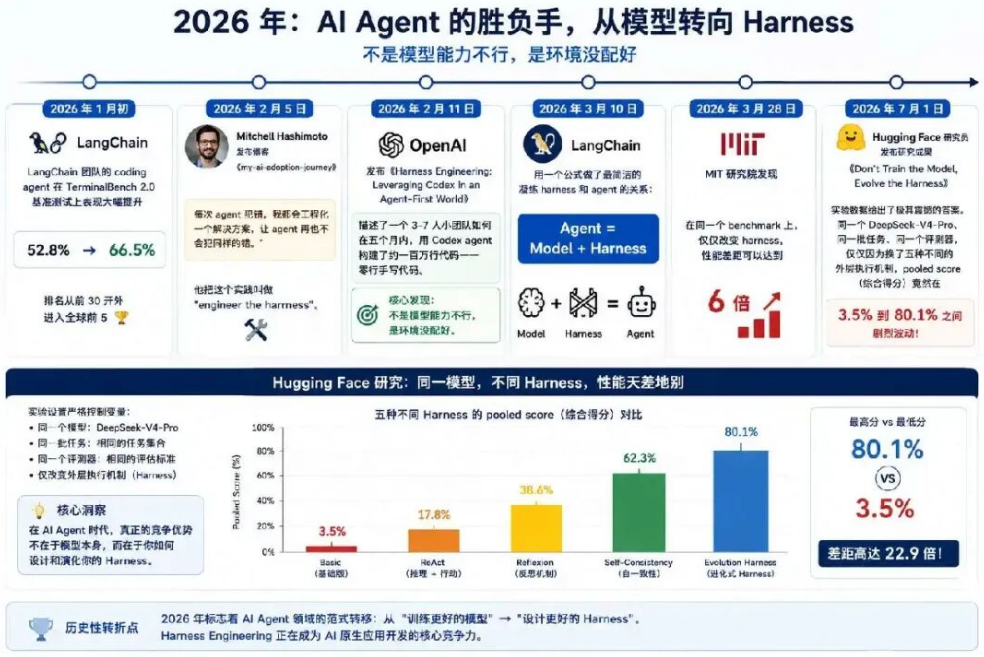
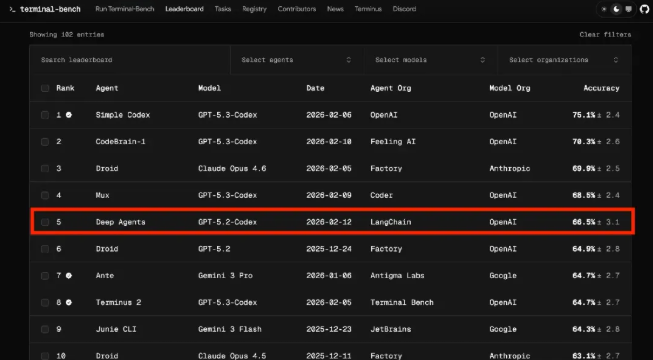
At the beginning of January 26, the langchain team's coding parties jumped from 52.8% to 66.5% on the TerminalBench 2.0 benchmarking test, ranking as the top five of the world when it was 30 years ago。
On February 5, 2026, Mitchell Hashimoto published a blog describing a habit he developed when he used AI anent:every time agent makes a mistake, he works on a solution so that angent never makes the same mistake again. he called it "engineer the practice."。
On February 11, 2026, OpenAI released " Harness Engineering: Leveraging Codex in an Argentina-First World " , describing how a small team of 3-7 people built about a million lines of code - a zero hand-written code - with Cordex anent within five months. The core finding is..It's not a model. It's a bad environment。
On March 10th, 2026, LangChain used a formula to work out the simplest of the relationship between harness and angent:Agent = Model + Harness;
ON MARCH 28, 2026, THE MIT INSTITUTE DISCOVERED on the same benchmark, just change the naturals, the performance gap can be six times higher.
On 1 July 2026, the researcher of Huggingface, Don't Train the Model, Evolve the Harness, gave a very striking answer. The same DeepSeek-V4-Pro, the same mission, and the same diagnosing instrument, with five different outer layers of implementation, the pooled score (comprehensive score) was able to fluctuate sharply between 3.5% and 801%:
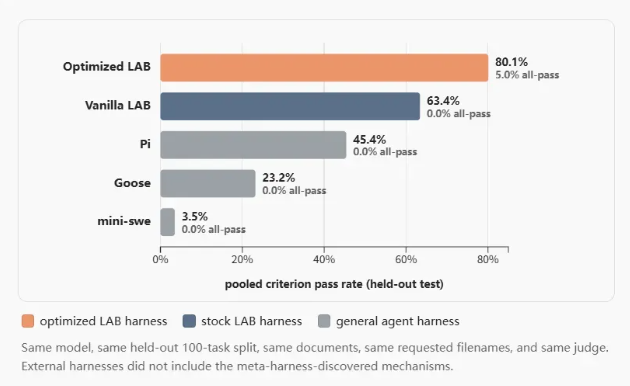
As can be seen from the real case above, the corresponding work for all of Agent's overall capacity ceilings, in addition to the LLM's own capabilities, is crucial; it can be seen that the entire agent design paradigm has changed: from the previous one "What does the model see?" It became.. “How to construct an implementation environment that makes the wrong structure non-recurrence?”
production classharness anent contains components
and here's a little bit of an x platform kshay_pacaarThe Anatomy of an Argentina Harness(b) for agent applications, there is an analogy between the owner and the computer operating system, as follows:;
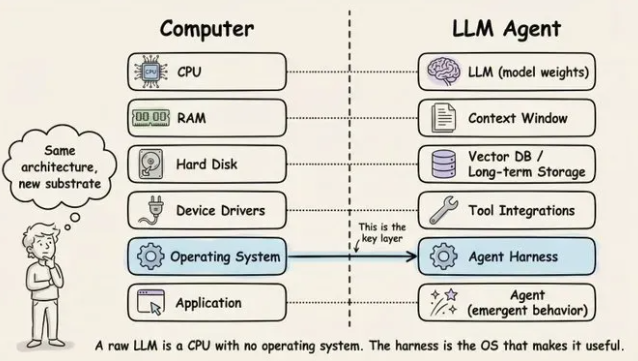
- AN ORIGINAL LLM LIKE A CPU WITHOUT RAM, WITHOUT DISK AND WITHOUT I/O。
- Context WindowACT AS RAM (QUICK BUT LIMITED)。
- External databaseAct as disk storage (large but slow)。
- toolIntegrated as a device driver。
- i don't knowIt's the operating system。
By combining Anthropic, OpenAI, Langchain and the wider community of practitioners, a production-level harness should have 12 different components。
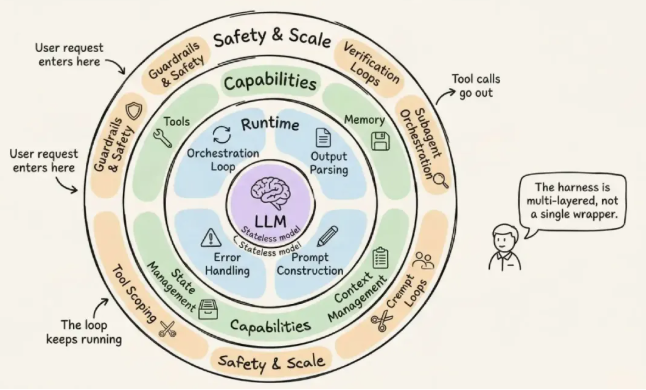
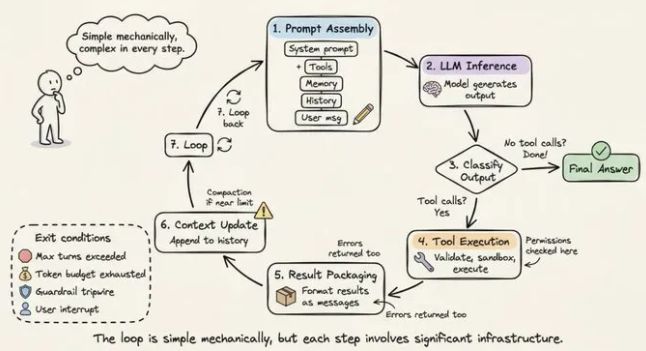
- Coordinate loops: It achieves the thought-action-observation (TAO) cycle, also known as Rect. Looping: The assembly hints - > call LLM-> parsing output -> execute any tool call, feedback the results and repeat them until they are completed. It's usually just a while cycle。Complexity exists in all things of circular management, not in the cycle itself。
- tool: Tools are the hands of angent; they are defined as the mode (name, description, parameter type) that is injected into the LLM context so that the model knows what is available. Claude Code, for example, provides tools across six categories: file handling, search, execution, web access, code intelligence and sub-agent generation。
- i'm sorry: agent's memory needs timescales; Short-term memoryA history of dialogue in individual sessions;Long-term memoryPermanent storage of sessions: Anthropic supports sessions supported by SQLite or Redis using CLAUDE.md project files and automatically generated MEMORY.md files; LangGraph uses the JSON store of Named Spaces。
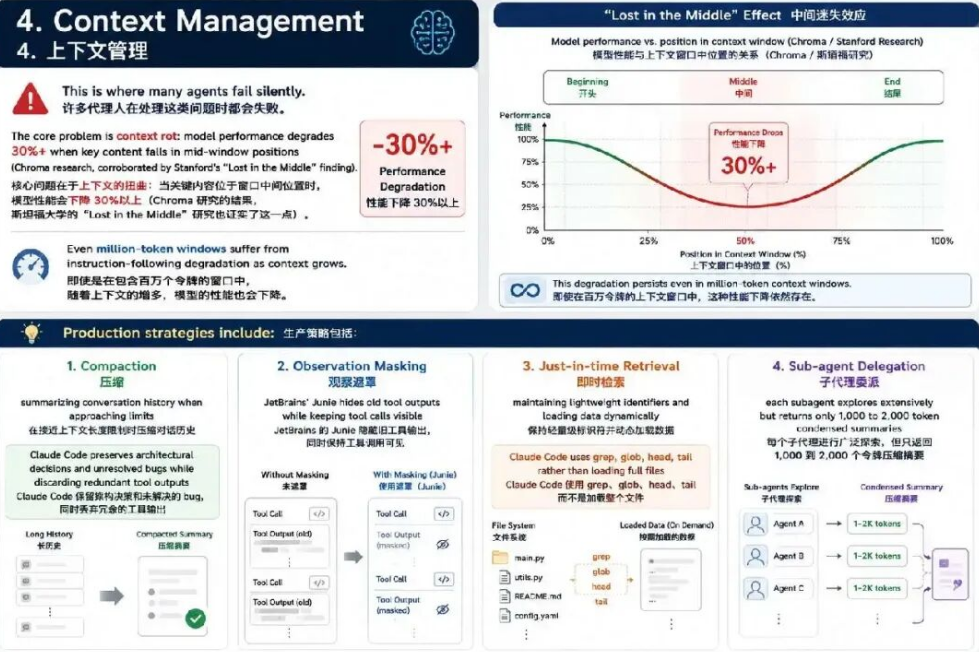
- Context Management: llm context window will haveContext decay effectI don't know. When key content is in the middle of the window, model performance decreases by more than 301 TP3T (the results of the Chroma study, as confirmed by the “Lost in the Middle” study of Stanford University). Even in windows containing millions of tokens, the performance of the model decreases as the context increases. The common correspondence is as follows:
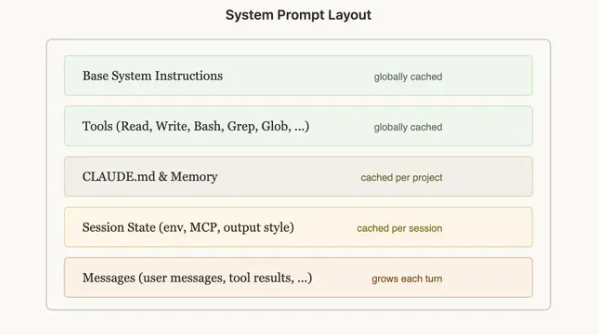
- Cue Construction: prompts are constructed in layers; system tips, tool definitions, memory files, conversation history and current user messages. claude code can be used to use prompt caping to provide ttft indicators for application and reduce token consumption costs;
- Output Resolution: modern harness relies on local tools, where models return structured tool_calls objects rather than free text; harness needs to check: is there a tool to call? implement them and circulate them. no tools to call? that's the final answer。
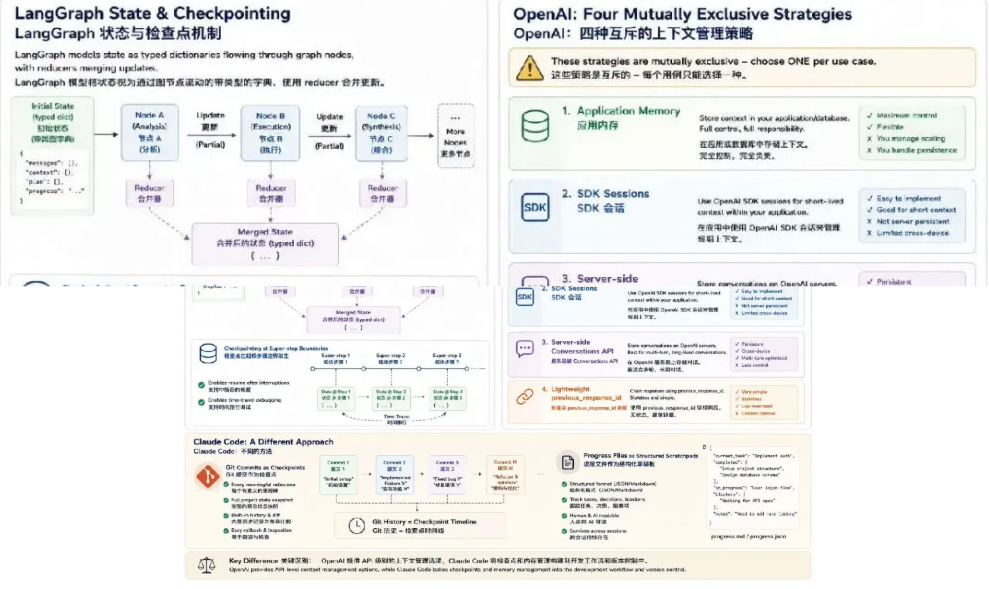
- Status Management: The LangGraph model treats the state as a type of dictionary that flows through the nodes, using reducer to consolidate and update. Checkpoints occur at the super-step boundary, supporting recovery after interruption and debugging time travel. OpenAI offers four mutually exclusive policies: apply memory, SDK sessions, server accesss API or lightweight previous_response_id links. Claude Code takes a different approach: Git submits as a check point and progress documents as structured draft boards。
- Error Handling: A process with 10 steps and a success rate of 991 TP3T per step, with a end-to-end success rate of ~90.41 TP3T. Errors quickly accumulate. Angent's errors need to be addressed;
- Safety and security:
- The SDK of OpenAI achieves three levels: the input handle (run on the first agent), the output handle (run on the final output) and the tool handle (run on each tool call). A “treadline” mechanism immediately ceases to act as agent when triggered。
- Claude Code Gates ~40 provides a stand-alone tool function, which is divided into three phases: a confidence-building mechanism when the project is loaded, a rights check before each call on the tool, and a clear user confirmation for high-risk operations。
- Authentication cycle: The creator of Claude Code, Boris Cherny, notes that providing the model with a way to validate its work results increases its quality by 2 to 3 times. Anthropic recommends three methods: a rule-based feedback mechanism (e.g., test, lint check, type checker, etc.), visual feedback (by Playwright generating UI interface screenshots), and LLM-as-judge (large language model as referee) (a stand-alone sub-agent to assess output results)。
- Sub-agent Organizationclaude code supports three implementation models: Fork (copy byte code equivalent to the parent's context), Teamamete (independent terminal window, communication by document-based mailbox) and Worktree (independent Git work tree, each agent has an independent branch). The SDK of OpenAI supports the use of agents as a tool (experts handle a limited number of sub-tasks) and task transfer functions (experts have complete control over the performance of tasks). LangGraph brings the sub-agents into the embedded state chart structure。
elements of a harness design
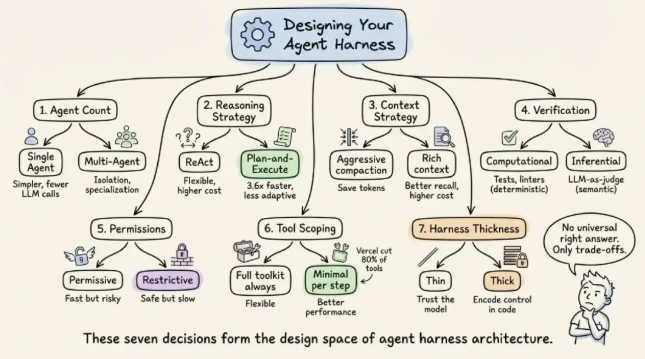
- single smart body vs. multi-smart bodyI don't know. Both Anthropic and OpenAI say:The performance of a single smart body should be maximized firstI don't know. The multi-intellectual system adds additional costs (e.g., multiple calls to large language models to address route problems, as well as loss of context when intelligent body switches)。
- React vs. plan-and-executeReact combines reasoning and action at every step (the cost of each step is higher, albeit with greater flexibility); according to LLMCompiler, the use of the plan-and-execute model is 3.6 times faster than that of react. 3.** Context window management strategy**: five production methods: time-based clean-up mechanism, dialogue summary generation, observation data shelter, structured notes, andSub-delegationI DON'T KNOW. ACON STUDIES SUGGEST THAT, BY PRIORITIZING THE REASONING RESULTS RATHER THAN THE ORIGINAL TOOL OUTPUT, THE TOKEN CONSUMPTION OF 26% TO 54% CAN BE REDUCED WHILE MAINTAINING ACCURACY ABOVE 95%。
- Design of the validation cycle: The computational certification (test, lint check) can provide the real results that are determined. The reasoning certification (using LLM-as-judge as a basis for judgement) can capture semantic problems, but may introduce some delay. The Toughtworks team of Martin Fowler divides this certification into two categories: pilot (prejudging at the front end) and sensor (resulting after action)。
- Authority and security architectureOne is a permissive mode (which is fast but risky, most of which can be automatically approved); the other is a restrictive mode (which is more secure but slow and requires approval for each operation)。
- Tool selection policy: Use of more tools often leads to reduced performanceI don't know. Vercel removed the 80% tool from version 0, thus obtaining better performance. Claude Code simplified the context of 95% by delaying loading. The rationale is to provide only the minimum number of tools required for the current steps。
Harness pickness: how thick is a harness sealed, how much logic is contained in the harness device and how much logic is included in the model itself? there was a tendency to use thinner control devices and the expectation was that the model would be improved and that it would also facilitate migration. the chart-based architecture framework emphasizes precise control of control。
it's the relationship between harness and subject
- you can see that harness engineering includes context engineering; context engineering contains hint engineering;
- Context Engineering: Show the model the right information and expect it to act right. It's a strategy based on trust -- you trust the model to do the right thing when you see the right information。
- Harness Engineering: Whatever the model sees, it must be checked externally before its output is applied to the real environment. It's a validation-based strategy -- you don't trust any single output of the model, you trust the certification process。
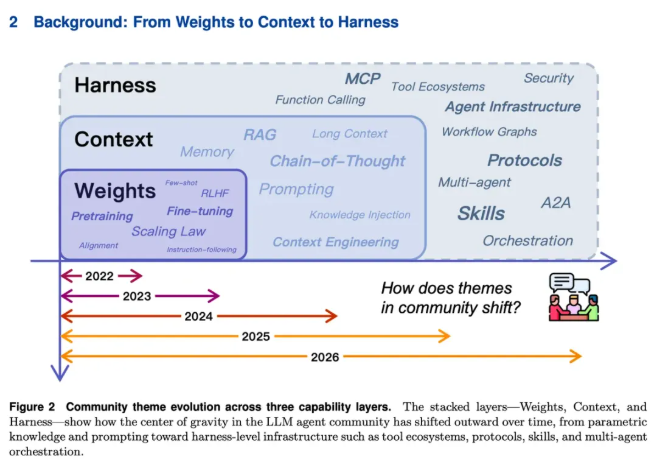
from x platform kshay_pacaar: https://x.com/akshay_pacaar/status/20447333300242/photo/1
harness learning materials
an open source project for all of you on the angligithubit's not like i'm going to have to do this, currently 3.6 k in stars;
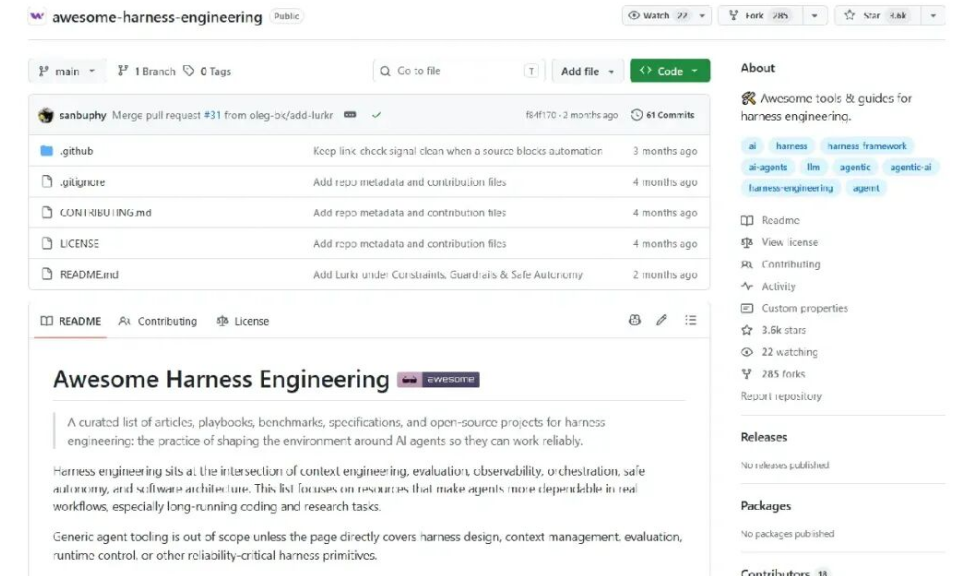
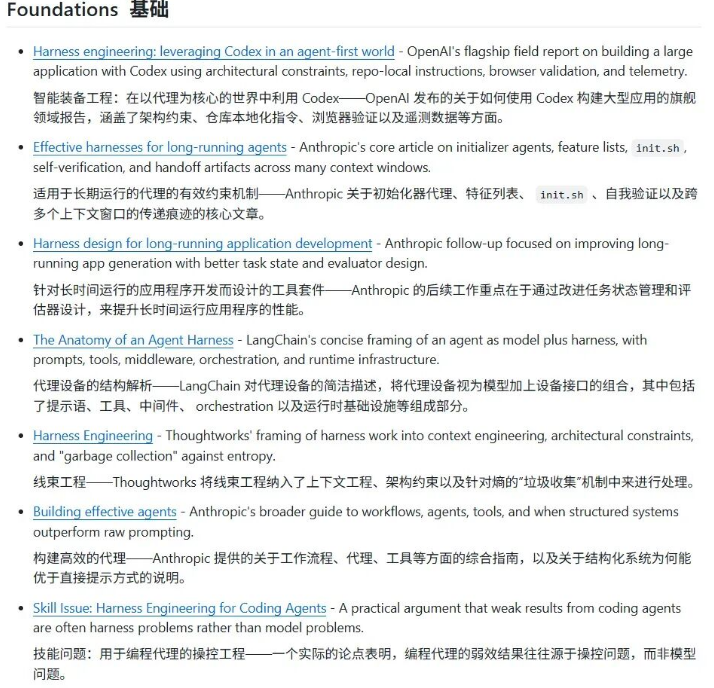
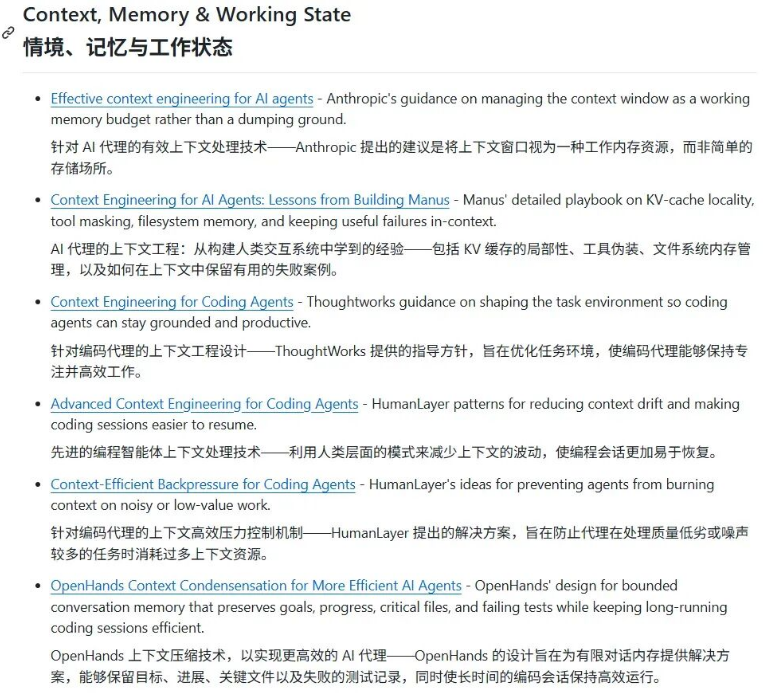
The collection of technical blogs is full of top-notch agencies, such as Openai, Anthropic, langchain and others, who provide detailed descriptions of the corresponding technologies,it's worth reading in depth, and it's a firsthand piece of information, and you know where angent comes from, you know where he comes from, you know why, you have friends who want to know more, you can read it;
- https://www.langchain.com/blog/improving-deep-agents-with-harness-engineering
- https://www.anthropic.com/engineering/effective-context-engineering-for-ai-agents
- https://mitchellh.com/writing/my-ai-adoption-journey
- https://openai.com/zh-Hans-CN/index/harness-engineering/
- https://www.langchain.com/blog/the-anatomy-of-an-agent-harness
- https://arxiv.org/html/2603.28052v1
- https://huggingface.co/spaces/joelniklaus/harness-optimization#introduction
- https://x.com/sairahul1/article/2063544956158185927
- https://github.com/walkinglabs/awesome-harness-engineering
- https://x.com/sairahul1/article/2063544956158185927
- The Anatomy of an Agent Harness: https://x.com/akshay_pacaar/status/204114899319971922