



Why are the words written in detail, but the results are unstable
The person in the last second was in the office area, and the next second was like a change of scene; the message was “scenes follow”, but the picture was turned into a few incoherent images; the result was that the character had to move from the door to the table, and the person was not in the right position, direction or movement。
THE REASON IS NOT NECESSARILY THAT THE MODEL IS NOT GOOD, BUT THAT THE INPUT INFORMATION IS NOT “ENFORCEABLE”. AI UNDERSTANDS THE LANGUAGE, BUT WHEN THE TASK INVOLVES COMPLEX SPACE, MULTI-PERSON HIERARCHIES, CHASES, FIGHTS AND THE END OF A SINGLE LENS, IT CAN EASILY BE AMBIGUOUS. YOU SAY, "THE HOSTESS MOVES RIGHT THROUGH THE TABLE," AND AI NEEDS TO JUDGE WHERE THE TABLE IS, WHERE THE HOSTESS IS, WHERE THE RIGHT IS, WHERE THE CAMERA IS TAKEN, HOW OTHER PEOPLE AVOID. ANY MESSAGE IS BLURRY, THE IMAGE WILL DRIFT。
THE SOLUTION WOULD BE TO UPGRADE THE HINT FROM “DESCRIPT IMAGE” TO “DESIGN SCHEDULE”. THE MOST PRACTICAL APPROACH WOULD BE TO USE OVER-VISION SCHEDULING MAPS TO AID THE INTRODUCTION. THE OVERHEAD SCHEDULE IS UNDERSTOOD TO BE A SPATIAL MAP FROM THE CEILING DOWN: IT SHOWS THE SCENE STRUCTURE, THE LOCATION OF THE PERSON, THE MOVEMENT ROUTE, THE PROPTILE BARRIER AND THE CAMERA PATH. THE TEXT IS RESPONSIBLE FOR INTERPRETING THE RULES AND THE IMAGE IS RESPONSIBLE FOR PROVIDING A SPACE BASIS, WHICH COMBINES TO MAKE IT EASIER FOR AI TO IMPLEMENT IT IN A STABLE MANNER。
I. DEFINITIONS FIRST: A scenario map, site map and schedule chart are not the same thing
WHEN DOING THE AI VIDEO, MANY PEOPLE UPLOAD A REFERENCE MAP DIRECTLY AND EXPECT THE MODEL TO AUTOMATICALLY UNDERSTAND ALL THE CONTENT. BUT THERE IS ALSO A HIERARCHY IN THE REFERENCE DIAGRAM。
The first is a scenario reference。
It replied, “What does this place look like?” For example, there are glass partitions, conference rooms, workshops, printing areas, document cabinets, long tables and corridors in the office. The role of scenario reference maps is to stabilize spatial styles and visual details so that different lenses appear to occur in the same place。
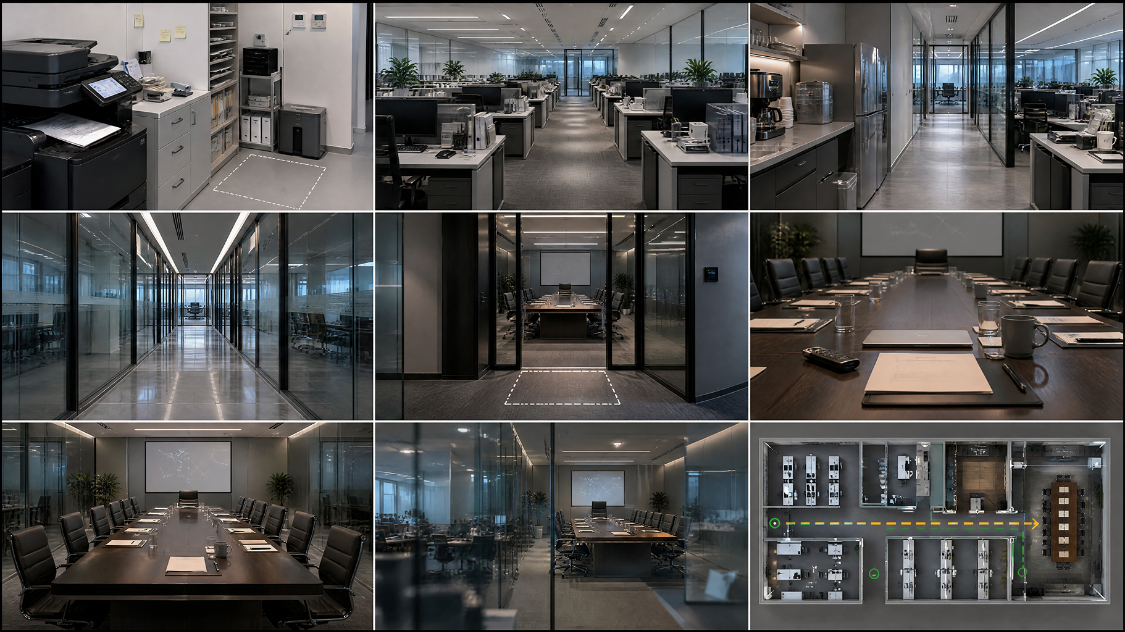
The second is the site map。
IT ANSWERS “WHO IS WHERE”. FOR EXAMPLE, NUMBER 1 IS THE FEMALE MASTER, STANDING AT THE LOWER LEFT CORNER OF THE TABLE; NUMBER 2 IS THE MALE MASTER, STANDING AT THE DOOR; THE BLACK DOT IS THE SIEGER, DISTRIBUTED ON BOTH SIDES OF THE TABLE. THE SITE MAP SOLVES THE PROBLEM OF PERSONAL RELATIONSHIPS, AVOIDING AI PUTTING THE ROLE IN THE WRONG PLACE。
The third is the schedule。
And it said, "How do you move and how do you shoot?" The schedule not only has scenes and sites, but also routes, directions, time nodes and camera locations. For example, the hostess moved from the centre to the side of the table, the siegers surrounded from the right side, the lens moved from the door to the side of the table, and then close to the hostess to finish the action。
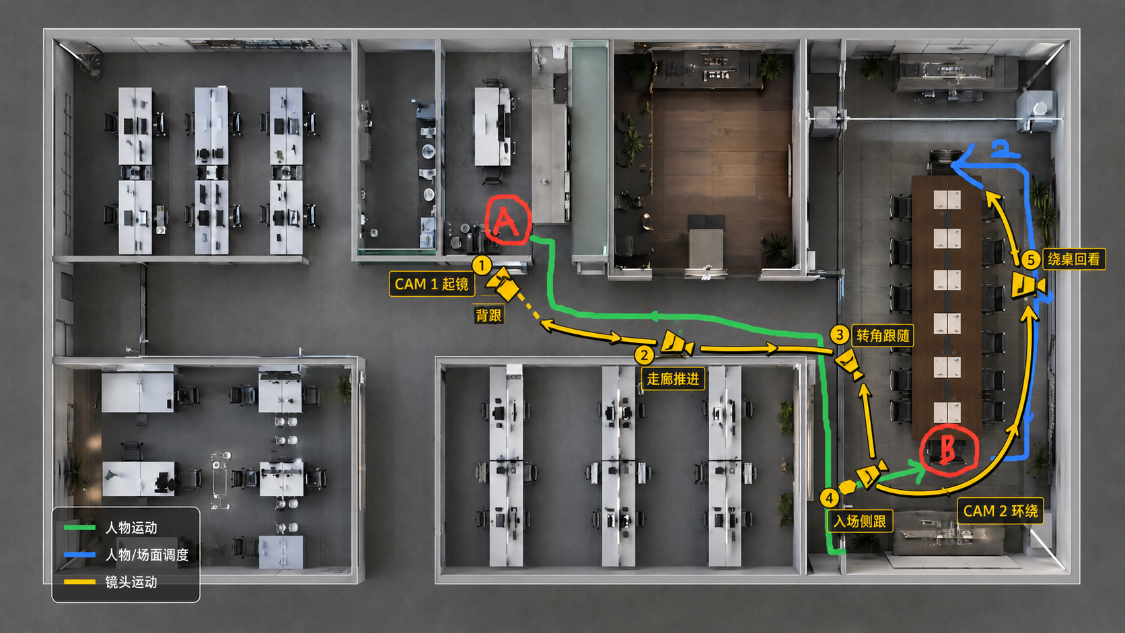
If you just want to create a static image, the frame of reference might be enough. But if you're going to chase, fight, multi-person confrontation, long shot, complex transition, you need a dispatch chart。
II. Step 1: Reversing the script into a complete scene asset
BEFORE WRITING VIDEO ALERTS, DO NOT RUSH TO WRITE "FILM SENSE, CAMERA FLOW, ACTION." LET'S GET BIG LANGUAGE MODEL AI BACK ON THE SCENE。
Here's my play:
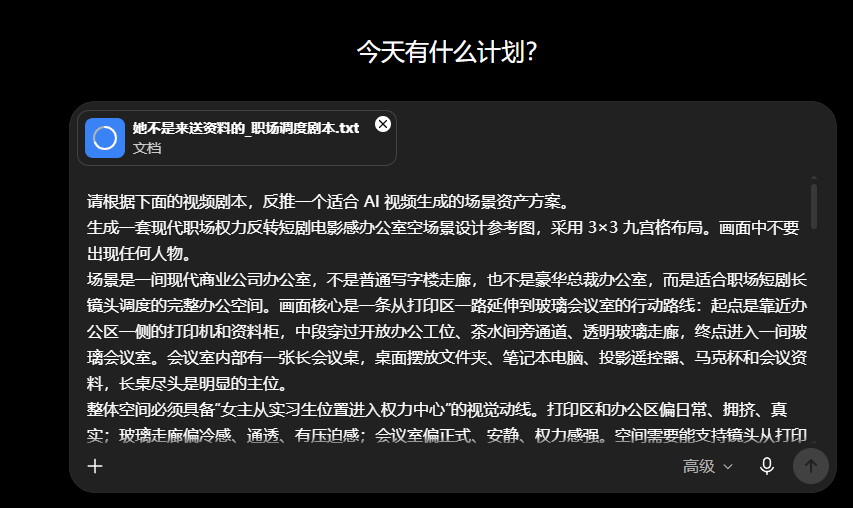
Chat GPT dialogue interface
Examples of direct-used hints:
PLEASE REVERSE AN AI VIDEO-GENERATED SCENARIO BASED ON THE VIDEO SCRIPT BELOW。
Generates a set of reference maps for the design of space scenes in the office of the Retro short-time film office, using 3x3 nine-gauge layouts. Don't show anyone in the picture。
The scene is an office of a modern commercial company, not a normal writing building corridor, nor a luxury office of the president, but a full office space suitable for the short-scenario long shot of the workplace. At the heart of the picture is the course of action from the printout to the glass conference room: The starting point is the printer and information cabinet on the side of the office area, which runs through open office spaces, the water-water sidewalk, the transparent glass corridor and ends in a glass conference room. There is a long table inside the conference room, with folders, laptops, projectors, glasses and meeting information on the desktop, at the end of which there is a clear lead。
The overall space must have a visual motion line for the “woman-in-person from the intern position to the centre of power”. Printed and office areas are more routine, crowded and real; glass corridors are cold, permeable and oppressive; conference rooms are more formal, quiet and powerful. Space needs to be able to support the lenses starting with the printer's paper exit, following the documents through the office area, entering the conference room through the glass corridor, then passing through the desktop at a low altitude, and finally overlooking the zipper to show the full schedule。
Using a 3x3 nine-gauge layout, the nine-gauge boundary is clear and each cell shows different angles:
The starting point of the first grid print area shows the modern office print area at close range. The images include large commercial printers, excavated documents, information cabinets, file trays, convenience stickers, staplers, shredders, white walls and cold white office lights. A starting point for a person is reserved next to the printer, but no person is present. Space must be like the first shot of a woman who picks up a file。
The second one is open to open office areas, showing open office areas, with a straight-line passage for people. On both sides are workspaces, computer monitors, office chairs, file racks, green plantings, working-plate hangers, coffee cups and cold white light. The passageway must be clear, from the direction of the print area to that of the glass corridor far away, and be suitable for smooth and smooth。
The third graze of the water sidewalk shows the transition space between the office area and the glass corridor. On the left side are small tea rooms, coffee machines, drinking water machines, bars, paper cups, refrigerators and lockers; on the right side are the edges of the office space and the glass partition. There is a narrow passage between them, which emphasizes that the female master does not explain, does not stop and goes straight through the past。
The fourth glacial glass corridor is deep and displays a modern office glass corridor, with transparent glass walls, metal frames, cold white light belts, reflective ground and remote conference room doors. The glass had a slight reflection, the space line was clean, and there was a strong sense of deep and oppressiveness. The entrance to the conference room must be visible at the end of the corridor。
At the door of the fifth gypsy meeting room, the glass room door view. The door is a transparent glass push or flat-opening door, which can be seen on the long conference table, projection screen, conference chair and desktop file. A stop-site of the person is reserved at the door, but no person appears. It's like a second before the hostess pushes in and says, "The meeting is suspended."。
The low view of the six-gauge table was taken from the low angle on the surface of the table, with folders, the cover of the appointment book, laptops, minutes, pens, projectors and water cups on the table. The long table extends from the horizon to the farthest, creating a strong depth of power. The main chair at the far end is more visible and more central than the ordinary chair。
The main inverse space for the 7th glycol room displays the entire glass room inside. At the end of the meeting, there will be a main seat at the centre of the table, with room reserved for the exchange of two persons, but no one will appear. The side of the table has a bypassable channel, which is suitable for the lens to move around half a circle around the table. An abstract project chart can be displayed on the project screen, but no readable text appears。
The eighth glacial glass looks at the conference rooms from the inside of the room, and the outlook is glass reflections, office area lights and blurry workspaces, within which are long conference tables, projectors, master chairs and desktop files. The image needs to have a sense of tension that “the outside workforce is looking at, the inside is changing power relations”, but no characters, people or images。
The ninth glyph overlays the layout of the plan above the plane, clearly indicating the full space: printing area, open office area, office area corridor, tea room, glass corridor, conference room door, long conference table, main seat at the end of the table, main side position, projection screen, glass wall, office area outside the conference room, elevator entrance direction. The main female route will be marked with a clear spatial motion line: a print area - > Open office area - > Pipewater Passage - > Glass Corridor - > Front of the conference room - > Head of the conference table. Point the lens line: printer comes out of the paper mouth with a flat look - > behind and on - > Through the glass corridor - > The desktop passes low - > Over and above - > Half a circle around the table - > The glass pulls back. The layout is like a visual art scene design, so don't show up。
Image style: Modern working-level short-time film sense, cold white office lights, low-saturation and commercial drama sense, clean high-quality, glass, metal, light grey wall, dark conference table, cold-sweet carpets, real office space, light shallow depth, stable long shot sense, film spectroscopy, video and video scenario design reference. ARRI Alexa Mini LF, Cooke Panchro/i Classic Prime Lines, 1/4 Black Pro-Mist, True Photography, Soft and High, Light Light, Light Particle, Low Contrast but Clear, Cold Grey Blue and Hot White Light Balance。
Important limitations: Must be a modern workplace office. There must be a complete continuum from the print area to the conference room. It must include printers, open office areas, water sidewalks, glass corridors, glass conference rooms, long conference tables and master chairs. The head of the table must be visible at the end of the table. The meeting room must be suitable for the person to go around the table to complete the reverse of power. The ninth grid must be top-vision layout. No person, person, hand, face, back or body is to be seen. Don't generate luxury president's office. Do not generate normal room single view. Don't create messy start-ups offices. Do not generate hotel rooms. Do not create courts, classrooms, hospitals, bank halls. Do not make the space structure inconsistent with each cell。
Negative Prompt: personals, roaders, shadows, handers, faces, backs, human scratches, employees, bosss, interns, conferencepersons, transmutations, work card scripts, readable texts, subtitles, watermarks, logo, misposters, nine palaces disorders, repeated images, disconnected space structures, no printed area, no open office area, no glass corridor, no glass room, no long table, no master table, change of table positions, overlux, office of the managing director, hotel hall, classrooms, courts, hospitals, banks, unreconciled works, sabour bank, sabour bank, fusion office, comfort, cartoon, low clarity, overbranding, plastic sension。
When you get a hint, use GPT image 2.0 to generate a scene。
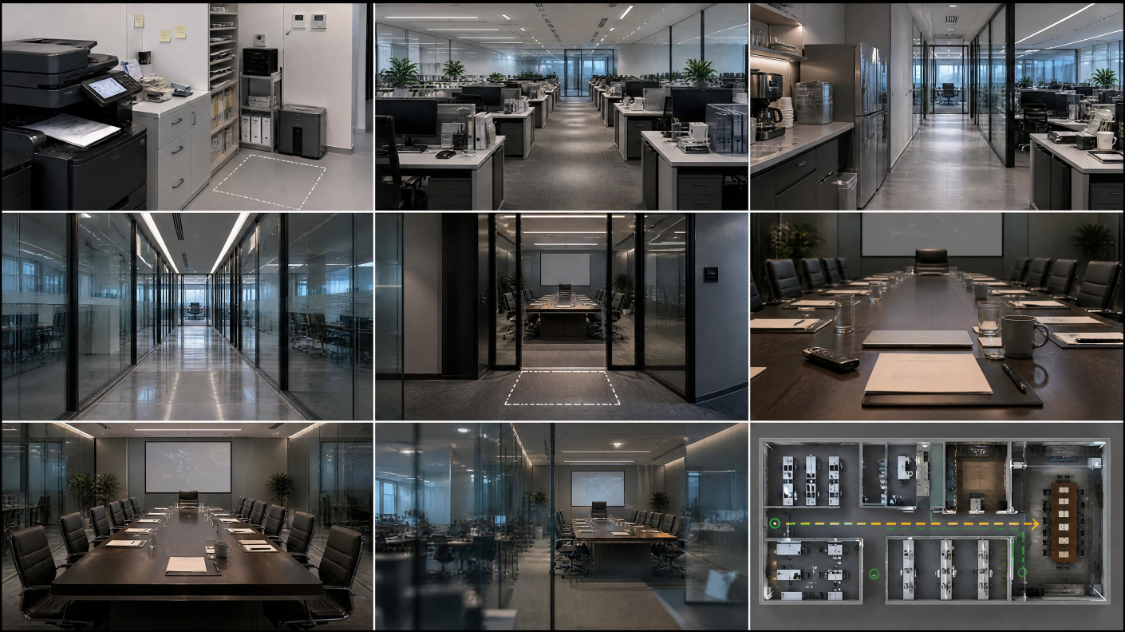
The purpose of this step is not to generate a final video at once, but to create a “site”. As long as the site is stable, the back seat and lens will depend on it。
Then you extract the last view。
the hints are as follows (using image2.0):
Extract the last view from the top view and do not copy the lines and circles
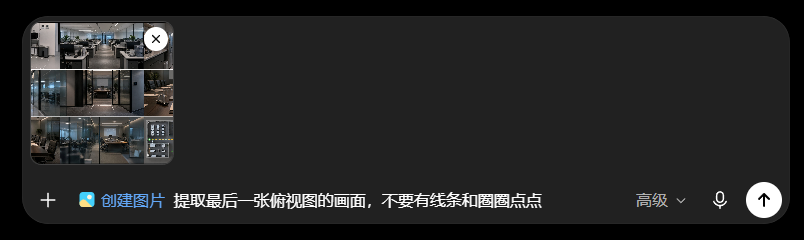
GPT interface 2.0
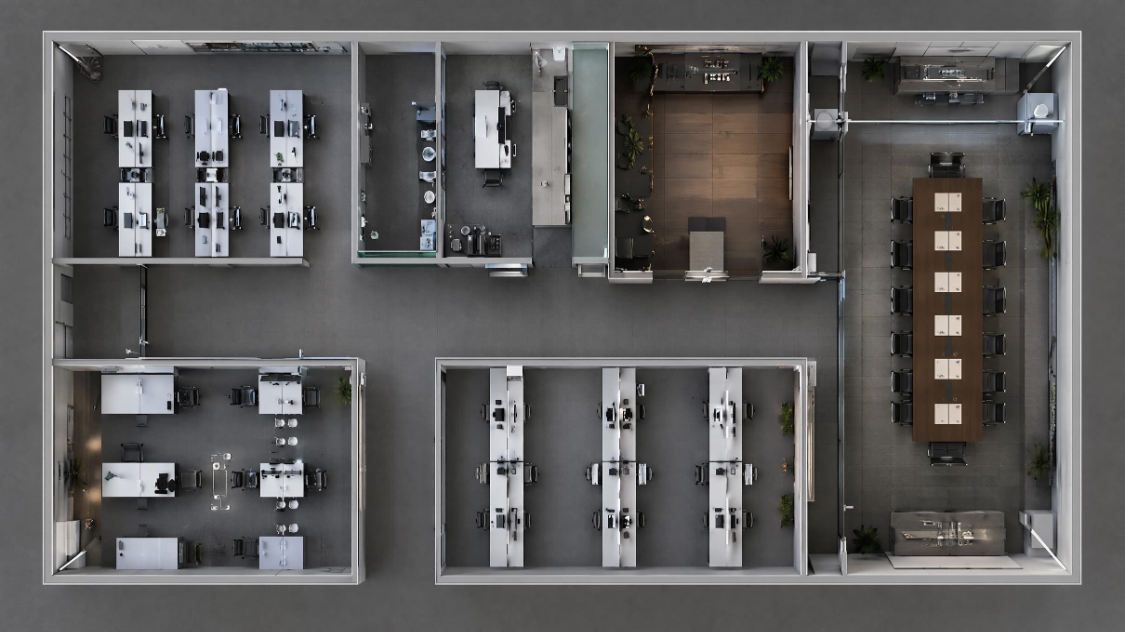
Extracted Pictures
Step 2: Mark the person's position on the view below
After extraction, mark the initial position. It is suggested to use simple, stable and easy to interpret symbols and not to make them too flowery。
If you use the design software, you can draw dots, arrows and text directly on this extracted subview。
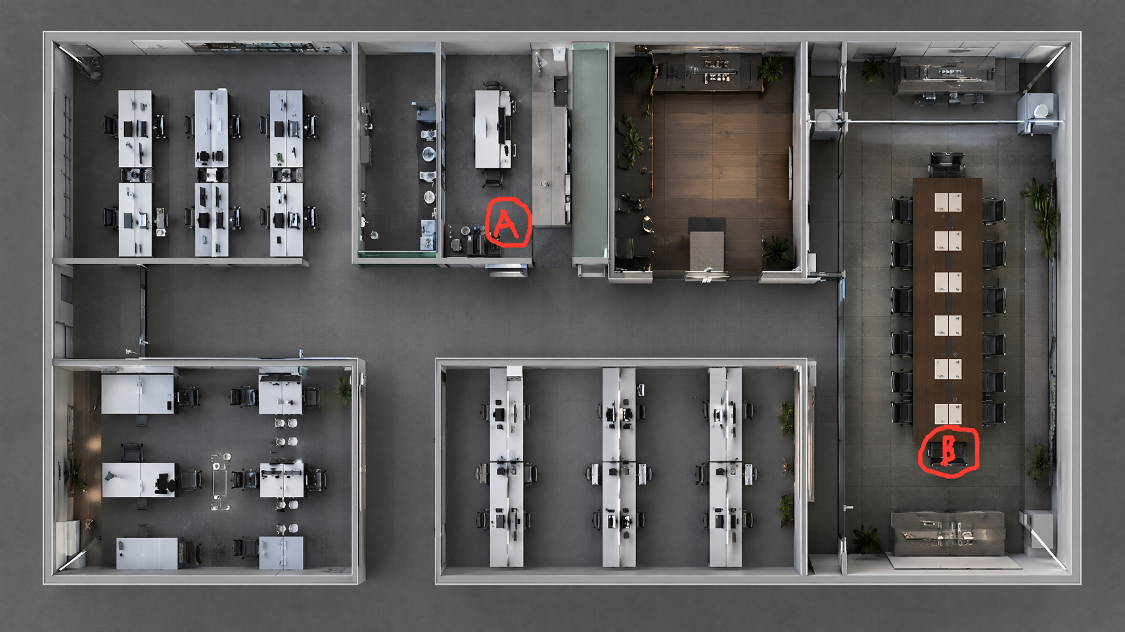
IV. Step 3: Mapping the movement of people
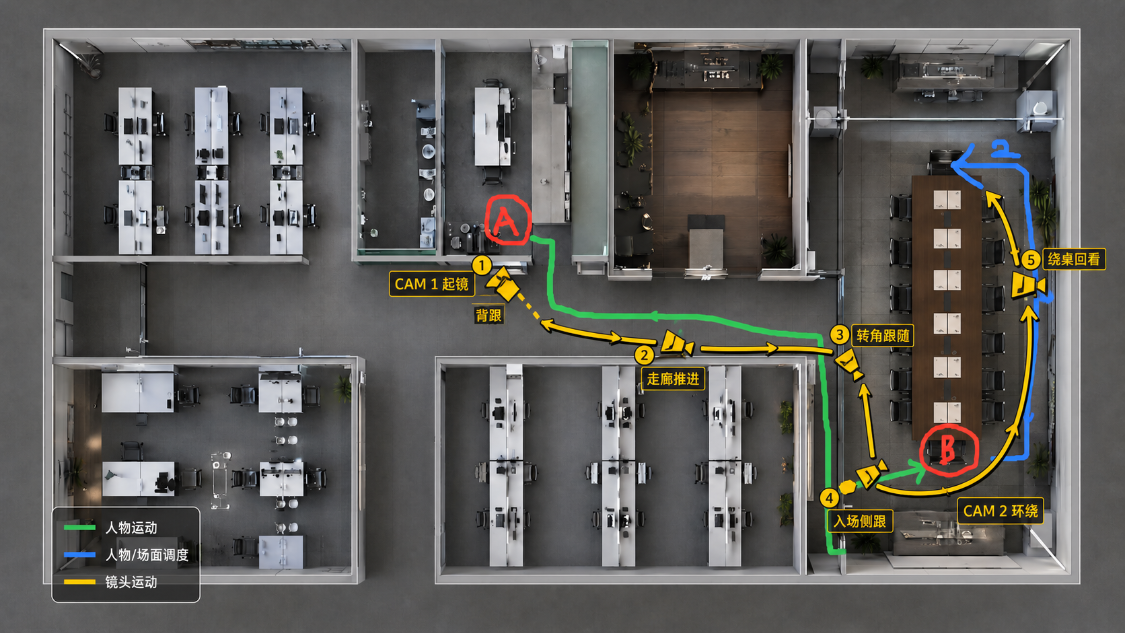
Stations are just the starting point, and the video is really moving on track. The trajectory is best represented by lines and arrows, and different colours are used for different figures。
For example, the green line represents the female ' s mobile route, and the blue line means the male ' s mobile route, which is not as good as it is, but the key action。
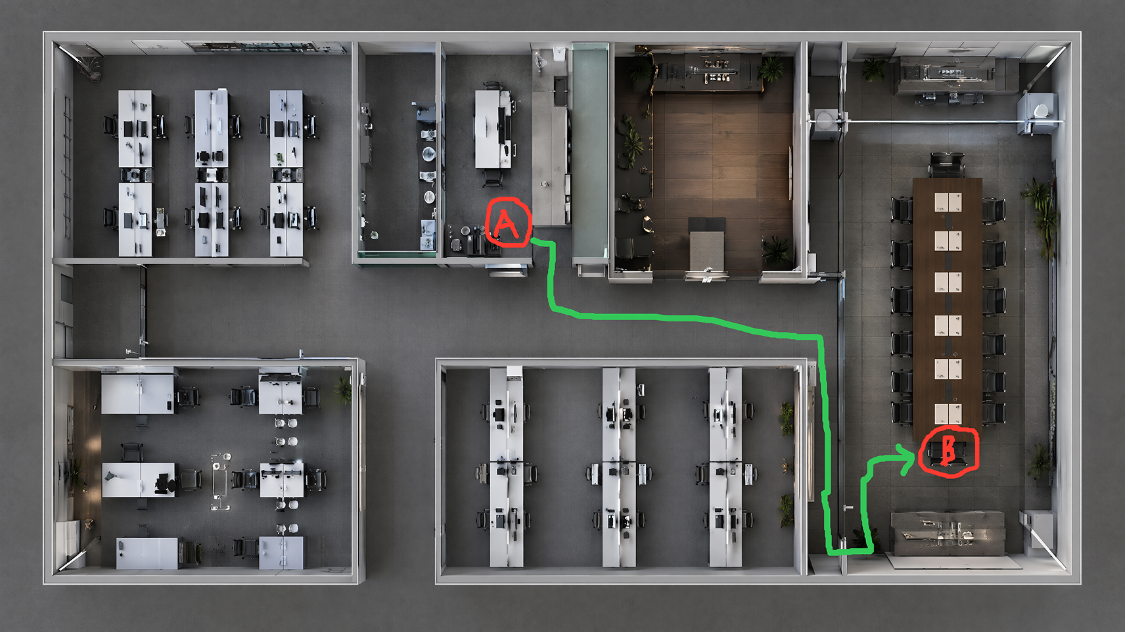
V. Step 4: Do not ignore camera scheduling
A LOT OF THE VIDEO WENT OUT OF CONTROL, NOT THE CHARACTER WAS WRONG, BUT THE CAMERA DIDN'T KNOW HOW TO DO IT. THE PERSON'S ROUTE DETERMINES THE MOVEMENT, THE LENS ROUTE DETERMINES THE PERCEPTION. ONE SCENARIO CAN BE ACOUSTIC, SIDE-PENETRATING, PROXIES, PULLS, SURROUNDS, OR, AT CRITICAL TIMES, CLOSE-UP. IF THE LENS IS NOT SPECIFIED, AI MAY RANDOMLY SWITCH VIEWS, CAUSING SPACE SENSES TO BREAK。
Camera scheduling can be written into three types of information:
The first is the space. That's where the cameras look, like the door, the hallway, the side of the meeting table, the people behind。
The second category is that of sports. It's like pushing, pulling, shaking, moving, following, going around. The rookies can understand that the push is the lens close, pull is the lens far away, shake is the lens in the direction, and move is the lens position horizontally。
The third category is addressed. Who's with each part of the camera, with the main character, with the opponent, with a props or with a move。
The prompt words are as follows:
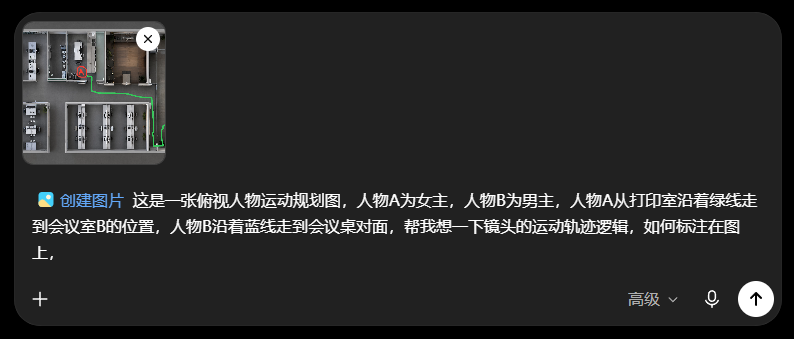
IN CONJUNCTION WITH THE SCRIPT, THIS IS A TOP-VIEWED SPORTS PLAN WITH A FEMALE, A MALE, A MAN FROM THE PRINTING ROOM DOWN THE GREEN LINE TO THE LOCATION OF CONFERENCE ROOM B, AND A MAN B COMING ACROSS THE BLUE LINE ACROSS THE TABLE TO HELP ME FIGURE OUT THE LOGIC OF THE TRACK OF THE CAMERA AND HOW TO MARK IT
VI. How to group the final video alerts
Full video alerts can be written by "[photographic parameters and image senses] + [total emotion] + [role description] + [situation/ schedulechart explanation] + [image content]"。
Example:
[photographic parameters and graphic senses] Cooke Panchro/i Classic Prime Lines, with 1/4 or 1/8 Black Pro-Mist radium and focal segment at the front of the camera: 35mm and 50mm focal points are used more frequently in the room than in the day-to-day use of 35mm and 50mm focal areas, with the optical circle controlled between T2.0 and T2.8. Kodak Portra 400 film color. It's called Teal & Warm Amber, no music, no subtitles。
"The Total Emotion"
The modern world of work reverses the sense of power, calms, oppresses, restrains and contrasts. The hostess, on the surface, looked like a general intern, carrying documents from the printing area through the office area and the glass corridor and entering the conference room. Everyone thought she was only here to send the information, but eventually she took the lead in the reverse of power. The focus is on unstoppable footsteps, convergence of vision, drop-off of documents, suspension of meetings, and main exchange of positions。
Young woman, one picture, two pictures of three Asian girls with straight, dark hair, air, cold and sweet. White shirts, black skirts, work cards around the neck and folders in hand. Looks like a regular intern, clean and quiet, but walking in a steady manner, with no explanation, no pause。
Photo 4 by a young Asian boy, cold-spirited, wearing a dark business shirt or a suit, sitting at the end of the table. The pre-session controlled the rhythm of the meeting with a chilling expression; the post-appointment was suspended after the post-appointment was seen, from the main position to the female side。
Scene: Photo 6 pic. 7 Modern Office Printed Area Connects Open Office Area. Printers, information cabinets, workspaces, computers, and employees are all in the picture。
personal track reference: a point in photo 6 is the hostess' position, he follows the green track 1
point b is the master's seat. he sees the hostess in the chair opposite the side of the circuit
[FIGURE CONTENT] STRICTLY REFERS TO THE OFFICE SPACE STRUCTURE AND THE MOVEMENT OF PEOPLE IN THE OVERLOOKING PLANS WITHOUT CHANGING THE ORIGINAL GREEN FEMALE AND BLUE MALE ROUTE. MODERN WORKPLACE OFFICES WITH OPEN OFFICE AREAS CONNECTED TO GLASS CONFERENCE ROOMS, COLD WHITE OFFICE LIGHTS, LOW SATURATION AND COMMERCIAL SHORT-TIME TASTES. A FULL ONE-STOP SHOT, DONE IN 15 SECONDS, WITHOUT ANY HARD CUTS, WITHOUT SWITCHING, WITHOUT CHANGING THE OFFICE LAYOUT. MASTER A WEARS A WHITE SHIRT AND A BLACK SHORT SKIRT, WEARS A WORK CARD, CARRIES A FILE AND MOVES STRICTLY ALONG THE GREEN ROUTE FROM POINT A IN THE PRINTING ROOM; MASTER B WEARS A DARK SUIT AND STARTS SITTING AT THE MAIN SIDE OF THE TABLE AND THEN MOVES STRICTLY ACROSS THE TABLE ALONG THE BLUE ROUTE. THE CAMERA MOVES STRICTLY ALONG THE YELLOW ROUTE: 0-2 SECONDS, MIRRORS FROM THE ROOM WHERE THE PRINTER IS LOCATED, A LOW SEAT CLOSES THE DOCUMENT, AND THE CAMERA MOVES BACK TO THE SIDE OF THE WOMAN ' S SIDE, FORMING A BACK-AND-EYE VIEW; 2-5 SECONDS, FOLLOWING THE WOMAN FROM THE FRONT DOOR OF THE ROOM, MOVING TO THE RIGHT SIDE ALONG THE CORRIDOR OF THE OPEN AREA, THE WOMAN REMAINS IN THE FRONT SIDE OF THE PICTURE, WITH THE VIEW MOVING FROM THE EDGE OF THE TABLE TO THE RIGHT SIDE, WITH THE VIEW MOVING TOWARDS THE ENTRANCE OF THE CONFERENCE ROOM; 5-7 SECONDS, WITH A NATURAL TURN-IN AT THE ENTRANCE OF THE CONFERENCE ROOM, WITH THE WOMAN ' S SIDE MOVING TO THE CONFERENCE ROOM, WITH THE CAMERA COMING FROM THE BACK SIDE OF HER SIDE TO THE SIDE OF THE PERSON ' S SIDE, WITHOUT A SUDDEN RISE; 7-9 SECONDS, WITH THE WOMAN MOVING FROM THE SIDE OF THE TABLE TO THE SIDE SIDE OF THE TABLE ALONG THE SIDE OF THE SIDE TO THE SIDE SIDE OF THE CONFERENCE, WITH THE WOMAN ' S SIDE MOVING FROM THE SIDE TO THE SIDE OF THE SIDE OF THE TABLE TO THE SIDE OF THE SAME SIDE WITH THE OTHER SIDE OF THE OTHER SIDE, AND TAKING THE SIDE OF THE SIDE OF THROUGHOUT THE PROCESS, THE WOMAN MOVES FROM THE FILE TO THE CONFERENCE ROOM TO THE MAIN SEAT, AND THE MAN RISES FROM THE MAIN POSITION TO THE OPPOSITE SIDE, DOES NOT MOVE INSTANTANEOUSLY. THE CAMERA IS ONLY A BACK, A CORRIDOR, A CORNER, A SIDE OF THE SCENE, A SLIDE AT THE TABLE, A SMALL ROUND TABLE, A LOOK AT IT AND PULLS IT TO THE END. THERE IS NO HARD, FLASH, MEANINGLESS ROTATION, LENS THROUGH WALLS, PERSON THROUGH TABLES, TABLES AND CHAIRS。
Capacity boundaries
OVERVIEWING THE SCHEDULE WILL SIGNIFICANTLY INCREASE CONTROLLABILITY, BUT IT WILL NOT GUARANTEE THAT IT WILL ALWAYS BE FULLY GRAPHED. AI VIDEOS CONTINUE TO BE INFLUENCED BY MODEL CAPABILITIES, REFERENCE CHART CLARITY, ACTION COMPLEXITY, VIDEO HOURS AND TOOL PARAMETERS. THE MORE COMPLEX THE ACTION, THE MORE THE ROLE, THE LONGER THE LENS, THE HIGHER THE PROBABILITY OF FAILURE。