



WHEN YOU PRODUCE THE AI VIDEO, YOU MAY FIND A PROBLEM: WHILE THE SAME SCENE REFERENCE IS USED, AND THE SAME SCENE IS REPEATEDLY EMPHASIZED, WHEN THE LENS IS SWITCHED TO DIFFERENT ANGLES, THE FIXED WINDOW, FURNITURE AND SPACE LAYOUT WILL CHANGE。
Looking at each shot alone, the picture seems to be fine, but once they are cut together, it is as if the person entered another room. This not only affects the coherence of the video, but also increases the time costs of recurring generation and modification。
IN FACT, SCENARIO CONSISTENCY IS NOT JUST ABOUT GIVING DIFFERENT LENSES A SIMILAR STYLE AND COLOUR OF RETROFITTING, BUT, MORE IMPORTANTLY, ABOUT GETTING AI TO UNDERSTAND THE STRUCTURE OF THE ENTIRE SPACE AND THE LOCATION OF THE OBJECT. THIS SECTION WILL START WITH THE LIMITATIONS OF THE SCENARIO REFERENCE MAP AND WILL EXPLAIN HOW SPACE INFORMATION CAN BE SUPPLEMENTED WITH A THREE-DIMENSIONAL PROFILE MAP TO MAKE MULTI-PHOTOGRAPHIC VIDEO LINKS MORE STABLE。
I mean, why does the camera change and the scene change
A lot of people are making itAI video generationSimilar problems have been encountered。
In the first video, the background is hanging, green
The second part is gone. It's gone
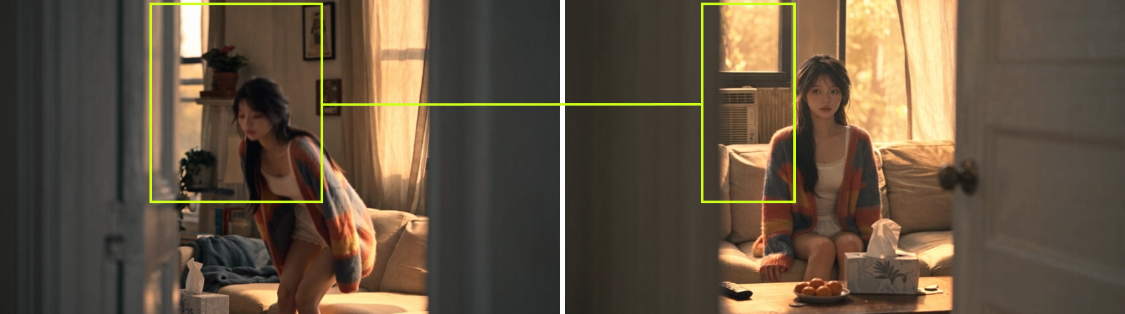
Look at these two shots alone. They're probably all right. The style of the renovations is similar, the colours are uniform and there is no apparent conflict of light。
But if they are played on a continuous basis, there is a problem: the picture looks like the same room and the actual space has changed。
That is the problem that is being addressed by the coherence of the scene。
We usually focus on the person, for example, by requiring that the person's face, hair, clothing and figure be consistent. These requirements are important, but the person is only part of the picture。
A complete scene also contains wall structures, the location of doors and windows, furniture layouts, ground materials, space depths, as well as distance and covert relationships between objects。
For example, the same coffee shop can be filmed from a front, side and overlooking angle. Regardless of the location of the camera, the cashier should be in the original area and the relationship between the window and the entrance should remain unchanged。

The lens can change, but the basic structure of the scene cannot change at will。
THEREFORE, WHEN PRODUCING AN AI VIDEO THAT REQUIRES A CONTINUOUS LENS, WE NEED NOT ONLY TO TELL AI WHAT'S IN IT, BUT ALSO TO TELL IT AS CLEARLY AS POSSIBLE: WHERE THESE THINGS ARE, WHAT RELATIONSHIPS THEY HAVE, AND HOW THEY SHOULD STILL BE FORMED WHEN THE LENS CHANGES。
ii. Why is a complete picture not enough
NOW THAT THE SCENE MAP HAS SHOWN THE ROOM, WHY CAN AI STILL PRODUCE A DIFFERENT LAYOUT
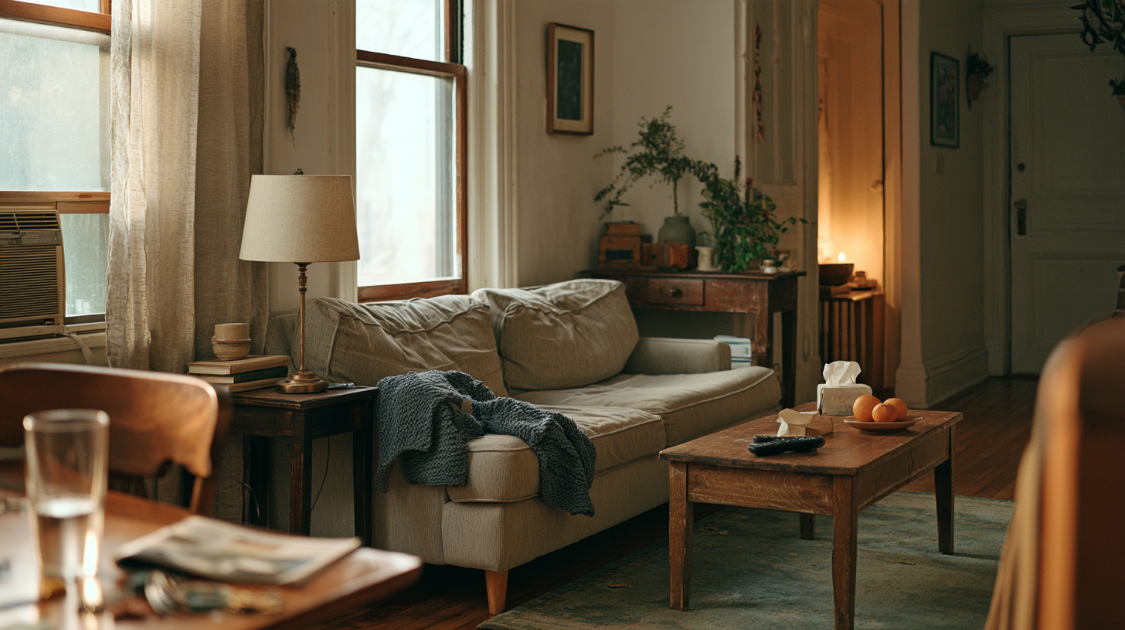
The reason is that a two-dimensional picture can only directly present the information that can be seen in a given perspective。
Let's say we film a positive picture of an office。
A table, chair, bookcase, window and wall decoration can be seen. These elements are more clearly presented, but there is still a lot of unknown information in parts of the picture that are not fully displayed。
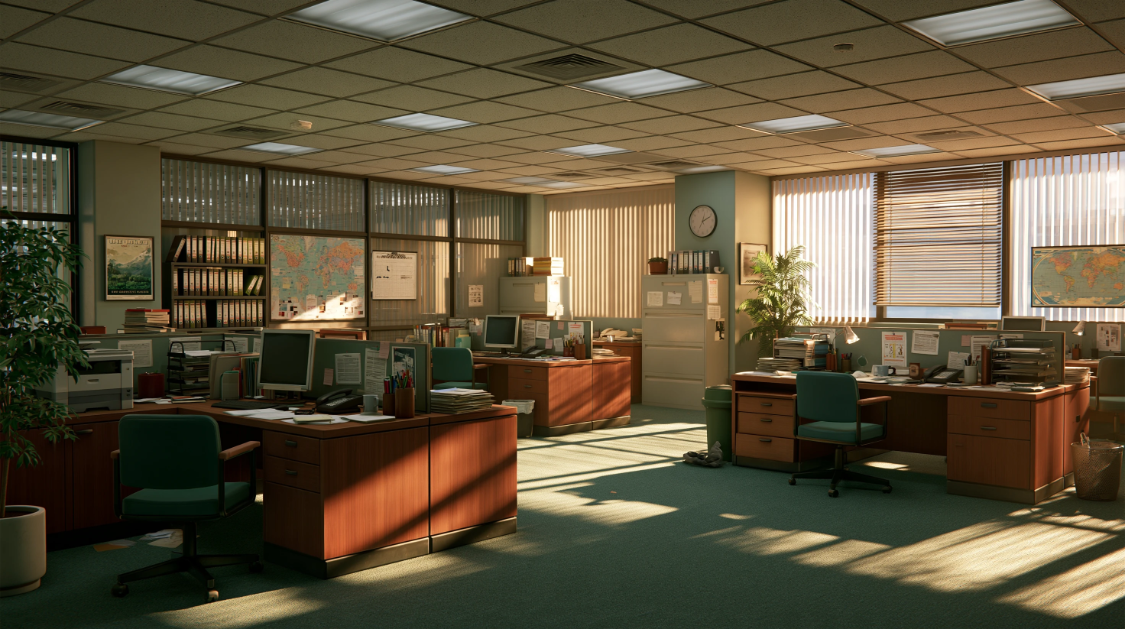
For example:
How much room is left behind the desk
How far is the shelf and the side wall
Door on left or right
Does the window extend to the adjacent wall
Is there any other furniture behind the table
What route do people have to follow when they walk from the door to the table
IF THIS INFORMATION IS NOT CLEARLY PRESENTED, AI WILL NEED TO EXTRAPOLATE FROM EXISTING IMAGES。
This unknown information may not affect the outcome when the lens remains the same. But when the camera turns to the side, the person goes to the room, or the camera has to be taken from the door to the inside, the area that was not shown becomes important。
AT THIS POINT, AI MUST FILL THE SPACE OUTSIDE THE PICTURE。
Completion is not a problem in itself, but the problem is that different outcomes may offer different means of completion。
At first generation, the door may be on the right side; at second generation, the door may appear in the back wall. At first generation, the table was far from the window; at second generation, the space between the two changed。
Even if the same reference and the same hint are used, it is not guaranteed that the results are identical at each time。
This is because the reference diagram is not an accurate space model, but only provides a visual basis for the generation and does not automatically lock up all undisclosed space information。
THEREFORE, IN ORDER TO IMPROVE THE COHERENCE OF THE SCENE, THE FOCUS SHOULD NOT ONLY BE ON REPEATING “SYMMETRY”, BUT ON FURTHER SUPPLEMENTING THE SPATIAL STRUCTURE OF THE SCENE TO GIVE AI A CLEARER REFERENCE。
III. Why are there limits to a multi-dimensional reference map
When we realize that there's a missing information on a single picture, it's natural to think of another way: to generate a few different angles。
For example, a front, side and back map for the same room was prepared, which was then combined into nine palaces。
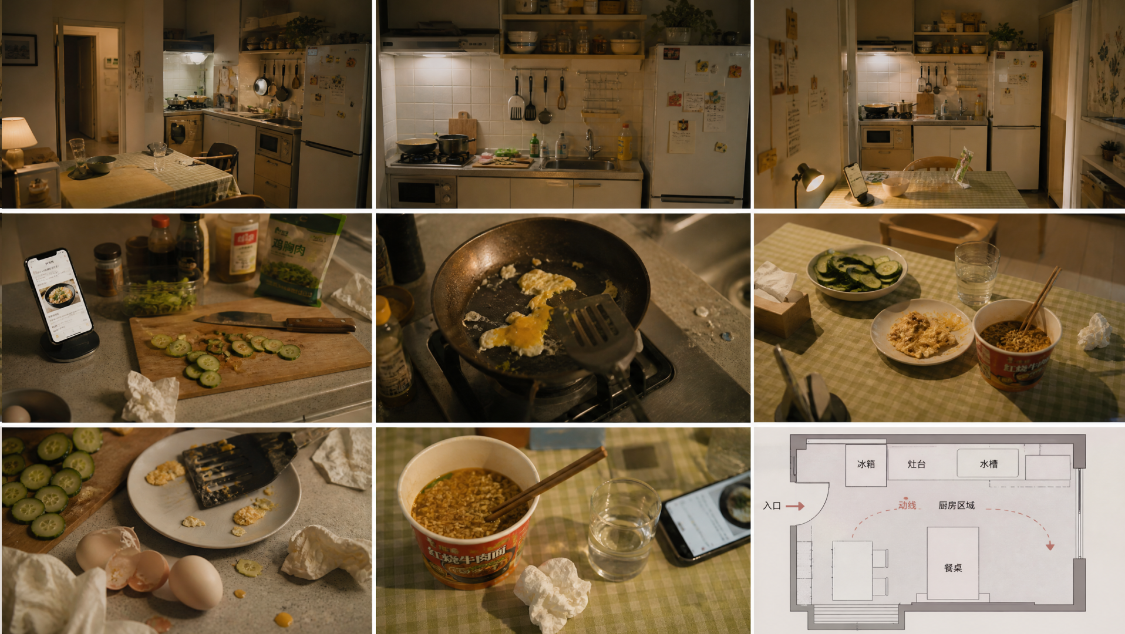
This approach does help。
The front chart shows the look of the main furniture, the side map supplements the depth of the room and the back map presents the area that was previously blocked. A multi-angle reference allows us to observe more details than a single picture。
There is, however, a problem here: multiple pictures show different parts of space, but not necessarily a clear expression of the unified relationship between them。
For example, the first shows the corner of the kitchen and the living room, the second shows the middle of the kitchen, but the pot is different
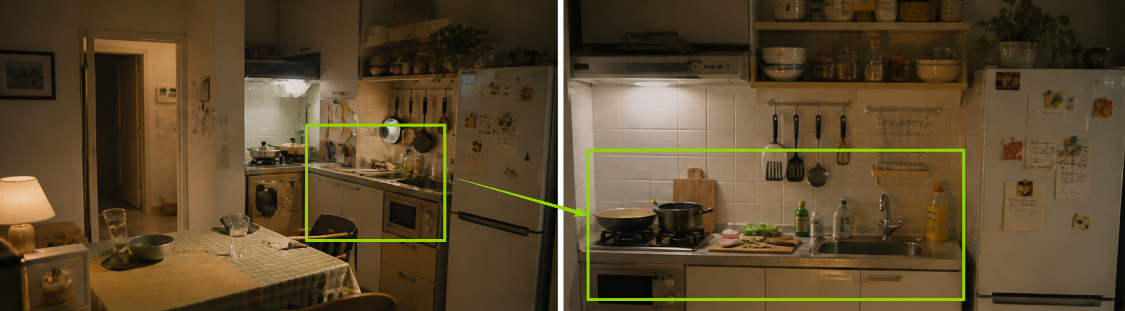
These changes may be due only to the different angles of the camera and may also come from variations in the layout of different images。
IN THE ABSENCE OF A CLEAR SPATIAL STRUCTURE, AI STILL NEEDS TO JUDGE THE CORRESPONDENCE BETWEEN THESE IMAGES。
In addition, pictures from different angles vary in their perspective, object size and cover relationship. Even if each picture appears to be in order alone, it does not mean that they must be able to form a fully unified three-dimensional space。
Of course, this does not mean that the Nine Palaces are worthless。
If the focus of the mission is on the appearance of the person, the details of the costume, the different sides of the product, or the visual style of a scene, the multiple angles remain very practical。
But we also need a more intuitive way to focus the space structure when the mission becomes a continuous video production that requires the same space to recur in different lenses。
This leads to a three-dimensional profile。
What's the problem
A three-dimensional profile can be understood as a stereo-reference map that can observe the interior structure from above the slope。
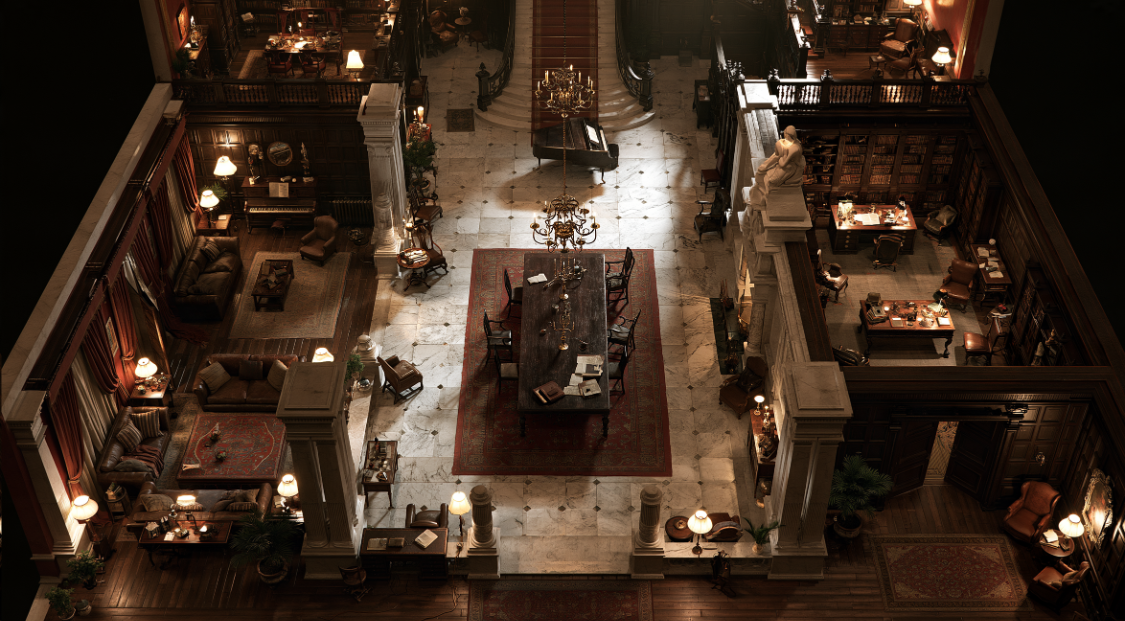
It usually retains floors, parts of walls, doors, windows, furniture and fixtures, while removing or lowering parts of the walls so that the previously concealed interior areas can be presented directly。
Visually, it has a model of a room that opens the wall。
Its main value is not to make the picture more stereo, but to make space relations clearer than ordinary scenes。
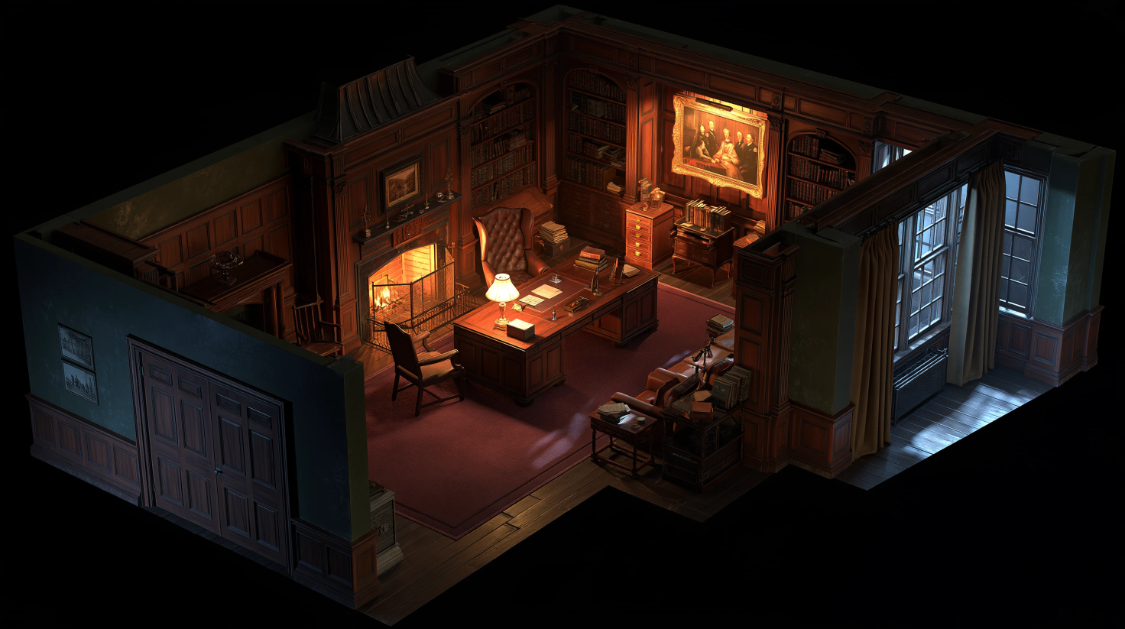
First, it can present the whole layout of the room。
We can see the relationship between the entrance, the window, the main furniture and the wall at the same time, rather than just looking at the room in one direction。
Second, it can help clarify the relative position of the object。
For example, a table close to which wall, where the couch is located in the window, and whether there is a passage between the cupboard and the entrance, can be presented in more intuitively in the same picture。
Thirdly, it could reduce the problem of the dispersion of space information。
THE CONTENT, WHICH WOULD HAVE REQUIRED MULTIPLE PICTURES TO BE SEEN SEPARATELY, CAN NOW BE CONCENTRATED IN A THREE-DIMENSIONAL REFERENCE MAP. AI CAN OBTAIN A MORE COMPLETE ENVIRONMENTAL LAYOUT WHEN GENERATING NEW FOOTAGE。
Fourthly, it helps to distinguish between fixed structures and changes in content。
The walls, doors and windows of the room and the fixed furniture are elements of a relatively stable scene; the position, movement and camera angle of the person may vary according to the situation。
When these two types of information are distinguished, subsequent lens design becomes clearer。
IT SHOULD BE NOTED THAT A THREE-DIMENSIONAL PROFILE IS NOT THE EQUIVALENT OF A THREE-DIMENSIONAL MODEL THAT CAN REALLY BE MEASURED ACCURATELY. IT REMAINS A TWO-DIMENSIONAL IMAGE, AND AI MAY ALSO EXTRAPOLATE THE INVISIBLE AREAS IN THE ORIGINAL MAP。
Thus, its role is to provide a more complete and understandable space reference rather than an absolute locking down of each object。
V. First step: to identify scene information that really needs to remain unchanged
DIRECTLY DESCRIBE THE SCENE YOU WANT, AND ALLOW AI TO GENERATE A THREE-DIMENSIONAL SPATIAL MAP OF THE SCENE FROM THE START。
For example, you need to create a living room, which is described in the alerts as the building structure of the living room, the location of the doors and windows, the placement of furniture and the overall style, and uses a fixed space plan prefix。
In this way, the same basis can be used in living rooms, bedrooms, coffee shops and offices。
1. Midjourney
Midjourney can use a simpler way of writing。
Before the original scene, add:
45 o'clock's-eye view of
copy
And then you take the scene you want to create。
For example:
45 ° 's-eye view of a Grand 1930s European dukeson Hall, pacificistic trajectoria, climatological diametrical, diametrical, diametrical, diametrical, diametrical, diametrical, diametrical, diametrical, and diametrically –
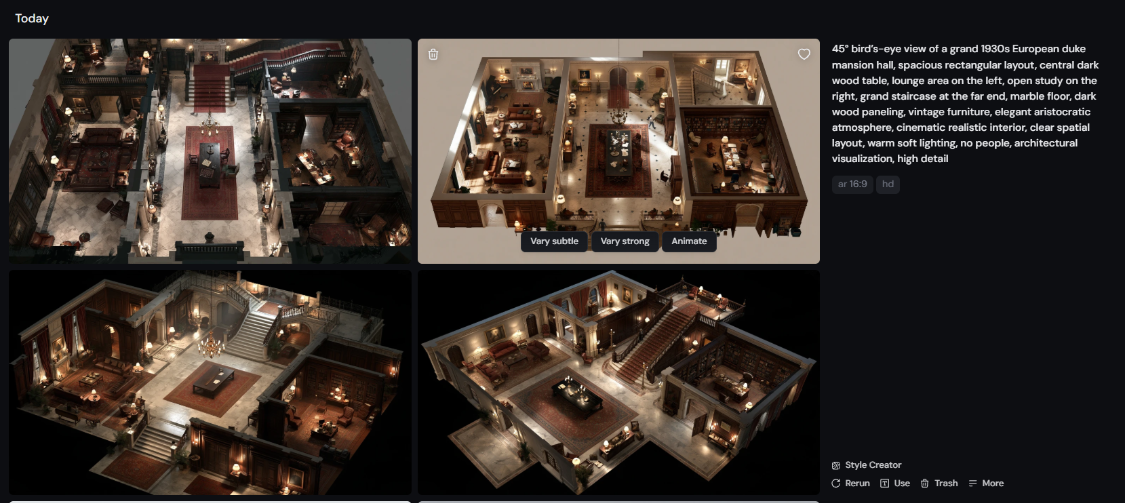
There is no need for an additional stack of spatial planning notes. You can see what you need by combining the front and back scenes。
But it's important to note that the picture is not just about furniture and architecture, but also about the light atmosphere you want。
If you want to create a sunset scene, write about the sky of sunset, the direction of light and the colour relationship inside and outside; if you want to generate a blue moment, write about the dark blue environment outside the window, the warm light in the room, and the contrast between the cold and warm light。
2. Seedream 5.0 Pro/GPT image 2.0
Based directly on the video scene you're going to make, you're going to create one:
A complete 45° tilt view of three-dimensional spatial planning map。
This sentence can be placed directly at the top of the hint。
For Seedream 5.0 Pro and GPT Image 2.0, that is enough. I'll pick up your original scene description later。
Basic
You can understand that directly:
A complete 45° tilt view 3D spatial planning map + scene description
For example:
A complete 45° tilt view of three-dimensional spatial planning map. The grand hall of the European Duke's mansion in the 1930s, with a wide rectangular layout, with a dark wood table in the centre, an open library on the left, a luxury stairway on the right, at the far end of the world, marble floor, dark wood-covered walls, retrofitting furniture, an elegant aristocratic atmosphere, a film-class-written indoor style, a clear space layout, warm and light, no one, visualization of buildings, high-level drawings
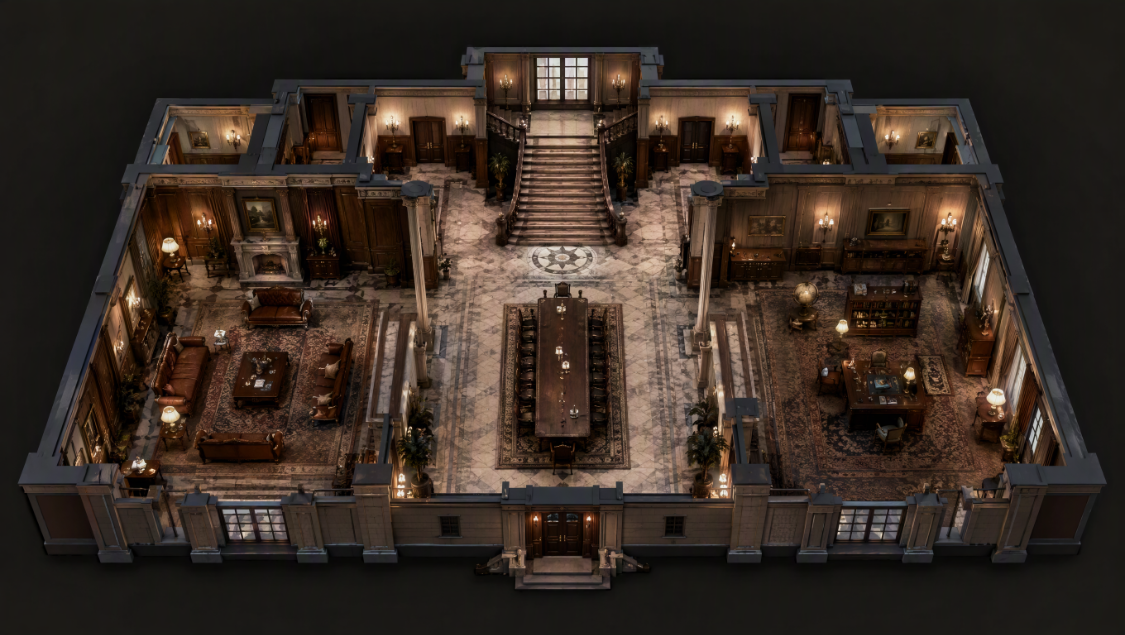
The underlying spatial planning map is thus expressed。
This is really important
Here's a particularly critical place:
Space planning maps are not only used to control layouts, but also to set up a light atmosphere for subsequent videos。
In other words, you don't understand it as a cold space map。
It is also an atmosphere reference for follow-up videos。
If the video behind you wants:
Blue-Tone Times
Indoor heating
Warm comparison
The sun's sunset
Rain Night Neon
It's cold in the morning
Then you should write it together。
For example, my scene is the air of the blues
The prompt words are as follows:
A 45° tilt view of the three-dimensional spatial planning map of a full house, 4:3. Pixar style three-dimensional animated film tastes, sturdy shapes, fine material and a warm, real family life. Remove the roof, properly lower the front wall of the front line of the line of view, and give a clear view of the layout of the rooms, the location of the furniture and the interconnected motion lines of the entire house. There are no characters in the picture。
"Time and Shadow" "The blues of sunset, the soft blues of the sky outside the window." Cold, blue skylights penetrate through the balcony and room windows and form soft and cold light on the side floors, curtains and edges of furniture. Home landing lamps, bed headlamps, chandeliers in restaurants and corridor walllights have just been activated, releasing low-light warm amber light, forming warm areas of varying size on the couch, desktop and bedside. The light reflected through the wall and wood floor, and naturally lighted the surrounding details。
The position of the interior close to the lamps is warm and bright, and the window edges retain a clear blue and gray shadow deep inside the room, in contrast to the level of coolness. The brightness of the rooms varied slightly, the corridor was dark, the living room was warm and the bedroom was quiet. The overall exposure is soft, the dark detail is clear, and there is a calm atmosphere when animated films come home in the evening。
ONE FLOOR, FOUR ROOMS, TWO-GUARD RESIDENCES. BEHIND THE SCENES ARE THE BEDROOMS OF THE ELDEST DAUGHTER, THE BEDROOMS OF THE SISTER, THE PARENTS' MAIN BEDROOMS, THE DINING ROOM AND KITCHENS ON THE LEFT SIDE OF THE FRONT ROW, THE LIVING ROOM AND BALCONY IN THE MIDDLE, AND GRANDMA'S BEDROOM ON THE RIGHT. THE CENTRE IS CONNECTED THROUGH A SHORT T-SHAPED CORRIDOR, AND EACH BEDROOM HAS A SEPARATE DOOR. THE ENTRANCE DOOR IS LOCATED IN FRONT OF THE LEFT, WITH SHOE CABINETS AND SHOES-STOOLS; THE PUBLIC HEALTH ROOM IS NEAR THE CORRIDOR AND THE MAIN IS A SEPARATE BATHROOM。
Beds, closets, mirror dressing tables, bookshelves and cell phone stubs, open space at the dressing table, small carpets and soft beds。
Sister bedrooms: small children ' s beds for five or six-year-olds, toy cabinets, drawing books, carpets and small edge tables. Butter ash with soft and orange and a small nightlight on the side of the bed。
In the living room: gray clothed sofa, orange single-person chairs, lightwood teas, linen curtains. The warm light on the couch lit the mattress and the carpet. A small table and seat, a needle basket and a folded shirt are set up near the corridor. The balconies of the balconies concocted naturally with the warm light in the living room through the curtains。
Grandma's bedroom: wooden bed, warm gray bed, low cabinet and comfort armchair. The wide windowsills are ploughed with meat, pottery and small horticulture tools, the bedside lights on wooden cabinets and chairs, and the windowsills have soft blue edge light。
The parent's main bedroom: the bed against the side wall, the closet with the wall, the dressing table and the mirror are located on the wall opposite the door, with a slight error in the opening axle, in which the front area is shown. A comb and a mobile phone are placed on the table, with a free space reserved for the centre. The light of the bed headlights and the light of the light on the side of the mirror, and the cold blue light on the side of the window。
[Colours and labels] Furniture and flexibles are dominated by low-saturated orange, warm ash, cream white and light oak, combined with changes in woodlines, cotton marmalade, knitting, sanding walls and pottery. Blue grey environment light, together with indoor warm orange light, forms the colour atmosphere of the picture。
Spaces are marked with clear and visible Chinese names and text is placed in a rounded rectangle frame with a dark gray word and orange brown border to avoid furniture and doors. The overall picture is complete, the rooms are clearly identifiable, and there is a unified cinema and living atmosphere。
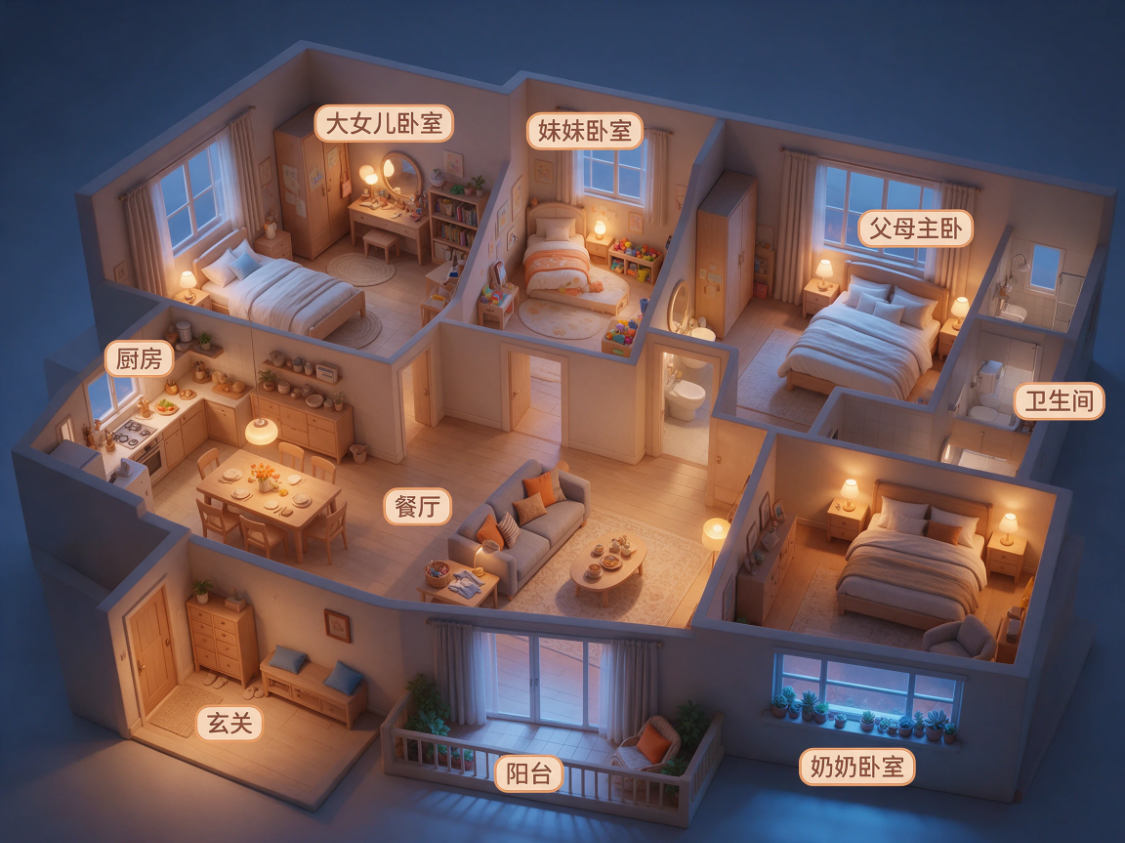
Do not create a neutral model that is all-white, all-lighted and all-ambient。
Because it's going to be a direct reference to the video, what's the atmosphere, and what's going on in the video。
Step 2: Spatial planning as a reference for video scenes
The next step is very simple when this spatial plan is produced。
In Seedance 2.5, it is directly used as a scenario reference。
And upload the character reference。
And write about the camera, the action and the mirror of your video。
There is no need to do much more here。
There is no need for a rewriting of a particularly complex set of scenarios。
All you have to do is make a very simple scene。
Generic scene binding hint
A three-dimensional spatial planning map is provided as a reference to the scene, maintaining the same spatial relationship between the original building structure, the location of the doors and windows, the layout of the furniture and the object. Cameras are allowed to change their position, angle and view, but all lenses take place in the same space, and no room structure or movement of fixed furniture can be randomly altered by changes in perspective. The overall light atmosphere, the environment colour and the relationship of indoor and outdoor cooling in the reference map are continued。
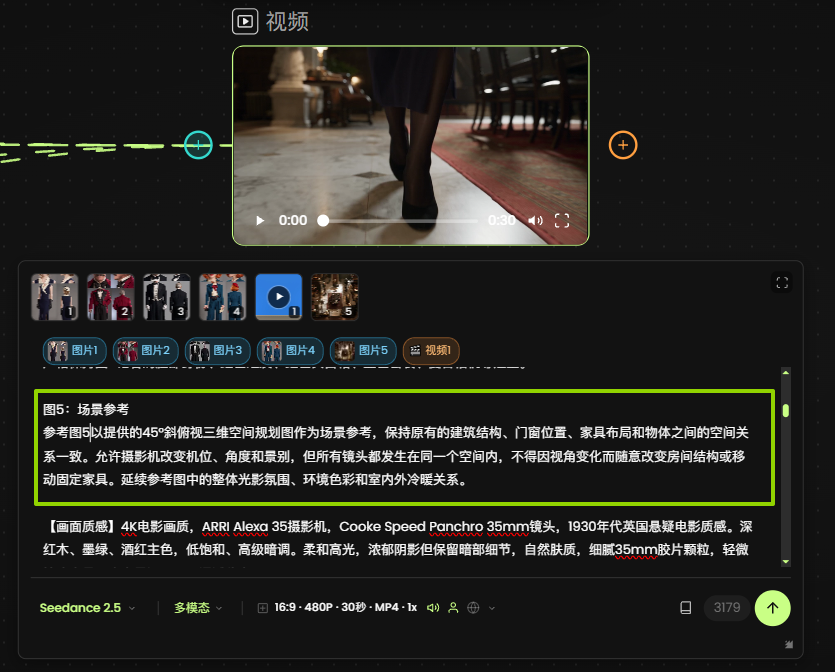
A simple use logic
When you did the video behind you, it was three things:
1. Uploading space planning maps
Control the layout and overall atmosphere。
2. Uploader reference maps
Controls the person's appearance, clothing and identity。
3. Writing current camera content
Controls movements, flight slots, mirrors and story advancement。
The logic is thus clear。
IX. Conclusion
The approach to this section is very simple。
The first step is to form a frame of reference for the scene, which will be preceded directly by:
A complete 45° tilt view of three-dimensional spatial planning map。
Then I'll pick up your normal scene description。
If you have a problem with the atmosphere, you have to write it here。
That means you don't just have to write:
What's in this space
What about the furniture
Where are the doors and windows
You have to write:
What time is it
What light is it
What kind of warm relationship is it
What does it feel like
Because this is not just the layout of the follow-up video
It is also an atmosphere reference for follow-up videos。
Step 2: Use this image as a reference for the scene at the time the video was generated。
TOGETHER WITH THE CHARACTER REFERENCE MAP AND A SIMPLE SCENARIO, AI WILL TRY TO CREATE THE PICTURE IN THE SAME SPACE AND MAINTAIN THE SAME VISUAL ATMOSPHERE IN DIFFERENT LENSES AND AT DIFFERENT SLOTS。
What you really want is not all the same。
They are:
The lens can be changed, the angles can be changed, but the space is still that space, and the light atmosphere is that atmosphere。
THAT'S THE REAL MEANING OF A 45-DEGREE TILT VIEW OF THREE-DIMENSIONAL SPATIAL PLANS IN THE VIDEO CREATION OF AI。