



Finally, we come to the final installment! We've already covered the basic narrativeAI short video dribbling tutorial, how to use AI to make dock level cinematic footage for startersEmotional ReinforcementAI short video dribbling tutorial, how to use AI to create docking grade cinematic footage primer (emotionally enhanced footage)Space constructionAI short video dribbling tutorial, how to use AI to make dock level cinematic footage introductory chapter (the construction of cinematic space)slicklens handling techniquesAI short video dribbling tutorial, how to use AI to make dock level cinematic footage introductory chapter (special effects footage), for those of you interested in the po-po, I'm going to share a mental mapping lens with you today.
Mental Mapping Lens
Take a look at the overall comparison:
| Contrasting Dimensions | First-Person-Overview (POV) | Voyeuristic Shot
| Voyeuristic Shot (POV) | Voyeuristic Shot (VShot) | -Immersion: the viewer becomes the character -Physiological response: simulation of real senses (e.g., shaking, blurring) -Empathy: direct feeling of the character's emotions (fear, anger, etc.) |Voyeurism: the viewer becomes the "invisible observer", with moral pressure -Uneasiness: the restricted field of view creates fear -Power imbalance: the oppressive feeling of the strong watching the weak | Classic Scenes | -Horror films (Blair Witch's Shake Shot)
| Classic Scenarios | -Horror (Blair Witch's Shaky POV) -Action/Gaming (Hardcore Henry's full POV) -Science Fiction (Avatar's Neural Link POV) Scenarios: Scenarios where the audience needs to be "in the role" |Suspense/Thrillers (Rear Window's Peeping Tom Murder) -Movie Noir (Blue Velvet's perverted peeping Tom) -Anti-Utopia (1984's Big Brother Surveillance) Suitable for: Scenes that require a sense of covert observation.
| Technical Characteristics | -Camera = character's eyes -Often combined with breathing sounds, subjective sound effects.<br>-Possible vertigo (prolonged use) | Hidden camera (doorway/surveillance/glasses) | Composition emphasizes "blocking" and "limiting" | Telephoto/silhouettes are often used to create a sense of depression | Audience role | "I am TA" (direct characterization) | "I spy on TA" (onlooker, possible moral discomfort)
| Audience Role | "I am TA" (direct characterization) | "I am spying on TA" (bystander, may cause moral discomfort)
| Classic Examples | - Resident Evil 7 (gaming POV) - Deadpool (breaking the fourth wall) | - Psycho Bathroom Murder Voyeurism<br>-Truman's World (Hidden Camera) -The Wire (Buggin' Out)|
Case Study
First person point of view (POV, point of view)
"The empathy machine of vision."
Presenting the screen from the subjective viewpoint of the character, the camera directly replaces the character's eyes, and what the audience sees is what the character sees, with a strong sense of immersion, restricted information, physiological response simulation, and breaking the fourth wall, commonly used in horror, action, science fiction, and experimental films.
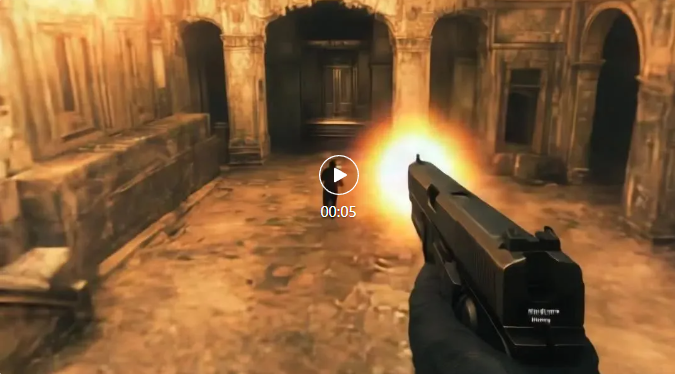
Cue word: POV, the man holds a gun and shoots wildly at the person opposite, running down the stairs to chase, the camera shakes, and it is tense and exciting / POV, the man holds a gun and shoots wildly at the person opposite, running down the stairs to chase, the camera shakes, and it is tense and exciting camera shakes, and it is tense and exciting
Replicates Hardcore Henry's full first-person perspective; enhances immersion/limits information.
peephole
"The Gray Area of Morality"
Through a hidden, non-participatory perspective to simulate "voyeurism", the camera acts as an observer or voyeur, creating a secretive, disturbing or dangerous viewing experience, with a hidden perspective, compositional oppression, voyeur identity, a sense of suspense, often used in suspense/thriller, sci-fi/anti-utopia, horror, film noir.

Cue word: peeping lens, fisheye lens, man driving a car / Peeping lens, fisheye lens, man driving a car
Replica of Truman's World hidden camera shoot; creates a sense of absurdity and depressing atmosphere.
Beginner's Guide to Mirroring Techniques
| Categories | Dolly In | Core Functions | Golden Scenes | Masterpiece Reference |
| Basic Narrative | Push Shot (Dolly In) | Attention Leader → Detail Focus | Suspense Revealed / Emotional Outburst | The Godfather Opening | The Godfather Opening | The Godfather Opening
| Basic Narrative | Dolly Out | Individual→Environmental Narrative | Truth Revealed/Time Shift | The Girl in Red | Schindler's List
| Basic Narrative | Truck | Spatial Relationships | Environment | Multiple Narratives | The Grand Budapest Hotel | The Great Budapest Hotel
The Grand Budapest Hotel | Basic Narrative | Tracking | Presence Creation | Chase/Environmental Traversal | The Long Shot | Hitchcock and Hartford
| Emotional Intensification | Hitchcock Zoom | Mental Imbalance Intensification | Shocking Moments / Perception Upsets | Staircase Scene - Psycho | Handheld | Staircase Scenes
| Emotional Intensification | Handheld Photography | Physiological Emotional Expression | Violent Scenes / Moments of Crisis | Spy Kids | Fight Scene
| Emotional Enhancement | Low Angle Panning | Power Relations Visualization | Villainy / Oppression | The Dark Knight Interrogation | Spatial Construction | Lifting and Lowering
| Spatial Construction | Elevated Lens | Vertical Dimension Narrative | Scene Transitions/God's View | Titanic Ship Show |
| Spatial Construction | Surround Shots | 3D Spatial Perception | Important Objects | The Matrix - Bullet Time | The Matrix | The Matrix - Bullet Time
| Spatial Construction | Depth Shift | Spatial Layers Analysis | Peek-a-boo Scenes/Depth Dispatch | Citizen Kane Deep Focus | Special Effects | Long Shots
| Special Effects | Long Shots | Enhanced Spatio-Temporal Continuum | Immersive Experience | Children of Men Inside the Vehicle |
| Special Effects | Variable Speed Lens | Time Perception Manipulation | Action Scene Climax | 300 SPARTANS Slow Motion | Special Effects | Tilt Shot
| Special Effects | Tilt Shot | Unusual Psychological Suggestions | Dream/Drunk Scene | Inception Twisted City | Special Effects | Mental Mapping | Pilot Shot | Pilot Shot | Mental Mapping
| Mental Mapping | POV | Substitution | Subjective Experience | Hardcore Henry Full Movie | Mental Mapping | Voyeurism
| Psychological Mapping | Voyeuristic Lens | Peeping Tom Guilt | Suspenseful Buildup | Telescope Scene from Rear Window |
When reviewing the 15 camera tricks shared in this series, it's amazing to realize that behind these brilliant uses of the camera lies a common thread: the use of physical movement to simulate mental movement.
Every technique of camera movement, whether it is pushing, pulling, moving across, shifting, or any other unique design, is not just a simple physical displacement of the camera, but a subtle interaction with the viewer's psyche. Just like a silent dialog, through the movement of the camera, the emotions of the characters and the atmosphere of the story are accurately conveyed to the audience's innermost being. For example:
Push the lens: simulates the process of focusing attention. The camera slowly pushes forward, the main body of the picture is continuously enlarged, and the details are then clearly presented, just like our eyes are attracted to a specific thing, and our attention is unconsciously focused. In suspense movies, the push camera is often used to reveal key clues and guide the audience to become "detectives" and immerse themselves in the intense drama.
Shaky-cam: a figurative expression of adrenaline rush. Unstable camera movement brings a strong sense of motion and tension, just like our physiological reaction when facing exciting scenes. Shaky camera is frequently used in disaster and action movies to make the audience feel as if they are in the scene, experiencing the thrilling moments with the characters, and the emotions go up and down.
Horizontal panning shot: creates an atmosphere of calm observation. The camera moves horizontally and slowly, and the image is smooth and soothing, as if we were looking at the world from an objective point of view. Literary films often use this kind of camera to show the environment and character relationships, guiding the audience to feel the delicate emotions and subtleties of life in the story with a calm mind.
This way of simulating psychological movement with physical movement gives visual works such as movies and videos richer layers and a powerful infectious force. It allows the audience to immerse themselves more deeply in the plot, to share the fate of the characters and to feel the joys and sorrows of the story.
final law: all mirror-carrying essences areResonance of physical motion trajectories with psycho-emotional curves.
That's all for today, and the series of introductory articles on mirror transportation techniques is now complete.