



Recently found that many netizens out of the AI map cue word can basically master, whether through the intelligent body out, or directly apply the modification, basically can get their own satisfactory picture, but to the next step of the figure born video, and stuck.
The AI video clips made can move, but compared with the masters always feel almost feel, not advanced enough.
In fact, the problem is mainly in the operation of the mirror, many people will only simply describe the picture character action, will not write the operation of the mirror, which leads to the picture is a fixed state, the lack of dynamic effects.
Today to summarize the ai video in the more commonly used 8 kinds of transport mirror way, these basic mastered, your video effect must be able to more on a level.
Today all the videos are out of the Dream 3.0 model, just to show the lens, so there is no dubbing, the generated material is directly inserted, you can see the effect of the lens can be.
▌Basic Lens: Push Lens
Push Shot: It's like you're walking down the street, slowly moving forward, that's what a push shot feels like. The camera gradually pushes forward, allowing the viewer's eyes to go deeper and deeper into the frame.
For example: for a shot of a mysterious door, the camera could use a propulsion shot to create tension and immersion.

★ Toussaint video cue word: The camera quickly advances to the doorknob where the door is about to slowly open.
▌Basic Lens: Pulling the Lens
Pull Shot: the opposite of a push shot, like you're slowly moving backward. The lens gradually moves away from the subject and can show a larger scene.
For example: a shot of a man standing at the top of a mountain, with the camera pulling back to gradually reveal the entire spectacular mountain range.

★ Toussaint Video Cue Words: the camera quickly pulls away for an aerial view and the characters stand still.
▌Basic Lens: Panning
It's like when you stand still and turn your head from side to side to look at the scenery. Turning the camera from side to side in a fixed position is the same thing as turning your head to look at something.
For example: photographing a forest, the camera reveals another scene by panning.

★ Toussaint video cue word: The camera pans quickly left, the light shifts, and a hut appears.
▌Basic Lens: Lens Shift
The position of the camera is mobile, remaining horizontal and moving along a horizontal or vertical axis. It is used to explore and show the structure and details of a scene, and is also suitable for photographing a character's path of action.
For example: shoot a row of display cases with the camera moving from bottom to top to show each exhibit. Suitable for libraries, museums and other scenes.

Toussaint video cue word: The camera pans up to gradually show the collection on the front wall from low to high.
▌Basic Shots: Follow Shots
It's like you're following a friend. The camera follows the subject and moves at a fixed distance.
For example: following a runner, the camera keeps moving in sync.
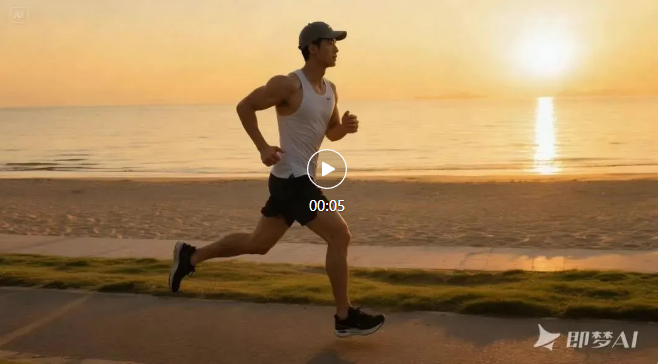
★ Toussaint video cue word: camera follows, filming a runner, camera keeps moving in sync.
▌Basic Lens: Surround Lens
A surround shot can be visualized as you walking around a sculpture. The camera circles around the subject, showing it from all angles.
For example: take a picture of a sports car and the camera goes around the car to show the various parts of the body.

★Tusheng video cue word: The camera shoots around the sports car, showing the exterior details of the body in 360 degrees.
▌Special Transportation Lenses: Over-the-Shoulder Lenses
An over-the-shoulder shot is actually a shot where the camera shoots from behind one character's shoulder, focusing on another character. More common in movies, this perspective is realistic and immersive.
For example: you peek over one person's shoulder at another's movements and expressions.

★Tu Raw Video Cue Words: the camera cuts in behind the man's right shoulder and advances to a close-up of the woman's face as she smiles and takes a sip of coffee, with a bokeh in the background and soft lighting
▌Specialized Ops: Subjective Lenses
This is to make the viewer feel like he or she becomes the main character in the picture. The camera simulates the perspective of the human eye, giving the viewer the feeling of being there.
For example: first person view riding with the camera shaking slightly as it travels.

★ Toussaint Video Cue Words: subjective shot, first person point of view, girl riding forward on a bicycle.
These are just a few of the more common basicsvideo transport lensThe effect is now, when you write the cue word, first write the effect of transporting the mirror, and then describe the content of the picture, it is OK.