



August 1 News.GoogleA new AI model called AlphaEarth Foundations was released yesterday, which has been imaginatively dubbed "virtual satellite", designed to revolutionize the field of Earth observation, could help researchers track changes in the planet over time.
According to 1AI, AlphaEarth Foundations uses a system called embedding, which works by collecting large amounts of public information from multiple sources every day, including optical satellites, radar, and climate modeling data, and integrating that data together. The model then integrates the data from both land and coastal areas. The model then divides the land and coastal waters into 10m x 10m squares, which are analyzed and tracked over time and color-coded according to different characteristics, such as vegetation type and material properties.
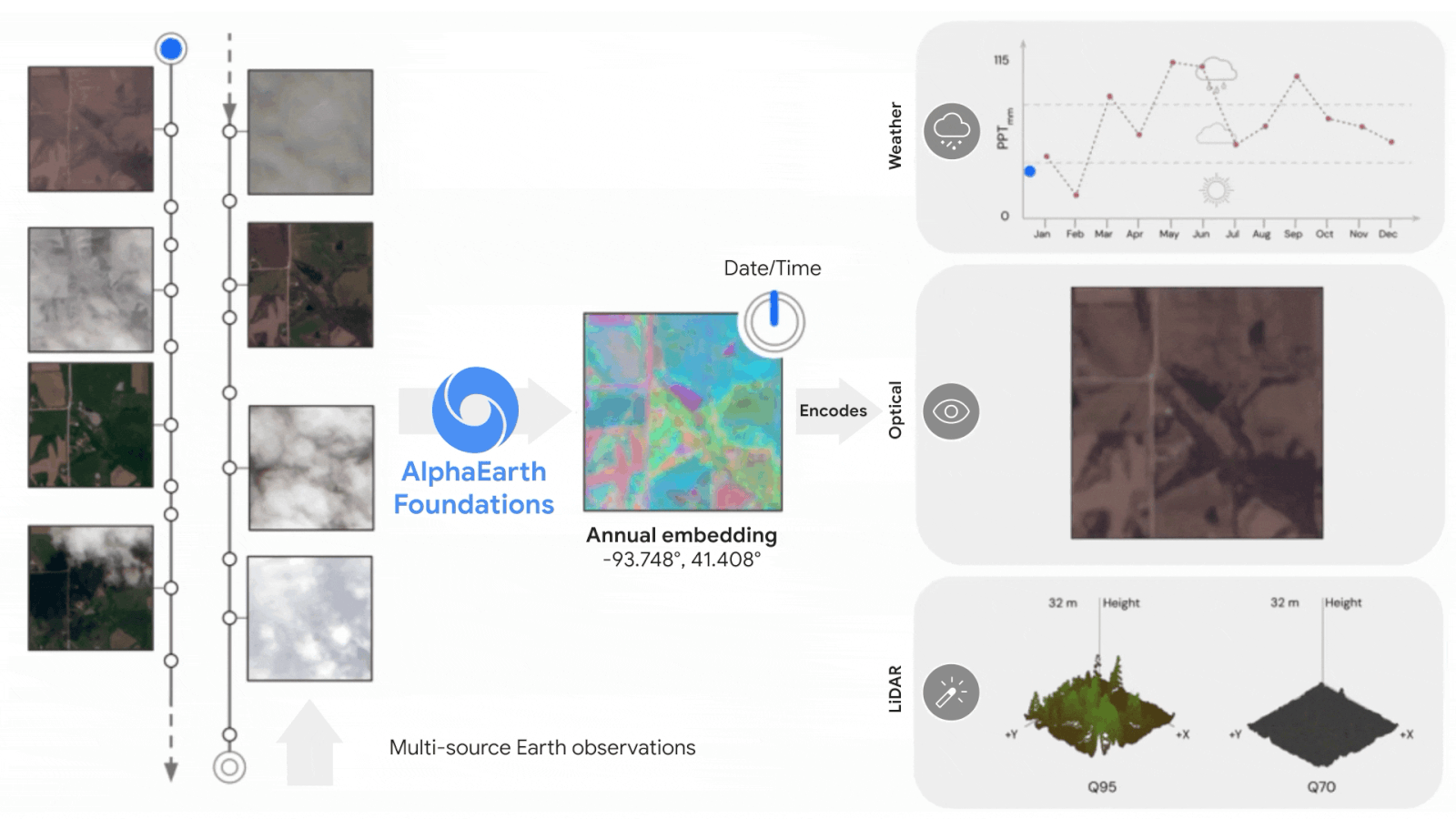
A major advantage of AlphaEarth Foundations is its ability to generate so-called "highly compact summaries" for each monitored square, Google says. These compact summaries require as little as 1/16th of the storage space compared to similar AI systems, dramatically reducing the cost of Earth observation.
So what exactly can the model's data be used for? Google explains that scientists can use AlphaEarth Foundations to create detailed maps on-demand for a variety of purposes, such as monitoring crop health or tracking deforestation.
In a statement, Google mentioned that the model has performed well in multiple task tests across different time spans. Google said, "AlphaEarth Foundations is an important step forward in understanding the state and dynamics of our ever-changing planet."
Over the past year, Google has given more than 50 organizations access to the model's Satellite Embedding dataset, a collection of its annual embedded data, so that these organizations can test its utility in real-world applications. Today, Google has published the dataset on Google Earth Engine for other scientists to use in their own research.