



In the first three issues, we talked about mirrors, reruns, scenes and images, and many of our friends, in private, said that they had begun to analyze the lens consciously while watching movies, which is what we wanted。
HOW DOES AI GENERATE FILM-GRADE MIRRORS
FIRST-TIME AI VIDEO TUTORIAL, MOST COMMONLY USED VERSION OF THE AI VIDEO REPLAY
BUT THERE'S ANOTHER QUESTION: WHY IS IT THAT SOME OF THE I.A. VIDEOS ARE TECHNICALLY OKAY, THAT THEY FEEL CHEAP, THAT THEY DON'T LOOK LIKE MOVIES? IT WOULD BE USEFUL TO LOOK BACK AT THE PREVIOUS ELEMENTS OF MIRRORS, RERUNS, SCENES AND DRAWINGS。
The answers are often hidden in light and tone。
In the same scenario, direct sunlight and cloud-dispersion are two completely different stories; warm orange candles and cold blue sunlights, speaking of very different emotions. Light and tone are the invisible language of emotion — the audience can't see it, but can always feel it。
TODAY THE SYSTEM DISASSEMBLYS THE LIGHT SENSE X THE LIGHT DIRECTION X THE COLOR-TEMPERATURE X THE LIGHT LOGIC, AND EACH DIMENSION TELLS YOU WHAT IT IS, WHAT IT CONVEYS, AND HOW IT IS ACCURATELY DESCRIBED IN THE AI HINT。
part i: lightness - hard light vs soft light
Before getting into the picture, the light begins with a basic attribute: hard or soft。
This attribute determines the overall quality and tone of the picture, which is the background of the visual style of the film。
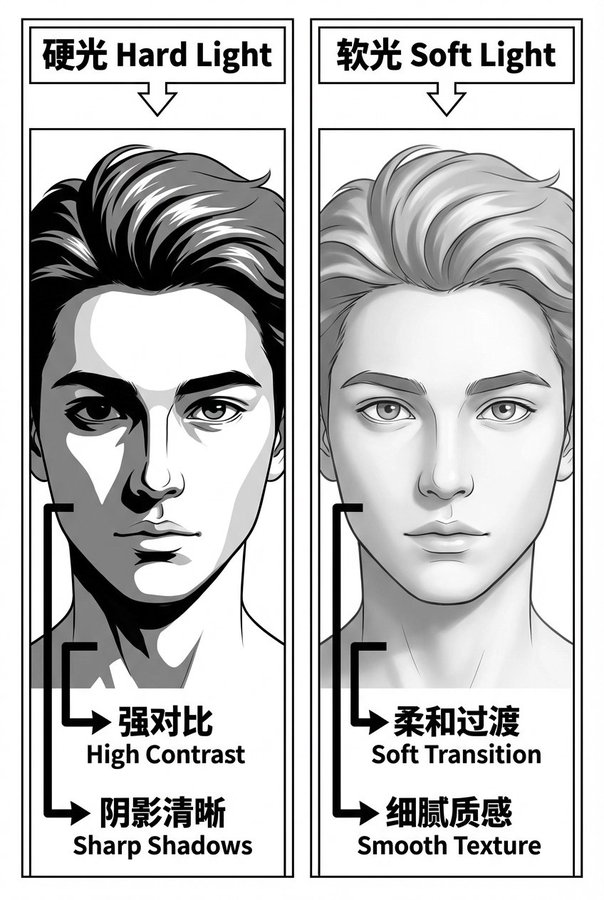
Hard Light
What is it: light is small and concentrated, light is strong in direction, creating clear and sharp shadow boundaries. Suns, naked light bulbs and spotlights are typical hard lights。
Passing emotions:
- Theatre, tension, conflict
- Strong contrasts create insecurity
- "Inquiries" "exposure" -- nothing to hide in the shadows
- The face is sharper, the characters are more subtle and tougher
Classic use of scene:
- Suspended, Criminal, Black Film
- Confrontation scene, high-pressure conversation
- Emphasizing the strength, danger or complexity of the person
A specific example: The Aged's almost full-scale use of hard light, and the line between light and shadow is extremely distinct — this aesthetic is not an accident, and it continues to create a sense of "no one is safe" in vision。
AI PHRASING REFERENCES:
- Hard light light, strong contrast, clear shadows on the face, film sense, black film style
- Single hard light, 45 degrees above the side, half bright and half dark, dramatic light
2. Soft Light
What: The light is large or diffused (the dark sky, reflector panels, flexible boxes), the light is dispersed in the direction of the light, and the shadow edges are blurred and soft。
Passing emotions:
- Soft, close, natural, real
- The skin is so delicate, the person looks softer and more real
- "The sense of daily life" -- the world is safe
- Instead of dramatic, let the audience focus on the character itself, not the light
Classic use of scene:
- Love, family, healing
- Memories
- The person who needs to trust the camera
Note: Soft light doesn't mean boredom. The City of Love uses a lot of soft light to match the colours, creating a vision of vision without loss of emotional thickness。
In retrospect, using soft light in situations where tension is needed, the conflict will be "defunct" and emotions will not be focused。
AI PHRASING REFERENCES:
- Soft light, natural light in the dark, light in the face, delicate skin, film
- Scatter light by the window, warm and soft, shallow, life, documentary
hard light vs soft light contrast
Part two: Light direction -- where light comes from, who you look like
The same soft light, from different directions, has a completely different character. The light direction is one of the most direct tools for characterizing people。
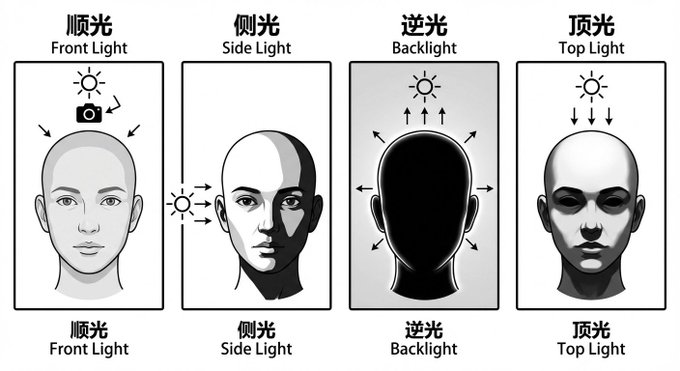
1. Front Light
The light is in the back of the lens, with a bright light on the subject, with little shadow。
It's like a flat, objective, informative, emotional. It is common in news interviews, documentaries, and product presentations. The characters are frank but lacking in cynicism。
AI PHRASING REFERENCES:
- The light on the front, the shadows, the details, the documentary style
Side Light
The light comes from the side of the person, half bright and half dark。
That's one of the brightest lights in the movie. It is clear and dark that there are two sides to this man — internal conflicts, hidden secrets, complex moral situations. The classic "moral ashscale" is used to light up。
A specific example: almost all the classic posters of the bad or complicated protagonists are side-lighted -- because it says visually: this man is not simple。
AI PHRASING REFERENCES:
- STRONG SIDE LIGHT, FACE 50% MING 50% DARK, DRAMATIC SHADOW, FILM SENSE, CHARACTER COMPLEX
3. Backlight / Rim Light
The light source is behind the subject, which forms a contours or a cut。
Passing emotions:
- Outline light: the subject is surrounded by gold or white light, creating a sense of sanctity/heroes/visibility of fate
- Shape: Mysteries, power, puzzles -- information is hidden, the curiosity of the audience is inspired
Classic use of scene:
- A hero's moment
- It's the first time that a suspense has appeared
- A "dignity" of religious, paranormal subjects
AI PHRASING REFERENCES:
- In retrospect, there's a strong golden sunset behind the main character, a radiant radiance, a movie, a heroism
- ♪ Strong-forward-lighted, dark, bright, mysterious ♪
4. Top Light
The source of light is radiantly and vertically directly above, with deep and heavy shadows in the eye, under the nose and under the jaw。
It's weird, depressing, tired, suppressed. This is almost non-existent in nature — the closest in the midday sun — so it's natural to feel wrong. They are often used in terrorist films, anti-rebel roles, situations where people are extremely tired or collapse。
AI PHRASING REFERENCES:
- Top light, vertical exposure, deep shadows in eyes, a sense of oppression, a chilling atmosphere
Four light contrasts
Part III: Color temperature and tone - Invisibility switches for emotions
If the light is the shaper of the character, the color temperature is the master of the whole emotional tone of the film。
Colour temperature base: Kelvin
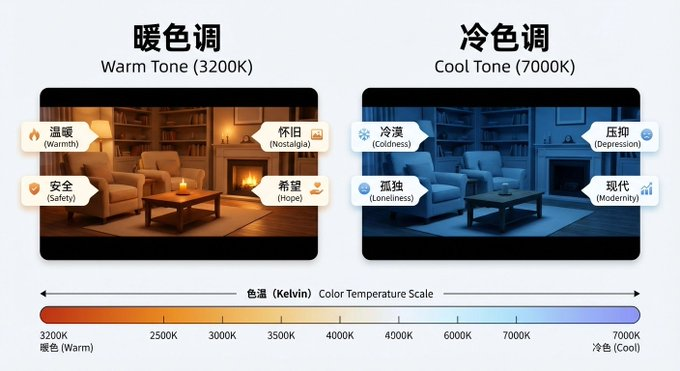
COLOUR TEMPERATURE MEASURED IN KELVIN (K), THE LOWER THE VALUE WARMER (ORANGE RED), THE COLDER THE VALUE HIGHER (BLUE AND WHITE):
- 1500K-3000K: CANDLELIGHT/FLAMMATION/TUNGSTEN LIGHT - EXTREMELY WARM ORANGE, OLD, DANGEROUS, INTIMATE
- 3200K/4000K: INDOOR WARMTH - WARMTH, FAMILY FEELING, NOSTALGIA
- 5500K: STANDARD DAYLIGHT - NEUTRAL, NATURAL, REAL
- 6500K - 8,000K: SUNSHINE/BLUE SKY - CALM, ALIENATED, MODERN, DEPRESSED
Warm Tone
The feeling of warmth, security, nostalgia, hope, intimacy, home。
Classic use of scene:
- Family scenes, love scenes, childhood memories
- The character's status in the "safe zone"
- The emotional climax of the film -- the warm light that relaxes the audience and creates a relationship
A specific example: The entire visual tone of Answer 1988 is warm orange. It's not because it's nice, it's because it's warm, it's visual, it's a time to be remembered。
AI PHRASING REFERENCES:
- WARM TONE, CANDLELIGHT ATMOSPHERE, ORANGE AND YELLOW LIGHT, ABOUT 3000 K, SWEETNESS, FILM
- Golden Hour warms up, orange light, soft, nostalgia
Cool Tone
It's a message of emotion: indifference, loneliness, modernity, depression, reason, alienation。
Classic use of scene:
- People in crisis, isolation, collapse
- Future perception, science fiction
- City night view, modern city apathy
One concrete example: The Missing Lover, the whole film, with a cold blue tone -- even if it's still cold in the daytime. It's keeping the whole film in a sense of anxiety that something's fundamentally wrong。
AI PHRASING REFERENCES:
- COLD, BLUE AND GRAY, ABOUT 700 K, URBAN ALIENATION, MODERN FILM
- Cold and blue, dark and white at night, solitude, shallowness, cinema
Contrast of Warm & Cool
In the same picture, there is also a cool contrast, which is one of the most aggressive techniques:
- Warm subject + cold background → a bit of temperature in the cold world
- Cold Subject + Warm Background Quite alone in isolation from warmness
AI PHRASING REFERENCES:
- It's a warm comparison. The characters are in a warm window with a blue, gray, cold corridor
temperature vs coldteleon
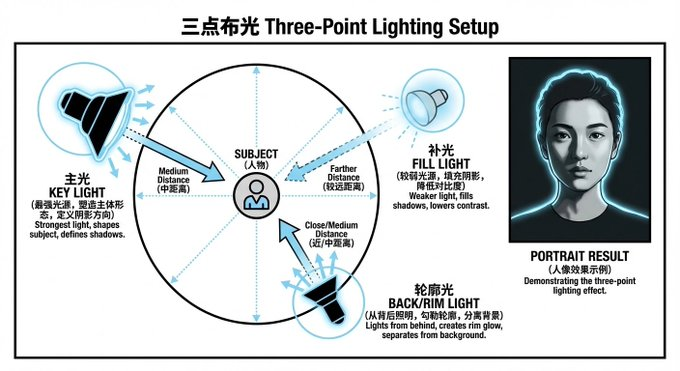
Part IV: Three points of light - the classic
THE FIRST THREE PARTS ARE LIGHT READING, AND THIS PART IS GOOD LIGHT. WHETHER IT'S A REAL SHOT OR AN AI HINT, HAVING THE LOGIC OF THREE DOTS OF LIGHT CAN MAKE YOUR PICTURE PROFESSIONAL IMMEDIATELY。
Three dots of light consist of three light sources:
1 Main Light (Key Light)
The most important light source defines the person ' s bright and dark relationship and overall quality. Usually 45 degrees in front of people, is the answer to where the light of this picture comes from. The more hard the main light, the more dramatic it is; the softer the main light, the closer it is to the day-to-day sense。
2 Fill Light
Opposite the main light, which is used to fill the shadows created by the main light and to reduce the dark and bright contrasts. The weaker the light, the heavier the shadow, the greater the drama; the stronger the light, the more even and lighter the picture. The intensity ratio of the main light and the recharge light is the core parameter to control the dramaticness of the picture。
3 Contour (Rim Light / Back Light)
Behind the person, the contours are sketched to create a sense of separation between the person and the background. Without a contours, the person is easily attached to the background and the picture is flat. With a contours, the person immediately had a 3D feeling and a carving of the quality。
AI PHRASING REFERENCES:
- Three dots of light, main light from the left 45 degrees, soft and patching light from the right side, behind the contours, professional like light, film sense
- Powerful light-side, no light, contours from behind, high contrast, dramatic figure
Three-point light structure map
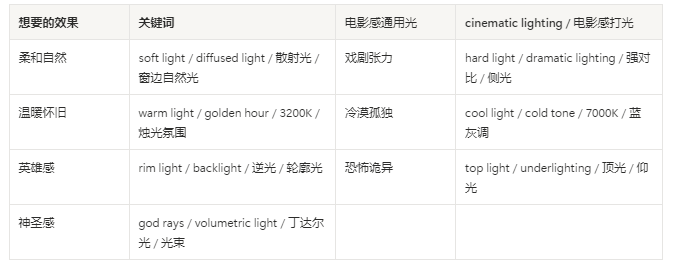
AI KEY WORD SWAB FOR LIGHT IN A HINT
Light and color errors common to starters
1. No source of light
AI GENERATES IMAGES THAT SOMETIMES COME FROM ALL SIDES -- IT'S AGAINST PHYSICAL LOGIC AND MAKES THEM LOOK FAKE. THE HINT SHOULD CLEARLY INDICATE THE LIGHT SOURCE POSITION AND DIRECTION。
2. Motion and mood mismatches
Scratch the solo hero with a warm orange, and a nice home play with a cold blue... Such a misalignment would confuse the audience and not know what to feel。
3. Ignore contours
THERE IS NO CONTOUR, THE PERSON IS IN THE BACKGROUND, AND THERE IS NO STEREOSIS. ADD A CONTOUR TO THE AI HINT, AND THE IMAGE IS IMMEDIATELY RAISED TO A LEVEL。
4. No light at all in the hints
A LOT OF PEOPLE WRITE SCENES AND CHARACTERS, AND THEY DON'T WRITE LIGHT AT ALL -- AI DECIDES THE LIGHT AT RANDOM, AND THE RESULTS ARE RANDOM. A LIGHT DESCRIPTION IS THE HIGHEST INPUT OUTPUT IN A HINT, AND THREE OR FOUR WORDS CAN COMPLETELY CHANGE THE IMAGE。
5. Abuse of "gold moments"
Golden Hour is one of the best light effects, but if every scene is used, the picture will appear monotonous. The choice of light is based on emotional needs, rather than on "gold is good at all times."。
📹 Recommended video
In order to provide a more intuitive understanding of light and tone, two videos are recommended, covering all core elements of the period:
1 Full guide to film filament — detailed description of all light types
https://www.youtube.com/watch?v=r2nD_knsNrc
2 Full Resolution of Colour Temperature — Visual Class Colour Temperature Control Method
https://www.youtube.com/watch?v=APLq7aPlDhk
By this point, we have dismantled four core modules: mirrors, reruns, schematics, light. Together, these four modules basically cover the full visual dimensions of one lens from one lens to another。
The next phase begins with the second phase, the director thinking, from what to why。