




In the last two issues, we talked about mirrors and reruns, and many of our friends wrote in private that they finally understood "why the camera moved" and "how the camera was connected."。
HOW DOES AI GENERATE FILM-GRADE MIRRORS
FIRST-TIME AI VIDEO TUTORIAL, MOST COMMONLY USED VERSION OF THE AI VIDEO REPLAY
But there's another problem that's not resolved: what's in every shot itself, and how much? From what angle
That's the problem with the scenery and the map。
If the mirror is "the motion of the lens" and the turnover is "the bridge of the lens," then the scene and the image are the first decision of the director to open his eyes to the world. The same person standing at the corner, close-up his eyes is a story, and the vision of his small back in the city is another story. The choice is what you want the audience to feel。
Today the system dismantles four core scenarios x four basic diagrams。
Zenium Part I: 4 Core
The core logic of the scenery is one thing: the larger the scenery, the more the message, the more the emotion; the smaller the scenery, the less the information, the closer the emotion。
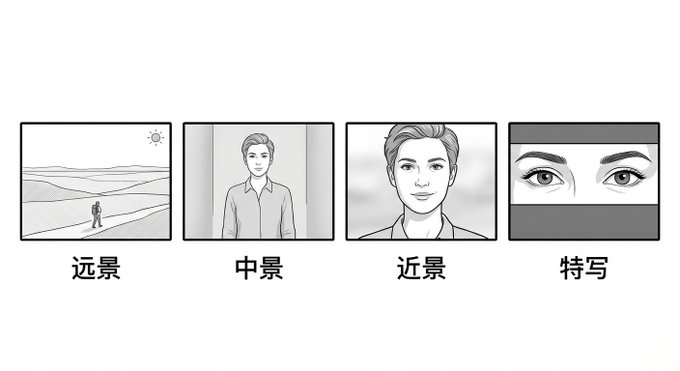
1. Vision / Establishing Shot
1. Wide-angle lens / Create lens
What is it: People are small or almost invisible in the picture, and a lot of environmental information is full of images。
Message conveyed:
- "This happened here" -- creating a sense of location, a sense of time, space
- Loneliness, smallness, a strong contrast between man and great circumstances
- Quick-stealing "breathing" - a breathing space for the audience
- Insinuation of the role in relation to the world: Does he fit into it or is he swallowed up by the environment
Classic use of scene:
- At the beginning of the video or paragraph, give the location background (which is why the vision is called Establishing Shot)
- Nature scene: wilderness, oceans, mountains, speaking with the environment itself
- The mood after the climax is released, the camera pulls out, and the audience takes a breath
one concrete example: every time the ring king cuts from hobton to mordor, it starts with a big vision to create a difference between the two worlds. - green, vs. volcanic wasteland, one shot completes the 180-degree turn of emotion。
An example of this is: "I see him, but I can't feel him." Vision is stage, not magnifier。
AI PHRASING REFERENCES:
- The big vision, the air view, the lonely person standing behind the foot of the snowhill, the character is only one tenth of the picture, the cold blues, the fog, the epic sense of film
2. Median Shot
2. Medium-range fire
What is it: shooting people above their waist, taking into account their faces and physical movements, is the most frequently used picture。
Message conveyed:
- Nature, objectivity, everyday sense of "normal distance of conversation"
- Balancing character and environmental information -- "Seen him and see where he is."
- The narrative pushes "conventional slots" that don't stress emotions and focus on content transmission
Classic use of scene:
- Show the speakers in the conversation scene (the main point of the fight)
- Showcasing man moves and body language: delivery, handshakes, hugs, confrontations
- The character's first "introvert shot" when he enters the new scene
Note: Medium view is the most used and most easily ignored view. It is not too emotional in itself — it is precisely its value: to focus the audience on the content of the story itself. But if it's abused, the whole film will look flat, lacking layers。
AI PHRASING REFERENCES:
- Midview, interior window edges, mirrors above the waist of the role, contours of the side-reverse light, sane retrogression of the background, natural light, film sense
3. Near-Up / Extra Close-Up
3. Case-by-case/extreme
What is it:
- Proximity view: above shoulder, accentuated face expression
- Special features: Focus on the face, full of paintings
- Big close: eye, lip, hand, certain key details
Message conveyed:
- Emotional amplification: the fear in the eyes, the twinkling smile in the mouth, the infinity in the close-up, and there's no escape for the audience
- "You have to feel him."
- A big close-up gives the object the meaning of narrative -- a ring, a shaking hand, a symbol with a close-up
- It's essentially an emotional code: the director tells the audience that it's important to be aware of it
Classic use of scene:
- Critical moment of emotional outbreak: tears, anger, shock
- The key clues that were deliberately cleaned up in the skeptics
- Suddenly, a slow close-up was inserted into the fast cut, and the mood was raised in an instant
One concrete example: The Father's opening, Marlon Brando's meeting in the dark, with a lot of close-ups on his hand, his eyes, his mouth — the audience felt the man's sense of power before even hearing a few words from him. It's more direct than any line。
An example of this is the fact that, without a mattress, it's suddenly written, and the audience feels a little bumpy, but when it's the most time, it's "missing." Courage and patience in close-ups。
AI PHRASING REFERENCES:
- It's very close, it's only a character eye, it's got tears in it, it's on the side, it's on the eye texture, it's shallow, it's slow, it's a movie
- Big close-up. Fingers slowly release an old ring. The ring slides
Four comparison diagrams
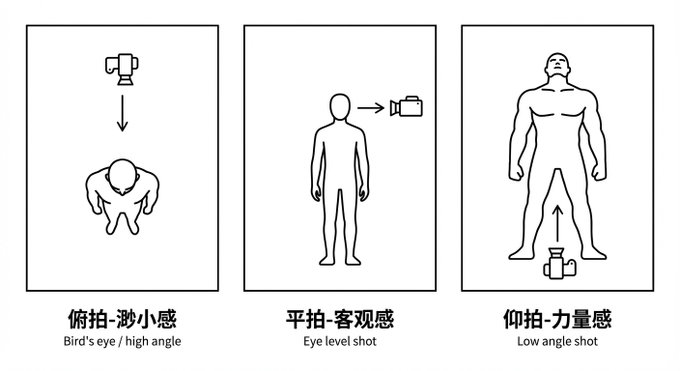
4. Adding an angle to the top: doubling the mood of the landscape
The scenery determines how much to shoot, and the angle of the film determines where to look
- Overlapping: Roles are small, fragile, suppressed
- Flatshot: objectivity, equality, everyday sense - the most neutral angle
- Acclaimed: The role is big, powerful and powerful - the hero moment, the sense of power
AI PHRASING REFERENCES:
- Low angles, characters at the top of the steps looking down, reverse light, dramatic light, heroism
- High angles, strangling in the corner of the room, extremely small, cold, depressed
Three angle contrasts
Part Two: 4 Basic Chart Law
The viewing determines how much you "see" the audience, and the drawing determines where you "see first" the audience. A good picture, where the eyes of the audience naturally fall where you want to emphasize, without any explanation。
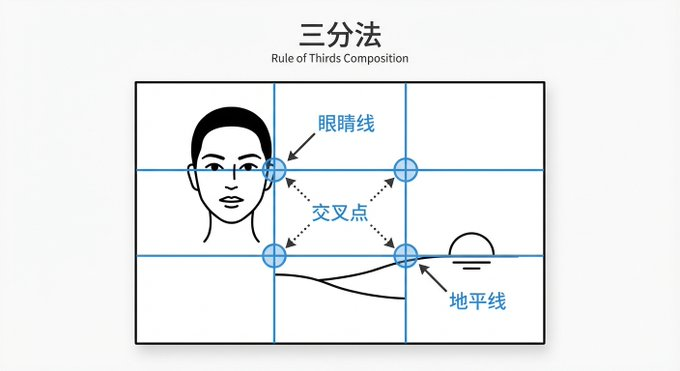
1. Three of Thirds
The images are divided into nine palaces, two in two, and important elements are placed on the intersection or dividing line rather than in the centre。
Why is it working: People's eyes aren't meant to be "too symmetrical" things, and they're going to look dead in the middle. It's more natural, it's more stressful, it's more "breath space" for the picture。
Specific use:
- The person's eyes are on the top three-point line
- The horizon is set at the bottom of the three-point line - the sky is open; the top three-point line - the earth is thick
- The character stands at the left or right triline, looking in the direction of space -- there's a sense of going
An example of this is the fact that it is not impossible to use -- it conveys a "official sense" of "ceremonial sense" of "conversation" -- but it is consciously used, not because it's "safest in the middle."。
AI PHRASING REFERENCES:
- Three-part, one-third on the right side of the picture, looking to the left, leaving the left wide white, the golden hour glowing, the movie feeling
Paradigm of the triform
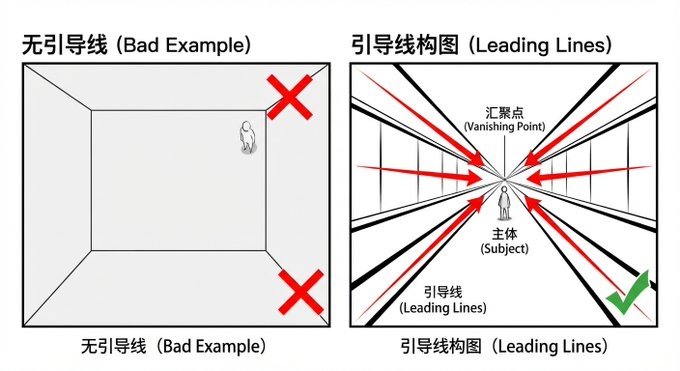
2. Lead Lines (Leating Lines)
With the lines that are naturally present in the picture — roads, tracks, corridors, rivers, bars — the view of the audience is directed to the subject。
Three common guides:
- Convergence (perceived): The line bound to a point in the center, generating a strong and deep feeling that the eyes of the audience are "pulled in"
- Curved direction: soft flow, often used in natural landscapes
- Angular mapping: unstable, moving, suitable for conflict scenes
A specific example: the long corridor to freedom in Shawshank's Redemption, where the walls form a strong convergence line -- This line is not just a building, but a direction of hope。
AI PHRASING REFERENCES:
- Broad angles, role at the end of the old corridor, both sides of the pillar forming a strong fusion of vision, morning light coming in from the end, film feeling
Guided chart contrasts
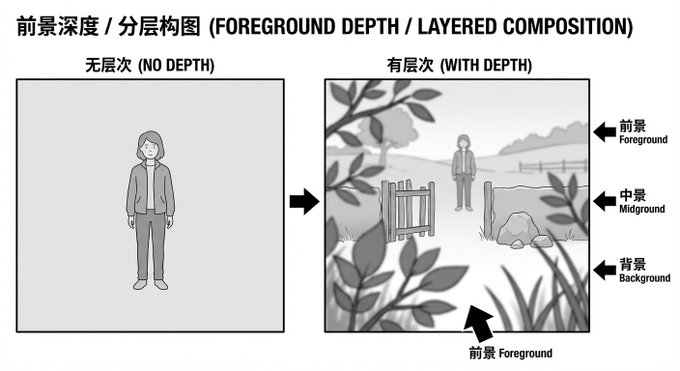
3. Foreground & Deep
Add a future element between the main subject and the camera, so that the picture can be changed from "platform" to "space."。
Three common uses:
- Fulfilled vision: the subject is clear, the outlook is vague -- "poaching" -- the audience is hiding somewhere to see everything
- Foreground cover: the subject is partially overshadowed by the outlook - creating a mystery
- Multi-level: Foreground + Midview + 3-level background information exists at the same time — the picture is "heavy" and uneven, and the film is so strong
ONE OF THE CREATIVE TECHNIQUES: RAIN, FOG, GLASS REFLECTIONS, FLAMES, STEAM -- IT'S ALL NATURAL FOREGROUND MATERIAL, IT WORKS IN THE AI VIDEO, AND IT'S EASY TO WRITE HINTS。
AI PHRASING REFERENCES:
- Hand-held lenses, foregrounds are defunct raindrop glass, background players stand alone under street lights, defunct focus, natural cold light, documentary quality
Foreground level comparison
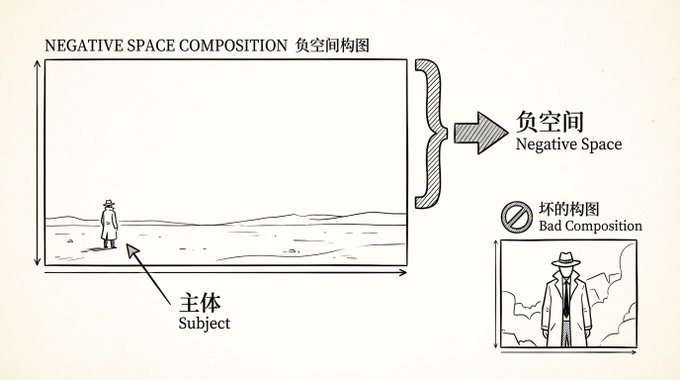
4. Negative Space
What is it: The subject is only a small part of the picture, and a lot of it is "empty" -- sky, walls, ground, water。
Why is there power: a lot of "empty" makes the subject more prominent, more isolated and more emotional? Negative space gives the audience a sense of a certain distance between this person and everything around him。
Classic use of scene:
- The expression of loneliness, confusion, loss
- Extremely simple product or art presentation
- The silent camera before the character made the big decision
AI PHRASING REFERENCES:
- Negative spatial images, very small figures, standing on the corner of the vast white desert, with large areas of white, subsided, extremely simple, film sense
Negative spatial diagram
Zenium The idea of a combination of scenery and structure
It's not enough to have a separate view and a picture. The real director thinking is to put them together:
Classic formula one: Emotional evolution
- Medium view (presenters)
It's like "getting close" to a story, every step of the way: Now, I want you to feel more。
Classic formula two: emotional isolation
- Close-up, medium-range, long-term vision
It often conveys the word "good-bye" and "end of story" and uses it more effectively in conjunction with the pull shot。
Classic formula three: Information disclosure
- Queue (local details, sparking suspense) Cuts out the vision
One of the most commonly used visual techniques for skepticism is the logic of "hidden and exposed"。
Numerator's common image error
1. Same scene for the whole trip
From the beginning to the end, there was no change — the whole video was flat like a newspaper。
2. Designed too early
It is written directly before an emotional pad has been created and the audience feels compelled rather than brought in. The power of the close-up comes from the "past in front."。
3. The subject is always in the middle
Image "safe" but boring. It's not because it's lazy。
4. Forgetting the horizon level
THE IMAGE OF AI IS NATURALLY "EVEN" AND A LAYER OF VISION IS ALMOST THE LEAST COST-EFFECTIVE AND MOST VISIBLE FILM-SENSORING TECHNIQUE, BUT MANY PEOPLE NEVER EXPECT TO HAVE WRITTEN IN。
5. AI NOT WRITTEN IN THE INTRODUCTION
IT JUST SAYS, "TAKE A MAN ON THE BEACH" -- AI DOESN'T KNOW IF YOU WANT A VISION OR A CLOSE-UP, AND IT'S COMPLETELY RANDOM. THE SCENERY IS THE MOST EASILY IGNORED, BUT THE MOST DIRECT, PARAMETER IN THE AI VIDEO ALERT, AND MUST BE CLEARLY WRITTEN。
📹 Recommended video
To provide a more intuitive understanding of the scenery and the structure, two videos are recommended, covering all the contents of this paper:
1 Speculation System Lecture - Full interpretation of all lens sizes
https://www.youtube.com/watch?v=AyML8xuKfoc
2 Maps and complete graphic design guide
https://www.youtube.com/watch?v=hUmZldt0DTg
After this period of study, it is recommended that you keep an eye on the movie or the short video: What's the scene? Where's the main subject on the picture? Any prospects? For a long time, the way you look at the video is completely different。
And you can do a little experiment with Seedance: the same scene, created with vision and close-up, and feeling the difference in emotional density -- it works more than a hundred theories。