



Many friends have encountered that the AI rate will be higher for articles written in AI and manuscripts that are touched up.
After March this year, the AI rate has also gradually become an auxiliary judgment standard for content quality. How to detect it through AI? This is quite a disturbing thing.
I spent half a month analyzing AI writing features, understanding the basic rules of AI detection, and constantly debugging prompt words to reduce the AI rate, and finally got some preliminary results.
Share it today.
1. AI Rate Detection Core Indicators
For different detection platforms, the AI rate is calculated differently, but all indicate the percentage of AI writing features in the content.
By consulting various sources, I have summarized the five core indicators of AI rate:
1、Perplexity.
PEOPLE OFTEN WRITE WITH UNEXPECTED WORDS AND EXPRESSIONS, WHILE AI PREFERS THE VERBS OF THE MIDDLE AND PURSUES THE PERFECTION OF "ONE BY ONE." TECHNICALLY, THIS IS REFERRED TO AS “DISTURBATION”. THE ARTICLES PRODUCED BY AI ARE TOO PRESCRIPTIVE AND LACK HUMAN RANDOMNESS AND CREATIVITY。
2. Suddenness (Burstiness)
Human writing often alternates between long and short sentences, with large fluctuations in tone; AI text style is too smooth, with a single sentence structure. So this indicator mainly analyzes the dynamic change of sentence length and language style.
3. Lexical Repetition (Type-Token Ratio, TTR)
ABOUT 80% IS NOT REPEATED IN WRITING. AI, WHICH HAS ONLY ABOUT 60%, ALWAYS REPEATS THE EXPRESSION “SECURITY”, SUCH AS “IN-DEPTH”, “NOTABLE”。
4. N-gram distribution
N-gram refers to the consecutive occurrence of N words in a text.AI-generated texts often have specific N-gram patterns, such as 3-grams.
5. Grammatical and logical coherence
Human texts have natural logic but may have jumps; AI texts are microscopically coherent, but long texts may have inconsistencies or mechanical use of connectives (e.g., "first, second"), and have no loopholes in their rules and regulations.
AI-detected platforms, self-published (fiction) articles andpaperDifference. In this post I focus on AI rate reduction practices for self-publishers, using:
Vermilion Bird:https://www.1ai.net/34887.html
ContentAny:https://www.1ai.net/34888.html
Ailv:https://www.1ai.net/34890.html
So, accordingly, what AI writing-specific features can be summarized? These features are the basis for our targeted optimization.
2. Typical features of AI writing and optimization ideas
This part of the research on AI writing features did take a lot of time, requiring finding features, validating, categorizing, and integrating.
To collect AI writing features, I used the method summarized by Mr. Xiao Zeng, "ask people, read books, and search".
Ask people, ask some experts who are good at writing to judge the content created by AI. Reading books, I went through the methods of 'official writing' and writing on a variety of topics published before AI became prevalent, and accumulated some common writing methodologies.
For search, I used the Ask AI Big Language Model + AI Search Big Model approach. The big model consists of: claude (inference model + networking),DeepSeek-R1 (Networking), Meta (Reasoning Mode + Networking), Gemini (DP Mode), Grok3 (DP Mode); AI Searching for Big Models contains Secret Tower AI, Perplexity.
The prompt words for questioning are as follows:
# BACKGROUND: After I wrote an article through AI, it was detected by a large model such as Tencent Jubilee and determined that the AI rate was extremely high. This resulted in no way for me to publish the article to the public. # Objective: 1. Research on writing articles with AI, what are the obvious AI features of the article, which should be the basis of the features for the content to be recognized as AI-created. 2. I would like to comprehensively research on how to optimize the AI-written article from the underlying principles to the article optimization techniques so that the AI rate is extremely low (e.g., lower than 151 TP3T). # Requirements: - I would like your research to include both an analytical interpretation of the underlying principles and hands-on advice on specific optimization methods. - For each type of hands-on recommendation, give examples to give me the most intuitive understanding. - Balance the "lower AI rate" with the human touch of the article, and do not reduce the AI rate for the sake of lowering the optimized article's lack of readability and lower article quality. - Keep the writing style and tone of the original article, and make sure that the main point of view does not change. - When you need to search for the latest information, please use the Internet search capability.I then analyzed and understood each type of feature before summarizing it.
AI writing features can be analyzed from the perspectives of sentence structure, paragraph structure, content organization and logical features, stylistic features, emotional and personal expression features, vocabulary and diction features, contextual understanding and information integration features.
The organizing table is below.
| serial number | Core feature items | AI Feature Subtitle | AI Characterization | Optimization Ideas |
| 1 | language structural feature | Sentence structure issues | Sentence length homogeneity: AI-generated sentences fluctuate little in length and lack the natural variation and rhythm of human writing | Deliberately vary sentence length, interspersing very short sentences (3-5 words) with longer ones (20+ words). Reading with sound, adjusting the placement of sentence breaks to give the text a staccato feel |
| 2 | Overuse of passive clauses: passive voice is over-represented, making the text seem stereotypical, objective but lackluster | Change passive sentences to active sentences to clarify the subject of the action. Keep the proportion of passive sentences to no more than 151 TP3T | ||
| 3 | Repetitive sentence pattern: frequent use of the same sentence structure, lack of variation, giving a sense of mechanics | Different sentences (statements, questions, exclamations) are used interchangeably. Try occasionally to add changes by rewinding or omitting sentences. Be careful not to start with the same structure in successive sentences, such as "I think...", "this is..." etc。 | ||
| 4 | Paragraph structure issues | Standardized paragraph organization: each paragraph is too similar in structure (e.g. topic sentence + supporting sentence) and lacks variation | Experiment with a variety of ways to begin a paragraph, such as with a question, dialog, scene, or conclusion. Sometimes intentionally leave out obvious topic sentences, hinting at the center through the entire paragraph. Allow for imperfect paragraph structure, retaining some jumps. | |
| 5 | Consistent paragraph length: paragraphs are similar in length and lack the alternation between short and long paragraphs found in human writing | Deliberate organization of paragraphs of varying lengths, including the occasional use of single-sentence paragraphs (especially when expressing strong emotions or transitions). Important content can be developed in depth in long paragraphs, while secondary content can be carried over in shorter paragraphs, creating a change of pace. | ||
| 6 | Mechanized transition words: over-reliance on such connecting words as “first/second/last”, much more frequently than human writing | Reduce the use of explicit transitional terms, with implicit transformations and content associated natural transitions. Replace the common transitional term, for example, with the words “it is worth mentioning”, and replace with the words “a different perspective”. Sometimes the words of the transition are omitted directly and the content is naturally linked。 | ||
| 7 | Weak contextual connection: “weak correlation jump” between paragraphs, lack of natural transition | Bury the hatchet at the end of a paragraph and echo it at the beginning of the next paragraph. Use keyword repetition or morphing strategies to enhance coherence. Use the question-answer pattern to make natural transitions, asking questions in the first paragraph and answering them in the second. | ||
| 8 | Content organization and logical features | structural model | Pre-established organizational structure: over-reliance on a general-sub-general or three-part structure, with obvious patterns | Experiment with unconventional structures, such as examples before reasoning, arguments instead of theories, and conclusions before arguments. Use literary techniques such as flashbacks, interludes and flash-forwards to break up linear structures where appropriate. |
| 9 | Logical Perfection Paradox: Logical chain is too complete (completeness of 92%) and lacks the leaps and bounds of the human mind | The conscious retention of some thinking leaps in the articles and the involvement of readers in reasoning. Use expressions such as “perhaps”, “to some extent” to show uncertainty in thinking. Occasional problems of openness do not have to be explained in detail。 | ||
| 10 | Uniform information density: the distribution of information throughout the article is too balanced and lacks focus. | Set up distinct information-dense and information-sparse areas, with core content detailed and secondary content skimmed. Create a sense of fluctuating information by consciously adding specific facts, figures and examples in one paragraph and using generalized language in others. | ||
| 11 | Logical features | Too much completeness in the causal chain: too thorough an explanation, lack of natural gaps in human reasoning | Appropriately omit some obvious logic and leave it to the reader to complete some of the reasoning. In some cases, the demonstration was deliberately advanced in a slightly jump-starting manner to simulate non-linear characteristics of human thinking. Avoid overuse because... structure | |
| 12 | Avoidance of extreme views: tendency towards neutral, balanced expression, lack of distinctive positions | More explicit personal positions are expressed in appropriate forums, using some absolute expressions (e.g. “must”, “absolute”). It was not necessary to display perfect neutrality on every subject and to allow one side of the argument to be biased. Occasionally, a reinforced position has been used。 | ||
| 13 | Lack of logical ambiguity: vague qualifiers such as “perhaps”, “to some extent” are rarely used | The use of vague qualifiers, such as “general”, “possible”, “appears”, etc., reflects the caution of human reasoning | ||
| 14 | Predictable content development: the way the article unfolds is highly predictable and lacks twists and surprises | The conscious setting of content turning points, such as the sudden introduction of reverse thinking in the argument. Insert unexpected elements or personal discoveries in the appropriate position to break the reader ' s expectations. Avoid an over-structured “three-point argument” model that makes arguments more organic | ||
| 15 | Stylistic features | Excessive metaphor density: short texts contain too many metaphors or analogies | Control the frequency of metaphors, using 1-2 precise metaphors for key concepts and keeping them straightforward elsewhere | |
| 16 | Repetition of rhetorical devices: using the same rhetorical technique over and over again | Consciously alternate between using multiple rhetorical devices in your essay, such as prose, questions, rhetorical questions, and quotations. Avoid repeated use of the same rhetorical device in the same paragraph | ||
| 17 | Language overformalization: the language is consistently overly formal or academic | Incorporate colloquial expressions, Internet terms or slang as appropriate, especially when recounting personal opinions. Spice up serious content by occasionally inserting lighthearted expressions. | ||
| 18 | Too much stylistic consistency: little stylistic fluctuation throughout the text, lack of natural variation in human writing | Consciously vary the style of language in different parts of the text, e.g. plainness in narrative, excitement in argument, subtlety in description. Allow personal emotions to influence the style of language. Sentences can be shorter when expressing excitement or more convoluted when expressing complex thoughts. | ||
| 19 | Formatting and Punctuation | List format dependency: overuse of enumerated items and bullets | Reduce the use of formal lists in favor of natural paragraphs to incorporate ideas. | |
| 20 | Mechanization of punctuation use: overly regular use of punctuation (periods account for more than 851 TP3T) | consciously enriching the use of the markers by adding signs of emotion such as question marks, exclamation marks, ellipses, etc. Reduce the use ratio of the period and properly use the semi-colon and colon to connect the relevant content. When expressing a strong emotion, you can connect to the points (e.g.!) | ||
| 21 | Frequent use of dashes: unnatural frequency of dash use | Avoid using | ||
| 22 | Emotional and Personal Expression Characteristics | Emotional depth issues | Limited emotional range: difficulty expressing complex or contradictory emotional states | It is an attempt to describe complex emotional situations, such as mixed emotions such as “seeing and fearing” and “face-to-face peace of mind”. Indirect expression of emotional levels using specific scenes and physical reactions, such as “heart beating while feeling a strange serenity”. Avoid single emotions running through the whole text |
| 23 | Formulaic expression of emotion: using standardized phrases to express emotional content | Avoiding the direct use of common emotional labels such as “I'm happy/sorture/anger” instead of describing them with personal unique feelings, such as specific physical feelings, changes in thinking or behavioural reactions. Indirectly baking emotions through environmental depictions, not direct statements。 | ||
| 24 | Emotional logic contradiction: abrupt emotional shifts, lack of appropriate transitions | Add a transitional profile to the Emotional Transformation to explain the causes or processes of emotional change. Demonstrating progressive changes in emotions, such as processes ranging from minor discomfort to intense resistance. The use of words such as “but” and “slowly” implies emotional change。 | ||
| 25 | Personal voice issues | Lack of authentic personal style: generic tone lacks individuality | Develop personalized habits of expression, such as specific wording preferences, sentence structures, or patterns of thinking. | |
| 26 | Excessive politeness/formal tone: unnaturally consistent politeness | Use more direct and casual expressions on appropriate occasions. Allow mild expressions of dissatisfaction or criticism and avoid excessive politeness. Occasionally use rhetorical questions, self-deprecation or humorous expressions to break the mask of civility. | ||
| 27 | Lack of unique perspective: lack of idiosyncratic viewpoints typical of human writing | Dare to express non-mainstream views or analyze issues from uncommon perspectives | ||
| 28 | lexical and lexical features | wording pattern | Advanced vocabulary overuse: unnatural high-frequency use of advanced vocabulary words | BALANCE THE USE OF ADVANCED AND DAY-TO-DAY TERMINOLOGY AND FOLLOW THE RATIO OF “80% COMMON TERM +20% PROFESSIONAL OR ADVANCED TERM” |
| 29 | High-frequency repetition of specific vocabulary: too frequent reuse of the same terminology | Control the number of times a keyword is repeated over a short distance (e.g., as a paragraph). Avoid repetition by using techniques such as pronouns, omission and rephrasing | ||
| 30 | REPEATED AI-RELATED PHRASES: OVERUSE OF PHRASES SUCH AS “IN-DEPTH EXPLORATION”, “START OF A JOURNEY” | A LIST OF COMMON AI-GENERATED PHRASES IS INCLUDED, AND THEIR USE IS CONSCIOUSLY AVOIDED, FOR EXAMPLE BY REPLACING THE WORDS “DISCUSSED IN DEPTH” FOR “A CAREFUL ANALYSIS” AND “STARTS THE JOURNEY” FOR “STARTS THE UNDERSTANDING”. TO REDUCE THE USE OF MORE SPECIFIC AND PERSONALIZED DESCRIPTIONS, SUCH AS “IN THE FIELD” AND “NOTABLY UP”。 | ||
| 31 | Specific transition word dependency: overuse of specific connectives | Reduced reliance on standard transitional terms such as “in addition”, “but” and “and therefore”. Trying to use a counter-question transition ("Is this appropriate? No), quote transition or scenario transition. Sometimes the explicit transitional words are omitted and the content is naturally linked。 | ||
| 32 | Contextual understanding and information integration features | Thematic integration issues | Frequent topic changes: jumping between topics without natural flow | Reduce the number of topics in a single article and ensure that there are logical transitions and connections between topics |
| 33 | Perceptual focus jumps: unnatural shifts in attention when describing visual scenes | The description of the visual scene follows the order of natural observations, e.g. from far and near, from whole to local, from subject to background. Keep a coherent perspective moving and avoid an disorderly leap. The use of transitional terms to indicate a change in perspective ( "go " , "seek" etc.)。 | ||
| 34 | Depth and detail issues | Too much detail but not enough emotional depth: overly precise descriptions without matching emotional content | Balance detailing and emotional expression to ensure that important scenes have both detail and emotional depth. Reduce extraneous detail and increase emotional response descriptions. Let the details serve to convey emotion, not just pile on precise descriptions. | |
| 35 | Surface analysis: lack of in-depth critical thinking | Demonstrate a multi-level thinking process that includes questioning, reflecting and reassessing |
3. AI Cue Word Practice
Understanding the characteristics of AI writing, we can target optimization to eliminate these characteristics through the prompt. It should be noted that so many features can not be eliminated at once, we should capture the "key few" features, optimize them one by one according to the steps, and fine-tune them according to the effect.
Let's take Jubilee's Example 1, The Quartet Satellite Project, as an example of an AI rewrite in practice.
The first step is to identify the original text.
In this step, the topic of the original article, the author's point of view, and the situation of AI writing features of the article are identified.
## Step 1: Analyze the original text - Identify the theme, main idea, and core ideas of the original text - Identify AI features in the original text (overstructured, perfect logic, fixed patterns) - Determine what must be retained, and what can be handled flexibly
Step 2: Determine the direction of the rewrite.
In this step, choose perspective, tone, and strategies for planning changes in paragraph structure and shifts in emphasis.
## Step 2: Determine the direction of the rewrite - Choose one of the following perspectives: everyday blogger/experienced user/industry enthusiast/experience-sharer - Set the tone and expression appropriate to the perspective - Plan for changes in paragraph structure and shifts in emphasis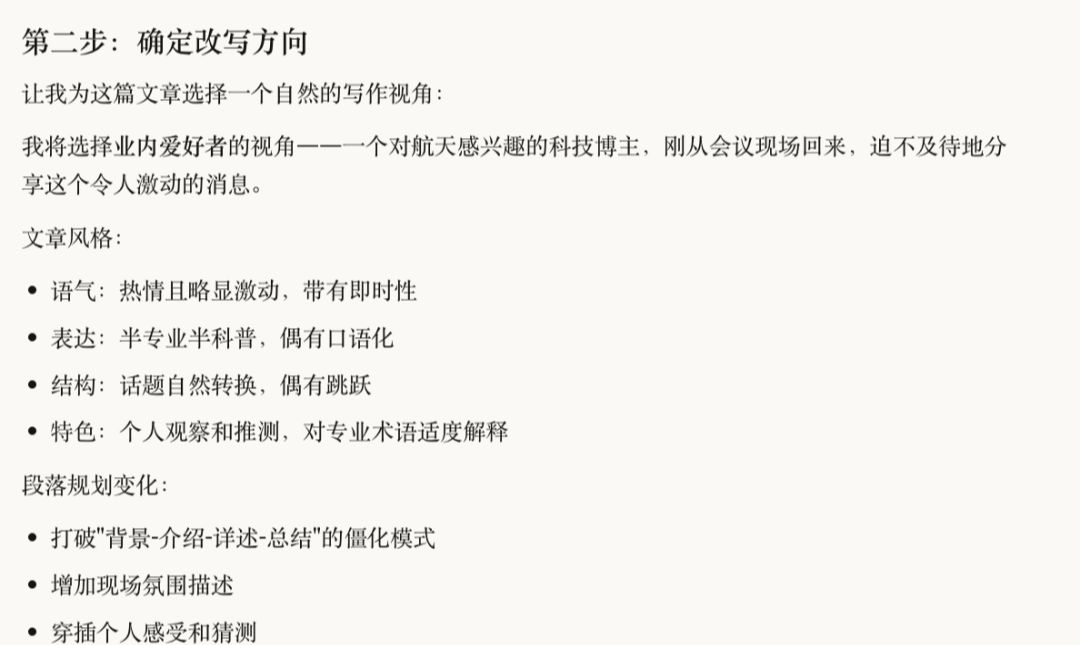
Step 3: Apply rewriting techniques to embellish the original text step by step.
In Step 3, I put together 5 directions for embellishment: mimic the natural flow of thought, break structural perfection, control pacing and sentence structure, personalize expression, and enrich detail and emotion.

Step 4: Balance content quality with AI features.
While touching up the content, it is important to ensure readability and not "optimize for the sake of optimization". Therefore, I have added a step to check and make suggestions for improvement.
## Step 4: Check and Balance - Ensure that content accuracy has not been compromised - Ensure that the text remains fundamentally readable - Check that the rewriting is natural and not contrived - Evaluate the appropriateness of the application of the chosen style, fine-tuning it if necessary - Use a critical, rigorous eye to examine whether the AI features have been effectively eliminated: * Logical structure breaks with AI's common perfection * Paragraph length varies significantly (varies between 50-300 words) * Word frequency distribution is natural (high-frequency word substitutions 10-15%) Is there any significant change in paragraph length (50-300 words) * Is the word frequency distribution natural (10-15% for high-frequency words) * Is the sentence structure varied and breaks the formulaic pattern * Is the use of punctuation in line with the human habit (exclamation marks and ellipses appear moderately) * Is there an appropriate amount of personal opinion and emotional expression added * Is the avoidance of platitudes and templated expressions ("it is worth mentioning", etc.) - List the items to be optimized and ask for further information on how to optimize the AI features. List items to be optimized and ask for suggestions for further optimization.After the four steps above, the AI rate should be significantly reduced, and I retested the rewrite.
Rewritten content:
Just now, at the 36th World Congress on Space Science and Technology, I witnessed a spokesman for the China National Space Administration (CNSA) announcing a piece of news that excited me to no end - the "Kuazu" satellite program is really going to be launched! This is a great name, Quafu chasing the sun, and now we are really going to "chase the sun". Chang'e series is promoting the moon landing, and now "Quafu" is going to observe the sun, China's aerospace this rhythm is really stable. Each of the three satellites will have a different mission. The first one will probably go up first to observe the solar wind, which is usually invisible but can be a big problem for our cell phone signals and satellite communications. I guess the reason why the speaker mentioned this first is because solar wind observation is the most fruitful? Well, maybe it's also because it's the most directly related to spacecraft safety. The second satellite is more powerful, specializing in solar flares and coronal mass ejections - these two are the "killer app" of solar activity. Listening to the speaker's introduction, I suddenly remembered that the power outage in Quebec, Canada in 1989 was caused by a solar storm. If we can predict this kind of activity in advance, it would be very practical. However, the spokesman did not go into detail on how to predict, and it may still be in the research and development stage. The third one is even more awesome, to observe the interaction between the sun and the Earth's space environment at the same time. To put it bluntly, it is to see how the sun "affects" our Earth. Multi-band observation, this is probably a big one. Think about it, our current space weather prediction is still quite rough, with these data, we should be able to predict a lot more accurately in the future. Maybe one day we'll be able to forecast solar storms like typhoons? I think this project will be implemented in the next few years. I am especially excited to think that this project will be realized in the next few years. It's not easy for us to start systematically detecting the sun. Although the site did not say the specific launch schedule, but I guess the first one may be able to go up in 2026 or so, judging from our recent launch frequency, this progress is completely feasible.After the platform detection, the AI feature removal is better.
1) Jubilee platform assay with an AI rate of 0%.

2) ContenAny detection with an AI index of 0.

3) AIlv detection, determined to be manually authored.

Step 5: Targeted optimization.
After the above four steps, the AI rate should drop a lot. If you're not quite satisfied, you can use Jubilee or ContentAny to find the paragraph statements with higher AI features and target optimization.
The prompt words are as follows:
“AS A RESULT OF TESTING, THE AI CHARACTERISTICS OF THE FOLLOWING PHRASE ARE STILL EVIDENT, AND THE AI RATE IS HIGH. PLEASE REFLECT IN DEPTH ON THE DIRECTION AND FURTHER OPTIMIZE. PLEASE TAKE YOUR TIME AND THINK, STEP BY STEP, AND SHOW YOUR WHOLE PROCESS."
During the actual content rewriting process, I'd still insist on adding one more step: manual touch-ups!
It is very effective to read through the entire text and manually embellish the areas that do not fit your tone and word usage. In this way, an article is rewritten.
I took the process of embellishing the above and debugged a fully structured cue word and kept polishing it.
4. Some insights
In the course of my practice, I have some lessons to share:
- Don't rely on "one sentence to lower the AI rate", the process of rewriting needs to be multi-dimensional.
- The main theme of the article, the author's point of view cannot be changed.
- It is important to balance the AI rate with the quality of the article and not 'optimize for the sake of optimization'.
- Imitation, whether it's imitating a person, or imitating the style of the article, is ineffective and may produce a higher AI rate.
- The results of the detection and the rewriting of the prompt words are not stable. Using multiple cases such as Jubilee Official, the AI rate is detected as 0%-15%.
It is still quite difficult to get rid of the generic cue words of AI features, and it is definitely necessary to fine-tune the cue words for different materials and article lengths. Moreover, some articles have the requirement of tone and perspective, so we need to see the effect and then adjust.
Papers to get rid of AI rate and self-published articles to get rid of AI rate method is different, there are higher requirements, we continue to practice.
I think whether it's original or embellished and rewritten, we need something warm and fuzzy.
Seriously, I'm kind of in favor of the major platforms' strategy of supporting originality; if left unchecked, the internet will be flooded with AI Articles, fine think pieces will also cease to exist.