



recent,AI skitsIt's all over the internet. From "Shoot Me AI" to "Seedance", from "Dream" to "Vidu", from "Keling" to "Conch AI", everyone can be a "Seedance".director (film etc). But have you ever been in this situation:
The plot isn't halfway through, the characters change faces; the shots are cut out like PPT page turns; the style is scattered, and the before and after look like two productions.
Many people think it's the technology that's not working, but in fact the problem with 80% is that you're not using "frame thinking" to do short plays.
I'll make it clear to you today:
What is "frame thinking" for AI sketches? What is the underlying logic of frame thinking?
Real-world examples teach you how to make highly finished short plays with frame thinking (with cue words).
First, what is "frame thinking"? If you don't get it, the skit will be useless even if you do it 10 times.
"Frame thinking" simply means that before you start, you build a skeleton to ensure that the script, characters, camera and style are unified from start to finish.
AI skit is not like a real person shooting a movie, directing and editing are all up to you. If the framework is not firmly built and the AI understands it wrongly, it will be considered dedicated if it does not change its face.
Framing thinking consists of three layers:
- Narrative framework: where the story begins, where it climaxes, and how it wraps up.
- Visual framework: what the characters look like, stylistic tonality (warm and cool tones, realistic OR secondary) uniformity.
- Framing: what camera language is used to express each scene (push, pull, pan, change of scenery).
To summarize: the frame is the underlying code of the director's mind that allows the AI to "understand" exactly what you want to shoot.
Second, why is framing thinking especially needed for AI sketches?
- Countering AI's "diffuse" weakness: AI is good at thinking out of the box, but lacks focus and logic. Frames are the reins that keep the AI's whims in check, so that creativity serves the core story.
- Enhance the efficiency of creation: After clarifying the framework, AI generation has more direction and reduces ineffective modification, from "repeated trial and error" to "accurate generation".
- Ensure storytelling appeal: At the heart of a short drama are "excitement", "conflict" and "pacing". Framing ensures that these key elements are precisely designed and front-loaded to grip the audience.
- Realize large-scale production: With a mature framework, we can quickly replicate the success experience and produce high-quality short plays in bulk to capture the market.
Third, the underlying logic of the framework thinking: from the "global" to "local", with this three steps
1. Setting the "global anchor" - determining the "skeleton" of a work
This is the "full movie command" you give to the AI, including:
- The main plot line (Revenge? Love? Suspenseful reversal?)
- Style anchors (cinematic texture? Japanese manga style? Cyberpunk?)
- Main character image (facial features + clothing + character keywords)
Cue word templates
Global Anchor Prompt Words (Vinnie): cinematic, dark noir tone, sharp contrast lighting, young female detective with short black hair, wearing a leather trench coat, urban night scene, realistic textures
This is the step where the AI's "comprehension" is boxed into your settings.
2. Re-building "scenario modules" - each scenario is a "joint" in the skeleton
Scenario Module means:
- Scene setting for each key plot point (e.g., dark alley chase, secret room questioning, rooftop confrontation)
- Scene shot style (e.g., low angle elevation shot to create a sense of oppression)
Cue word templates
Scene Module Cue Words (Graphic Video): low angle tracking shot of female detective running in a dimly lit alley, neon signs reflecting on wet pavement, intense chase sequence, handheld camera movement, and a video of the female detective running in a darkly lit alley. handheld camera movement
This step ensures that your skit is smooth in pacing and uniform in camera style.
3. Final "consistency of detail" - completing the "muscular skin" on the skeleton
- The protagonist's posture and emotions in different scenes (high spirits, anger, fear)
- Props and costume details can't be messed up (model of pistol, color of necklace)
Cue word templates
Detailed consistency cues (Tucson video): close-up of female detective's face, cold and determined expression, subtle scar on left cheek, gripping a black Glock pistol, wind blowing her hair slightly, cinematic depth of field
This level of detail is the key to making the audience "believe" in your character from start to finish.
Fourth, the actual case: using the framework thinking to do a "cliff edge of the transaction
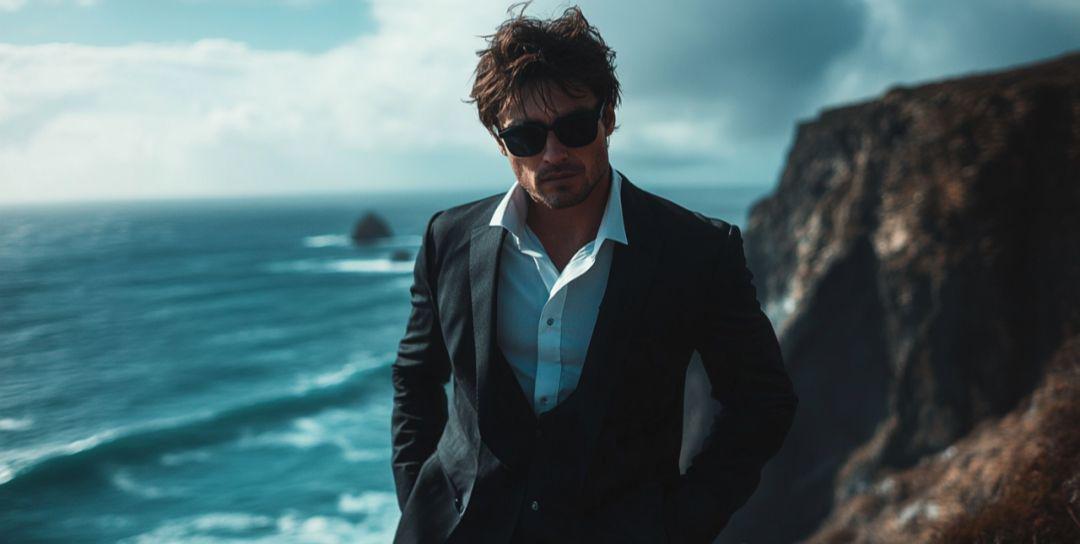
Plot Summary: A man in a suit trades information with a mysterious buyer on the edge of a cliff in a cold, oppressive style, with a reversal at the end - the man is actually undercover, and the police are watching from a distance.
1. Global anchors (Vincennes map cue words)
Role: Lock the whole film style + protagonist image unification.
- cinematic, high contrast lighting, cold blue-gray color tone, male agent in a sharp black suit with dark sunglasses, standing at cliff edge, rugged coastal landscape, wind-blown hair, intense atmosphere, photorealistic, moody shadows, 35mm lens depth of field
2. Scenario Module Design (Toussaint Video Cue Words)
Scene 1: Cliffside Confrontation
- medium shot of male agent standing at cliff edge, facing a mysterious figure in long coat, ocean waves crashing below, camera slowly dolly-in, wind ruffling their clothes, intense face-off, overcast sky, cinematic lighting contrast
Scene 2: Suitcase exchange (close-up)
- close-up of agent's gloved hand opening a silver briefcase, revealing confidential documents, shallow depth of field, subtle lens flare, tension-filled atmosphere, handheld camera shake tension-filled atmosphere, handheld camera shake
Scene 3: Police Surveillance (distant view)
- wide shot from elevated angle, agents in tactical gear watching through binoculars from hidden vantage point among rocks, long lens compression effect, muted color palette, ocean spray in background, steady cam slow zoom-in muted color palette, ocean spray in background, steady cam slow zoom-in
3. Detailed consistency cue words (Toussaint video fine-tuning)
Character expressions and movements
- close-up of male agent adjusting his sunglasses with a smirk, sharp jawline highlighted by side lighting, wind moving his tie, cinematic shallow depth of field
Scenic Ambience Supplement
- over-the-shoulder shot of agent holding a document with cliff and crashing waves blurred in background, desaturated color tone, subtle camera sway to mimic wind pressure
4. Full film style anchoring parameters (attached to each scene)
- photorealistic cinematic style, cold color grading (blue-gray), moody high contrast lighting, consistent character design (black suit, sunglasses, sharp jawline, short textured hair), dynamic camera motion, 35mm lens depth of field, and a large number of other features. sharp jawline, short textured hair), dynamic camera motion, 35mm lens depth of field
Core Tip:
- Vincennes: Used to generate the protagonist's global makeup and scene base (to ensure that the character image does not jump face, no change in costume).
- Graphic Video: Forced to add "whole movie style anchoring parameter" in the cue word of graphic video, to avoid the style break before and after.
- Each subplot cue should have a description of the protagonist's appearance + a description of the scene's atmosphere + the language of the camera's movement.
5. Final Scene Cue Words (Toussaint Video Cue Words)
Integrate global anchor cues, detail cues, and style anchor parameters into each scene's cue, so that "one cue=directly usable", so that they can be used directly in AI tools (e.g., Corinne, Vidu, Midjourney, Veo 3, Runway) to ensure that the characters and styles are consistent across the entire movie. Consistency.
Scene 1: Cliffside Confrontation
medium shot of a male agent with sharp jawline, short black textured hair, wearing a tailored black suit and dark sunglasses, standing at the edge of a medium shot of a male agent with sharp jawline, short black textured hair, wearing a tailored black suit and dark sunglasses, standing at the edge of a rugged cliff, facing a mysterious figure in a long coat, ocean waves crashing violently below, wind ruffling their clothes, intense face-off moment, cinematic high-contrast lighting, cold blue-gray color tone, moody and dark, with a dark face and a long coat. cinematic high contrast lighting, cold blue-gray color tone, moody shadows, photorealistic textures, 35mm lens depth of field, photorealistic cinematic style, consistent character design (black suit, sunglasses, sharp jawline, spiky short hair), dynamic dolly-in camera movement, realistic wind effects on clothing

Scene 2: Suitcase exchange (close-up)
close-up shot of the male agent's gloved hand (black leather glove) opening a silver briefcase, revealing confidential documents under soft spotlight, subtle lens flare on the metallic surface, shallow depth of field focusing on the agent's fingers gripping the case latch, cinematic high contrast lighting, cold blue-gray color grading, photorealistic detail on texture, and a black leather glove. cinematic high contrast lighting, cold blue-gray color grading, photorealistic detail on textures (glove stitching, metal reflections), consistent character identity (agent in black suit with silver chain necklace), cyber-noir cinematic style, dynamic handheld camera shake for tension, 35mm lens depth of field

Scene 3: Police Surveillance (distant view)
wide elevated shot of tactical agents hidden among rocky outcrops, observing through binoculars, in the background the male agent (sharp jawline, black photorealistic textures on rocks and tactical gear, cinematic high contrast lighting, dynamic zoom-in camera movement towards agents, atmospheric mist drifting across scene, consistent visual visualization of the ocean. mist drifting across scene, consistent visual style with global anchor (cyber-noir cinematic look, high contrast shadows, consistent character design with tailored black suit and spiky short hair)

Scene 4: Mystery Buyer Retreat (Medium Side Shot)
side tracking shot of the mysterious buyer (long dark coat, face partially hidden under wide-brim hat) walking away from the agent towards a black SUV parked near the cliff edge, ocean backdrop with dramatic lighting, reflections on car surface, cold blue-gray color tone, cinematic high contrast shadows, photorealistic textures on coat fabric and gravel ground, consistent scene style (noir cinematic look), steady cam movement, characterization, visual consistency (male agent remains stagnant), and a strong, clear, and clear image of a black SUV. visual consistency (male agent remains static in frame, black suit, sunglasses, sharp jawline, spiky hair visible from behind)

Scene 5: Reverse Reveal (close-up)
close-up of the male agent adjusting his sunglasses with a subtle smirk, faint scar visible on his left cheek, intense side lighting casting sharp jawline shadow, wind moving his tie slightly, cold blue-gray cinematic lighting, shallow depth of field focusing on facial details, photorealistic skin shadow, wind moving his tie slightly, cold blue-gray cinematic lighting, shallow depth of field focusing on facial details, photorealistic skin texture and suit fabric, cyber-noir visual tone, consistent visual tone, and a strong, dark, and light color. texture and suit fabric, cyber-noir visual tone, consistent character design (spiky short hair, silver chain necklace), slight camera push-in for dramatic effect

Scene 6: Police Strike (Dynamic Vision)
wide action shot of tactical agents emerging from cover, sprinting towards the agent and buyer, ocean waves in the background, dynamic low angle camera tracking their movement, photorealistic gear details (vests, helmets), cinematic high contrast lighting, cold blue-gray tones, environmental dust kicked up from footsteps, consistent character placement (agent by cliff edge, black suit, sunglasses, sharp jawline), cyber-noir cinematic visual style, smooth dolly camera movement following style, smooth dolly camera movement following action

Cue word structure summary:
Each scene cue word is included:
- Character appearance anchors (black suit, short hair, sunglasses, jawline, etc.)
- Action + camera language description (dolly-in, handheld, side tracking, etc.)
- Lights and tones (cool blue-gray tones, high-contrast lights and shadows)
- Consistency of detail (gloves, suitcase, necklace, facial features)
- Style anchoring parameters (photorealistic, cyber-noir, cinematic style)
6、Editing into a movie

V. Summarize: with the framework thinking, you can make AI short drama "once into a movie".
The AI skit is bad, 80% is not that the AI is bad, it's that the director (that's you) didn't build the "frame" properly.
Remember these three steps:
- Set the "global anchor" first - unify the story, style, and characters.
- Then build "scene modules" - each scene according to the module design lens language.
- Lastly, the "consistency of details" - expressions, props, costumes - should not be messed up.
Learn to think in terms of frames, AI sketches for you is not "luck", but "strength".
This is what I shared today, did you learn it?