



- A skit without a voiceover is like a dish without salt - watchable, but not edible.
existAI skitsToday, we talk about why voice-over thinking is the "hidden nuclear weapon" of AI dramas, and how to use it to make the quality of the work rise. Let the quality of the work soared.
I. Why voice-over thinking is the "second lifeline" of short plays
Many people think that the soul of a skit is the picture, but in fact, sound is the fast track to the audience's emotions.
A shot of an actor frowning, with heavy breathing and muffled narration, the audience is immediately gripped; the same image, if paired with a comedic tone, immediately becomes a funny short film.
The value of voiceover thinking is largely:
- Enhance Emotional Impact -- Dubbing is the most direct transmitter of emotion, hitting the audience faster than subtitles.
- Completing the information in the picture -- Details not shown in the picture can be explained in sound, such as the psychological activities of the characters and the atmosphere of the scene.
- Rhythm Controller -- The voiceover carries the beat, allowing the audience to follow the breath and mood.
- Enhance the professionalism of the work -- High-quality voice-over + picture matching makes the AI skit look more like a movie or TV show rather than an "animated pilot".
Second, what is voice-over thinking?
Voiceover thinking is not just "getting someone to record a voice", but an approach to sound design that runs through the entire creative process.
Definition: Voiceover thinking is a kind of systematic thinking that actively plans, designs and creates sound (dialog, narration, ambient sound, special effect sound) as a narrative tool in the creation of a short play, taking into account the character's personality, emotion, identity background and other characteristics.
It contains three core elements:
- Emotional positioning: the voice should match the emotional tone of the plot.
- Character voice design: differentiate between different characters in terms of timbre, speed of speech, and intonation
- Sound and picture integration: synchronization of sound with the rhythm and movement of the picture.
III. The underlying logic of dubbing thinking
To use dubbing well, you need to understand its underlying logic:
1. Sound is the art of time
Picture is the presentation of "space", sound is the flow of "time". The length, rhythm, speed, pause, and fine-tuning of the voice-over show the ups and downs of emotions, and give the dialogues emotional tension, which directly affects the audience's emotional stay time.
2. Tone = character personality
The heroine is gentle and delicate? Soft tones. The villain is vicious? AI-generated voiceover should first determine the character's voice tag. The voice should match the character's age, personality, and emotional state.
3. Synchronization of emotional curves
The emotional fluctuations of the plot should be synchronized and reflected in the sound, for example, the climax section is dubbed with fast speed and high volume, and the trough section is dubbed with slow speed and low volume.
4. Sound effects are ambient boosters
Ambient sounds (wind, rain, footsteps) can three-dimensionalize the picture of the AI skit, which is part of the voiceover thinking.
5. Plasticity of language expression: adjust the tone and language style according to the needs of the plot, so that the lines are more natural and not dull.
6. Consistency and differentiation at the same time: maintain the consistency of the character's voice style, while differentiating the character through different voice differentiation.
7, with the picture and rhythm: the rhythm of the sound echoes the picture editing, creating a sense of atmosphere and rhythm.
IV. How to use voice-over thinking at various stages of AI sketch creation
1. Script stage
Voiceovers should be considered when writing a script:
- Which emotions are expressed in lines?
- What information is added by the narrator?
- Where do I need to leave "breathing space" for the voiceover?
Example:
(voice-over) Little did she know, this rain, would change her life forever.
2. Scripting stage
During script design, consider the character's voiceover needs, such as personality settings and mood changes, and mark emotional labels and tone cues in advance to facilitate subsequent voiceover generation. If using AI script generation tools (e.g. Beanbag, DeepSeek, ChatGPT, Claude), label each shot in the sub-scene table:
- Voiceover Type (Dialogue / Narrator / Ambient)
- Voice Over Mood (Tense / Relaxed / Sad)
Adding character timbre and emotional directives to cues improves the fit of vocal expression for scripted dialog.
Example prompt words: protagonist Xiaofang, a vivacious 18-year-old girl with a clear, sweet voice, fast speech, and an upbeat mood but with a hint of nervousness.
3. Screen-generation phase
When generating the screen with AI, reserve the character's mouth movement or leave space to match the post dubbing.
Example cue word: "Late night alley (panoramic view): streetlight flickering, black cat by trash can (give cat close-up for 3 seconds, reserve cat purring sound effect bit)"
When generating a screen with the AI tool Midjourney, add "sound space for [specific sound]" to the prompt.
4. Voice-over synthesis phase: letting AI "act"
useAI Dubbingtools (e.g., ElevenLabs, Fish Audio, Cyberdubbing, etc.):
- Determine the tone first (you can upload a reference tone)
- Re-match sentiment (select tone label or sentiment parameter)
- Final alignment with the screen (with fine-tuning of speech rate and pauses)
Adjust the tone parameters according to the character's settings to control the speed of speech, pitch and emotional expression. Multiple auditions and adjustments are made to ensure that the character's voice performance matches the character's characteristics.
Don't use the default voice, add performance commands to the AI.
Example cue: "Xiaomei (crying, with sobbing, pause 0.5 seconds for every 3 words): I... really... didn't see..."
5. Post-sound and mixing phase: creating "immersion"
Adjust the balance of sound and background music, environmental sound, enhance the sense of scene, according to the rhythm of the plot to do sound effects editing with, so that the overall audio-visual experience is more impact; according to the scene plus environmental sound, so that the sound has a sense of space.
Example cue word: "classroom squabbling (add the harsh sound of chalk rubbing against the blackboard as the noise of the playground fades in the distance)"
V. Case Practice - Maintaining Character Consistency + Voice Matching
🎬 Case Settings
Title of the skit: "The Last Message
Character: Lin Wei (female reporter, 30 years old, gentle but tough)
Style: realistic, suspenseful, emotionally rendered
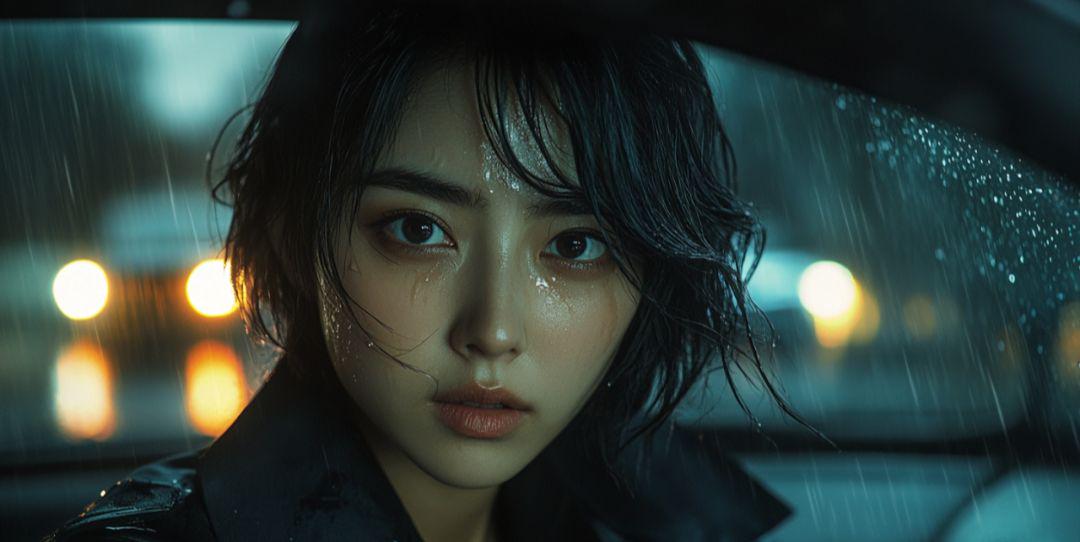
SCENE: On a rainy night, Lin Wei hears a recording in her car and her expression gradually breaks down.
Vincennes Map Prompt Words (Midjourney)
- Chinese: 30 year old female reporter Lin Wei, short hair, wearing dark trench coat, sitting in car, heavy rain outside window, street lights dim, emotional tension, tears in eyes, cinematic lighting, realistic style -ar 16:9
- English:30-year-old female journalist Lin Wei, short hair, wearing a dark trench coat, sitting inside a car, heavy rain outside, dim streetlights, tense expression, teary eyes, cinematic lighting, realistic style -ar 16:9 tense expression, teary eyes, cinematic lighting, realistic style -ar 16:9
Toussaint Video Cue Words (Korin / Runway / Veo 3)
- Chinese: Keeping the character consistent, Lin Wei sits in the car and hears the recording, her expression goes from puzzled to shocked to tears sliding down her face, rain slides down on the car window, the road light reflects shadows on her face, cinematic texture
- English:Maintain character consistency, Lin Wei sits in the car, listening to a recording, her expression shifts from confusion to shock, then tears fall, raindrops sliding down the window, streetlight shadows on her face, cinematic quality fall, raindrops sliding down the window, streetlight shadows on her face, cinematic quality
AI dubbed cue words (Kerin / ElevenLabs / Xunfei dubbing)
- Chinese:
- Character: Lin Wei (female, 30 years old, gentle but with pronounced mood swings)
- Emotions: puzzled at first, voice trembles in the middle, choked up at the end
- LINE: "Why did you ...... lie to me? ...... this all ...... is a lie?"
- English.
- Character: Lin Wei (female, 30 years old, gentle but emotionally volatile)
- Emotion: Starts confused, voice trembling in the middle, choked up at the end
- Line: "Why... did you lie to me? ...All of this... was fake?"
Effect Highlights:
- The images are synchronized with the rhythm of the sound: the moment when the tear slides down is exactly matched by the sound choking.
- Character consistency: same appearance + same timbre, strong audience immersion.
- Atmospheric rendering: the sound of rain + voiceover for emotional immersion.
VI. Creative techniques for voice-over thinking
1. Record first, adjust the screen later
In AI sketches, the voiceover can reverse the pace of the picture.
2. Sound layering
Dialogue layer + narration layer + ambient sound layer, processed separately, easy to adjust later.
3. Emotional progression
A voiceover should not be emotionally flat to the end, it should have ups and downs that make the audience fluctuate with it.
4, AI tone reproduction
Train exclusive character tones with AI to ensure consistent voices across multiple episodes of the skit.
Seven, avoid the pit guide: AI dubbing overturned the three major minefields
- Character Tone Drift ⚡️: Inconsistencies in the voice before and after the same character (changes in timbre, accent).
- Solution: Strictly use cured sound models; avoid switching between tools to generate the same character; keep the cues consistent in their descriptions.
- Emotional Plastic Sense 🤖️: Flat or exaggerated distorted sound, lacking the nuances of real human emotions.
- Solution: refine emotional cues; generate key lines in separate sentences; make good use of the tool's emotional parameters; add sensible gasps, pauses, and non-verbal sounds (sighs, light laughter).
- Sound and picture out of sync/weird mouth shape 👄: mouth shape is out of sync or movement is exaggerated.
- Solution: Ensure that the dubbing audio is consistent with the input source of the mouth synchronization tool; choose a mature mouth synchronization tool (HeyGen usually works better); fine-tune the mouth or consider switching shots for key shots that are clearly out of sync.
viii. final recommendations
Dubbing is not as simple as adding a voice, but rather treating the voice as a "narrative weapon" as important as the picture.
The competition for AI short plays has changed from "who has better graphics" to "who has better overall immersion" - and voice-over thinking is the key to immersion.
Remember the saying: the picture makes you look in, the sound makes you stay in.
This is what I shared today, did you learn it?