



DoAI skitsThe work of no one to see, the amount of playback is not a thousand? It's not the technology that's not working, it's your "user mindset" that's not working right!
A lot of people learnAI directorIdeas, sub-screening skills, and even cue word tuned up, but still create a video viewers "do not buy". The root cause: you did not start from the user's point of view!
Today's article, take you once to understand the AI short drama in the "user thinking" is what, why it is the core of the explosion, and how to put the user thinking into practice through the case.
I. What is user thinking? In one sentence!
User thinking means standing in the viewer's perspective and making content that the user really wants to see.
No matter how good the AI skit looks, the audience will still scratch away if it is detached from the "user's pain point, pleasure point and itch point".
-You're not making content that you like, you're making content that users will like, comment on, and retweet.
User Thinking = Pain Points + Pleasure Points + Itch Points
|
|
|
|
|---|---|---|
|
|
|
|
|
|
|
|
|
|
|
|
AI sketch user thinking, at its core: you have to make the user hurt, make him feel good, make him itch.
Second, why is user thinking the "top logic" of AI short plays?
1. AI technology is strong, but users don't resonate with it = no avail
As beautifully generated as it is, as unified as the characters are, as cinematic as the camera is, the audience doesn't resonate with it within 5 seconds and just scratches away.
2. The user mindset determines "whether or not the brush can explode".
Short drama track, the user decides to click, the algorithm decides to distribute. The user stays, likes, comments and retweets are the core variables that really decide whether to explode or not.
3. User thinking is "quantifiable"
- Airplay = pain points poked and prodded
- Likes = cool enough to be direct
- Comments section = itch buried deep
Technology is the chassis, user thinking is the "gas pedal".
Third, the underlying logic of user thinking: three key issues
1. Who are they? (user profile)
- Age, gender, identity
- Hobbies and interests, anxiety points
2. What do they want to see? (Desire for content)
- Emotional resonance (pleasure, pain, itch)
- Plot expectations (adversity, suspense, emotion)
3. how will they operate? (Dissemination path)
- What kind of headline would come in?
- What plot points will stay liked
- What topics get commented on and retweeted
- Only by answering these three points will your skit be "appetizing".
Fourth, operational cases: "user thinking" to do explosive short drama
Case skit: The Poor Boy Makes a Million a Day Scam
1. User thinking dismantled:
- User Profile: Laborers, Young Entrepreneurs
- Pain points: anxiety about wealth, fear of being cheated and desire to get rich overnight
- Highlights: scam reversal, IQ crush
- The itch: story truth buried until the last 5 seconds to whet the appetite
2. Scene-splitting cue words (text-to-diagram + diagram-to-video):
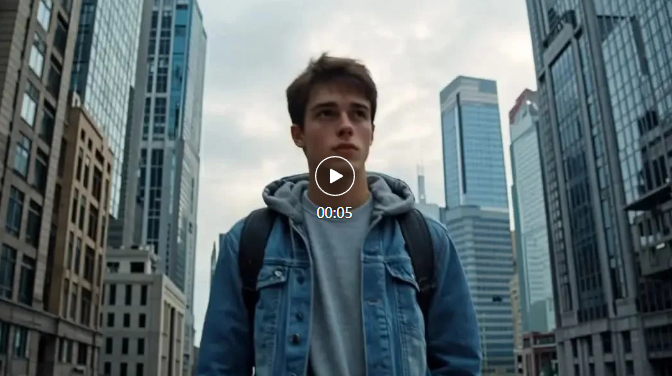
Shot 1: The poor boy clutches his last bankbook in his hand and stands under a busy CBD office building
- Chinese prompt: young man in tattered denim, standing under a skyscraper, looking anxious
- English prompt: A young man in a worn denim jacket stands under towering skyscrapers, looking anxious
Camera 2: Mysterious middle-aged man handed him a "million-dollar project" business card.
- Cue in Chinese: mysterious middle-aged man, handing out a golden business card, dark background
- English prompt: A mysterious middle-aged man handing over a golden business card in a dim background

Shot 3: Poor boy enters posh office with hidden cameras in the dark
- Cue in Chinese: Young man walks into a luxury office with a gold business card and a miniature camera on his chest.
- English prompt: A young man enters a luxurious office with a golden business card, a mini camera hidden on his chest

Shot 4: Meeting in a luxury office (scam ambush)
- Chinese cue word: The rich boss sitting in a luxurious office looks at the poor boy and speaks to him.
- English prompt:The wealthy boss sitting in the luxurious office looked at the young man across from him and spoke to him.

Shot 5: Counter-killing to reveal the scam (cool point reversal)
- Chinese cue word: The poor boy smiled in response, then raised the tape recorder in his hand and spoke with a sneer.
- English prompt: The young man smiled in response, then raised the recording pen in his hand and sneered as he spoke.

Shot 6: Poor kid exposes video to the internet and the whole network likes it
- Cue in Chinese: Young man smiles as he uploads stolen video to his computer, "100,000 likes" pops up on the screen.
- English prompt : The young man smiles as he uploads a secretly filmed video, a "100K likes" notification pops up on the screen

Shot 7: Ending Hook
- Cue word in Chinese: young man stands up, smiles coldly and talks to the camera as he walks away
- English prompt : The young man stood up, smiled coldly, and spoke to the camera as he walked

3. User thinking application skills:
- 5 seconds to poke the pain point: the beginning is "no money + anxiety", the audience sense of immersion instantly pulled full
- The coolness isn't held back until the end: the coolness of the mid-range counter-kill has to be fast and can't be dragged out
- Tickle to create desire to comment: end with the line "What other harvesting scams have you seen? Talk about it in the comments section." Trigger users to leave comments
4、Editing into a movie
Fifth, the user thinking to create a pop-up practical formula and prompt words
|
|
|
|---|---|
|
|
|
|
|
|
|
|
|
|
|
|
Comparison table of user mind blowing cue words:
|
|
|
|
|
|---|---|---|---|
| target user |
|
|
|
| Core Hooks |
|
|
|
| Emotional Design |
|
|
|
| Conflict Settings |
|
|
|
| endgame |
|
|
|
The Case for User Thinking Explosive Cue Words:
Case 1: "Moments of Meltdown with Kids" from the Baby Momma Community
- Wrong prompt word: "Write a story about a mom who is tired of bringing up a child and ends up being touched by her child, be heartwarming." (too general, misses the point)
- User Thinking Cue: "Scenario: 10 a.m. Saturday morning, mom has just mopped up the spilled milk floor and turns around to find her 2-year-old smearing lipstick all over the wall. As mom clenches her fists and takes a deep breath, the baby holds up a melted candy bar and says, 'Mommy eat. We used 3 shots to capture the mom's 10 seconds from devastation to softness, highlighting the paradox of 'wanting to be angry but instantly breaking down'." (Accurately reproducing the scene + capturing real emotions)
Case 2: The "State of Finals Week" for College Students
- Incorrect cue word: "Shoot the inspirational story of college students who study late into the night and end up in graduate school." (Cloying and lacking resonance)
- User thinking prompt words: "Lens 1: 2:00 a.m., six professional books piled up on the desk, the student yawns at the computer screen, the mouse stops on the 'withdrawal application' page; Lens 2: cell phone pops up a message from your best friend, 'I've occupied the library seat for you! '; Lens 3: The student deleted the half-entered 'I don't want to take the test' and silently clicked on the online class. With the text: 'It turns out that when you can't hold on, someone to give you a push is enough'." (Spotlight on the real mindset of "wanting to give up but not being able to")
Sixth, AI tools + user thinking: 1+1>10
AI can help you quickly generate images and optimize lines, but it can never replace the understanding of the user. Remember: the tool is the brush, the user's mind is the canvas.
Next time you open an AI authoring tool, ask yourself 3 questions:
- What type of people do I want to write for? What might they be doing at the moment?
- What are they hiding in their hearts that they haven't said while watching the show?
- Can I make them think, "This show gets me" in three seconds?
Master the user mindset, and you'll realize: explosive AI skits are never "made for everyone to see", but "so that the right people can't leave once they've seen it".
Seven, summarize: AI short drama creation, user thinking is the strongest weapon!
Stop thinking about "making a good-looking video" - you want to make a video that viewers won't want to scratch.
AI allows the creation of lower threshold, but whether the "explosion" also depends on who can play the user thinking to the extreme.
Understanding users, catering to them, and mobilizing them is the underlying pass rule for AI skits to go from 0 to 1 million plays!
This is what I shared today, did you learn it?