



After the drumming of the previous notes, we have some knowledge of the pull, the script decomposed, the graphics, the core elements, and now we need to further integrate the elements
I'M GOING TO GET AN I.A. SHORT PLAY
"AI SHORTS" IS THE FIRST COURSE TO LEARN HOW TO MAKE SHORTS
INTRODUCTION TO THE AI SHORTS, ROLE-CONSISTENT SHORTS VIDEO COURSE
It's all madeAI skitsAnd it turns out that most of the little whites are going to come up at this stage, and there are some evil ways of doing it, for example, by looking for free-of-charge video-telegraphs from the market, or by drawing comics (four or nine palaces) from the script, or by breaking the frame or moving
the main purpose of this is to select a good shot, to make a screenshot, which is actually used by a lot of directors, for example, to produce videos in sora, and then to learn the language of the video
adversity is efficient, but orthodox has to be mastered, and the core task of this note is to build on the derelicted script spectroscopy, which combines the generation of three viewes of people, scenes, props and effects, with multiple tools. (bananapro does work well, loveart can be shallow!) but five bananas are lost for each day's credit
I'm mostly passing hereThe bean bag, or the dream tool, has completed the melting—Accurately integrate people, props, according to the needs of the spectroscopy into the scene, produce frame-by-spectroscopy, and provide pictograms for subsequent spectroscopy videos, the core requirement being"Integration maps with spectrometers, scale coordination, style consistency, nature of detail"
I. Core course objectives
1. Proficiency in the integration of bean bags, i.e. dreams, which integrates characters, props, special effects and scenes in a precise way, as required by the lens"Single material full spectroscopy"conversion
2. Clear criteria for the integration of the spectroscopy to ensure that the person is compatible with the scene ratio, that the light is suitable, that the style is consistent, and that the spectroscopy is consistent with the spectroscopy, the mirror and the graphic description requirements. It's easier to ignore it, and it's time to look at the unity and harmony of the light and the atmosphere, and if you don't notice it, it'll be a little remediate at the time
ii. Core requirements of the melting map (compatible lens and material characteristics)
The integration map needs to be strictly spectroscopyed, based on the material of the person's scenery, taking into account the integrity of the picture and the character of the spectroscopy, as follows:
(i) Precision matching lens parameters
1. Speculation fit:Adjusts the profile of the person by the lens (e.g., feature focus on the face of the person, overall view highlights the relationship between the person and the scene as a whole) and does not change the core image of the image at willAt this point in time, if a given scenario is not working well, it can be adjusted quickly, but be careful not to try to be the same. _Other Organiser

2. Action and location:People's movements and props need to fit into the mirror
Example 1 (Persons Three View + Object Chart + Site):
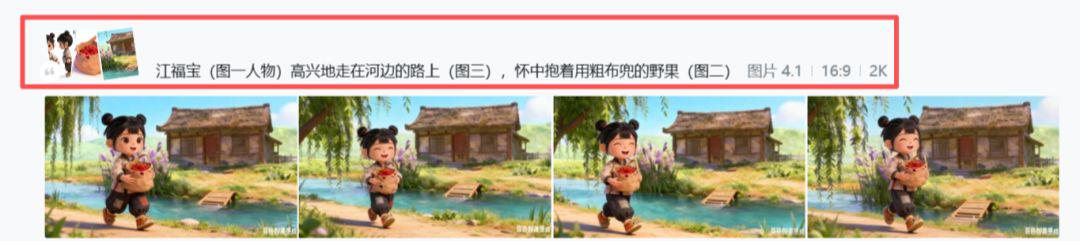
The location of the person in the scene needs to be in line with the drama logic (e.g., dialogue scenes stand face to face, conflict scenes stand opposite)
Example 2 (Package by image of Example 1, Example 1+Person 3 View):

Note: The multi-person fusion is really hard to do, so it's really bad, and it's better to change your mind and break four or five into two or two sets
When lucky, you can draw a good profile of the person, fine-tune it, which is inevitable, compared to the figure below, which allows you to adjust the percentage of the person lying alone, which was supposed to be standing, but this is a much better one, so it's used directly to this position
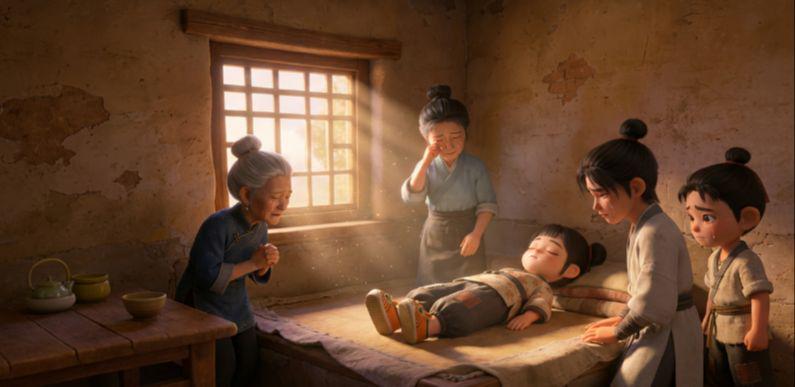
3. Special effects superimpose:The spectroscopy requires that special effects be stacked at the corresponding position to clarify the hierarchical relationship between the effects and the person, the scene and avoid blocking the core image elements
Here's the real thingSpace is deep and personalThe relationship, it's been stuck for a long time, if it's really hard to showIt is suggested to invert the desired effect maps in other animations and to adjust them to what they need after obtaining an accurate hint
(ii) Image integration of nature
1. Proportional harmonization:Persons, props and props need to be proportional to the scene, avoid problems such as “too big/too small”, “unbalanced props and scene”, and fit realistic visual logic
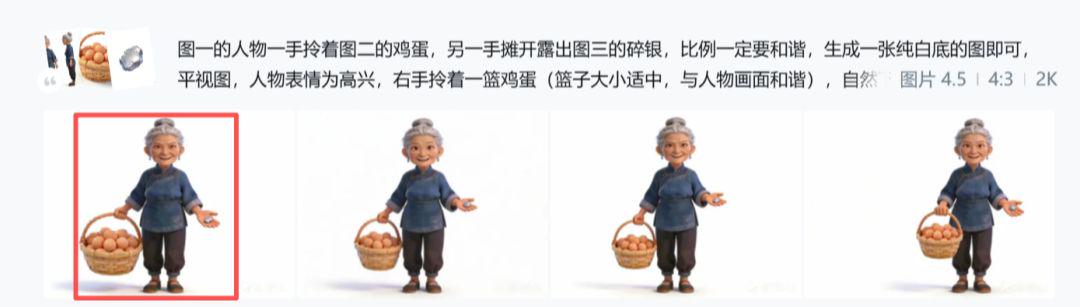
[Note: The spectroscopy must be limited in size (the whole set is 16:9 or 4:3 or something) and, if not, the later video size will be distorted, and the clippings or cropping will affect the camera presentation, so it must be fixed.]
2. The unity of light:The photo effect of the person, props and props needs to be consistent with the picture (e.g., the scene is a side-light, the person's shadow needs to be on the side to avoid conflict in the light)
It's a uniform syllable for every drawing, avoiding deviations
It's all coming from a complete replay, and I didn't take that into account when I was doing the drawings, so I fixed the clips later, but the effect of the alignments was only marginal, or did I suggest to keep an eye on the drawings
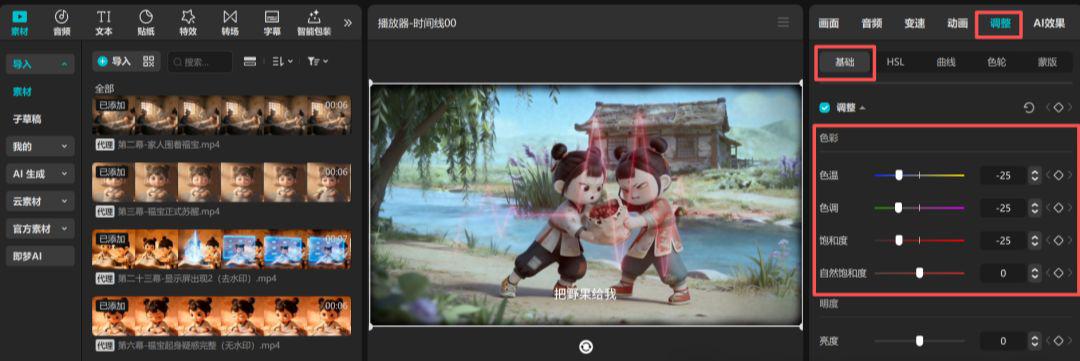
3. Harmonization of style:Continue the style of the graphics to ensure that the post-melting spectroscopy is not fragmented (e.g. phantom scenes are matched with symmetric characters, special effects, not blending with other style elements)
_Other Organiser
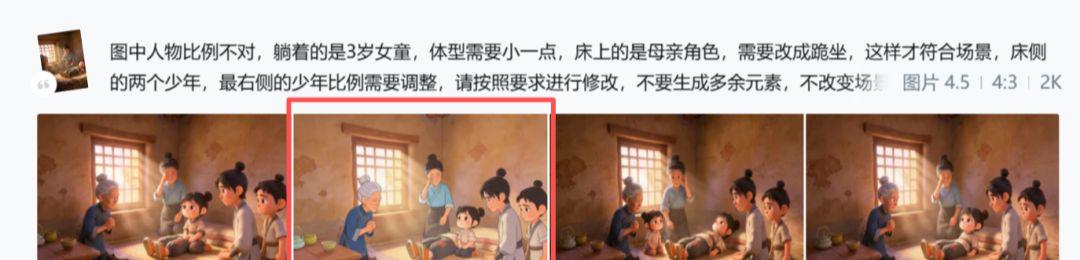
(iii) Detailed control points
1. Core elements are not missing:Key figures, props, scene details in the spectroscopy description need to be presented in full, leaving out the core narrative elements
Redundancy elements to be removed:Only the elements required by the spectroscopy are kept while melting the map, avoiding the addition of irrelevant decorations, ensuring that the picture is simple and that it corresponds to the high information density requirements of the short spectroscopy
III. Tool exercise: bean pack + description and attention
(i) Bean packs (fast-melting + base adjustment, light white and simple spectroscopy)
Core uses
It is appropriate to generate simple, less elemental spectrographs (e.g., meso-scenario conversations, close-scenario features) that quickly integrate people and props into the scene, while supporting basic photo fixes and special effects superseding and operating efficiently
2. Melting chart operating processes
(1) Material preparation:This is the first time that we have been able to do this in advanceBy spectroscopy numberEasy to access quickly
(2) The construction of a hint:(a) Construct a hint in accordance with the "Specific requirement + material integration + detail adjustment " , with a clear view of the person ' s action, location, light and style
(3) Uploading material support:If the automatic melting map is more biased, the corresponding material (e.g. scenario, figure) can be uploaded, so that the bean bag is based on the uploading material to improve accuracy
(4) Effect fine-tuning:IF THE LIGHT IS INCOHERENT AND UNBALANCED, THE ADDITIONAL HINT CORRECTION (E.G. “RESIZE THE PERSON TO REDUCE 101 TP3T TO MATCH THE PERSON TO THE SCENE; RE-CREATE THE PERSON'S SHADOW TO THE LEFT, IN LINE WITH THE LIGHT OF THE SCENE”)
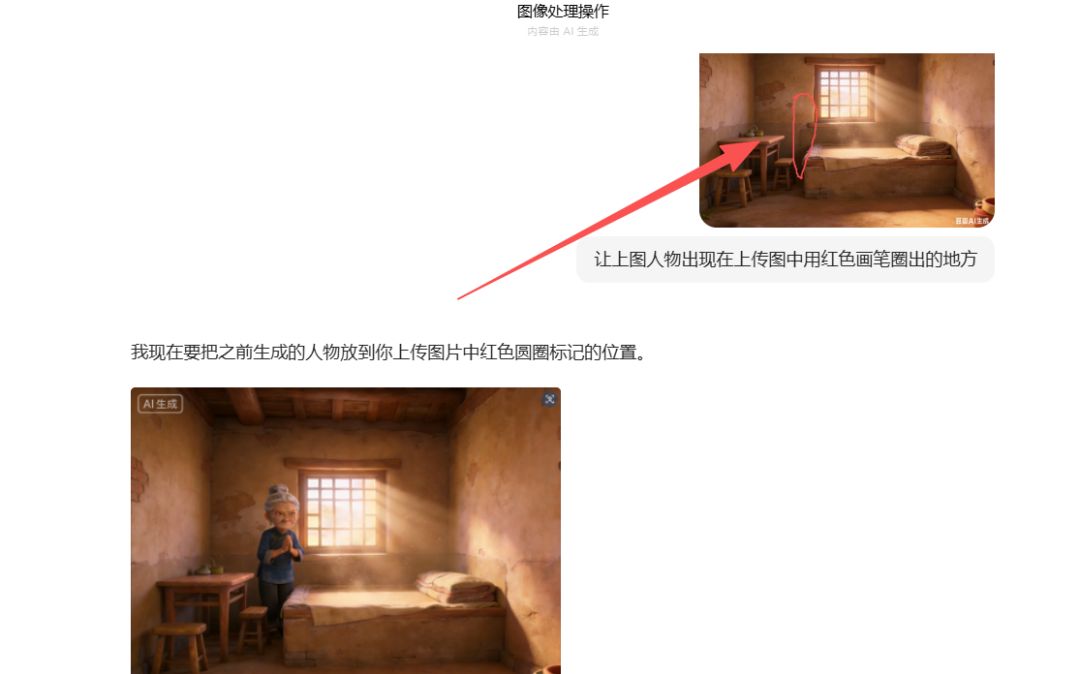
Note: The size of the bean bag can easily automatically change direction, so it is recommended that a map of the person in the drawing scene be prepared in due course
3. Integration of attention
(1) The prompting shall specify the properties of the “melt map” and the material associatedUpload reference maps at any time to avoid new material from bean packs that deviate from demand;
(2)A complex spectroscope (many people, multi-protocols, special effects) does not recommend a single bean bag(b) Elemental disarray and hierarchies, which can be used in combination or in the dream
(3) The focus of the examination on the ratio and light after the melting of the map, which is a common short sheet of the soybean pack, with a targeted and optimized hint
(4)Save the melting map by spectra number, name codeEnable follow-up and sequential video generation
(ii) A dream (a fine fusion map + an optimisation of the atmosphere with a complex lens)
Core uses
A spectroscopy (e.g., multi-person landscape, conflict scenes with ambivalence) that is suitable for generating larger elements, complex photoscopying, fine-tuning element levels, photo-details, and a better sense of melting quality, while supporting local redrawing to optimize integration
2. Melting chart operating processes
(i) Preparation of prior periods:Open the dream, log in the account number, enter the Photo Generation moduleCreate a local spectrograph folder (archived by scoping number) in advanceUpload the corresponding material to the material bank
(2) Basic integration map:Import scene maps as bottom-up material, then add person charts, prop sheets, drag and resize to ensure that the spectroscopy and action requirements are met
(3) Detail optimization adjustments:
– Level adjustment:Repositioning of people, props, special effects through layer function to ensure that core elements are at the top (e.g. above the person's scene, with special effects stacked at the corresponding position)
Example:
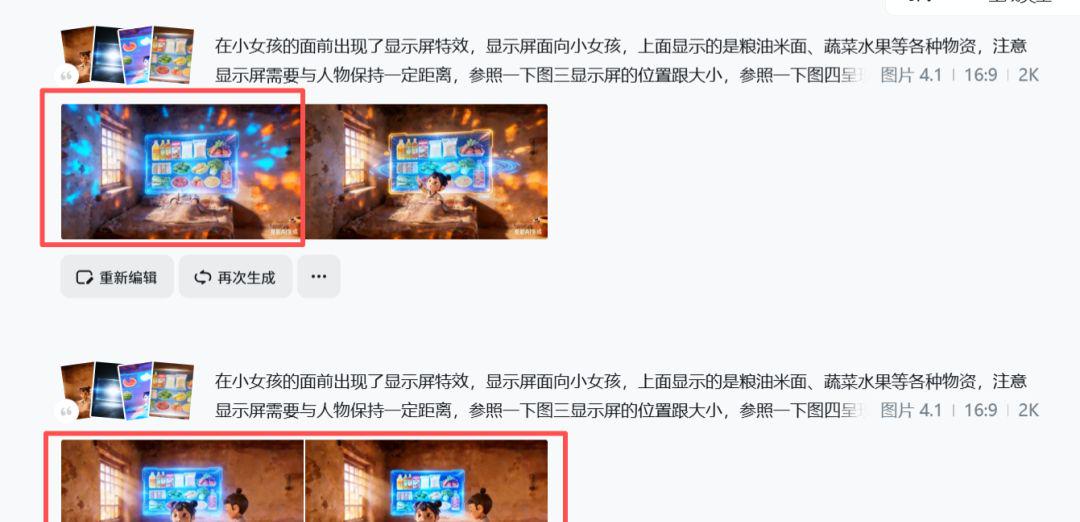
AT THIS POINT, IT IS POSSIBLE TO REVERSE THE IMAGES MENTIONED EARLIER TO ACCESS THE MORE UNDERSTANDABLE HINTS OF AI:
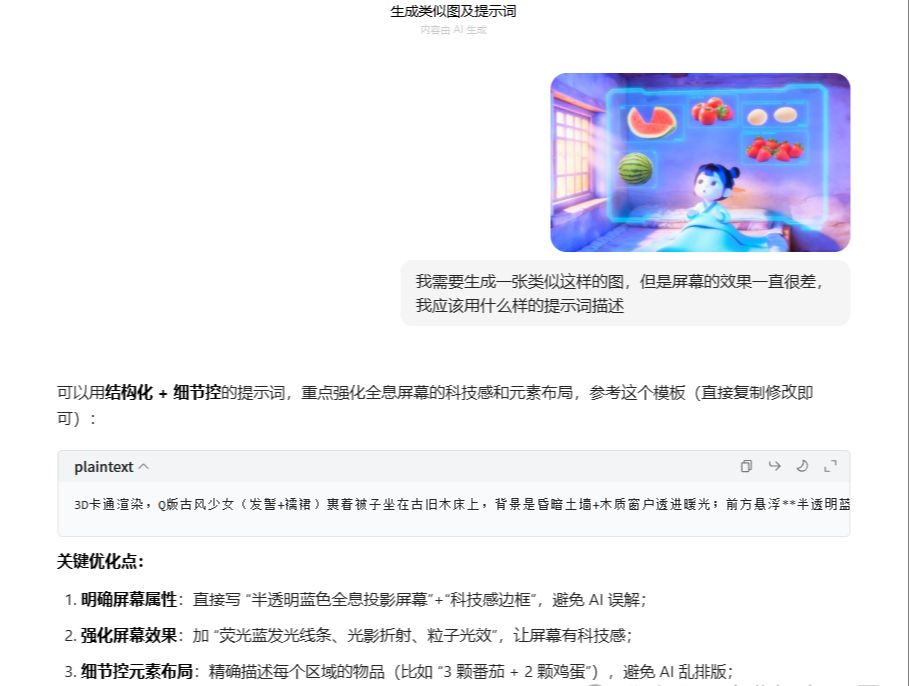
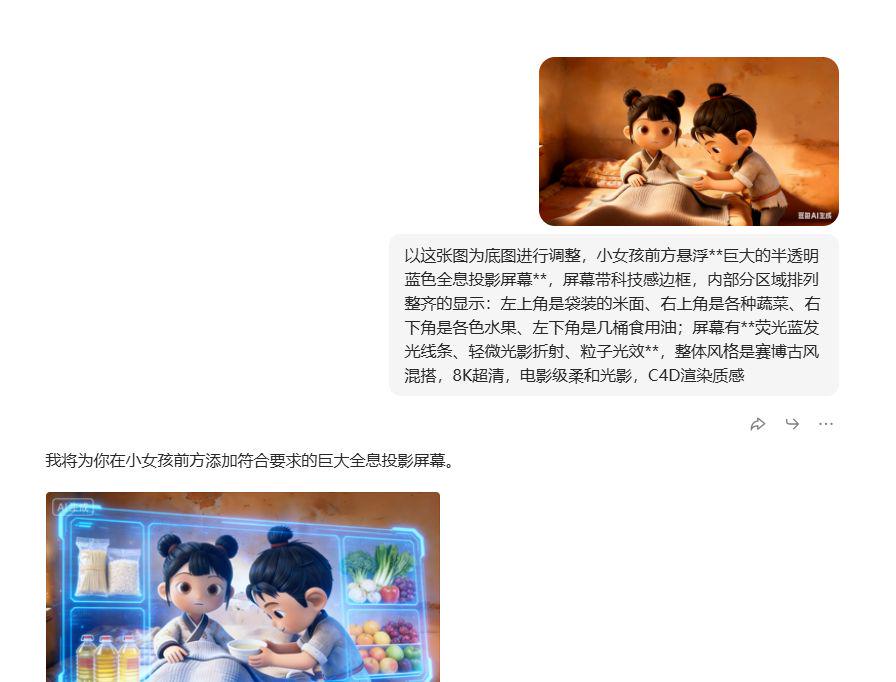
Even so, the bean bag and the dream didn't produce a particularly suitable picture, which involved a new way of dealing with it, skipping the living map directly to generate the video, and using the video to generate the right static frame screenshot
– Shadow appliance:(a) Use of the "light-adjusted" function to fine-tune the brightness, shade and direction of the person, the props, so that it is fully consistent with the scene light
– Special effects superimpose:Import special effects maps, adjust transparency and scope to ensure that the special effects are naturally integrated into the picture and do not block core figures and props
(4) Local redrawing amendments:If the person is connected to the scene (e.g., if the edge is broken), it will be used“local redrawing”The functional box selects the corresponding area, with the hint " Optimization of connecting the person to the edge of the scene to make the integration more natural and to keep the overall light in line " , after adjustment and export。
3. Integration of attention
(1) High-resolution images are to be selected when materials are imported in order to avoid their compression leading to a blurring of the post-melting picture and affecting the quality of the spectroscopy
(2) Layer management needs to be clear. Multi-Element Melting by“Scene-person-protocol-special effects”Layering to allow subsequent individual adjustments of an element
(3) The light adjustment needs to be moderate and not blindly bright/deep, based on the original light of the scene and avoiding undermining the overall atmosphere of the picture
(4) Select the size and resolution of the material when exportingEnsure that all spectrograph specifications are harmonized and reduce adjustment costs for subsequent video generation
(iii) Summary of adaptation scenarios of the two tools
1. Priority is given to bean bags: single person, simple view, less elemental spectrograph(a) The rapid generation of first drafts, with a large number of spectrometers and the need for efficient landingsBut the bean bag's so stable that it happens so often, it's got a lot of character
2. Prioritization of the vision: multi-person, complex scenery, high-demand speculation of light(b) Finely optimized integration and fit into the core drama lens (e.g., opening, conflict, ending)
Co-use: Generate a first draft of all spectroscopy with a bean bag, screen out a complex spectroscopy and optimize details with the i.e. dream-specific(e.g., photo, level, edge interface), balance efficiency with quality
IV. Summary of learning and learning
(i) Core focus
The core of the spectrogram is.."Accurate pair lens + natural integration of details"The level of fine-tuning of the second spectroscopy and the quality of the material for the third lesson directly determine the efficiency and effectiveness of the melting map。
The bean bag owner is highly efficient and fast enough to produce a first draft in bulk (and can even produce a direct picture by the script), i.e., the dream focuses on fine optimization and is suitable for grinding the core lensThe co-use maximizes the overall quality of the spectrograph
In addition, integration maps must not only pursue image beauty, but must always be focused on the needs of the spectroscopy to ensure that each spectroscopy accurately conveys the corresponding story
(ii) Real-time double-hatting
1. Achievements:Generate a full frame-by-spectrum map by spectroscopy number, and achieve a precise integration of characters, props, effects and scenes, a uniform style, a coordinated scale and a basic alignment of the spectroscopy requirements
2. Core issues:Some multi-person spectroscopes are in disarray and incoherent; when simple spectroscopes are generated with bean bags, there is a slight deviation between the person's action and the spectroscopy description
3. Optimizing direction:Pre-combine complexity of spectroscope elements, use of scenery for rational distribution tools; inclusion of phrases such as "Practical retrospective description of the person's action" in bean-packing tips to reduce deviations
Additional matters of concern
1. Cross-check the spectroscope tables and materials to ensure that they are complete, that the spectroscopy requirements are clear and that the missing elements or differences in understanding lead to return to work
2.All speculations need to be harmonized (resolution, size), avoid the problem of conflicting image sizes in the subsequent generation of the lens video
3. Maintenance of the Magnetic Project file (i.e., dream) and hints (beans packs) and subsequent re-enactment of the spectroscopy without re-melting
After the meltingPreview all pictures in spectroscopy order, check the consistency of style and styleMake sure the spectroscopy returns the script logic
The short play spectroscopy is the key link between the material and the video, and the core logic is, "Accurate against the spectroscopy + details of natural integration."
For beginners, there is no need to struggle with the full power of a single tool, but to rationalize the distribution of bean bags and the use of dreams based on the complexity of the spectroscope -- simple spectrometers are generated in high-efficiency mass, complex spectrometers are sharpened
As long as the three core elements of proportional coordination, photometric harmonization and consistency of style are captured, and attention is paid to the consistency of the spectroscope specifications, the required frame-by-scope mapping can be generated
AS HANDS-ON EXPERIENCE GROWS, THE EFFICIENCY AND EFFECTIVENESS OF THE MACHINATIONS WILL GRADUALLY INCREASE, REDUCING SIGNIFICANT ADJUSTMENT COSTS FOR SUBSEQUENT VIDEO GENERATION AND CLIPPINGS, AND IMPROVING THE AI SHORT PLAY PRODUCTION PROCESS