



Mid-level solves three problems: I can't remember, I can't find it, I can't break it
but you might find that-- angent's getting smart
It's like you trained an intern with good memory, fast search, and no break. But you still have to tell him everything
This is the problem that seniors are going to solve: making interns regular employees
What do the regulars need
Skill -- let it understand your business
SOP(Hook) -- makes it follow the rules
MCP - TO ENABLE IT TO USE COMPANY TOOLS
Independently responsible for the project (autonomous mission) - let it work on its own
And because it's complicated, we're talking about the core concept in each direction, plus a killer case
Skill — pre-service training for staff
you tell angent every day about the format of the daily newspaper: first the work done, then the important decision, and then the plan for tomorrow
i told you 50 times, change the session
no, it's not. it's not smart. it's everything you teach
It's a question of nature: what is taught in dialogue is temporary
Skill, what is it
One sentence: Skill = a training manual for angent, which will take effect permanently
It's essentially a SKILL.md file under skills/catalogue. Scanning this directory on startup, identifying triggers, matching the content of SKILL.md into context
and AGENTS.mdWhatDifferent
AGENTS.md is a universal working code -- how to write, how to search, how to record mistakes. Every time a session is loaded, whatever you do
Skill is a specific business process and knowledge -- what's your daily format, what's your code code and how your search tools work. Load only when required, match by trigger word
AGENTS.md, working attitude, Skyll, business knowledge
Or Skill, whatever
Murder cases: a daily newspaper, Skyll
When there's no Skyll, every time you write a daily, you have to say a big part:
Write for me today's daily newspaper, in the form of a list of the main tasks accomplished today, followed by important decisions, problems encountered and solutions, and finally tomorrow's plan
read today's memory file extract
Fifty words of instruction. Say it every day
Create a file after Skill ~/.opencllaw/skills/ Daily-report/SKILL.md
—
name: daily-report
description: >
Generally works reports by reproducing memory files and semmarizing
i'm sorry, acts.
Triggers: “Daily report”, “Daily newspaper”, “What has been done today”, “Summary of Work”.
—
# Daily Report Skill
When tried:
Read today's memory file
2. Subject key actors, experts, and issues
Format as:
– Work accomplished
– Important decision-making
– Problems encountered
– Tomorrow
—
Name: Daily coverage
Description:
Daily work reports are generated by reading memory documents and summarizing activities。
Trigger words: “Daily report”, “Daily newspaper”, “what has been done today”, “Summary of work”。
-# DAILY REPORTING SKILLS
When triggered:
1. Read memory files for the day (memory/YYYY-MM-DD.md)
2. Extracting key activities, decision-making and issues
The format is:
– Work accomplished
– Important decision-making
– Problems encountered
– Tomorrow
From now on, you just have to say three words: a daily
angent matches the trigger word, automatically loads SKILL.md, knows what to read, in what format, how to output
fifty words to three words. and no matter how many sessions, the format is the same
Skill doesn't exist alone, it and Hook and MCP form a complete angent enhancement system
Let's do a preview. We'll do it in each direction
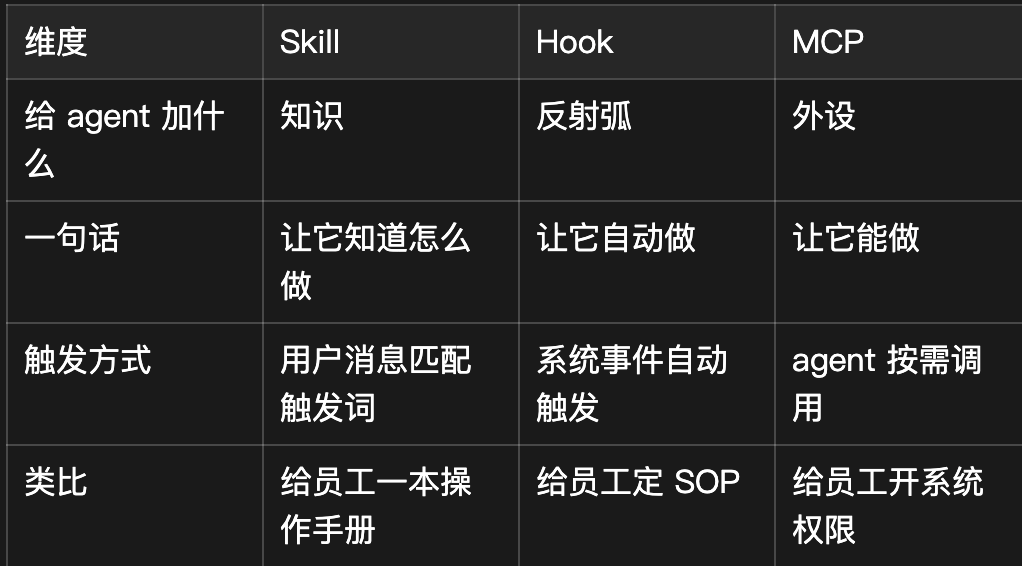
Skill, whatever it is, Hook, whatever it is, MCP, whatever it is
Remember that. It'll be used again and again
Full Skill development tutorials -- from catalogue structure to trigger mechanism to pit-to-pit record -- in an advanced complete section
ii. Hook - SOP for employees
every time you open a new session, you have to say, "look at today's plan and the diary."
I've said it a hundred times and I've finally figured out one thing
I'm not supposed to remember this
I'm the boss, not the nymph. I shouldn't have reminded the secretary to turn on the notebook before every meeting
Hook, what is it? Hook = angent reflect arc
What's a reflection arc? Knee jump a reflection. The hammer hits the knee, the leg goes off, the signal goes through the spinal cord, not through the brain
Hook, this is the thing -- when a given event occurs, the code runs, without going through ant, without LLM decision-making
This and Skill are two levels:
Skill is a manual for angent -- it may look like it doesn't look at it, it may look like it doesn't. First event, code runs, 1001 TP3T confirmed
Key difference: Hook runs TypeScript code, not LLM decision-making
ONE IS THE RECOMMENDATION, ONE IS THE IRON LAW. YOU SAY TO THE EMPLOYEE, "EMAIL FIRST EVERY MORNING," HE PROBABLY FORGETS. YOU GIVE HIM A SOP WITH AN ALARM. HE CAN'T FORGET IT
The structure of Hook is simple:
you know, my-look/
Ideas--HOOK.md # announces what to listen to
Ideas-handler.ts # on the trigger
HOOK.md told the system, "What's my name, what's my story?"
handler.ts, tell the system, "what exactly is the incident doing?"
Still Case: A Hook Let angent read today's plan automatically
every time you open a new session, you want angent to automatically read today's diary file -- you don't have to
Synchronising "%s"
—
name: session-loader
file: "new session automatically loads today's working log"
metadata:
openclaw:
participants: ["command:new"]
well, let's see
bins: [`node']
—
—
Name: Session Loader
description: "new session automatically loads today 's working log"
Metadata:
Event: ["Order: New"]
request: bins: [`node']
—
_other organiser
import {readFileSync, examplesSync} from “fs”;
import {join} from “path”;
=async(event)=>
if (event. type! = “command” ||event.action! = “new”) {
return;
}
(a) Const memoryDir = join (proceed.cwd(), “memoory”);
const today = new Date().toISOString().split (“T”) [0];
const diaryPath = join;
if (existsSync (diaryPath))
(a) Constcontent = readFileSync (diaryPath, “utf-8”);
`today's work log has been loaded:
${content} `;
♪ orse ♪
(a) events.messages.push (“no work logs available today, start a new day”);
}
};
i don't know;
Import {readFileSync, externalsSync} from "fs";
import {join} from 'path ';
consthandler = step (incident) = {
if! == sync, corrected by elderman == = “new”)
Return;
}
(a) Const memoryDir = join (proceed.cwd(), “memoory”);
const today = new Date().toISOString().split (“T”) [0];
const diaryPath = join;
If
contContent = readFileSync (diaryPath, “utf-8”);
('today's work log loaded:
${content} ');
Otherwise
(a) events.messages.push (“no work logs available today, start a new day”);
}
};
Export the default processor;
effect: you open a new session, angent already knows what to do today
You don't have to say, "Look at today's plan."
You don't need to be TypeScript. Just describe what needs -- "do what at what time" -- and get your angent to write for you handler.ts
Core competency is not a writing code, it is defined clearly. This is what PM does every day
Progress scene
Hook can do much more than load the diary:
- Listen to campaign event: autosave task status before compression, autorestore after compression -- plan file mode for mid-text, make it fully automatic with Hook
- Listening write operation: Intercept dangerous document coverage -- 345 KB no more accidents
- Complementing Heartbeat: autochecking for unfinished tasks every heartbeat
from "you remind angent" to "agent knows himself" -- that's the power of the reflection arc
Several practical Hook Configuration Templates + Full Penetration is recorded in advanced complete pages
MCP - SYSTEM ACCESS FOR STAFF
you want angent to help you check the data in the database, and it says, "i don't have that ability."
You want it to run a specific directory in the file system. It says, "I can't."
there's only two things you can do by default: think and talk. nothing else
You're gonna have to take it out
MCP = Mode Context Protocol
ONE SENTENCE: USB INTERFACE FOR THE AI WORLD
Whatever external services -- databases, search engines, file systems, browsers -- support the MCP protocol and get on your agent
YOU DON'T HAVE TO WRITE A SPECIFIC DOCKING CODE FOR EACH SERVICE. IT'S LIKE USB UNITES EXTERNAL INTERFACES -- WHETHER YOU'RE A PRINTER OR A CAMERA, THE SAME PLUG-IN
LEARN USB, AND YOU WON'T HAVE TO RETRAIN ANY EQUIPMENT. MCP, TOO
The structure is simple:
Agent → mcporter → MCP Server → External service
mcporter is the medium for communication between antent and MCP Server. OpenClaw incorporates mcporter skill, angent knows how to call it
profiles in config/mcporter.json - each project can access different external services
killer case: a configuration for angent to read and write files
The simplest MCP Server is the file system -- no API key, no local run
write a configuration in config/mcporter.json:
{
"mcpServers": {
"filesystem":
"command": "npx",
"args": ["-y", "@modelcontextprotocol/server-filesystem", "/tmp/mcp-test"]
}
}
}
{
"mcpServers": {
"filesystem":
"ORDER": "NPX"
"args": [("-y", "@modelcontextprotocol/server-filesystem", "/tmp/mcp-test")] }
}
}
Three lines is enough. Meaning: Start a file system MCP Server, only allowed access to /tmp/mcp-test directory
The last path is the safe boundary -- the limit for Server can only read and write documents under this directory. And a reason to give app permission
Let's check it out
mcporter list
1 TP5T, seeing the filesystem Server and the tools it exposes, means it works
=/tmp/mcp-test/test.txt
# READ TEST FILES
You can say in angent conversations, "Help me read files under /tmp/ mcp-test" -- angent will automatically go mcporter call
Unable to answer MCP angent
Agent of MCP can work with tools
That's what system access means
Ecology
MCP is not just a file system. Server:
- File system (reading and writing local files)
- PostgreSQL / SQLite (database query)
- Brave Search (search engine)
- Puppeteer (engineer automation)
- Memoory
A USB interface, unlimited outside. With a new Server, just a few lines of configuration in mcporter.json -- the process is exactly the same as the file system above
Don't use MCP for MCP. A simple file reading and writing agent accompanies a tool, MCP suitable for a scenario that requires external API access, standardized multiple external calls
Autonomous tasks — independent responsibility for the project
Say, "Do me a community trend study, Agent says, "Okay, what's the first step?"
He's waiting for your command
You said the first step was to search GitHub, and it did. Then we'll wait for your second step
You said step two search Reddit, it search. Then I'll wait for you
That's not what you want. You want to give it a goal. It dismantles its own steps, implements it, and decides whether or not it's done
You say one step at a time -- this is an intern
You do it to the target -- this is a regular employee
Core concept: from directive to objective
It's the biggest cognitive upgrade from mid-level to advanced
Command Drive:you give step, angent execution. this is the medium-level plan document model -- you create the plan manually, you list the steps, you go the steps
Target drivers:you give the target, angent deciphers his own mission, plans his own execution sequence, and makes his own judgment
This will take three infrastructure, and the medium level has taught it:
- schedule file -- angent created and updated itself, not for you
- Heartbeat -- wake up angent every 30 minutes, let it see if there's something to do
- AGENTS.md Rules -- Tell angent how to decompose, how to execute, how to assess a target-type mission
killer case: to a target, angent broke six steps to implement
actual case: i gave an agent a goal -- to complete a six-direction collection
all i'm saying is that we're going to take the six directions of the prompt, and we're going to do the research and the field
what did he do:
- Read the target document and understand the specific requirements of the six directions
- created its own plan document
- Dismantling of 6 directions into 6 phases with clear outputs for each phase
- Start from the first direction - search for documents, field tests, recording of pedals
- Automatically update the progress of planned documents at each stage of completion
- Heartbeat regularly check to make sure angent doesn't forget what he's doing
center context has been compressed twice and crossed three sessions
but every time a new session starts, angent reads the plan document, then the last progress continues. i haven't lost any progress
FINAL OUTPUT OF 5 MATERIAL DOCUMENTS ADDED UP TO 160 KB
Mid-level program document + Heartbeat = Infrastructure, Advanced Autonomy = Building Autonomy on Infrastructure
middle: you create the plan document, angent executes the plan document, advanced: angent creates the plan document itself, executes the plan
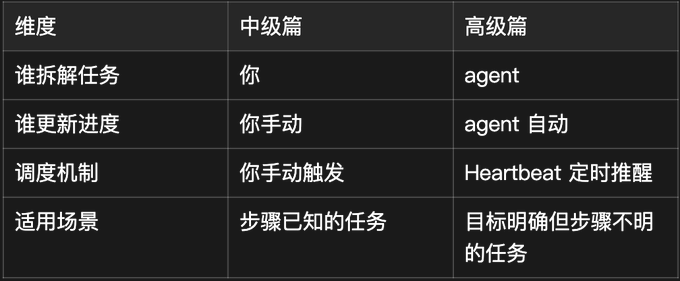
The ability to grow is now working
not all missions are suitable for target-driven — simple things give orders faster. but when the task is so complicated that you don't know how many steps to take, let angent try
Full autonomous task configuration + pedals are recorded in full, advanced content
Four pieces of equipment, one sentence recalling:
Skill, make it business
Hook, let it follow the rules
MCP LET IT USE TOOLS
Autonomy makes it work on its own
From mid- to high-level, we learned not four new concepts -- but the ability to raise them
MEDIUM-LEVEL SEARCH STRATEGY → ADVANCED TOOL SELECTION
mid-level plan document → advanced-level self-programming (agent created and updated)
Mid-level Heartbetat
The basics teach you how to fit, the medium ones teach you to work, the advanced ones teach you to work