



A LOT OF PEOPLE MAKE SHORT FILMS WITH AI, AND THEY GET USED TO STARTING WITH A NICE CHARACTER MAP, AN ATMOSPHERE, OR A "DO ME A REVERSE STORY." THIS LOOKS QUICK, BUT IT TENDS TO GET MORE AND MORE MESSY: PEOPLE LOOK LIKE DIFFERENT PEOPLE, THERE'S NO CAUSE OR EFFECT BETWEEN THE SCENES, AND THE CAMERA LOOKS GOOD, BUT DOESN'T KNOW WHY。
The problem is not that the picture is not sufficiently precise, but rather that it does not finish the story。
The short script is not a beautiful story sheet, nor is it a pile of characters, scenes and reverses. It is a continuous chain of creation: first, an idea, then the target of the person and the conflict from the point; then a determination of the emotions in which the story is to be told; then the design of a reversal in an already existing conflict; and, finally, a script of the selected programme that can be filmed and deciphered。
Instead of tearing down “targets, styles, inverts, scripts” into a few pieces of independent knowledge, the curriculum takes you through the whole process. For ease of understanding, a model idea will be used throughout the full text:
An intern was suspected of disclosing company secrets and she had to find a lead to prove her innocence before the supervisor took the computer。
This case is just a demonstration. You can replace it with anything like love, doubt, sci-fiction, affection, work, phantom. It is not where the story happens, but the content of each step of output becomes the next input。
I. Understanding: The script is not a narrative
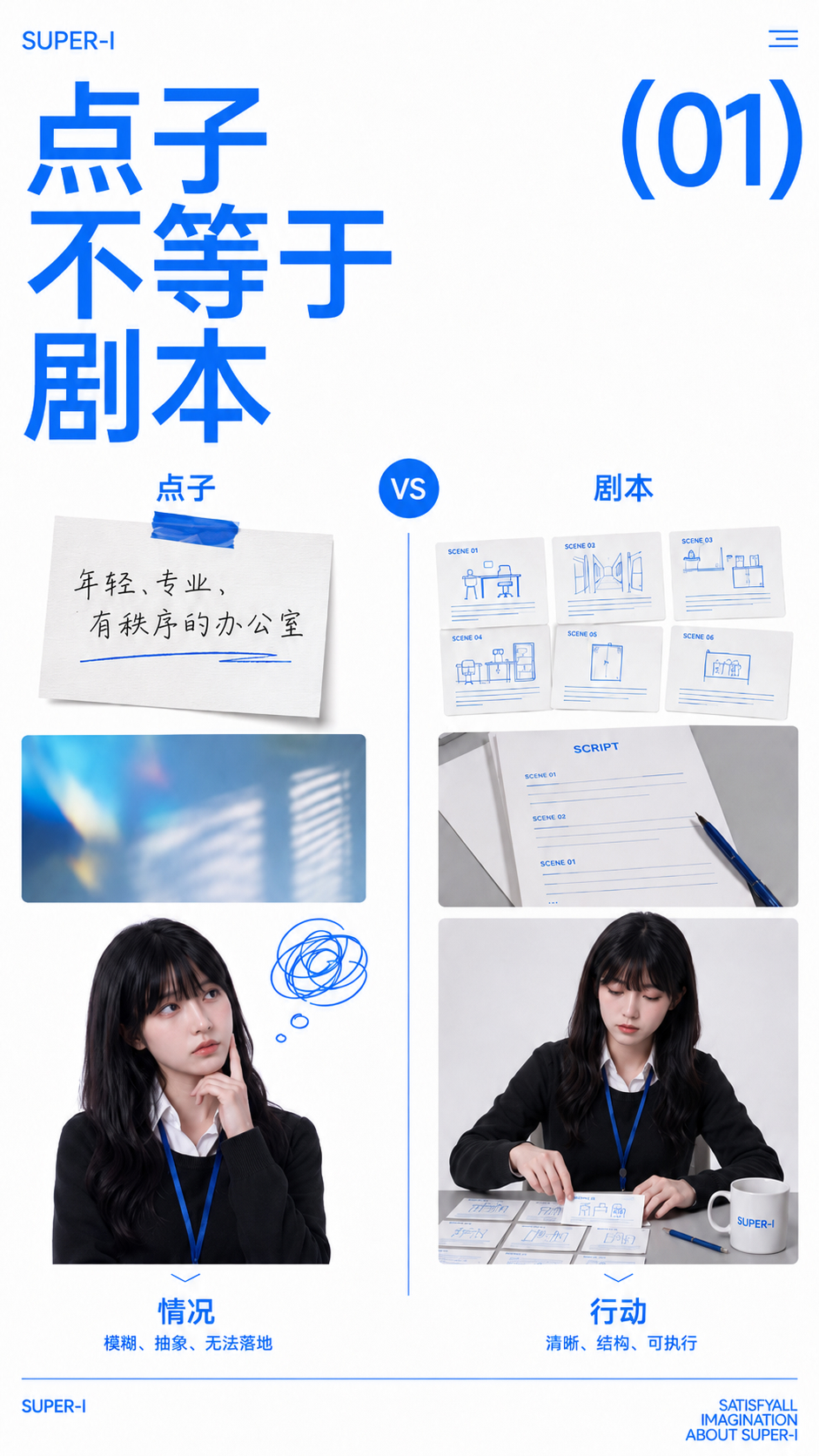
"A girl entered the company and found her colleagues in secret." It's an idea, not a script。
The idea is to provide an initial direction; the script is to allow the person to act in a clear situation and to make a difference. This is particularly necessary for short films, given the short time available and the impatience of the audience to wait for the creator to explain the context。
A basic script that can be used for short films, answers at least three questions:
What does the protagonist want
Who or what is stopping him
If it fails, what will he lose
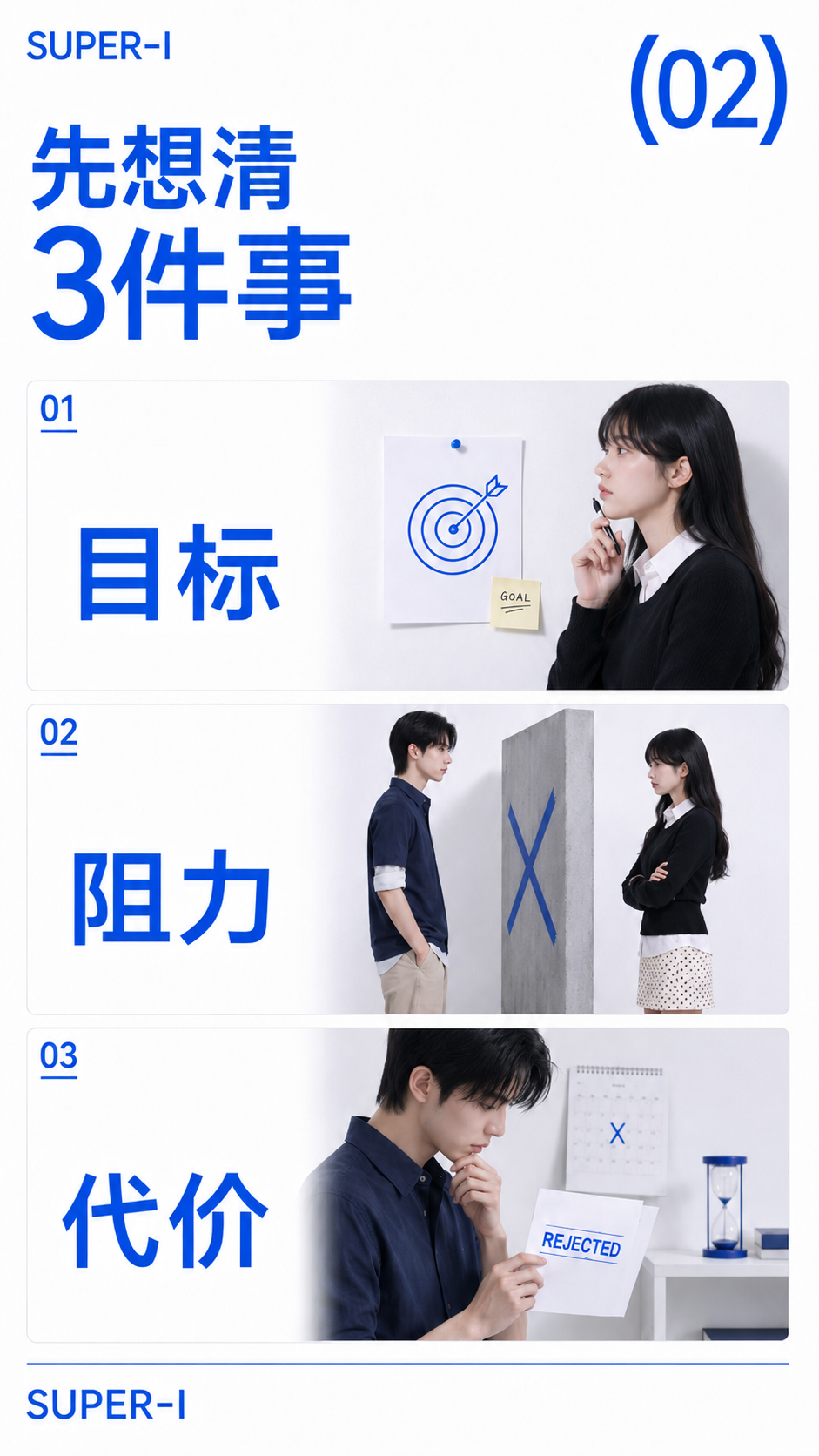
The three issues correspond to objectives, resistance and costs, respectively. They're like a line that combines people, scenes, props, actions and lenses。
For example, “girls discover company secrets” are still cited:
The main character wanted: she wanted to prove that she had not leaked company information。
What is the resistance: surveillance records indicate that she was the last person to contact the file; the supervisor asked her to hand over the computer immediately。
What is the price of failure: she loses her job and lets the real leak escape。

At this point, the story is no longer a “discovery of secrets”. The characters had a reason to act, the scene was tense, and the follow-up footage was available: conference room questions, computer screens, closed-door records, characters hesitated, hidden documents, and finally revealed the truth。
It's much more stable to build up the bones of a story, to think about character formation, environmental style and lens effects。
II. EXPAND THE BLURRY IDEA AND ASK AI TO FINISH IT
It's common for starters to say, “Do me a short film about missing, revenge, work or love, and reverse it.”
WHEN CREATORS DO NOT PROVIDE THE TARGET OF THE PERSON, THE STORY LIMITS AND THE EMOTIONAL DIRECTION, AI CAN ONLY CHOOSE A RELATIVELY GOOD COMBINATION FROM A LARGE NUMBER OF COMMON STORIES. AS A RESULT, MANY EXPLANATORY LINES ARE GIVEN, CONFLICTS APPEAR IN THE SECOND HALF OF THE YEAR, OFTEN RELYING ON IDENTITY REVELATIONS AND ENDING WITH A STATEMENT OF THE TRUTH. THE TEXT LOOKS COMPLETE, BUT IT'S HARD TO TURN INTO A REALLY RHYTHMIC SHORT FILM。
IT'S BETTER TO HAVE AI AS THE "STORY QUESTIONER" TO HELP YOU OPEN YOUR MIND. YOU DON'T HAVE TO HAVE THE WHOLE STORY AT THE OUTSET, JUST ANSWER A FEW KEY QUESTIONS。
The following phrase is used directly:
Ideas Extension Tip
You're a professional short film writer, visual narrative director and..AI VideoProduction planner。
I'M GOING TO PROVIDE AN IDEA OF A SHORT VIDEO THAT IS NOT YET COMPLETE. YOUR TASK IS NOT TO WRITE IT INTO A FULL SCRIPT AT ONCE, OR TO DESIGN A REVERSE AND AN END IN HASTE, BUT TO HELP ME OPEN UP THE POSSIBILITY OF THIS IDEA, FROM THE POINT OF VIEW OF A PROFESSIONAL WRITER, TO SET THE GOALS, OBSTACLES AND COSTS OF FAILURE THAT ARE THE MOST FUNDAMENTAL TO THE STORY。
THE IDEA OF MY SHORT VIDEO IS:
"Refill your ideas."
Anticipated length:
[Cook 15 to 60 seconds, or 60 seconds to 3 minutes]
Projected number of key figures:
♪ Fill in the numbers, or you judge by the story ♪
Number of major scenarios projected:
"To fill out the number, or according to your story."
Please first analyse what useful information is currently included in this idea, such as figures, circumstances, anomalies, personal relationships and potential conflicts。
The most attractive part of the idea is then judged, the questions that can be most likely to arise when the audience sees the opening, and the key messages that the idea currently lacks to further the drama。
Upon completion of the brief judgement, please build on the following three core issues。
First, what are the targets that the protagonists want most to achieve
Please provide five distinct targeted programmes。
Each objective must meet the following requirements:
The goal must be specific and not be limited to the abstract desire to “prove” “seek the truth” and “approval” “leave the dilemma”。
Targets must be able to be achieved through the specific expression of the person, such as finding, delivering, concealing, stopping, retrieving, exchanging, confirming, protecting or completing something。
Targets must be quickly understood by the audience within a limited short film。
Targets should preferably be linked to a clear person, a key props, a location or a time node。
Please describe for each objective:
What exactly is the lead to do
Why must the protagonist do this
(b) The time or conditions under which the lead person must be completed
This goal is the most appropriate way to get through the movement of people and key images
The goal is what the audience can expect。
Secondly, what is stopping the protagonist from achieving his goal
Please provide five significantly different types of obstructive programmes, covering as far as possible the following types:
People are blocking: another person has a direct conflict with the main actor's target。
Rules hinder: a regime, agreement, identity restriction or special rules restrict the movement of the protagonist。
Environmental impediments: space, weather, transport, closed spaces or changing environments create difficulties。
Time constraints: Countdowns, upcoming events or a shortened window of action。
Impediments to props: critical items lost, damaged, switched, unserviceable or hidden。
Information hinders: information held by the protagonist is incomplete or leads to a misjudgement of something。
Each impediment must meet the following requirements:
Be able to express itself directly through images, motion, props or environmental changes
We can't rely solely on character interpretation
It is important to force the protagonist to change the way he acted
Impeding the need for space for further upgrading, rather than being addressed as soon as it occurs
Impediments should be directly related to the main target and should not increase risk at will in order to create incentives。
Please describe separately for each impediment:
What are the obstacles
For the first time, it appeared in what image
How it affects the original actions of the protagonists
What new responses may be available to the protagonists
How it can continue to upgrade。
Thirdly, if the hero fails, what will he lose
Please provide five distinct costs of failure。
The cost of failure can be considered in the following directions:
Loss of real benefits, such as work, qualifications, money, opportunities or important items。
Loss of personal relationships, such as trust, commitment, partnership or opportunity to meet someone。
Discovery of secrets, such as true identity, past mistakes or hidden purposes。
Missing opportunities such as the last bus, the last meeting or the only window for action。
The consequences are for others, such as innocent people being misunderstood, punished or deprived of opportunities。
Putting a person in an irreversible state, such as being trapped, replaced, deprived of his or her identity or unable to return to his or her original life。
Each cost of failure must meet the following requirements:
There must be a direct causal link with the target of the protagonist
It can't just be said that things are going to get serious
It is desirable that it be demonstrated through a clear picture, by the movement of the person or by the prop
The cost is sufficient to keep the audience concerned about the outcome, but not to enter death, explosion or great disaster in an attempt to increase the level of stimulus
The cost should be in line with the emotional direction and character of the short film。
Please describe the costs of each failure separately:
What exactly will the protagonist lose
Why is this price important to the hero
What images can view the cost
It's a price that makes the story emotional
Whether it is appropriate to be quickly built within the short film。
Upon completion of the above, please provide a professional mix of objectives, obstacles and costs of failure。
PLEASE PROVIDE THREE BASIC STORY FRAMES FOR THE PRODUCTION OF AAI VIDEOS。
Each framework must choose one objective, one major obstacle and one cost of failure, and ensure that there is a clear causal link between the three, which cannot simply be adjoined。
Each basic story frame needs to include:
A summary of the story
Visual hooks available in the first three seconds
Specific objectives of the protagonist
To stop the main forces of the protagonists
The cost of failure
The first possible action by the protagonist
Specific incidents of the first escalation of the conflict
The story is best suited to preserve the core suspense
The main emotions that fit the presentation
One of the most critical props
The three most worthy images:
Number of key figures expected to be required
Number of major scenarios expected
POSSIBLE DIFFICULTIES IN THE GENERATION OF AI
This framework has its most prominent focus。
A clear distinction must exist between the three frameworks。
It is not just about changing a person ' s profession, place, name or props, but about really changing a person ' s target, source of conflict, way of revealing information or choice of person。
For the time being, do not design a complete ending, do not write a detailed spectroscopy, and do not add a non-thematic identity inversion to create suspense。
Finally, please give a 10-point rating of the three frameworks in the following six areas:
(a) Attractive opening
Story logic
Visual expression
Clarity of movement of persons
(A) FEASIBILITY OF THE GENERATION OF VIDEO FROM AI
Keep expanding the space。
Based on the ratings, a framework that is most worthy of further development is recommended, along with the reasons for the recommendation。
For the output, please follow the following order:
Ideas potential analysis
Five-person target
Five key obstacles
Five costs of failure
3 Foundation Story Framework
Rating and final recommendation
All answers need to give priority to “can it be expressed through concrete images” rather than just abstract emotions, contextualization and personality psychology。
To avoid the use of the usual routines of waking up in a dream, the death of the hero, the fact that good people are undercover and everything is delusions。
This phase is only for the creation of the skeletons of the story, without rushing to write the story or giving a full ending in advance。
At this stage, do not rush to choose the most complex answers. The short film is better suited to choose a contradiction that can be directly represented by the image. A countdown, an unopenable door, a deleted recording, a torn picture, is usually more likely to form an effective story than a big world view。
iii. Let the story lead, not just the way
The same group of characters can be written in completely different works. A story of a “staff member suspected of leaking” can be either a fast-paced suspense or a repressed job scene, and can be written as a negative story with black humor. The story is different, the way people talk, the speed of the lens, the colour of the scene and the meaning of the end。

IF AI IS NOT GIVEN DIRECTION, IT TENDS TO CHOOSE THE MOST COMMON EXPRESSION: THERE ARE MANY INTERPRETATIONS OF THE PERSON, EMOTIONAL FLUCTUATIONS ARE MORE EVEN, AND ALL INFORMATION IS FOCUSED AT THE END. SUCH A SCRIPT MAY NOT BE USEFUL, BUT IT IS DIFFICULT TO FORM A CLEAR SENSE OF RECOGNITION。
So, when you ask for a script, write what you want the audience to feel. Don't just write "advanced" "massy" "like a movie" because they're too broad. Translation of feelings into enforceable requirements。
For example, if you want a sense of oppression, you can write that for white, information is deliberately hidden, there is a pause and evading between characters, and the sound is exposed earlier than the line. If you want the story to be warm, you can write: conflict is not about defeating others, but about letting people see each other's real situation; and at the end, leave a proactive understanding or help. If you want the rhythm to be faster, you can state that the first 10 seconds of a problem, the middle part must have a choice and end with a picture。
The prompt words are as follows:
Please complete the development of the script from the perspective of the author and the director of the short professional film。
"The Core Story"
About three minutes
[Creative Positioning]
Type: —
Motion: -
Core tension: —
Narrative principles: Less interpretation, more presentation; transmission of information through behaviour, pause, vision, space relations, propsychology and environmental sound。
"Persons and theatre demands"
The protagonists must have clear and implementable immediate objectives and experience a key choice in the story
The role of the opponent or the source of resistance must be reasonably motivated and must not only assume the instrumental function of promoting the drama
(a) The existence of undisguised contradictions, concealment or conflicts of interest in the relationship of the person, so as to give a subtext to white
The first half creates the passive position of the protagonist and the miscalculation of the audience; the second part, through the details that have been laid, gradually makes the audience aware that the protagonist is not completely passive
(a) The reverse shall be a reinterpretation from the purpose of the person, the meaning of the action, the key props, the sound trail or the lens information, without the use of a flash for identity disclosure
It must end with an effective closure of the circumstances, while preserving a sense of emotion; it should not be used to explain the whole truth by citation, subtitles or explanatory notes。
[Voice and Voice Request]
Refinement of white, so that the person does not speak his or her heart and background directly
Each scene should have a clear and dramatic task: to create resistance, provide leads, change character relationships or promote the main actor ' s choice
At least one key prop or sound trail that can be repeated and change meaning in the later part
(a) Control of audience information through sight, cover, white, sound or lens
THE SCENES ARE CONTROLLED BY TWO TO THREE PEOPLE, WITH NO MORE THAN THREE KEY PLAYERS, AND ARE SUITABLE FOR SHORT FILM AND VIDEO PRODUCTION IN AI
It does not mimic the stories, roles or lines of any particular work, but draws on the rhythm, atmosphere and narrative strategy in the reference direction。
[output format] Please press the following structure to output:
The first is to describe the theme in 150 words, the core conflict, the emotions to be felt by the audience, and the reversion mechanisms of the story. Second, the profile of each of the principals is the surface target, the true purpose, the hidden information and the tension with others. III. The storyline gives a complete picture of the cause, development, turning and ending of the story in 300 words. 4. The part of the script is output based on “the scene, the time, the place, the person, the image and the action, the white, the sound design, the narrative function of the play”. v. Volkswagen and recycling lists the clues buried in the preceding paragraph, the way it is presented, how it is recovered, and what it changes the audience's understanding. 6. The end image depicts the image, state of the person, sound or environmental details of the last shot and describes the emotions it leaves behind。
When reference is made to video or director styles, the correct use is not to copy the original, but to extract the part that you really like. For example, the reason why you like a piece is that it's good at keeping white, slow-screening, people talk to each other, the tone is cool, or the answer is not said at the end. That's where you can write a hint。
DO NOT ASK AI TO “WRITE EXACTLY LIKE A WORK”. THIS MAKES IT EASY TO LOSE ITS OWN IDENTITY AND DOES NOT REALLY SOLVE YOUR OWN STORY. CLARIFYING EMOTIONS, RHYTHMS, PERSONAL RELATIONSHIPS AND NARRATIVES IS MORE USEFUL THAN VAGUE IMITATIONS。
IV. Inversion is not an identity exchange, but a new understanding
When it comes to inversions, many start with the idea that “good people are actually bad people” and that “the main actor is an undercover” and that “the victim is the mastermind”. The inversion of identity can certainly be used, but it is too common. Once the audience is used to this pattern, it starts by speculating “who is the real bad guy” and weakens the suspense。
A truly effective reversal is not just a surprise to the audience, but a fresh understanding of what has already been seen. It should make people realize that the original line of words, the move, the props were hidden。
Five of the short films are especially suited to design the reverse position。
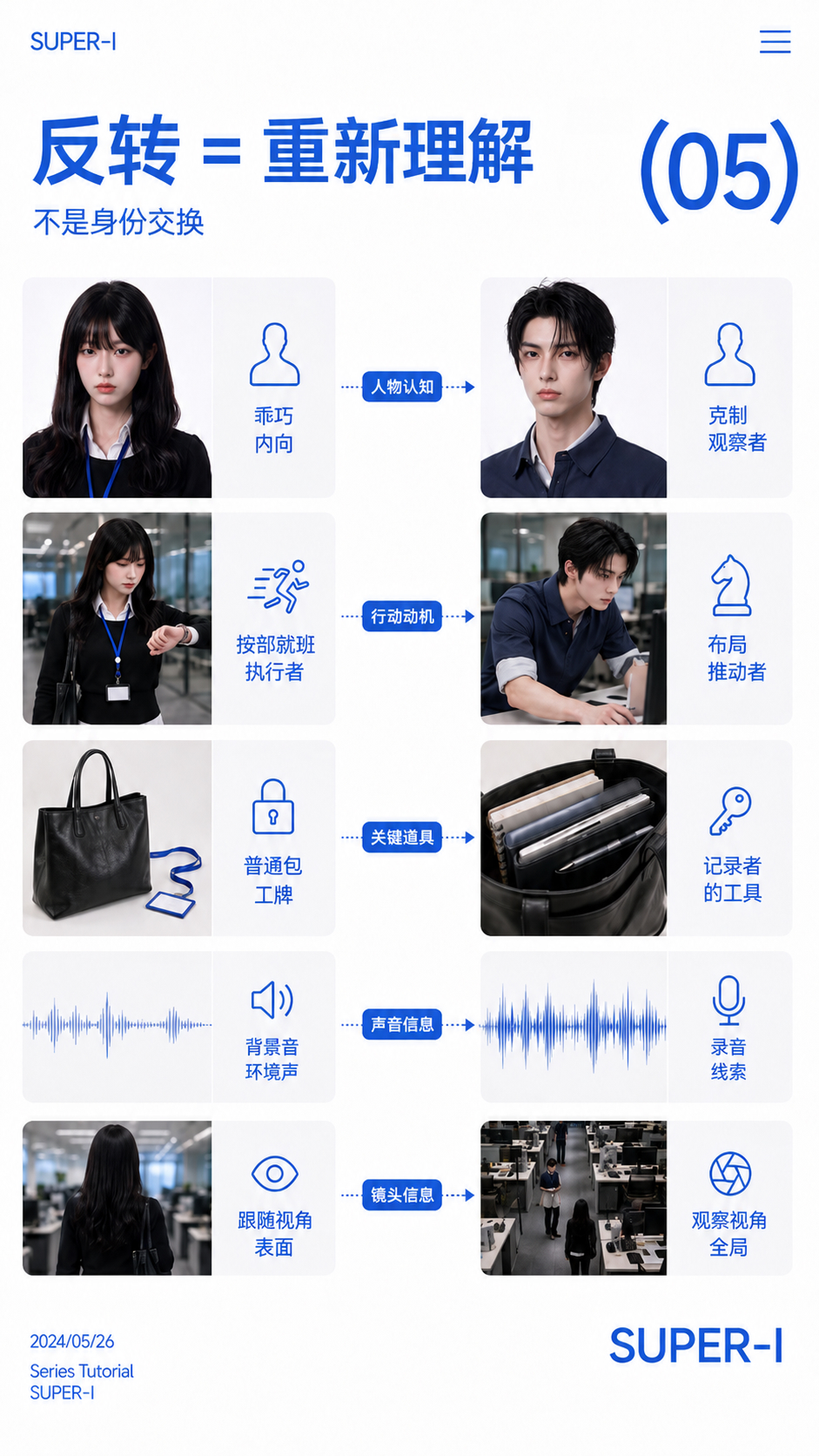
The first is the character. The inverted person is not necessarily a change of good or evil or a change of purpose. A person who seems anxious to clear his name may really want to protect another colleague; a seemingly indifferent supervisor may have been delaying time and seeking opportunities for the protagonist. Such changes are more closely related to personality relations and more likely to leave behind them。
The second is action. An action may seem meaningless at the beginning, but a new explanation is given. For example, before the hero entered the conference room, he deliberately spilled coffee and the audience thought she was nervous before she found out that she had taken the opportunity to get the key person out of her seat and got a security card. This reverse does not require a long explanation, and the audience can understand by moving。
The third is props. The short film needs a clue that can be clearly captured in the camera. Documents, mobile phones, working cards, headphones, taped pens, cups, photographs, keys can all appear in the ordinary context and then become key to changing the truth. The good props are not tools that suddenly appear, but items that have already been seen in front of them and that are known later。
THE FOURTH IS SOUND. THE SOUND OF FOOTSTEPS OUTSIDE THE DOOR, THE RECURRENT SOUND, THE SUDDEN INTERRUPTION OF THE CALL, AND THE SEEMINGLY IRRELEVANT WORD IN THE RECORDING CAN CHANGE THE AUDIENCE ' S UNDERSTANDING OF THE IMAGE. SOUND IS PARTICULARLY APPROPRIATE FOR THE AI SHORT BECAUSE IT CAN ADD INFORMATION WITHOUT ADDING SCENES AND ROLES。
Fifth is the shot. It's not just about recording the action, it's about what the audience sees first, what it can't see at the moment. Initially, only the person's face and hand were taken, preventing the audience from seeing the desktop; it was only when the camera was drawn that she had already placed the recording device on the table. Such inversions come from information control rather than from sudden increases in settings。
The prompt words are as follows:
Please design a reverse program based on the following story frame from the perspective of professional authors and short film directors。
[Story Frame]
– The length of the film: about three minutes; – The main role: not more than three; – The main scene: not more than three; – The reverse must serve the selection and expression of the person, not just to create an accident; – No new person, newly created person or extensive background description unrelated to the main line。
Please design two sets of inverters from each of the following five dimensions:
3. Key props: new narrative functions for objects that have emerged。
"Every package must contain"
– Revert core: a sentence to describe what the audience believed and what was eventually rewritten; – Information control: to explain why the preceding paragraph does not directly reveal the answer and what reasonable miscalculation the audience may have; – To reveal nodes: to specify which scene or specific scene should take place and which triggers the event; – Audio-visual presentation: to identify action, feature, voice-processing, camera-scenes or motion that is suitable for use; – Reasonability test: to indicate whether the viewer, in a second view, is able to extrapolate this result from the previous line; – Production assessment: from visual performance, clarity of narratives, difficulty, three dimensions, one to five evaluations each。
[Filter and Integration]
Upon completion of 10 programmes:
Select the set best suited for short audio-visual expression; Note: Refrain from using sudden identity revelations, coincidences to find out the truth, sudden changes in the position of a person, end-stated explanations, etc。
When designing to reverse, avoid an error zone: pursue only the last second of the accident. The inversion without a mattress usually resembles a temporary rewriting of the answer, which, while unexpected, does not make sense. The real inverse of power should remain valid at the second watch, because the first clue was there。
V. Gentlemen move in many directions and choose the most suitable version
A lot of the creators get the first version of the script, and they get to the scene. This can easily lead to passivity: it occurs halfway to find too many people, it's difficult to unify the scene, it's all about a white interpretation of the key cases, or it doesn't end at all for a moment。
THE FIRST VERSION COULD SERVE AS A STARTING POINT, BUT SHOULD NOT AUTOMATICALLY BECOME THE FINAL VERSION. STORY WRITING NEEDS COMPARISON. IT IS OFTEN MORE EFFICIENT FOR AI TO GENERATE MULTIPLE PATHS AROUND THE SAME CORE IDEA, FILTERED WITH CLEAR CRITERIA, THAN TO CHANGE THE SAME GENERIC VERSION REPEATEDLY。
The prompt words are as follows:
You're a professional short film writer, story designer and development producer. Please develop 10 differentiating scenarios for a short film of approximately three minutes ' duration that can be filmed and deciphered, around the following core ideas。
[core idea]
[Project boundary] – Type and tone: ___ – length: approximately 3 minutes; – Main role: no more than 3 persons; – Main scenario: 2 to 3; – Core conflict must be established within 10 seconds of opening; – Each option must be driven by a person's actions, visible props, spatial relationships, environmental sound or camera information, without reliance on byword and large sections of the interpretation; – The story can be reversed, but the reverse must be supported by a previous twilight, without the use of sudden identities to expose, coincide with the truth or temporarily add new creations。
Please generate 10 scenarios. The 10 programmes must share the same core idea, but there are clear differences in “persons' goals, sources of conflict, key choices, retroversion mechanisms, ending emotions” and cannot replace only the identity of the person or the name of the props。
[Each scenario output according to the following structure]
### PROGRAMME NAME
1. A dramatic premise: who is under what pressure and what must be done or what will be lost。
2. The theme and the emotional tone point to the real human contradictions or emotional propositions of the version, as well as the emotions that the audience should ultimately leave behind。
3. The opening hook describes an anomaly, crisis or suspense that can be directly captured in the first 10 seconds. The background cannot be given before entering the incident。
The target of the protagonist and the countdown — the external objective: the specific actions that the protagonist must accomplish; — the time pressure: the time before it must be done; — the inherent need: the matter touches the relationship, fear or gap of the protagonist。
5. Opposive force. Indicate which layer of resistance comes from a person, rule, space, time, evidence or poor information; and how it is upgraded in the middle。
Key choices The protagonists must choose between two costly options. No “easy-to-do” solution can be set。
Structure propulsion describes the story in concise terms by the following five nodes: – opening hook; – motivational event; – stress upgrading; – orgasm selection; – afterwave or ending image。
Voltal pens and recycling List at least two clues that can be seen or heard, describing, respectively: – How the previous paragraph appears; – How the middle paragraph is misread; – How the latter part is recycled and changes the audience's understanding。
9. Audio-visual design highlights the identification of one to two visual or sound elements that are best suited to carry the story, such as special features of key props, space cover, screen information, sound of the environment, cross-cutting, fixed slots or lens view limitations. Explain why they serve stories, not just decorations。
10. PRODUCTION ASSESSMENTS SHOULD BE RATED ON A SCALE OF 1 TO 5 AND JUSTIFIED IN ONE SENTENCE EACH: – DRAMATIC TENSION; – VISUAL PERFORMANCE; – PERSON CREDIBILITY; – INVERSE COMPLETION; – AI VIDEO PRODUCTION CONTROL。
[Final screening] After 10 programs, please:
The selection of the top three in order of their combined potential。
Please avoid the general adjective. All judgements must be translated into action by a person, a dramatic event or an enforceable audio-visual expression。
In the screening, do not just read "What's the strangest story." A version suitable for a short film usually has the following characteristics: it starts with a problem quickly; the main actor has a clear choice; the conflict is visible; the key props are small but effective; and the end can stop on a meaningful picture。

Special attention must also be paid to the difficulty of production. Consisting the story in a small number of characters and scenes does not mean that the story is simple, but rather makes every detail more powerful。
Short clips are not shorter long ones. It does not need to explain all the background, nor does it need to give a complete picture of each. What it needs is for a person to face an important thing in a limited time and to make a choice that can change results。
VI. EFFECTIVE PLAYING OF THE STORY STORY
ONCE YOU'VE IDENTIFIED THE TARGET, THE MAIN RESISTANCE, THE DIRECTION OF THE STORY AND THE WAY IT'S REVERSED, LET AI WRITE THE WHOLE SCRIPT. THE MOST IMPORTANT THING AT THIS POINT IS NOT TO THROW BACK AN OPEN QUESTION, BUT TO GIVE IT THE CHOSEN CHOICE。
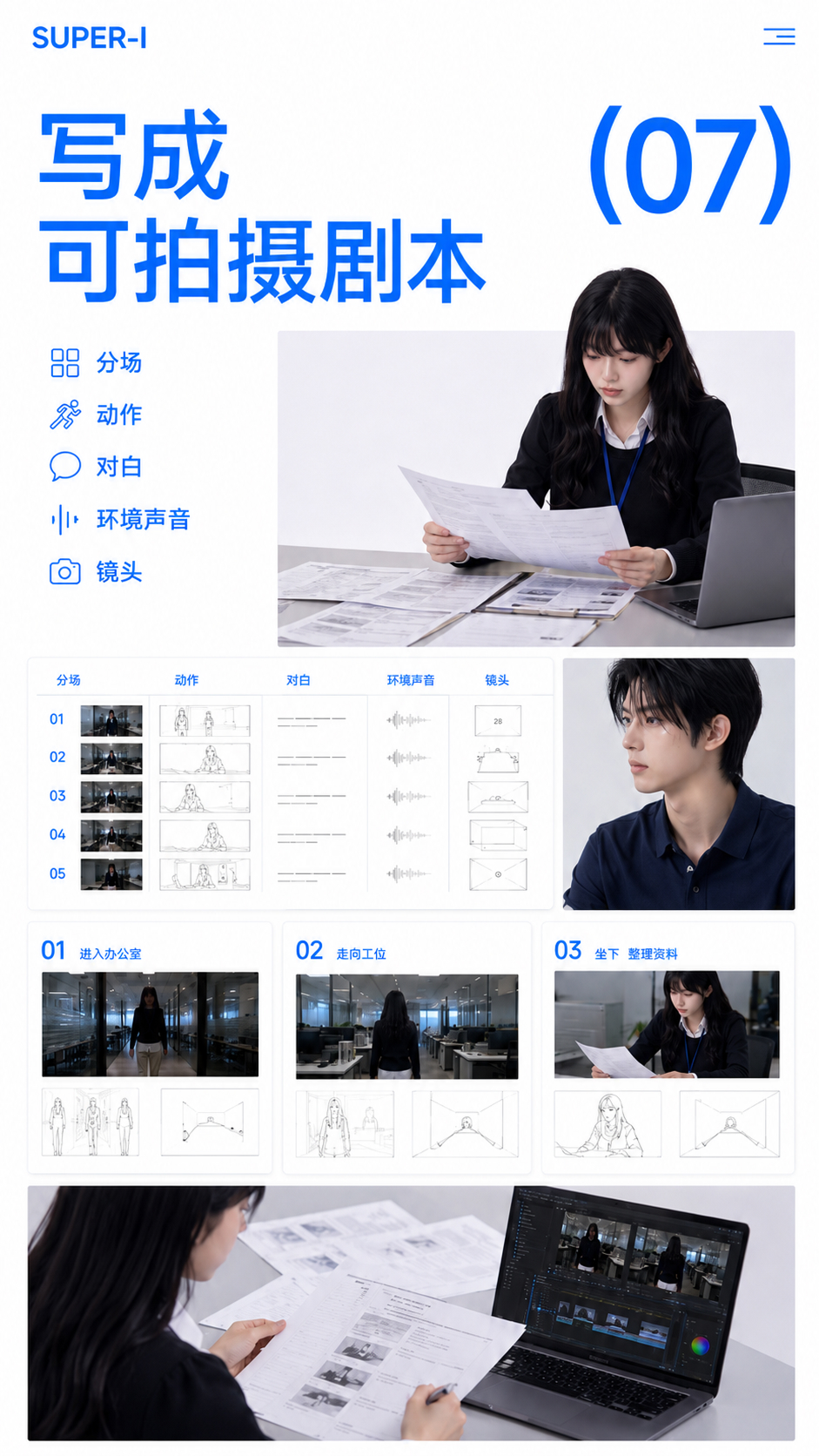
YOU'RE A PROFESSIONAL FILMWRITER, DIRECTOR AND SPECTROSCOPY PLANNER. PLEASE CREATE A FULL SHORT FILM WITH DIRECT ACCESS TO THE AI VIDEO PRODUCTION PROCESS BASED ON THE FOLLOWING CONFIRMED DEVELOPMENT INFORMATION。
[Fundamentals of the project] – Core idea: ___ – Type and direction of creation: ___ – Length: approximately 3 minutes – Main object: ___ _ _ _ _ _ Main resistance: ____ _ _ _ _ - Cost of failure: ____ _ _ _ _ _ _ _ _ _ Established invert mechanism: __ _ _ _ _ _ _ _ _ _ Target audience mood: ___
– All important information must be presented through a photographable action, spatial relationship, props, screen information, environmental sound or lens perspective。
[Output order]
##1
Use of the structure “who, under what pressure, must do what, or lose what”。
2. Theme and emotional orientation The core contradiction of the story discussion, the emotions left at the end, and the subject of inverted services are illustrated in 100 words。
The length and structure budget allocates three minutes to: – opening hook; – event creation; – stress upgrading; – orgasm selection; – end after wave. Mark the estimated number of seconds per segment and ensure that the rhythm is loose to tight and leaves a short breath。
##
Each of the principals is described separately: – the surface target; – the hidden information or the true purpose; – the conflict of interest with the protagonist; – the characteristics or habits of conduct that can be shown in camera; – the visible changes that occur at the end of the story。
Don't write a story about growing up, keep information directly related to the conflict。
##3 KEY NARRATIVE ASSETS
1. Core props or visual mathematics List between one and three key props, spatial details or sound trails, and explain how they appear in the preceding, misreaded in the middle and recovered in the latter。
The information release form states: – What does the audience know at the beginning of the session; – why does the audience miss the middle section; – What is revealed at the orgasm; – What is deliberately retained at the end。
## IV. DIVISION SCRIPT
Please output each set in standard script format:
[STEP X: LOCATION / TIME / CORE VISUAL INFORMATION] PROJECTED DURATION: XX SECONDS ON-SITE PERSONAL TARGET: ON-SITE OBSTRUCTION: ON-SITE RESULT OR TURN: PRECINCT RHYTHM: LOOSE / CENTRE / TIGHT EMOTION: LIGHT / CENTRE / HEAVY
Then it was written:
– Actions and images that can be photographed by a camera; – necessary and brief pairing; – environmental sound, key sound or silent design; – critical props and information trails; – causality between the scene and the back and forth。
Requests: – not to write “he's nervous” “she realizes” and so on; – to express the character of the person with conduct such as pauses, movements, evasiveness, taking up or dropping objects; – Every scene must promote the escalation of the conflict, change the character relationship or recover clues; – There should be no invalid scenes that only explain the context。
## V, INVERT AND END DESIGN
1. The Volkswagen List lists, article by article, the pen, the place of appearance, the initial understanding of the audience, the true meaning and the place of recovery。
2. Inverted revelation illustrates how an orgasm scene is accomplished by a specific action, props, sound or lens message, rather than by the role。
3. The end image describes the scene, the image, the movement of the person, the sound state and the information that is kept in the last shot. There should be no repetition of the inversion at the end。
## VI, AI VIDEO PRODUCTION INTERFACE
1. The key elements of consistency of roles。
2. The key points for consistency of scenes。
3. The camera split proposal lists 8 to 12 core shots in sequence. Each shot indicates: – Speculation; – Timing or Camera Exercise; – Image Subject; – Key Actions; – Ensemble Narrative Information; – Suggested Length。
TP5T#7 SELF-CENSORSHIP
– Whether a hook is created within 10 seconds of the opening; – Whether the main subject's target, resistance, cost is clear; – Whether there is a dramatic move in every scene; – Whether there are at least two visible pens in the reverse; – Whether there is an explanatory description of white or non-photographic; – Whether the role and the number of scenes match the production boundary; – Whether the conflict is completed at the end and the resemblance is preserved。
If any of these do not work, amend the script before the final version。
After the output of the script, it is suggested to look first at the “segment purpose”. If a scene does not promote the movement of people, nor does it provide clues, create resistance or alter relationships, it could presumably be deleted or merged. Every scene should have a mandate: to give people information, to lose opportunities, to make choices, or to re-understand what goes ahead。
Conclusion
THERE IS NOT A SINGLE ONE IN THE AI SCRIPT THAT CAN BE PUT IN ANY TOOL TO GET GOOD RESULTS. THE ABILITY TO BE TRULY EFFECTIVE IS TO MAKE CLEAR WHAT THE STORY IS ABOUT: WHAT THE PERSON IS TRYING TO TELL, WHY THE PERSON IS ACTING, WHAT IS STOPPING HIM, WHAT THE AUDIENCE SHOULD BELIEVE FIRST, AND WHEN IT IS AGAIN UNDERSTANDING。
Start with a question-and-discussion, then with an orientation to determine the quality of the story; first by burying visible clues in reverse, and then choosing the most appropriate version of the picture from multiple directions. Finally, the story is written into a script that can be implemented by scenes, actions, props and lenses。
WHEN YOU STOP LOOKING AT AI AS AN "AUTOMATED STORY" MACHINE, BUT RATHER AS A CREATIVE PARTNER TO HELP YOU SPREAD, COMPARE, SORT AND MODIFY, THE STORY WILL BE MORE FOCUSED AND THE PICTURE WILL HAVE MORE REASON. IT WAS NEVER TOO MANY IMAGES, BUT EACH OF THEM PUSHED THE SAME THING FORWARD。
Two scripts will be available for download
1. (From Github KongLingrui)。
https://github.com/GongLingRui/screen-creative-skills
2. (From Github @Mount)。
https://github.com/Shanyin-ai/shanyin-screenwriting-master