



Lately, almost every day (literally, scheduled through the end of next week...), I've been working for various organizations (with lawyers, administrators, marketers, doctors, educators, and entrepreneurs, etc.) doingDeepSeekThe offline sharing.
In these shares, many interesting questions were asked, questions that AI practitioners would never expect, such as:
- My file was passed to AI, will it be compromised?
- Why can't buttons subscribe to public numbers?
- What the hell is this AI?
- Why does the AI make up legalese and case numbers and act so confidently?
- Can AI understand me as well as Jitterbug?
- …
Isn't it interesting? Real users don't care about parameters, performance, model architecture, and so on, they just have three big philosophical questions - does this thing work or not? How to use it? Will it work?
Although this round of generative AI lowers our threshold of use through natural language interaction, it is still difficult to upgrade it from a "toy" to a "tool".
In the case of the DeepSeek-R1 inference model, for example, some skills in its use are necessary to realize its full potential.
Today, I'm going to continue to explore some practical tips to help you get better at using inference models.
1. Non-essential non-networking
After networking, if the RAG knowledge base provided is not authoritative or rich enough, it will rather reduce the intellectual performance of the model. Moreover, there is simply too much junk on the Chinese Internet to ensure the reliability of the search results.
Here, RAG (Retrieval Retrieval-Augmented Augmentation-Generation) is explained to elementary school students. It is a new technology that emerged last year, in which a retrieval system pinpoints the most relevant pieces of information to a user's query from a massive amount of data, and then uses that information as input to a model to generate fluent, lexically convergent responses.
Typically, it is recommended to prioritize relying on the model's own dataset to answer questions.
If you must be connected to the Internet, it is recommended that you prioritize AIs with strong search capabilities (e.g., Secret Pagoda AI Search, which has a wide range of sources and supports customized "source preferences"), AIs with high-quality sources (e.g., Tencent Yuanbao, which can search for public numbers), and AIs that are able to search for extranet resources (e.g., GitHub, Reddit, and Medium).
2、Specify the search source
The Chinese Internet is filled with a lot of spam and marketing number content, so specifying the source can significantly improve the authority of the search results.
(1) Add the prompt "Search only official government documents".
E.g. What does the Private Economy Promotion Law say? Search only official government documents.
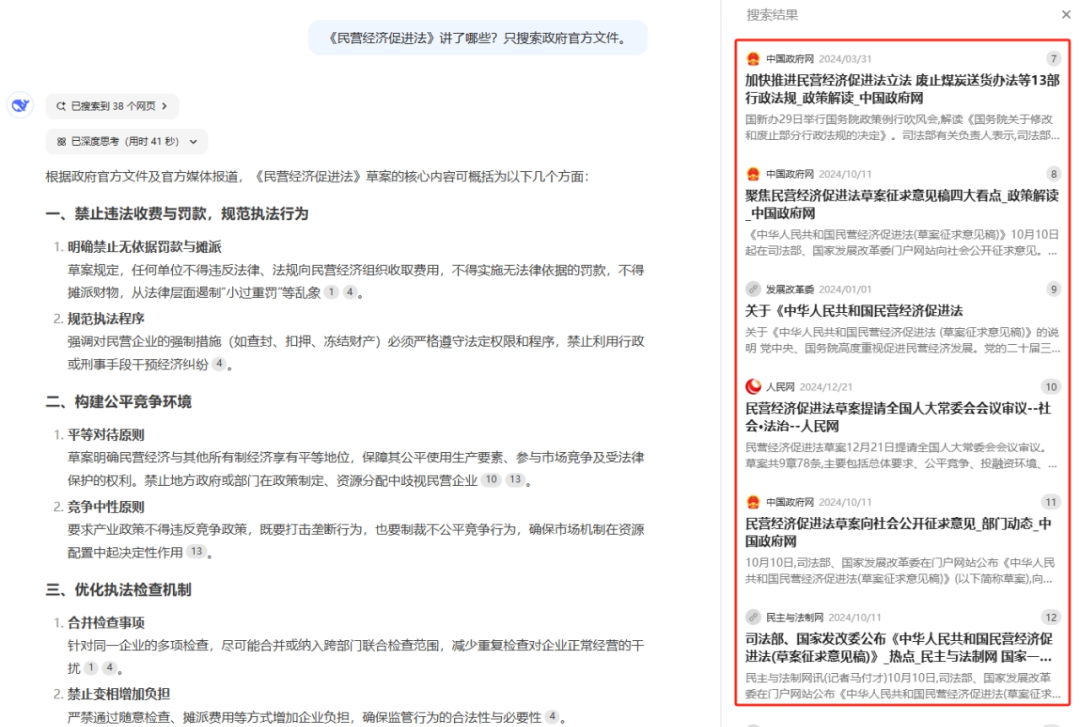
As you can see, DeepSeek focuses on searching government sites and official media information, no more of that nonsense, much less legal promotion sites.
2) Use the "site:xx domain" command.
E.g. What are the products of Unitree Technology? site:unitree.com.
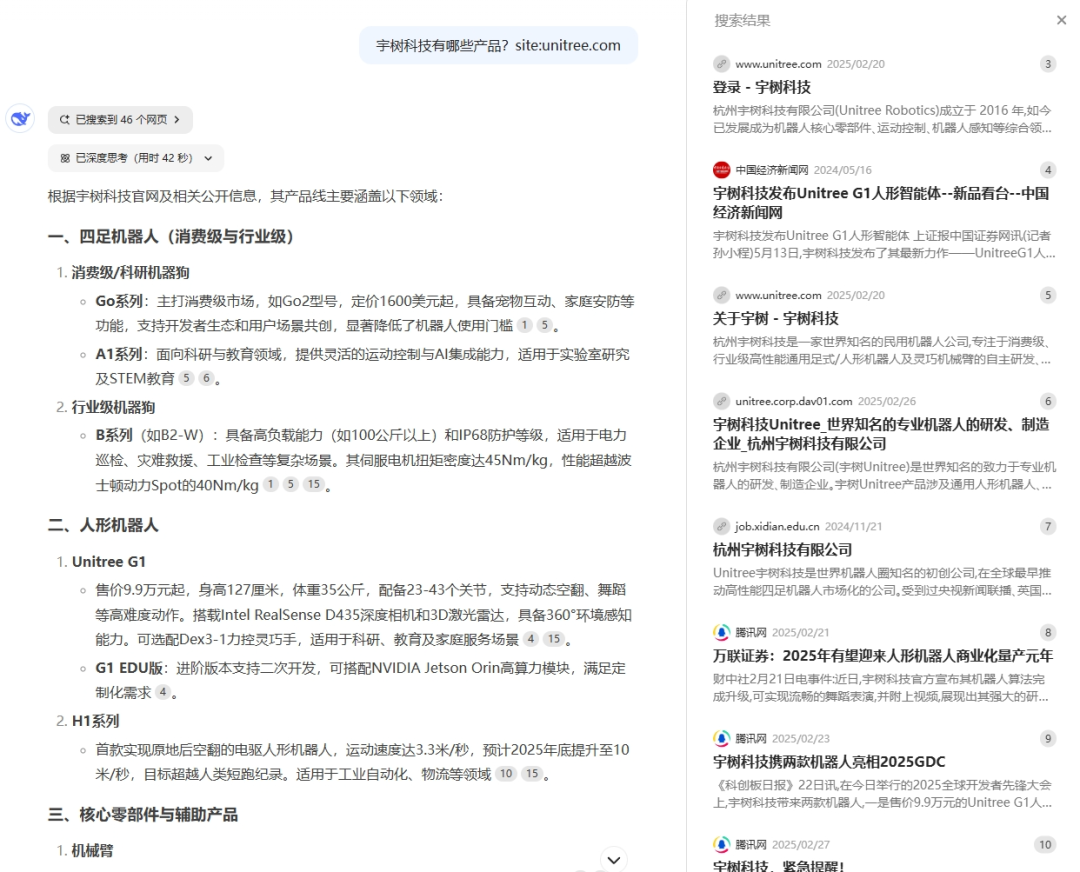
As you can see, the model focuses on grabbing information from Unitree.com, the official website of Yu-Tree Technologies.
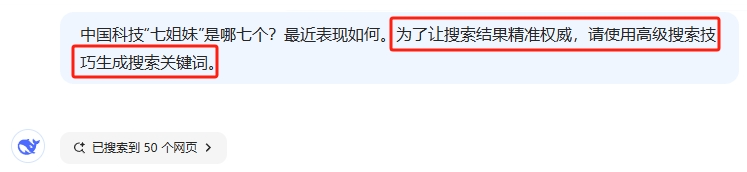
3) If you don't know what source to specify, you can just use this universal template (mention By Jiangshu in the clouds).
For accurate and authoritative search results, use advanced search techniques to generate search terms.
Add that to the end of the question and you're done.
For example, what are the seven sisters of China's "Seven Sisters" of science and technology? How have they performed recently. For accurate and authoritative search results, please use advanced search techniques to generate search terms.
Let's take a look at DS's answer, isn't this result much more reliable?
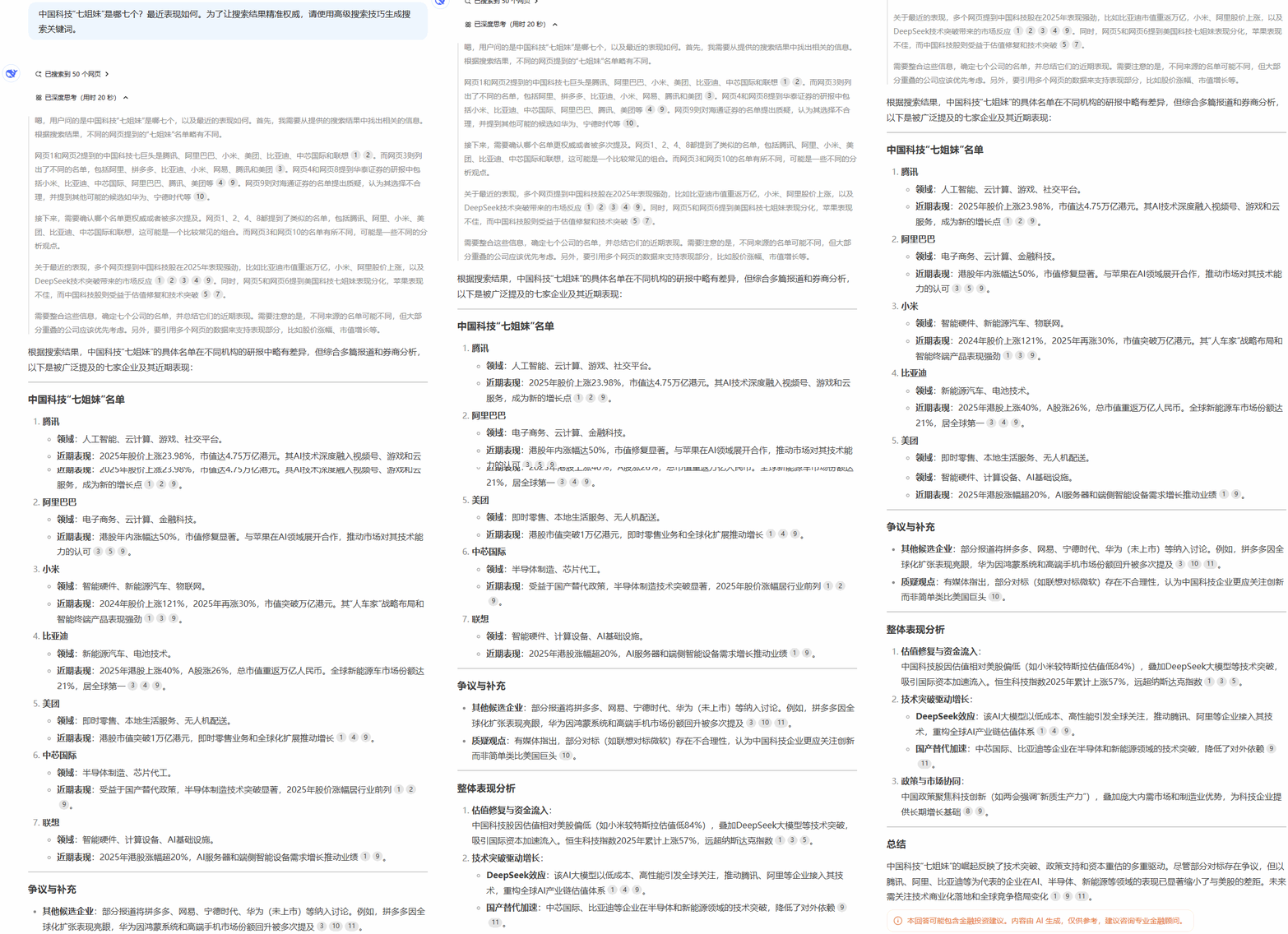
Moreover, it quotes all the regular media. 50 search pages, I went to trace back one by one, almost all of the mainstream financial media information (such as interface news, sina finance and economics, Oriental wealth, Wall Street news, surging news, etc.), there is no marketing number of the content.
3. DeepSeek + other AIs
DeepSeek has what it is good at (thinking, writing) and what it is not good at (e.g., visual recognition, networking capabilities, code capabilities, multimodal capabilities). Therefore, using DeepSeek in conjunction with other AI tools can capitalize on the strengths of each.
For example, to make a PPT, you can first generate an outline through DeepSeek, and then send the outline to Gamma/Baidu Wikipedia/AiPPT/Tongyi PPT/Xunfei Zhiwen to generate a PPT.
Then, for example, to create a video, you can first write the script and cue words through DeepSeek, and then generate the video with video models such as Korin/Manphase/Mixed/Helix/ClearShadow.
4. Full-blooded version ≠ true-full-blooded version
Recently, many products have claimed to have access to the DeepSeek-R1 full-blooded version.
But in reality, the so-called full-blooded versions of each have basically been fine-tuned or quantized.
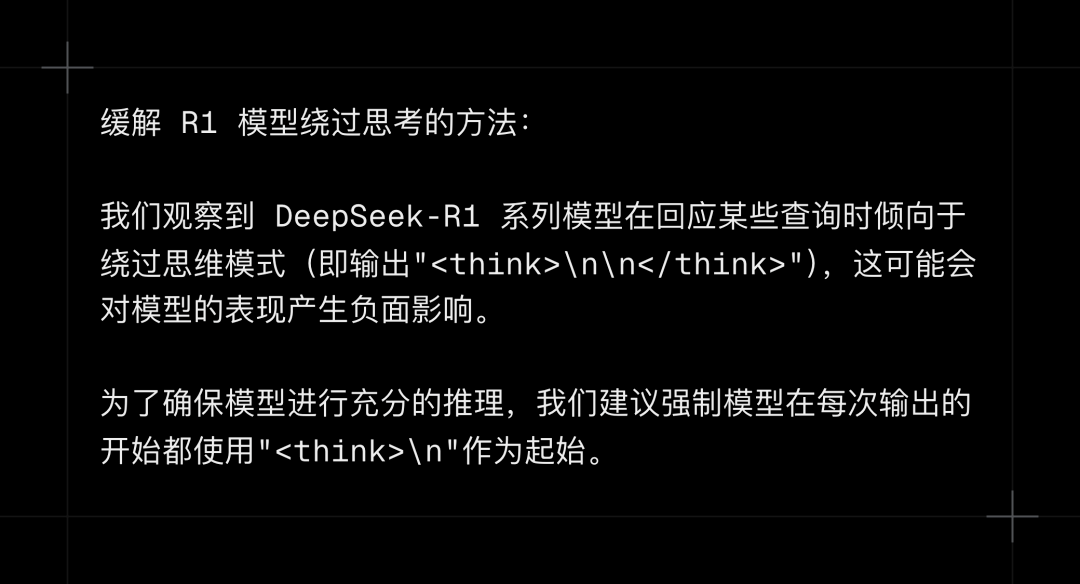
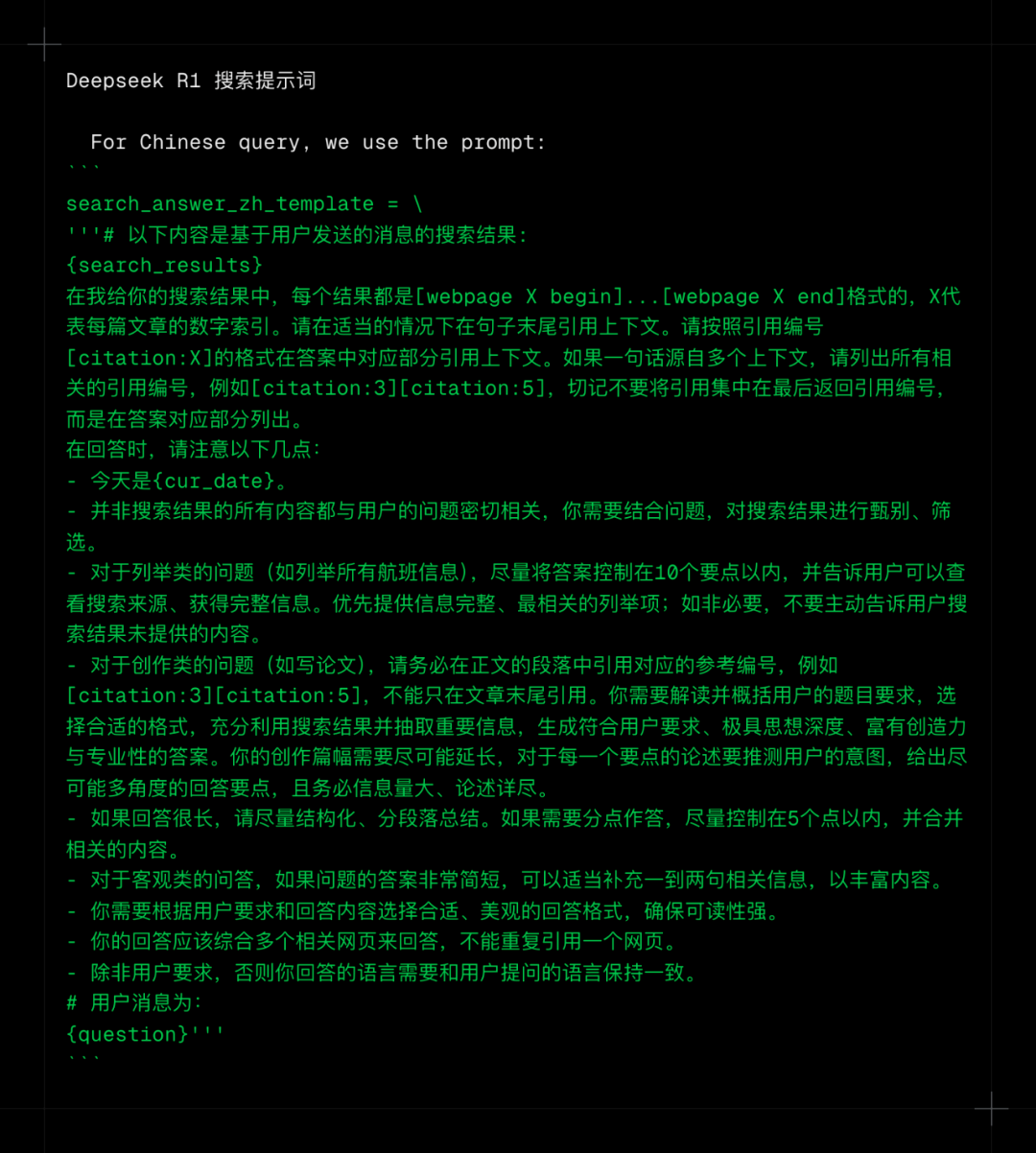
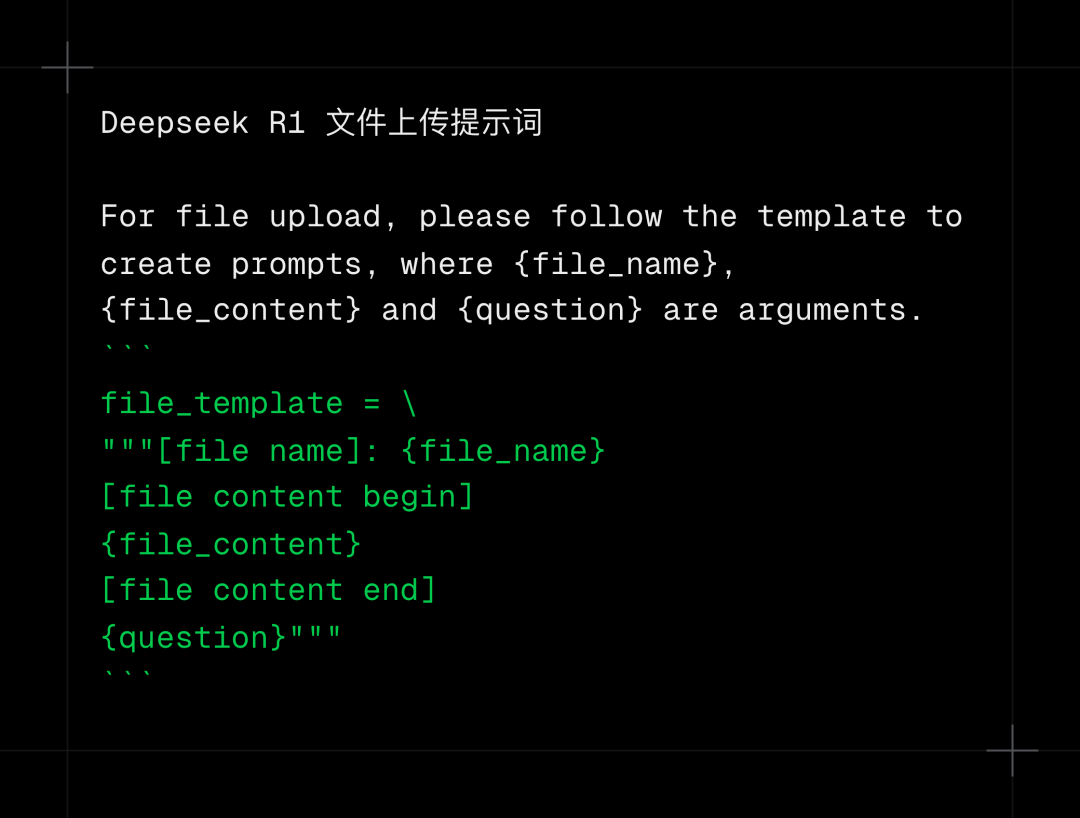
Either the system cue words were modified to make the AI model work logically and become consistent with the picture of your own company.
DeepSeek-R1 system cue word (official).
DeepSeek-R1 Search Prompt Words (Official).
DeepSeek-R1 File Upload Prompt Words (Official).
Either you have done model quantization, that is, the native R1 model of 671B has been "compressed", such as reducing the chain of thought, reducing the output tokens and so on. After all, the quantized model is faster and less expensive.
The true full-blooded version exists only on the DeepSeek website, app, and through API calls.
5. Not all scenarios require R1
DeepSeek provides a V3 generalized model and an R1 inference model.
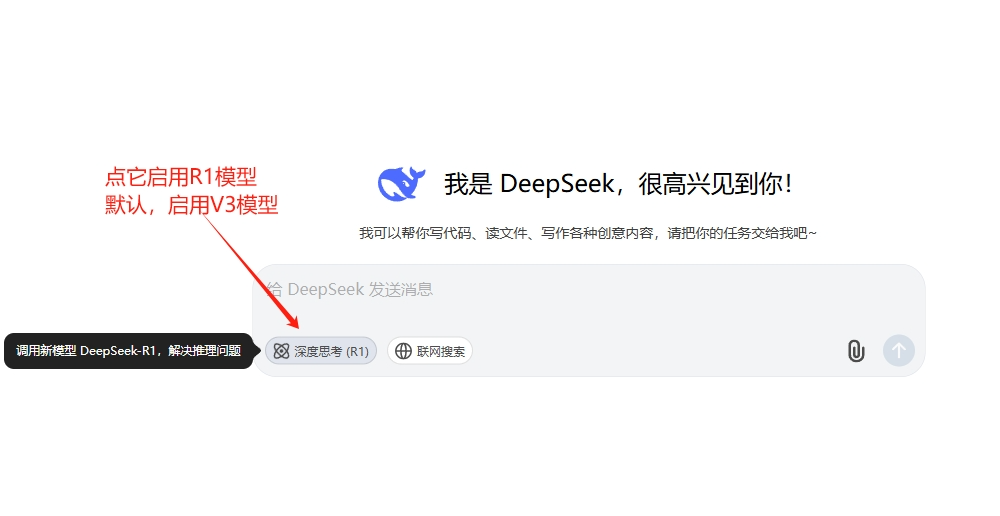
R1 specializes in complex reasoning and in-depth analysis, and is suitable for "open-ended" tasks, while V3 performs more efficiently and accurately on "prescriptive" tasks.
Not in all scenarios, you have to use R1.